zenpundit.com » JosephFouche

Archive for the ‘JosephFouche’ Category

The Mob of Virtue

Sunday, August 1st, 2010
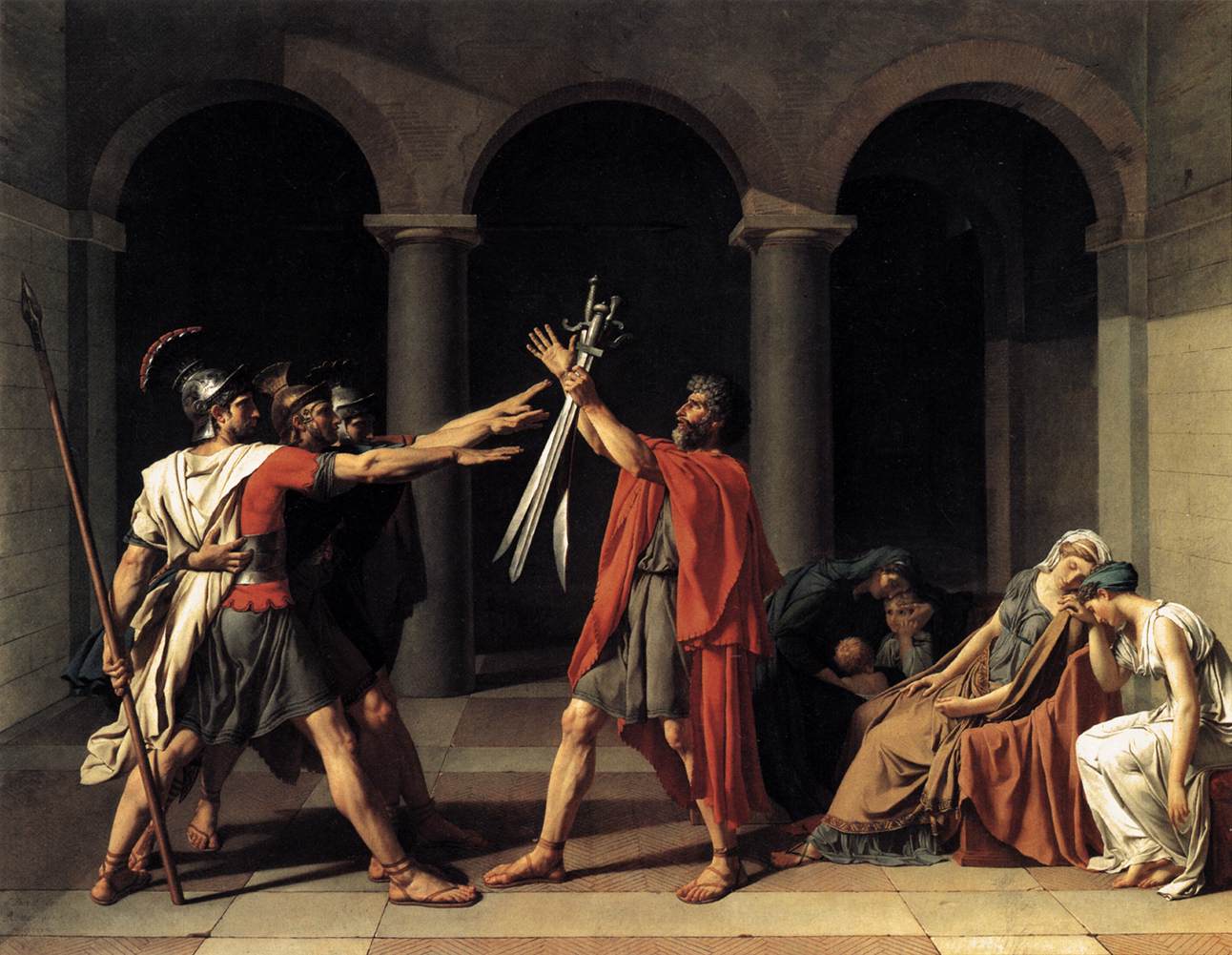
 

Small “r” republican virtue, to be precise.

A wise man once told me that a weakness of our Constitutional system was that the Framers implicitly presumed that people of a truly dangerous character, from bullies to bandits to political menaces to the community, would primarily be dealt with in age-old fashion by outraged neighbors whose rights had been trespassed and persons abused one time too many. They did not prepare for a time when communities would be prohibited from doing so by a government that also, as a whole, had slipped the leash. Indeed, having read LockeMontesquieuCicero, Polybius, Aristotle and Plato, they expected that such a state of affairs was “corruption” of the sort that plagued the Old World and might happen here in time. A sign of cultural decadence and political decay. They gave Americans, in the words of Benjamin Franklin, “A republic, if you can keep it”. It remains so only with our vigilance.

It is happening now.

We have forgotten – or rather, deliberately been taught and encouraged to forget – the meaning of citizenship.

We have let things slip.

Joseph Fouche superbly captures this implicit element, the consequences of the loss of fear of  informal but very real community sanction, in his most recent post:

People Like Us Give Mobs a Bad Name

….A classic American mob could exhibit any or all of these strategies. It could be a saint inciting a mob to attack others who deviated from a shared narrative. It could be a knave in saint’s clothing inciting an attack on personal rivals. It could be a moralist inciting a mob against the local knaves. The one constant is that an American mob was an expression of communal self-government by moralists seeking to punish what they saw as deviant, even if its manifestation was frequently unpleasant. It was a sign the local people were engaged.

Samuel Adams was the Lenin of the American Revolution. He conceived a hatred for the British Empire and a desire for American independence well before anyone else did. Adams skillfully used mobs alongside legal pretense to incrementally spread his agenda. Others followed his example. In the Worcester Revolution of 1774, the local population shut down the normal operations of royal government in west and central Massachusetts and drove royal officials out of those regions (the book to read is Ray Raphael’s The First American Revolution: Before Lexington and Concord). The British crown lost control of inland Massachusetts before Lexington and Concord were even fought.

However, eleven years later, when many of the same local residents attempted to do the same thing in protest of the policies of a now independent Massachusetts, the state government put down their rebellion with Samuel Adams’s strong support. The difference? An apocryphal remark attributed to Adams captures some of the truth behind his attitude: “the man who dares to rebel against the laws of a republic ought to suffer death”. Mobs protesting the actions of an unrepresentative government like the British Parliament, Adams argued, were valid. Mobs protesting the actions of a representative government like Massachusetts’s state government, on the other hand, were treasonous. This doctrine, supported by other Revolutionary leaders, especially the cabal behind the Order of the Cincinnati, was eventually enshrined as the higher law of the land in the slow motion coup d’etat that overthrew the Articles of Confederation and replaced it with the more authoritarian United States Constitution in 1787-1788.

While mobs continued to combine, they were gradually neutered by the conscious agenda of American elites who sought to replace informal norms enforced by communal censure with formal norms applied under the professional supervision of “wiser heads”. This was a collusion between saints and knaves against moralists. Saints got purer standards that were not reliant on the whims of moralists who got stirred up in unpredictable ways that might violate the saints’ prevailing narrative while knaves got credentials that allowed them to entrench their positions and agendas under the cover of serving a higher good. The same sense of community morality and punishment that gave nineteenth century self-government its vigor and occasional excess was weakened as moralists were tuned out by saints embedded in holy isolation and knaves concerned only with advancing personal priorities. Moralists saw the knaves getting away with free riding off of them and began to opt out, leaving room for more knaves to free ride. For a little formal pretense, the returns on rent seeking were enormous.

The ideal went from a citizenry engaged in self-government to a system designed to advance the best and brightest. Meritocracy sounds good in theory and has some positives in reality. However, a perfect meritocracy is a perfect tyranny. All of the leaders are on once side and all the followers are on the other. This tendency toward the separation of the best from the rest may only be checked by the tendency of those on the ascendant to favor their own children, whatever their merit, over strangers that are more meritorious. This will force some aspiring meritocrats to side with the followers and bring about a rotation of elites. But the transition may take a while and its best to start before you have a meritocratic problem….

Read the whole post here.

Today’s circumstances, with the elite determinedly crafting rules for the mass but not for their class, have an ominous portent for the future of America as a democratic republic, but violence is not yet required.

Political engagement is.

More Thoughts on Mexico

Tuesday, April 6th, 2010

From John Robb:

JOURNAL: Mexico’s Mercado of Violence Heats Up

Open source warfare often combines market-based functions to accelerate its innovation rates and expand its operations beyond the primary players.  These markets, or bazaars (as I called them) are very efficient.  For example: the price of violence plummets as the number of entrants increases and the capacity for violence improves as the market’s participants specialize and hone their skills.  

Usually, the military/law enforcement response to the surge in the sophistication and quantity of violence is to assume some outside source of training or support rather than something that is the natural byproduct of rapid marketplace development.  

So, it’s no surprise with the growing availability of the street/prison gangs (Barrio Azteca and the Artistic Assassins) as sources of cheap, violent labor the marketplace is heating up. Note the excellent quotes below from a WaPo article on the growth of the market for contract killings

From Joseph Fouche at The Committee of Public Safety:

Containing Mexico

….Mexico, showing more concern for its sovereignty than their northern neighbor, has launched a brave if thus far futile attempt to win control of its territory from large and powerful narco-traffickers. Large parts of Mexico are in disorder and large parts of Mexico threaten to descend into chaos. The Mexican Army has been brought in to take over from Mexico’s corrupt local and federal police. The well-armed and well-equippednarcotraficantes have counterattacked against the police and even the Mexican Army. The government is riddled with gang informants and corrupt officials. An already uninspiring government has pulled off the unique trick of becoming even more uninspiring.

In the long run, I believe the Mexican state will win. Colombia was in a similar pickle ten years ago but eventually found enough institutional resilience to fight back and win control of most of its territory. But the road back is long and, in the meantime, Mexico’s troubles will inevitably leak north, involving and corrupting American law enforcement even more than it already is, drawing entrepreneurs on both sides of the border to profit from America and Mexico’s shared misery, and applying negative pressures on Mexican residents in the United States to cooperate with the narcotraficantes¿O plata o plomo? (silver or lead?) the Colombian drug gangs used to ask their victims. Profit or death, a choice will be put to many Mexican Americans in the years ahead, or as Mexico’s own Porfirio Diaz put it, ¿Pan o palo? (bread or a beating?). Illegal immigration, perhaps deliberately induced by Mexican drug gangs in an ironic echo of the strategy of  Mexico’s incumbent elites, will destabilize American local governments and drain their resources. Violence in Mexican communities in America will increase and inevitably spill over to non-Mexicans. Political correctness and diplomatic niceties will paralyze American responses.

The historical significance of the War in Iraq will be revealed: COIN on American streets. Containment, if it can be described as such, will occur house by house, block by block, city by city, state by state. The traditional American response to crisis, the inspired muddle, will produce more corruption of American institutions and society, already weakened by the last round of containment….

Fouche on “Libeling Boyd”

Sunday, December 27th, 2009

Joseph Fouche blasts eminent scholar Dr. Colin S. Gray for doing to strategic theorist John Boyd what Gray’s fellow Clausewitzians complain that Martin van Creveld does to Carl von Clausewitz:

Libeling Boyd

Contrast this passage with two passages from Gray’s Another Bloody Century, published seven years later:

Air Force Colonel John Boyd touted a tactical insight derived from personal experience from aerial combat as a general theory  of conflict. His OODA loop, standing for Observation, Orientation, Decision, and Action, is revered by many as summarizing the wisdom of the ages on how to win. The core notion is that success rewards the warrior who can operate within the decision cycle of the enemy. It is a sound idea, but as the philosopher’s stone for victory for victory at all levels of warfare it is distinctly sub-Clausewitzian. A major problem with the OODA loop is that its devotees assume that a tactical insight, even principle, will be no less valid at the operational and strategic levels of warfare. It is fairly clear this is not the case.

…and…

As we noted earlier, Colonel John Boyd, USAF fighter pilot turned guru, applied his tactical knowledge of air combat to warfare at all levels  by means of his simple formula of the ‘OODA loop’. Unmatched speed in the sequence of observation, orientation, decision, and action is held to be the key to victory. This insight, banal statement of the obvious, or panacea-take your choice-is probably the most important concept undergirding the current US programme of long-term military transformation. The OODA loop is a formula for decisive success in a manoeuvering style of warfare. American technology, particularly in the realm of the real-time gathering, processing, and diffusion of information, enables US forces to act effectively with a speed that leaves their enemies gasping in their wake. At least, that is the theory.

This is like reading from Baby’s First Boyd Briefing and reflects a child’s understanding of Boyd’s theory. Dr. Gray, a distinguished strategist of the ultra-Clausewitzian school, often complains about the van Creveld School’s shallow (or, in my opinion, actively duplicitious) reading of Clausewitz. Keegan and van Crevald get taken out back for a well deserved whipping for their mis-characterization of Clausewitz and somehow John Boyd gets taken along in the same sordid ranks. Gray sees this:

Faster! FASTER!

Faster! FASTER!

and reduces Boyd to a child who runs along side a children’s carousel shouting “Faster! FASTER!”. If the carousel spins fast enough, victory is at hand. If it slows down, defeat is inevitable. This is the vulgar version of Boyd’s theory, the one that the marketing directors of defense contractors can understand and spout. If Dr. Gray is, as he frequently claims to be, a professional strategist, he should be able to see that Boyd’s OODA loop, inasmuch as it really is….

Much more here.

Outstanding post.

“Libeling Boyd” seems to me to be an accurate call by Joseph Fouche. I find it difficult to believe that a defense intellectual of Dr. Gray’s caliber does not know the difference between the ideas of John Boyd and Art Cebrowski. Or that there are Soviet antecedents of the Pentagon’s RMA. Or that Boyd’s history as an anti-defense contractor Pentagon gadfly is unknown to him. Or that Gray was too lazy to look up easily available material on the OODA Loop. If it would help, I’d be happy to send Gray a copy of Col. Frans Osinga’s Science, Strategy and War: The Strategic Theory of John Boyd .

Whether it would help though, is debatable.


Switch to our mobile site

