zenpundit.com » Clausewitzian

Archive for the ‘Clausewitzian’ Category

A Recommended Blog for Metacognition

Sunday, January 30th, 2011

A while back, I added Ribbonfarm to the blogroll, which is written by Dr. Venkat Rao, a corporate scientist typeafter John Hagel featured in his twitterstream an old but amusing post by Rao analyzing sociopathology in corporate life via characters from The Office. Clever. I thought I would blogroll him and check in periodically.

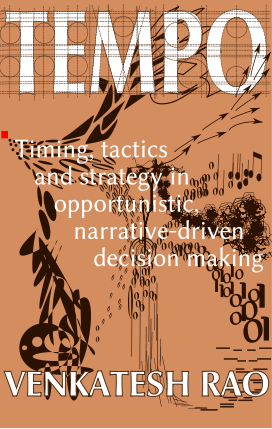
Later, I noticed that Rao makes frequent references to Clausewitz in his posts and that he is writing Tempo, a book on decision making that will be of great personal and professional interest to many readers here. At this juncture, I’m intrigued.
Then last week, Rao featured a lengthy post on metacognition where he made some excellent points. Here’s a few of them, but as I can only put up a small selection, you should go read the full post:

Boundary Condition Thinking:

 ….To build mathematical models, you start by observing and brain-dumping everything you know about the problem, including key unknowns, onto paper.  This brain-dump is basically an unstructured take on what’s going on. There’s a big word for it: phenomenology. When I do a phenomenology-dumping brainstorm, I use a mix of qualitative notes, quotes, questions, little pictures, mind maps, fragments of equations, fragments of pseudo-code, made-up graphs, and so forth.

You then sort out three types of model building blocks in the phenomenology: dynamics, constraints and boundary conditions (technically all three are varieties of constraints, but never mind that).

Dynamics refers to how things change, and the laws govern those changes. Dynamics are front and center in mathematical thought. Insights come relatively easily when you are thinking about dynamics, and sudden changes in dynamics are usually very visible.  Dynamics is about things like the swinging behavior of pendulums.

Constraints are a little harder. It takes some practice and technical peripheral vision to learn to work elegantly with constraints. When constraints are created, destroyed, loosened or tightened, the changes are usually harder to notice, and the effects are often delayed or obscured. If I were to suddenly pinch the middle of the string of a swinging string-and-weight pendulum, it would start oscillating faster. But if you are paying attention only to the swinging dynamics, you may not notice that the actual noteworthy event is the introduction of a new constraint. You might start thinking, “there must be a new force that is pushing things along faster” and go hunting for that mysterious force.

This is a trivial example, but in more complex cases, you can waste a lot of time thinking unproductively about dynamics (even building whole separate dynamic models) when you should just be watching for changes in the pattern of constraints.

….Historians are a great example. The best historians tend to have an intuitive grasp of this approach to building models using these three building blocks.  Here is how you can sort these three kinds of pieces out in your own thinking. It involves asking a set of questions when you begin to think about a complicated problem.

  1. What are the patterns of change here? What happens when I do various things? What’s the simplest explanation here? (dynamics)
  2. What can I not change, where are the limits? What can break if things get extreme? (constraints)
  3. What are the raw numbers and facts that I need to actually do some detective work to get at, and cannot simply infer from what I already know? (boundary conditions).

Besides historians, trend analysts and fashionistas also seem to think this way. Notice something? Most of the action is in the third question. That’s why historians spend so much time organizing their facts and numbers.

Nice. There’s a multitude of places here to jump off and generate further epistemic analysis, and I am sure that some of the admirers of Boyd, Polanyi, Wohlstetter, Feynman, Kahn and Clausewitz in the ZP readership might do so in the comments. Or my co-blogger Charles might weigh in from the imaginative/mythic/visual domain. We’ll see.

Regardless, I think if you are following blogs like Metamodern, Thomas P.M. Barnett,  Open the Future, Global Guerrillas, John Hagel’s Edge Perspectives, Eide Neurolearning Blog or liked the old Kent’s Imperative (suddenly live again after being dormant for 2 years), you’ll want to consider adding Ribbonfarm to your RSS feed or blogroll.

ADDENDUM:

Ed at Project White Horse, another fine site for your blogroll, is also blogging on boundary conditions:

Stall, Spin, Crash, Burn and Die – Boundary Conditions for 2011

….You can’t fix things without some understanding, real understanding of the problem – nor can there be real leadership without actionable understanding. That’s where establishing boundary conditions as a vehicle to frame the problem – and therefore garner greater insight – become important.

Drilling for oil at a depth of 5000ft and in open ocean – Deepwater Horizon – should have been/should be seen as a “crisis” in waiting no matter the historical track record. Proper understanding would have meant that the National decision making level immediately recognized the high potential for the initial crisis migrating into a severely complex catastrophe after the explosion and acted, not waiting to see if BP’s response plans would work. Activities in “Blue Water”/open ocean are not a linear extrapolation from “inshore,” nor is 5000 ft a linear extrapolation from 200ft or 500ft. depths.  BP’s plans might have been up to the problem, but the shear nature of the environment, if scrutinized in context of “unconventional” as described below, should have been a trigger to initiate intermediate action.  Rather, the declaration of an Event of National Significance was 30+ days in coming??? A significant point, I believe, is the problem generated by not recognizing the nature or even acknowledging the existence of a different kind of  problem, one potentially very complex or stochastic in nature – an “unconventional crisis.”
At the turn of another year

Saturday, January 1st, 2011

[ by Charles Cameron ]

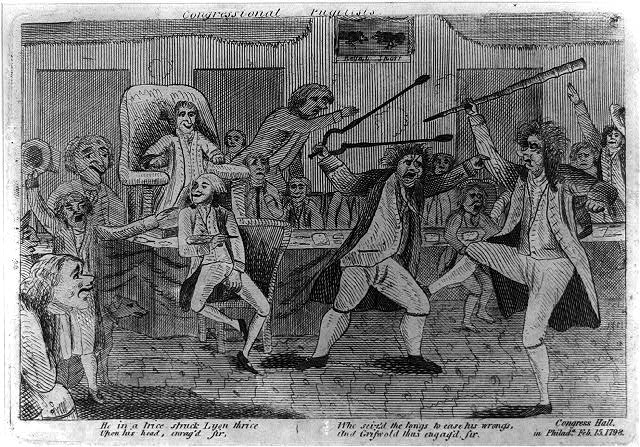
Lyon-Griswold brawl

Reps. Roger Griswold of Connecticut and Matthew Lyon of Vermont practice politics by means of hickory stick and tongs in Congress Hall, 1798

It’s always interesting to watch the way one thing morphs into another, and von Clausewitz’ formulation that war is “a mere continuation of politics by other means” is instructively illustrated in the gallery of a dozen photos on the CBS News site titled Best Parliamentary Brawls of 2010.

Ukraine, Indonesia, Italy, S Korea, Nigeria, Taiwan, Turkey… that’s a pretty fair slice of gepopolitics!

Happy New Year!

image above from the Prints and Photographs Division, Library of Congress.

A Clausewitzian on “Cohesion”

Thursday, December 30th, 2010

Long time ZP readers are probably familiar with seydlitz89, a dedicated Clausewitzian and retired former military officer who comments here occasionally and blogs at Milpub regularly. I first read seydlitz89 at Dr. Chet Richards’ late, great, DNI site and seydlitz89 went on to participate in two extensive events at Chicago Boyz, the Clausewitz Roundtable and the Xenophon Roundtable and also had some of his more extensive writings featured on Clausewitz.com.

I would like to draw attention to one of those articles and seydlitz89’s focus on Clausewtz’s concept of “cohesion” and an implicit “theory of political development”. I am going to excerpt for my own purposes, but suggest that you read seydlitz89’s argument in full:

The Clausewitzian Concept of Cohesion as a Theory of Political Development

….The concept of cohesion comes up in various forms in On War and to lesser extent in Clausewitz’s other writings.   These forms of the overall concept include:

  • Cohesion as the moral (think tribalism, nationalism) and material (think constitution, institutions, shared views of how to define “civilization”) elements that make up the communal/social organizations of political communities, as exemplified in the three ideal types discussed below. Moral cohesion can be seen as the traditional communal values of a political community, what values and motivations guide people in their actions with family, friends and neighbours, whereas material cohesion are the modern cosmopolitan values associated with society or those social actions associated with institutions of various types. The two types exist is a certain state of constant stress and tension with modern values actually being destructive to the retention of traditional values (following Weber). Cohesion here is Clausewitz’s theory of politics which also includes the abstract concept of money. (Book VIII, Chapter 3B & the essay titled “Agitation”)
  • Cohesion provides the process behind which the center of gravities of both participants in a conventional war are formed. Lack of a center of gravity would indicate the inability to win decisively, which would include the target of conventional militaries committed to unconventional/guerrilla warfare. (Book VI, Chapter 27, Book VIII, Chapter 4)
  • Cohesion is the target of strategy in that tactical success is extended by strategic pursuit in order to expand the sphere of victory and bring about the disintegration of the enemy. Cohesion links the whole sequence of decisions (contingency) that allows the political purpose to be achieved through the means of the attained military goal, that is cohesion provides the chain of decisions/outcomes that unite political purpose with strategy and strategy with tactics, or vice versa. (Books II, IV, & Book VI Chapter 8)
  • Cohesion acts within the balance of power among various states – especially in terms of interests – with an aggressor having to contend with all the other states having an interest in maintaining the status quo. This would include the tendency for Clausewitz of a potential hegemon to fail in its attempt to dominate other peer states. (Book VI Chapter 6)
  • Cohesion can also be seen has having an influence in the varying states of balance, tension and movement through which all conflicts proceed. The cohesion (moral and material forces, willingness to take risks, soundness of the military aim in connection with the political purpose, etc) of each side being relatively equal while in balance, but increasing on one side during tension until a release of the tension (attack) and decreasing again during movement until balance is once again achieved or the conflict ends. (Book III, Chapter 18)
  • At the most abstract level the concept of cohesion could be seen as providing the unifying concept which maintains the various elements (the remarkable trinity and the operating principles) of Clausewitz’s general theory as part of a whole, the fields of attraction and tension that provide the general theory with its dynamic quality. (Book I Chapter 1)

Thus cohesion can be seen as a very broad concept, but for my purpose I am using only the first point listed above. 

and later:

….The third type of theory I wish to mention is what I refer to as Clausewitz’s theory of politics, or maybe more accurately, a theory of political development, which I see as inseparable from his concept of cohesion as I described in point one above in discussing the various forms of cohesion. 

For our purposes here we are interested in Clausewitz’s concept of cohesion as it pertains to this first point, the physical and moral cohesive elements of political communities, how cohesion acts in effect as a sliding scale of ever increasing (or deceasing) concentration, integration and organization of a political community. 

This is a very useful elucidation by seydlitz89, regardless if one favors Clausewitz or Sun Tzu or is altogether indifferent to military-strategic concerns and are more interested in broad questions of political philosophy and social policy.

Furthermore, I think Clausewitz’s speculations on cohesion were, like many of his systemic perceptions in On War, remarkably farsighted and intuitively rooted in a scientific reality that was unknown and untestable in his day. The conservative and eponymous scholar, Paul Johnson noted in his book Birth of the Modern that the 1820’s represented a time of great intellectual ferment when the arts, humanities and sciences were not yet compartmentalized, professionalized and estranged from one another. To paraphrase Johnson, it was still an era when a scientist like Faraday and an artist ( probably Harriet Jane Moore) could and did have a productive conversation about the properties of light in complete seriousness. As an intellectual, Clausewitz shared that zeitgeist.

In a military frame of reference,  the concept of “cohesion” brings to mind the Greek-Macedonian Phalanx as a representative example

but the phenomena appears not merely in military tactics or in human social relations but throughout the animal kingdom. Howard Bloom, the popular science writer using a sociobiological perspective, used “Spartanism” and “Phalanx” as metaphors for documented behaviors of creatures as disparate as bacteria, baboons and hard shell Baptists. “Groups under threat, constrict” Bloom wrote in Global Brain and this characteristic of cohesion appears to apply even when the groups are not sentient. Network theorists and scientists can explain collective behavior in terms of “strong” and “weak” ties, nodes and hubs and resilience, including emergent behavior of systems are not even alive.

Cohesion is an aspect of the natural world.

Dogma

Tuesday, November 30th, 2010

Strategic dogma, that is. Thoughts by Joseph Fouche at The Committee of Public Safety.

Heh. Regarding the crappy and buggy formatting performance of the comment field here that JF terms “the worst on the internet”, I’ll be happy to take suggestions for a new, no-hassle, plug-in that works well with wordpress. There were trade-off issues involved with what was available at the time of the last site redesign and I rejected options that were actually, if it is to be believed, worse.  I would like to do some post holiday tweaking of the site and if there are better things out there, I’ll see if they can be used to replace the current plug-in.

More Books!

Friday, November 26th, 2010

Just picked up a few new reads…..


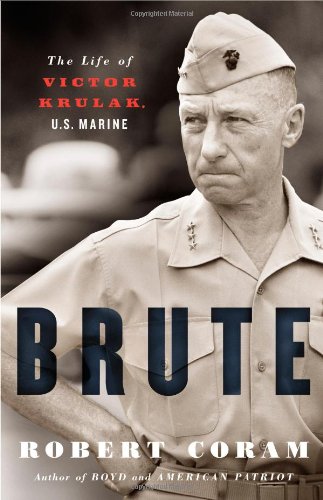
Brute: The Life of Victor Krulak, U.S. Marine by Robert Coram

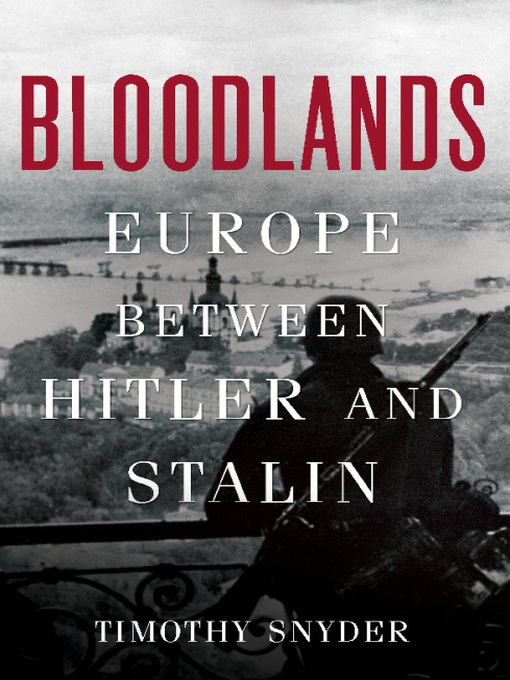
Bloodlands: Europe Between Hitler and Stalin by Timothy Snyder

Robert Coram, whom I had the pleasure of meeting at Boyd ’07, has a new biography of the legendary military visionary and Marine Lt. General Victor “Brute” Krulak, reviewed here by Max Boot and here by Tony Perry (Hat tip to Dr. Chet Richards). Having thumbed a few pages, Krulak appears a complicated man – gifted, dauntless and extremely driven but also possessed of a mean streak, edging at times toward petty cruelty.

Bloodlands I intend to read in a “Hitler-Stalin/Nazi-Soviet Comparison” series along with Richard Overy’s The Dictators: Hitler’s Germany, Stalin’s Russia, Robert Gellately’s Lenin, Stalin, and Hitler: The Age of Social Catastrophe , Richard J. Evans’ The Third Reich at War and Alan Bullock’s classic dual biography Hitler and Stalin: Parallel Lives.  I’d also recommend, for those with the stomach for historiographic commentary, Robert Conquest’s Reflections on a Ravaged Century and John Lukac’s The Hitler of History

CURRENTLY READING:

Human Face of War by Jim Storr

After reading approxmately a third of The Human Face of War by  Dr. Jim Storr, a retired Lt. Colonel, King’s Regiment and an instructor at the UK Defence Academy, I will say that if you are going to read only one book on modern military thought this year, it should be The Human Face of War. It’s that good.

Aside from a reflexive hostility toward John Boyd’s OODA Loop ( though not, strangely enough, toward the substantive epistemology advocated by Boyd that the diagram represented), Storr’s tome is an epistle of intellectual clarity on military theory that deserves to be widely read.

ADDENDUM:

NDU Press recommends, and I concur, this review of The Human Face of War by Col. Colonel Clinton J. Ancker III. Ancker, like Storr, is an expert on military doctrine, so it is a well-informed review by a professional peer.


Switch to our mobile site