zenpundit.com » Hipbone Games

Archive for the ‘Hipbone Games’ Category

The Said Symphony: moves 13 – 15

Wednesday, December 21st, 2011

[ by Charles Cameron – extended analytic game on Israeli-Palestinian conflict — continuing ]

.

It has been a while since I last played a move in the Said Symphony: our game has been quiet since July, and it is now December.  Meanwhile, the world has moved on, and many of the knowns of the Middle East have become unknowns – the Egyptian view of Israel among them.

My next move, then, will recognize this lapse of time — but for those who may be unacquainted with the game, and wish to follow it, here is a quick recap.

The Said Symphony Game, played in the spirit of Hermann Hesse‘s fictional Glass Bead Game, is an attempt to “concept-map” the various voices in the Israeli-Palestinian conflict and its wider context, both contemporary and historical/mythological, so that its many voices can be held in counterpoint in the mind, and parallelisms and oppositions discerned between them as in a great fugue of Bach or Beethoven — inspired by the Palestinian public intellectual and music critic’s suggestion:

When you think about it, when you think about Jew and Palestinian not separately, but as part of a symphony, there is something magnificently imposing about it. A very rich, also very tragic, also in many ways desperate history of extremes — opposites in the Hegelian sense — that is yet to receive its due. So what you are faced with is a kind of sublime grandeur of a series of tragedies, of losses, of sacrifices, of pain that would take the brain of a Bach to figure out. It would require the imagination of someone like Edmund Burke to fathom.

The game thus far:

The game is a solo game, and you may wish to read it slowly.

I will now play moves 13 – 15.

____________________________________________________________________________________________

Move 13: Pause

Move Content:
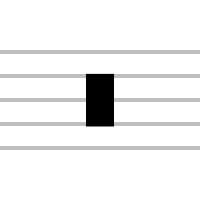
The rest [in this case a “long” rest] is the indication in the score of a musical silence: that is, a silence heard as musical, silence within the music. The rest extends over time, the music continues – so I’m adding a fermata or hold to the rest, which will extend it further, thus:

To my way of thinking, the pause is, above all else, a sabbath, a time of rest:

“Labor is a craft, but perfect rest is an art”, writes Abraham Joshua Heschel in his great, short book, The Sabbath — “He who wants to enter the holiness of the day must first lay down the profanity of clattering commerce … He must go away from the screech of dissonant days” and “How else express glory in the presence of eternity, if not by the silence of abstaining from noisy acts? These restrictions utter songs to those who know how to stay at a place with a queen…”

Links claimed:

There are other pauses, pauses of dissonance, pauses of rending.

To Auschwitz: The pause that Auschwitz enforces on us is a silent scream, atonal, ultra-modern in its sensibility, the attempt of a little, unmoored, desacralized western consciousness to get to moral grips with the factory extermination of one’s fellow beings by the millions, perpetrated by people who wear the same shoes and suits and ties, and carry the same briefcases as ourselves. It lacks all that has previously been called  musicality: it cannot cope.

I do not believe there is any escaping this scream: it is to be heard and held, embraced even. It is ugly, and it is an ugliness increaed by magnitude, by repetition, by number.

To Golgotha: The pause that Golgotha asks of us is of another order.  Christ, “when he had cried again with a loud voice, yielded up the ghost.” The Word is silenced. Only after three days will it begin to speak again.

Comment:

Leading into the next move, I have suggested that the rest is a musical silence – whether it be the deathly silence we may sense in Golgotha, the hideous silence that Auschwitz draws from our exhausted lungs, or the encompasing silence of glory of which Rabbi Heschel speaks.

It is a musical silence, a silence in each case to be listened to – tolerable or intolerable – a John Cage zen silence if you will…

In that silence, sounds can be vaguely sensed, emerging as if a morning mist is lifting, and some bird or twig or trill takes form…

Our board thus far:

[ my appreciation and thanks to Cheryl Rofer, who corrected me with regard to the notation of rests ]

____________________________________________________________________________________________

Move 14: Jerusalem


And so a new movement in our Symphony begins.

I have been aching for this moment: as move 14, I play Jerusalem

Move 14: Jerusalem

Move content:

Jerusalem is at the heart of the Israeli / Palestinian and Israeli / Arab problem, and thus of much of the tension in the  Middle east and the world.

It is also the city of peace, Salem – and you might say the ultimate hope, not of this game, which cannot aspire so high, but of the heart, is expressed in the three words: shalom salem salaam… In fact, ubi shalom, ibi salaam might be the motto of this work: where there is peace, let there be peace.

In making the opening move of this second movement of my game Jerusalem, then, I am taking us into the heart of the conflict, and into the heart of the hope for peace.

Jerusalem is a contested city, and we shall explore that contest in the moves to come.

Links claimed:

First, to the rest in 13: because in the silence, three sounds can be heard.  I quote here the words of Jamal Zahalka, a Palestinian Knesset Member — not for who he is but for their music:

The sound of the Muezzin, the church bells and the blowing of the shofar have always existed.

Those are the sounds “that can be vaguely sensed, emerging as if a morning mist is lifting”, in the silence of the musical rest.

Second, to Golgotha, the place outside Jerusalem where, according to the Christian telling, the body of the man who compared his body to the temple was so cruelly tortured that he “yielded up the ghost” – and at that moment, as if in sympathy, in the spiritual heart of Jerusalem and all Israel “behold, the veil of the temple was rent in twain from the top to the bottom; and the earth did quake, and the rocks rent…”

Third, to the Glass Bead Game: because “the holy city, new Jerusalem, coming down out of heaven from God, made ready as a bride adorned for her husband” of Revelation 21.21 finds its intellectual avatar in “the hundredgated cathedral of the mind” to which Hesse’s Game aspires.

Fourth, to William Blake, prophet, for whom Jerusalem was so urgent a matter that he must have it with him in England – as many Americans must have it with them in America — singing (as I myself have lustily sung):

And did those feet in ancient time.
Walk upon England’s mountains green:
And was the holy Lamb of God,
On England’s pleasant pastures seen!

And did the Countenance Divine,
Shine forth upon our clouded hills?
And was Jerusalem builded here,
Among these dark Satanic Mills?

Bring me my Bow of burning gold;
Bring me my Arrows of desire:
Bring me my Spear: O clouds unfold!
Bring me my Chariot of fire!

I will not cease from Mental Fight,
Nor shall my Sword sleep in my hand:
Till we have built Jerusalem,
In England’s green & pleasant Land

But Blake did better than to write these words – he illuminated them, and I shall place the text as he presented it at the bottom of this post.

Next: to Bob Dylan.  Well, there’s this:

— but it seems to be someone’s personal graphic for a compilation of Dylan songs, so this – Dylan at the Wailing Wall, 20 February 1983, attending his son’s Bar Mitzvah – will have to suffice:

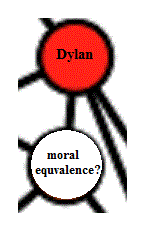
And finally, I find there’s a peruasive link to Moral Equivalence — because Palestinians claim possession of the Noble Sanctuary and parts of the old city, while Israelis claim the same rights over the whole of Jerusalem including the Temple Mount – the Temple Mount and Noble Sanctuary being one and the same physical space — and there are wise and foolish, hardliners and diplomats, scholars and treatises on both sides, and in the interstices between them.

And the question is: are the claims and complaints of one side justified and the other baseless, or is there a moral equivalence between them.?

That is a question of balance on the scale of justice, to be tempered, one always hopes, with mercy.

Comment:

What are the claims and counter-claims, ancient and modern – and what do the peace-makers say?

Addendum:

A page from Blake’s Preface to Milton:
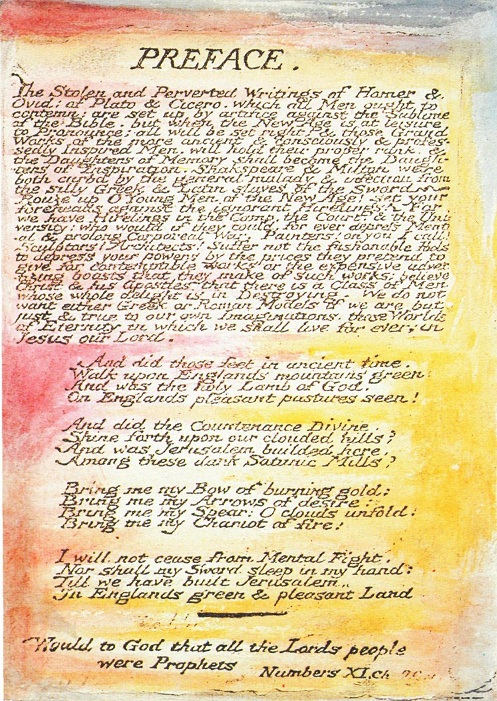
It would be a marvel to have purchased his book at the time, to have held it and read and savored it, each copy uniquely illuminated by his own hand…


____________________________________________________________________________________________

Move 15: Netanyahu’s Leopard

Move 15: Netanyahu’s Leopard

sforzando

Move content:

“A leopard has sunk its teeth in our flesh, in the flesh of our children, wives, our elderly, and we will not be tempted to believe that this leopard has now changed its spots. We will not ignore its voracious growls. We will strike it down.”

From the desk of Israeli Prime Minister Netanyahu, speech at the Memorial Ceremony for Victims of Terror, October 5th, 2011.

Links claimed:

To rest or pause, I suppose, because the lull between intifadas may seem like a sort of temporary truce, but it’s really mostly an opportunity for the enemy to regroup and rearm; and then to Jerusalem, because Jerusalem is Irael and Israel Jerusalem; and finally to — what was it — moral equivalence because there is no moral equivalence, is there?

I’m sorry if that seems a bit abrupt, but the musical signature at the top of the move says sforzando, and we’ve got work to do.

Comment:

Getting into the thick of it, Netanyahu’s speech doesn’t leave much room for compromise.  And sforzando, a musical term, literally means “forcibly” — “with strong emphasis”.

Conflict is not pretty, in the way one might hope that symphonies and other works of art and beauty might be.  There’s death to be distributed and withheld, and wealth and power — and the urgency they bring to the fight.
 

Tea Party and / or Occupy?

Sunday, October 9th, 2011

[ by Charles Cameron — parallels, opppositions, analysis, games, coincidentia oppositorum ]

.

labelling-bodies1.jpg

My friend Cath Styles, who has been developing an iPad playable version of my HipBone Games under the name Sembl for the National Museum of Australia, made a point I’ve been trying to make for a while now, with sweet lucidity, in a recent blog post:

A general principle can be distilled from this. Perhaps: In the very moment we identify a similarity between two objects, we recognise their difference. In other words, the process of drawing two things together creates an equal opposite force that draws attention to their natural distance. So the act of seeking resemblance – consistency, or patterns – simultaneously renders visible the inconsistencies, the structures and textures of our social world. And the greater the conceptual distance between the two likened objects, the more interesting the likening – and the greater the understanding to be found.

That’s absolutely right, and it gets to the heart of my games and analytic practice — to see and acknowledge both parallelisms and differences, oppositions…

Oxford is the polar opposite of Cambridge as anyone at the annual boat race between them will tell you — yet they’re so similar that the term Oxbridge exists to distinguish them as a dyad from all else the wide world round…

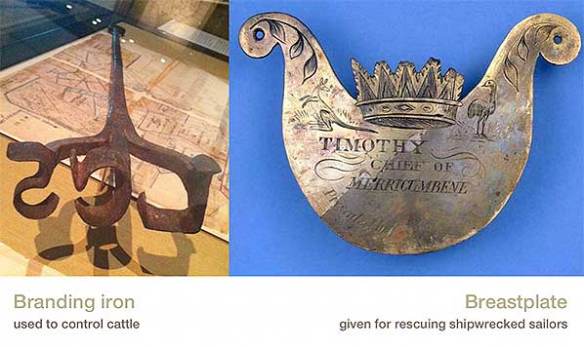
Similarly, in the example illustrated above, Cath shows two items from the Museum collection that were juxtaposed by players of an early version of her game, and writes:

the Sembl players who linked the above branding iron to the breastplate – because both are tools for labeling bodies – cast new light on the colonial practice of giving metal breastplates to Aboriginal people.

* *

Since the essence of my own analytic style (and that of HipBone and Sembl games) is the recognition of parallelisms and oppositions, I was particularly interested to see one group of early Tea Party folk reaching out to the emerging Occupy movement. Here, then, are two posts in which we can see the beginnings of recognition that there may be a kinship between the two…

Occupy Wall Street: Another View:

You know what the “Occupy Wall Street” movement is?
.
It is all the things that were in the original Tea Party, but were steadily ignored as the TP became a Republican booster club.

That comes from a post on FedUpUSA, a site with the Gadsden flag as its web-logo that was [as “Market
Ticker”], one of the founding orgs behind the TP. It’s from someone who identified as a Libertarian Party activist.

Here’s another post from FedUpUSA, not so identified:

An Open Letter From FedUpUSA To Occupy Wall Street Protestors All Over The Country:

This is a letter to OWS from FedUpUSA, one of the original Tea Parties:
.
We support you in exercising your First Amendment Right. We are outraged that any peaceful demonstrator would be assaulted or abused by any authorities.
.
If you are protesting because there are no jobs— We stand with you.
.
We are for a free economy and recognize that what we have now is NOT a free economy; it is not capitalism what we have is a fascist state or crony-capitalism. There is nothing free about doing business with Countries that manipulate their currencies to attract cheap labor. We agree that these jobs need to come back to America.
.
If you are protesting because no one has gone to jail— We stand with you.
.
Regardless of what is being said from the white house and media, we know that there are many in the financial district and the banks that have committed fraud and outright theft and we too want to see them prosecuted. We support the stop looting and start prosecuting.
.
If you are protesting because everything costs more— We stand with you.
.
We see prices rise in our food, gas, clothes yet our wages have stayed the same or have decreased. The Federal Reserve has bailed everyone out but us and not only are we going to have to pay for that, those bailouts make the price of everything else go up because it devalues our currency. We support monetary reform.
.
If you are protesting because you are tired of our bought and paid for government on both sides— We stand with you.
.
We are also against the banks and big corporations buying our politicians and writing laws that favor their special interests. We understand that our economy is broken BECAUSE of this and that all of our other issues will never be addressed as long as the financial elite control OUR government.
.
We understand that these issues cross party lines and ideologies and effect each and every one of us. We also understand that these issues will never get fixed as long as we continue to let the media, the elite, and members of the government separate us by our differing ideologies.
.
Only Together, can we Implement Change
.
It is time, We Americans, put our ideologies in our back pocket and not let them separate us so that we can work together for this ONE COMMON GOAL: to get the special interest money and elite out of OUR Government and return it to US — the people.
.
As long as the banks, largest corporations, and wealthy elite control our government, we will never have a representative republic and laws will continue to be passed that only benefit the few 1% at the expense of us 99
.
Demand that NOT ONE MORE LAW gets passed until they pass:
.
Lobby reform:
.
It is a Federal Offense punishable by a minimum 5 years in prison to:

.
Lobby any member of the US Congress outside of the district you live, work, or own a business.
Lobby a member of congress while they are physically outside the district they represent.
.
Campaign Reform:
.
It is a Federal Offense punishable by a minimum 5 years in prison to:
.
For any one person, corporation, enterprise, group, union or the like, to donate more than $2,000 to any one candidate during one campaign period.
For any member of the media to deny equal access to competing candidates.
.
These two laws will cut the control the Financial elite have on our government by leveling the playing field. You will have just as big as a voice with your representative as the big box retailer that resides in your town. Simply, it will end the Crony-Capitalism that is strangling our economy.
.
I encourage all my fellow Tea Partiers to join Occupy Wall Street protesters in their non-violent, peaceful protests and together demand that the Government be returned to the people. After all, this is precisely what the Tea Party was intended to be before it was taken over and marginalized by the establishment politicians.

.
FedUpUSA.org

* *

And we’re deep into John Robb territory…

What do you think? Do the parallelisms strike you, or the oppositions — or, perhaps, both?

FWIW, Cath’s Sembl version of my game looks like it is going to be a beautiful steampunk affair…

Formats for civil online debate II — inspired by Hesse’s Bead Game

Tuesday, August 16th, 2011

[ by Charles Cameron — hypertext, rhetoric, glass bead games, civility ]

.

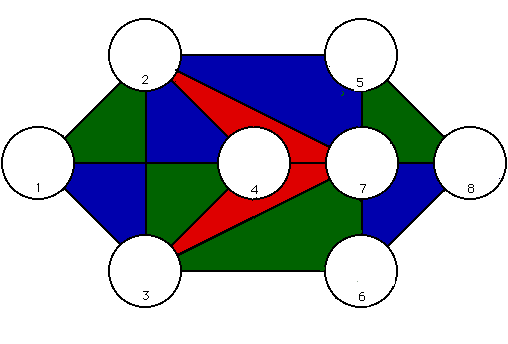
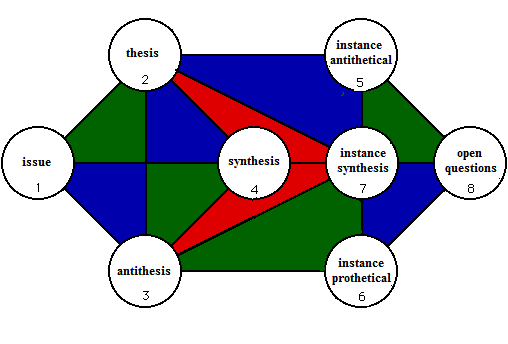
My second attempt at a format for online debate is, as I said, a variant on the “Dart Board” sometimes used for playing my HipBone Games (see, for instance, my solo game War is Sexy, says Dawn).

*

The idea here would be to format a blog post and series of 7 comments by a Querent (the one with the Question) who may also be the Umpire — both roles would be issue-neutral — a Proponent who would propose and support a thesis, and an Antagonist who would oppose it.And I should add, right at the outset, that this is a formal process for the named participants — as a white tie debate at the Oxford Union is a formal process — no matter how raucus the kibitzers may get, and accordingly requires a day or two between moves to allow for consideration, research and preparation.
dartbdwhitedebatesetup.png

The Querent makes the first move in the first position on the board, giving it short move title (short enough to be typed on the board graphic in the space currently occupied by the word “issue‘) and a paragraph or so of move content setting forth concisely the issue to be discussed — ideally via an issue neutral anecdote or quote. After each move, the Querent (or a graphically inclined observer) would ideally update and post the game board after inserting the relevant move title.

[ Those who are not among the named participants may of course kibitz at any time… ]

The Proponent next carefully chooses a pithy quote or anecdote, gives it a move title (as above), and posts the move title, the chosen move content (the anecdote or quote selected), the link claimed (setting forth concisely the nature of his or her argument as it relates to the move content of the Querent‘s issue), and if she or he so chooses, a comment (the comments in a HipBone Game are intended for meta-conversations among the various players).

The Antagonist then similarly chooses an anecdote or quote, and posts move title, move content, links claimed — in this case, showing the links with both the issue as stated at position 1 in the Querent’s move, and the thesis as stated in position 2 in the Proponent’s move — and a comment if so desired.

Okay, that’s thesis and antithesis, the Umpire then posts a move title, some move content and links claimed to all three positions in play, with a comment if so desired, in the fourth position (labeled synthesis).

The rule is that whenever playing in a position which links via a board line to one or more previous moves, the links claimed must include explanations of how the move relates to those previous moves.

The Antagonist plays next in position 5 — playing move title, move content, links claimed, comment — providing an instance with which to dispute the thesis, and linking as per the rule just stated to the thesis proposed at position 2 — only!

Since position 5 is only connected to position 2 of those positions in play, no other links should be claimed.

Similarly, the protagonist then plays in position 6, a move which I’ve called the “prothetical” instance without a clue as to whether prothetical is a real word — tho’ I like it — linking only to the antithesis in position 2, which it seeks to refute.

Move 7 is by far the trickiest of the game, and is made by the Umpire, who now has to provide move content that synthesizes the game thus far, explaining links claimed to positions 2, 3, 4, 5 and 6 (ie to the original thesis, antithesis and synthesis, but moving the synthesis to encompass also the two instances)…

But the Umpire can take consolation in the fact that in the final move 8, the Querent gets to raise afresh those questions which remain — now that both sides have had their say, and the Umpire has attempted reconcile them.

*

Three quotes, the first one on debate:

Harmony among conflicting viewpoints, not the victory of one of them, should be the ultimate goal…

— from Bizell & Herzberg, The Rhetorical Tradition, as quoted here

The second moving from debate to dialog:

One way of helping to free these serious blocks in communication would be to carry out discussions in a spirit of free dialogue. Key features of such a dialogue is for each person to be able to hold several points of view, in a sort of active suspension, while treating the ideas of others with something of the care and attention that are given to his or her own. Each participant is not called on to accept or reject particular points of view; rather he or she should attempt to come to understanding of what they mean.

David Bohm, Science Order and Creativity, p 86

And the third, from Buddhist Madhyamika philosophy, moving into the contemplative realm where all answers are seen as the stepping off points for open questions:

I wanted to use one word in Tibetan that I’ve found very useful for myself… and this is the word zöpa.. this translates usually as patience or endurance or tolerance, but there’s this very subtle translation of zöpa, which is the ability to tolerate emptiness basically, which is another ways of saying the ability to tolerate that things don’t exist in one way, that things are so full and infinite and leave you so speechless, and so undefinably grand – and these are just descriptive words, but you have to use some words to communicate, I guess — the ability bear that, that fullness, like we’ve been talking about, not turning away, not turning away.

Elizabeth Mattis-Namgyel, in (if I recall) a Shambhala-sponsored retreat video

*

A blank Dart board, downloadable for your convenience:

dartbdwhitedebateblank.png

The Said Symphony: move 12

Thursday, July 21st, 2011

[ by Charles Cameron – extended analytic game on Israeli-Palestinian conflict — continuing ]

.

I am titling my next move “Moral Equivalence?” with the question mark as the crux of the title, and I am posting it separately since it (a) raises a central question with regards to the entire project and (b) plunges us directly into the twin narratives of Palestinian and Israeli… in parallel, in counterpoint… perhaps in…

Move 12: Moral Equivalence?

move-12.gif

Move Content:

In President Obama‘s address at Cairo University on June 4, 2009, the President presents the two narratives, Israeli and Palestinian, side by side:

America’s strong bonds with Israel are well known. This bond is unbreakable. It is based upon cultural and historical ties, and the recognition that the aspiration for a Jewish homeland is rooted in a tragic history that cannot be denied.

Around the world, the Jewish people were persecuted for centuries, and anti-Semitism in Europe culminated in an unprecedented Holocaust. Tomorrow, I will visit Buchenwald, which was part of a network of camps where Jews were enslaved, tortured, shot and gassed to death by the Third Reich. Six million Jews were killed — more than the entire Jewish population of Israel today. Denying that fact is baseless, it is ignorant, and it is hateful. Threatening Israel with destruction — or repeating vile stereotypes about Jews — is deeply wrong, and only serves to evoke in the minds of Israelis this most painful of memories while preventing the peace that the people of this region deserve.

On the other hand, it is also undeniable that the Palestinian people — Muslims and Christians — have suffered in pursuit of a homeland. For more than 60 years they’ve endured the pain of dislocation. Many wait in refugee camps in the West Bank, Gaza, and neighboring lands for a life of peace and security that they have never been able to lead. They endure the daily humiliations — large and small — that come with occupation. So let there be no doubt: The situation for the Palestinian people is intolerable. And America will not turn our backs on the legitimate Palestinian aspiration for dignity, opportunity, and a state of their own.

For decades then, there has been a stalemate: two peoples with legitimate aspirations, each with a painful history that makes compromise elusive. It’s easy to point fingers — for Palestinians to point to the displacement brought about by Israel’s founding, and for Israelis to point to the constant hostility and attacks throughout its history from within its borders as well as beyond. But if we see this conflict only from one side or the other, then we will be blind to the truth: The only resolution is for the aspirations of both sides to be met through two states, where Israelis and Palestinians each live in peace and security.

Insult #3 in Nile Gardiner‘s piece, “Barack Obama’s top ten insults against Israel,” from the Telegraph blog of April, 2010, consists of the comment:

In his Cairo speech to the Muslim world, President Obama condemned Holocaust denial in the Middle East, but compared the murder of six million Jews during World War Two to the “occupation” of the Palestinian territories, in a disturbing example of moral equivalence:

followed directly by the third paragraph above from Obama’s speech.

The question raised by this move is that of “moral equivalence”. Specifically, I am raising the question of whether Obama’s four paragraphs do indeed contain “a disturbing example of moral equivalence”. More generally, I am asking whether juxtaposition — which is one of the central features of analogical thought, and thus of this game – implies equivalence.

Link claimed:

To Bob Dylan, “One too many mornings” and the lines “You’re right from your side / I’m right from mine” – juxtaposing them like that, is there a moral equivalence implied?

Dylan’s overview doesn’t sound too optimistic about the possibility of any kind of reconciliation of the opposites: “We’re both just one too many mornings / An’ a thousand miles behind…”

Accordingly, this may be an appropriate point at which to note that Edward Said thought the conflict between Israelis and Palestinians was asymmetrical and irreconcilable.

In the interview from which I borrowed Said’s notion of a “symphonic” reading of the conflict, the question and answer immediately following that paragraph reads thus:

Q: Is this a symmetrical conflict between two peoples who have equal rights over the land they share?

A: There is no symmetry in this conflict. One would have to say that. I deeply believe that. There is a guilty side and there are victims. The Palestinians are the victims. I don’t want to say that everything that happened to the Palestinians is the direct result of Israel. But the original distortion in the lives of the Palestinians was introduced by Zionist intervention, which to us – in our narrative – begins with the Balfour Declaration and events thereafter that led to the replacement of one people by another. And it is continuing to this day. This is why Israel is not a state like any other. It is not like France, because there is continuing injustice. The laws of the State of Israel perpetuate injustice.

This is a dialectical conflict. But there is no possible synthesis. In this case, I don’t think it’s possible to ride out the dialectical contradictions. There is no way I know to reconcile the messianic-driven and Holocaust-driven impulse of the Zionists with the Palestinian impulse to stay on the land. These are fundamentally different impulses. This is why I think the essence of the conflict is its irreconcilability.

Comment:

Are the two narratives symmetrical? Is there a moral equivalence between them?

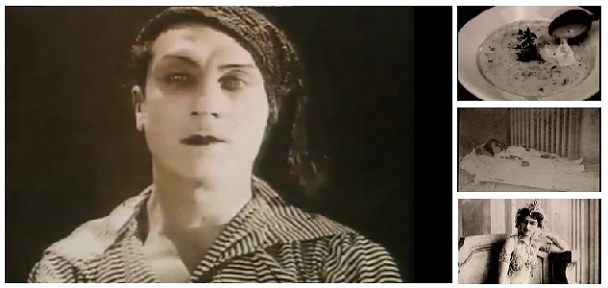
The great early Russian film director Sergei Eisenstein wrote that “the juxtaposition of two shots by splicing them together resembles not so much the simple sum of one shot plus another — as it does a creation.”

mosjukhin.jpg

His colleague Vsevolod Pudovkin goes further:

Kuleshov and I made an interesting experiment. We took from some film or other several close-ups of the well-known Russian actor Mosjukhin. We chose closeups which were static, and which did not express any feeling at all-quiet close-ups. We joined these close-ups, which were all similar, with other bits of film in three different combinations. In the first combination the close-up of Mosjukhin was immediately followed by a shot of a plate of soup standing on a table. It was obvious and certain that Mosjukhin was looking at this soup. In the second combination the face of Mosjukhin was joined to shots showing a coffin in which lay a dead woman. In the third the close-up was followed by a shot of a little girl playing with a funny toy bear. When we showed the three combinations to an audience which had not been let into the secret the result was terrific. The public raved about the acting of the artist. They pointed out the heavy pensiveness of his mood over the forgotten soup, were touched and moved by the deep sorrow with which he looked on the dead woman, and admired the light, happy smile with which he surveyed the girl at play. But we knew that in all three cases the face was exactly the same.

What I am getting at here is, first and foremost, that juxtaposition is a rhetorical and aesthetic device, and that how to “read” a given juxtaposition is not necessarily obvious.

In a subsequent move, I shall discuss the specific philosophical problem involved in weighing one body of suffering against another

The Said Symphony: Meditation / moves 10 and 11

Sunday, June 26th, 2011

[ by Charles Cameron – extended analytic game on Israeli-Palestinian conflict — continuing ]

Meditation part 1 / Move 10

.

What to say? There are two sides to the game, darkness and light, and the light encompasses the darkness, and the darkness threatens the light.

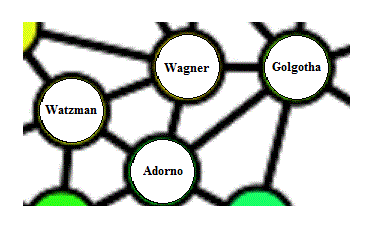
I promised a meditation on the state of the game, and it comes in the form of two moves: Move 10: Piano Lesson, by Haim Watzman, addresses the light, and my sense that the game is as much a gift to me as a gift from me to you, while Move 11: Auschwitz and Theodor Adorno raises the darkest question of all, whether art can still function in situations as terrible as those where humans hate to the fullest extent of their powers.
____________________________________________________________________________________________

Move 10: Piano Lesson, by Haim Watzman

move-010.gif

Move content:

The content of this move is Haim Watzman‘s story Piano Lesson which comes from his Necessary Stories series, on the South Jerusalem blog he shares with my friend and colleague Gershom Gorenberg. It concerns young Felix Mendelssohn, the grandson of the rabbinic scholar Moses Mendelssohn, composer – and the man who revived Bach‘s St Matthew Passion after it had lapsed into obscurity for a century or so.

Links claimed:

With Wagner, in complete refutation of the latter’s opinions about Judaism and musicianship – Watzman’s story opens with the words:

I am impressed. You play like a Jew, Felix. What I mean by that is that you have Johann Sebastian Bach in your heart as well as in your fingertips…

contains this more detailed assertion:

This piece you have played so beautifully for me this morning, the Partita No. 5 in G Major, can only be played properly, in our falscherleuchtung age, this time of false enlightenment, by a person of Jewish sensibility. Please do not interrupt me. At your age you are to listen to your elders first. After you listen you may disagree, you may do whatever you want. But first you must listen.

Sebastian Bach was a devout Lutheran, true, but he wrote Jewish music. I do not say this simply to embellish the repute of my ancestral people. The nation Israel needs no trills. I say this after long years of study and performance of Bach’s music, during which I have come to know this remarkable man. Better, I hazard to say, than his own sons did.

What is Jewish about the music? To see that, you have to know music. Which, of course you know. You also have to know what Judaism is. Which, thanks to my niece, you do not. This is scandalous. The grandson of the great Moses Mendelssohn knows nothing of his own people’s special relationship with God.

and closes with:

Remind me to show you the “St. Matthew Passion.” It is such wonderfully Jewish music!

Comment:

I read this story a day or two after completing moves 8 (Wagner) and 9 (Golgotha) and posting the game thus far to Zenpundit, and was astonished and delighted to find that a mind and heart in Jerusalem – friend of a friend – was touching on the same territory: the relationship of music, especially that of Bach, and Judaism.

But not only does Watzman deftly refute Wagner’s position on Judaism and music as presented in move 8, he also specifically discusses the contrapuntal aspect in both music and religious understanding, and the power of dissonance at times to work towards resolution.

This he accomplishes through a discussion of the two “laws” of Judaism, and the complexities of their musical relationship with one another:

I kept working on the piece and the morning prior to the performance I had my epiphany. Here, let me play it for you.

So where is the stress? Yes, here. And here too. At the end of the melodic line. And at the end of the harmonic progression. Which do not coincide.

You see, the underlying harmonics here are the Torah, the Written Law. And the melody playing above it is the Oral Law. The melody would be hollow, meaningless without the underlying harmony, and the underlying harmony would be incomplete and useless without the melody above it.

The simple-minded might think that the two laws should coincide. What good is a God if his message is not clear?

Yet it is the lack of clarity, the occasional dissonance, the unsynchronized phrases that move us forward, that propel us toward the final resolution. And that final tonic itself sends us off into new melodic and harmonic firmaments, from which we again return to our G major chord. One idea begins before the previous idea has been completed. As when you interrupt your Great Aunt Sara.

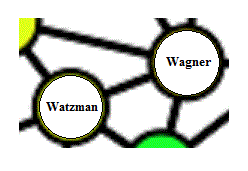
There is thus an uncanny melodic line here, running from Said through Bach, Gould, Wagner, to Watzman.

said-watzman.gif

Whatever I am doing here – and it feels at times quite lonely, I am not sure how many people will find this game an easy work to follow – in reading Watzman’s tale of Felix Mendelssohn I felt again my kinship with what has been termed the “invisible cloud of witnesses”…

Indeed, my sense of the gracious synchronicity involved in my stumbling across this particular story of Watzman’s at this particular time can only deepen as Watzman concludes his story – and I my move – with this rendition of the Bach Partita No. 5 in G major BWV 829, played by one Glenn Gould

____________________________________________________________________________________________

Meditation part 2 / Move 11

If the first part of this meditation relates to the game <as a whole, and to the fabric of grace of which, it seems, the universe as a whole is woven, this second part addresses the sense — as bitterly merciless to those who suffer it as grace is merciful to those who receive it — that the fabric of grace is itself picked at and torn by humans, in danger at any point (and perhaps in this moment more than most) of unravelling.

In my personal perspective, I should no more ignore the threat than ignore the grace — for love extends itself in compassion to the one, even as it extends in gratitude to the other.

____________________________________________________________________________________________

Move 11: Auschwitz and Theodor Adorno

move-011.gif

Move content:
Theodor Adorno famously said: “To write a poem after Auschwitz is barbaric.”

*

Think of this move as a sort of metaphysical black hole, an anti-game.

To expand on this idea a little: Adorno was a musical advisor to Thomas Mann while Mann was writing his novel Doctor Faustus — a copy of which he inscribed to his friend Hermann Hesse with the words “To Hermann Hesse, this glass bead game with black beads, from his friend Thomas Mann, Pacific Palisades, January 15, 1948” – featuring a composer named Adrian Leverkuhn, whose intention in his final work was to retract — cancel, annul — Beethoven‘s Ninth Symphony, and in particular its Ode to Joy with his own oratorio, The Lamentation of Doctor Faustus.

 “I find,” he said, “that it is not to be.”
“What, Adrian, is not to be?”
“The good and the noble, what we call the human, although it is good, and noble. What human beings have fought for and stormed citadels, what the ecstatics exultantly announced — that is not to be. It will be taken back. I will take it back.”
“I don’t quite understand, dear man. What will you take back?”
“The Ninth Symphony,” he replied.

Herbert Marcuse — another modernist philosopher of the left — is quite clear on the power of this Faustian attempt, which he approves as liberating us from “illusion” and indeed “making us see the things which we do not see or are not allowed to see, speak and hear a language which we do not hear and do not speak and are not allowed to hear and to speak”:

The present situation of art is, in my view, perhaps most clearly expressed in Thomas Mann’s demand that one must revoke the Ninth Symphony. One must revoke the Ninth Symphony not only because it is wrong and false (we cannot and should not sing an ode to joy, not even as promise), but also because it is there and is true in its own right. It stands in our universe as the justification of that ‘illusion’ which is no longer justifiable.

Links claimed:

To Wagner, because the mythology of blood and race which he promulgated so stirred one Adolf Hitler that the latter carried out the Shoah, in face of which Adorno finds poetry – hence Orpheus and the muses — speechless.

To Golgotha, because Christ is banished and beaten from the city, Jerusalem, whose name is The Abode of Peace — because there is no more despairing cry than his cry at Golgotha: “My God, My God, why hast Thou forsaken Me?” — because the Descent of Mercy in human form is then brutally executed as a common criminal – because the very veil that protects the holy of holies in the JerusalemTemple is then torn asunder, as his body is broken – because all this marks the darkest moment in the Christian narrative – and because such desolation, felt by the Marys gathered at the foot of the cross, is nowhere so closely mapped in the history of the arts as by the silence of poetry and the arts before atrocity.

And to Watzman, because despite the Shoah — the Golgotha of my civilization and Hesse’s and Bach’s — and despite Adorno, there is poetry in his voice — an Israeli voice, speaking after Auschwitz, in an Israeli State, in Jerusalem.

Comment:

As I was setting out the ground-rules for this game, my friend Lexington Green made what I’d like to call “the essential objection”. He wrote:

Pals send their teenagers to be suicide bombers. That is beyond dissonant. There is no symphony where one group of musicians is committed to a relentless campaign of murder and terror. Said was using this as one more way of playing make-believe, and claiming moral equivalence. In other words, it was a sophisticated move in an elaborate scheme to help disarm his opponents so his fellow Palestinians could kill them.

There is another point of view, which sees the Israelis enforcing a mutant form of apartheid with attendant horrors on an occupied population – indeed, I have Israeli friends who hold some version of this view — but Lex’s point is crucial:

There is no symphony where one group of musicians is committed to a relentless campaign of murder and terror.

This cuts to the heart of the work, as it cuts to the heart of our world. It is, in essence, the issue of theodicy, and which Lex’s permission I am addressing it in this meditation, within the work itself …

My linking of the cry of Golgotha –“My God, My God, why hast Thou forsaken Me?” – with the cry of Adorno – “To write a poem after Auschwitz is barbaric” – is my presentation of the most godforsaken of despair of which we are humanly capable, and I present it within that opposite extremity of human possibility represented by Bach’s motto which I invoked earlier, Soli Deo Gloria.

It is precisely in the context of free will that both possibilities arise, and theodicy becomes an issue. Here, then, is the relationship of darkness to light as described by St John in the Prologue to his gospel:

the light shines in the dark, darkness does not blot it out.

I can say no fairer than that.

____________________________________________________________________________________________

Conclusion:

Oliver Sacks in Musicophilia tells the story of a Manhattan psychiatrist who lived immediately opposite the Twin Towers, and whose otherwise rich interior musical life went blank for months after he witnessed the 9-11 attacks:

My internal life was dominated by a dense and silent pall, as if an entire mode of existence were in an airless vacuum. Music, even the usual internal listening of especially beloved works, had been muted…

“Music”, the psychiatrist said, “finally returned as a part of life for and in me” after an absence of several months. The first music to return was Bach‘s Goldberg Variations.

Again, I must admit it was by no skill of mine but some grace of god or muse that I stumbled on Sacks’ book today, while searching my cramped and overflowing shelves for something else entirely.

There are, it seems true, periods of silence in the arts, while we absorb horrors of our human doing.

There is also a return from those horrors to the arts — even Marcuse admits this — and as forgiveness, mercy and compassion alike claim, to that great possibility, “a happy issue out of all our afflictions”.

Or so the mystics tell the realists — and time grinds all to dust.

[ next ]


Switch to our mobile site