zenpundit.com » language

Archive for the ‘language’ Category

No man’s land, one man’s real estate, everyone’s dream?

Monday, August 17th, 2015

[ by Charles Cameron — borders and distinctions from Trump to Revelation, plus one ]
.

Donald Trump‘s “three core principles of real immigration reform”:

1. A nation without borders is not a nation.

**

G Spencer-Brown wrote of his book. Laws of Form, “The theme of this book is that a universe comes into being when a space is severed or taken apart” — or as Heinz Von Foerster rephrased him, “Draw a distinction and a universe comes into being”. Indeed, his book opens with the words:

We take as given the idea of distinction and the idea of indication, and that we cannot make an indication without drawing a distinction.

He writes:

Distinction is perfect continence.

That is to say, a distinction is drawn by arranging a boundary with separate sides so that a point on one side cannot reach the other side without crossing the boundary. For example in a plane a circle draws a distinction.

Similarly, Gregory Bateson defines an idea as “A difference or distinction or news of differences”.

**

Borders are both physical and metaphysical: the border between the physical and the metaphysical passes through human beings, who are themselves both metaphysical and physical.

Borders may thus be heeded or ignored.

Smugglers don’t necessarily ignore them, they may take them very seriously, as do those who police them. Birds, however, ignore them, fishes, lizards, languages..

There are would-be states that straddle national borders, as the Basque peoples straddle the border between France and Spain:
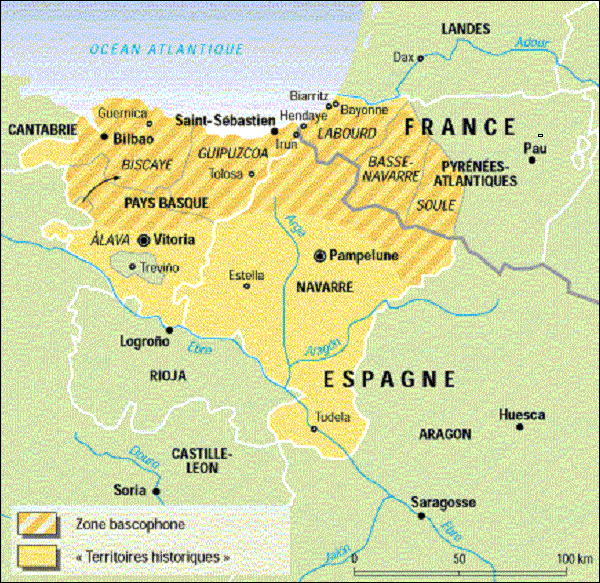
Basque France Spain 600

There are also would-be states that literally erase national borders, as in the case of IS bulldozing thw border between Iraq and Syria:
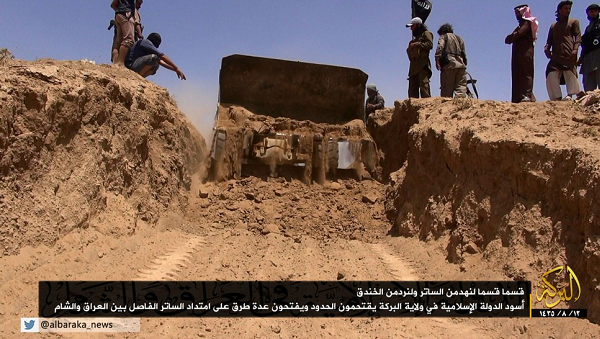
Iraq Syria Border 600

Thus while borders may be tidy in separating one from a second, they are also untidy in straddling them, neither one nor two, yet (like Janus) both.. They are, in short, thresholds, limina. And so wahat we know of liminality applies to them. I have discussed tthis previosuly on Zenpundit in Liminality II: the serious part — suffice it to say here that limiality is a condition that exacerbates, intensifies.

**

The anthropologist Mary Douglas, in her book Purity and Danger: An Analysis of Concepts of Pollution and Taboo, quotes Leviticus 19.19:

You shall keep my statutes. You shall not let your cattle breed with a different kind; you shall not sow your field with two kinds of seed; nor shall there come upon you a garment of cloth made of two kinds of stuff.

Why these disjunctions? Dougles notes the repeated refrain in just such contexts:

Ye shall therefore be holy, for I am holy

and points out that Ronald Knox correctly — if “rather thinly” — translates this:

I am set apart and you must be set apart like me

She then tells us:

Holiness means keeping distinct the categories of creation. It therefore involves correct definition, discrimination and order.

noting that:

The word ‘perversion’ is a significant mistranslation of the rare Hebrew word tebhel, which has as its meaning mixing or confusion.

and concludes

ideas about separating, purifying, demarcating and punishing transgressions have as their main function to impose system on an inherently untidy experience. It is only by exaggerating the difference between within and without, above and below, male and female, with and against, that a semblance of order is created.

**

The upper image, below, is taken from my recent post on Matrioshka cartography, and waas taken in turn from Say goodbye to the weirdest border dispute in the world in the Washington on August 1st..

SPEC DQ maps

… while the lower image is from Welcome to Liberland, the World’s Newest Country (Maybe) in the New York Times Magazine, dated Aug 11

**

Lydia Kiesling, in her post Letter of Recommendation: Uzbek in the NYT magazine today, writes:

National borders can be risibly at odds with reality, especially in Central Asia, where Turks, Mongols, Persians and others roved and mingled, where ‘‘Uzbek’’ was, for a time, more of a descriptive antonym of ‘‘Tajik’’ — no­­madic versus settled — than an ethnic classification.

And why not?

They are, after all, distinctions drawn in the mind, lines drawn on paper. Thus the Sykes-Picot map:

Sykes_Picot_Agreement_Map_signed_8_May_1916 600

Sykes was quite clear about the “lines dorawn on paper” part. He is reported to have said:

I should like to draw a line from the e in Acre to the last k in Kirkuk

The map, in other words, is not the territory: the map is a map.

To take another instance of importance in today’s world, the Durand Line:

Durand_Line_Border_Between_Afghanistan_And_Pakistan 600

Not only is the map not the territory in this case — it can be seen, as one-time Afghan president Hamid Karzai said, as “a line of hatred that raised a wall between the two brothers” — Afghanistan and Pakistan.

**

Sympathies which exist across borders can be potent forces for their dissolution. In a poem titled “Their Eyes Confer Fire” written in the 1980s about Basque country, I wrote

We have
little time,
Marie explained,
for those
who, because
it is hard
to draw
lines
across actual
mountains,
carve up
this earth on
paper.

France, Spain:
we disdain
boundaries, borders,
and border guards.

A canny reader noted that the entire poem could be read not as a description of the Basques as they exist in reality, but as a paean to the corpus callosum joining the two hemispheres of the brain — and thus the two modes of cognition of which I so recently wrote.

**

Returning to Lieberland, or Gornja Siga as the locals call it, we learn:

Gornja Siga has come, over the last few months, to assume an outsize role in the imagination of many — not only in Europe, but also in the Middle East and in the United States. Its mere existence as a land unburdened by deed or ruler has become cause for great jubilation. There are few things more uplifting than the promise that we might start over, that we might live in the early days of a better nation. All the most recent states — South Sudan, East Timor, Eritrea — were carved from existing sovereignties in the wake of bitter civil wars. Here, by contrast, is a truly empty parcel. What novel society might be accomplished in a place like this, with no national claim or tenant?

Consider one sentence alone as the key to that “outsize role in the imagination”:

There are few things more uplifting than the promise that we might start over, that we might live in the early days of a better nation.

The apocalyptic yearning here and its kinship with the Amrican dream are hard to miss — it is like a conflation of Matthew 5.14:

A city that is set on an hill cannot be hid.

with Revelation 21.1-2:

And I saw a new heaven and a new earth: for the first heaven and the first earth were passed away; and there was no more sea. And I John saw the holy city, new Jerusalem, coming down from God out of heaven, prepared as a bride adorned for her husband.

**

Plus:

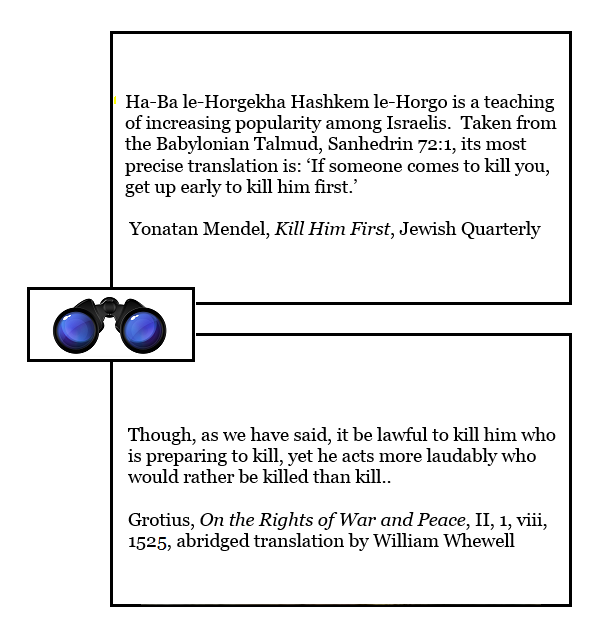
Get up early to kill him first

Thursday, August 6th, 2015

[ by Charles Cameron — from Tractate Sanhedrin and Grotius to Gershon Scholem and the power of names ]
.

I ran across Yonatan Mendel‘s post, Kill Him First, in the Jewish Quarterly today while searching for the Habrew of the phrase get up early to kill him first, which I wanted to pair with the quote from Hugo Grotius which is pretty obviously derived from it:

SPEC DQ rise up early

**

I arrived at that page, in other words, looking for the phrase Ha-Ba le-Horgekha Hashkem le-Horgo, and was glad to find it there, along with a fascinating narrative of some of the times it has been quoted in recent Israeli political circles:

Following the Second Lebanon War, Ehud Yatom, a Likud MK, explained the asymmetrical death toll of 44 Israeli civilians and 1,191 Lebanese civilians with the same trump card: ‘and if someone comes to kill you, get up early to kill him first.’ It has been used by Minister of Strategic Affairs Moshe Ya’alon when addressing university students about their military reserve service and by Minister of Public Security Avi Dichter when lecturing about IDF strategy. It was also the explanation provided by Minister of Minorities Avishai Braverman for the assassination of a Hamas leader in Dubai. Even Ayoub Kara, a Druze MK from Likud, has used it. When asked about the Iranian nuclear plan Kara showed little originality: ‘I think an attack on Iran will be justifi ed’, he said, ‘since if someone comes to kill you, get up early to kill him first.’

**

But, but.

That’s not the real treasure. For me, the real treasure is in the quote that heads Mendel’s article, from the great schoilar of Kabbalah Gershom Scholem in his 1926 letter to Franz Rosenzweig, On Our Language: A Confession. Here’s Mendel’s quote:

The people here are not aware of the significance of their acts. They only think they have turned Hebrew into a secular language. That they have released the apocalyptic sting out of it… but God will not remain silent in the language in which he was invoked again and again, thousands of times, to return into our lives.

Scholem’s whole letter is a powerful poetic testament:

Language is name. The power of language is enclosed in the name; the abyss of language is sealed within it..

Language, language, please!

Thursday, April 23rd, 2015

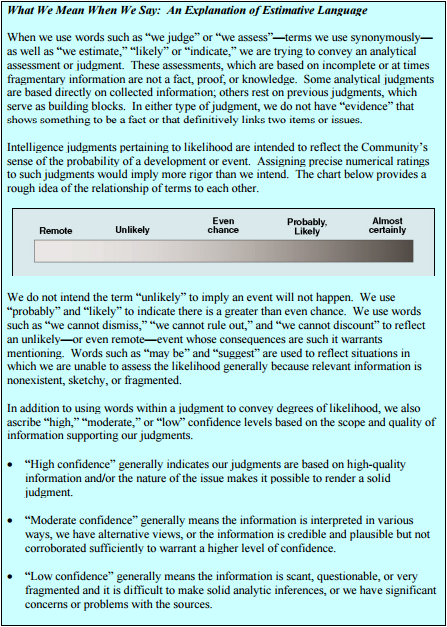
[ by Charles Cameron – unclear language gives an out-of-focus snapshot of reality, estimative language hopes to facilitate precision ]
.

Take a quick look, then skip to the rest of this post & come back later. Unless you already know this thing by heart, and perhaps nurse an inordinate hatred for it. In which case you can skip the whole post — we may even see eye to eye already..

NIE what we mean when we say estimative language

**

In light of the above, I was a tad surprised to read these words in Time this morning:

“Documents were also found and they prove, without any ambiguity, that the individual was preparing an imminent attack, in all probability, against one or two churches,” Cazeneuve said.

Somehow the combination of “without any ambiguity” and “in all probability” didn’t quite mesh. But the original speaker was French, so I did whatever diligence I could muster, and found this, selon Minister Cazeneuve:

Les perquisitions menées à son domicile ont permis de retrouver, outre de l’armement et du matériel de vidéo, des écrits « établissant sans ambiguïté que l’individu projetait de commettre un attentat, vraisemblablement contre une ou deux églises », a précisé Bernard Cazeneuve.

Apparently Le Monde viewed Cazeneuve as having “clarified” the matter, bringing it to precision.. And I suppose that means we should read the Minister’s words as indicating that the intention to attack was proven “without ambiguity” while the targeting of “one or two” churches was — my French is rusty, so I asked Larousselikely, convincing, or plausible.

All of which is by way of remarking on the necessity for — and inherent problems arising regarding — what’s called “estimative language”. Problems which may be doubly obscure in translation.

Unless someone suggests a “plausible” reference from Walsingham, Marlowe or Shakespeare, a decent starting point for consideration is to be found in Sherman Kent’s 1964 Words of Estimative Probability:

It should not come as a surprise that the fact is far from the ideal, that considerable difficulty attends both the fitting of a phrase to the estimators’ meaning and the extracting of that meaning by the consumer. Indeed, from the vantage point of almost fourteen years of experience, the difficulties seem practically insurmountable.

For a more recent take on the matter, and to see whether we’re surmounting the insurmountable yet, there’s always the chart at the head of this post, taken from the 2007 NIE on Prospects for Iraq’s Stability — something we should still be worrying about eight years later, no?

**

No sense in beating about the bush: poets can handle this sort of thing better than layfolk, but then – what’s the use? Who can read poetry any more?

Sunday surprise: petals, faces, cities

Sunday, April 12th, 2015

[ by Charles Cameron — so come on, be honest — which do you prefer, Washington 2015 or Paris 1913? ]
.

Admittedly, the text in the upper panel came from a report on yesterday’s suicide on the Capitol west front..

SPEC DQ Paris DC

**

I’m not sure whether the most interesting comparison here is between prose and poetry, Washington and Paris, the seat of power and the underground — or the present day and a century or so ago. No matter, text for text and language for language, I’ll take the Pound.

Sources:

  • Politico: Capitol lockdown – shooting – cherry-blossoms festival
  • Poetry magazine: Ezra Pound, In a Station of the Metro
  • **

    Until next time..

    Ukraine, The, unh?

    Friday, February 20th, 2015

    [ by Charles Cameron — when the definite article is simply too definitive — and how about The Levant? ]
    .

    In my ongoing, if pretty much one-sided, convo with Marc Andreessen [1, 2, 3], I’ve been arguing for Twitter to offer a format for DoubleTweeting. People do it anyway, because it’s a neat way of raising questions or making points — but it would be nice to have a format that made it both easy and elegant, and thus expand the practice. Today gave us another example of what I’ll call, for want of a better term, DoubleTweeting in the Wild:

    That was tweeted on February 18, 2015.

    **

    I’d actually like to suggest that Vox isn’t dumb, at least as far as these two tweets are concerned — it’s learning.

    Jimmy Princeton had to dig back to April 2014 to find Ezra Klein‘s use of “the Ukraine”

    and he then compares it unfavorably with Max Fisher ten months later, ie two days ago, on February 18, 2015 — the same day on which he posted his own DoubleTweet:

    Even more to the point, Fisher’s post on the importance of the distinction between “The Ukraine” and “Ukraine” was posted on Vox on September 3rd, 2014, so they hadn’t even issued their own warning at the time Klain tweeted his needless “The”.

    **

    Cheryl Rofer had to teach me the distinction, and language being language, I still can’t promise I’ll get it right every time — old habits die hard. But for the record, here are the first paras of Fisher’s Vox “card” giving the reason for the change in name

    It used to be “the Ukraine,” but after breaking away from the Soviet Union in 1991 the name changed to just “Ukraine.” That distinction actually turns out to be pretty important for understanding the current crisis.

    Ukraine has a very long history of being subjugated by outside powers, and a very short history of national independence. That may actually be why the country became known as “the Ukraine,” which many historians think meant “the borderland” in the language of ancient Slavs (it may also mean “the homeland,” a theory that Ukrainian nationalists understandably prefer). In other words, it may have been called “the” because it was considered more of a geographic region than an independent country, and one defined by its in-between-ness.

    **

    Having said all that, I’m still grateful to Jimmy Princeton for illustrating the sort of use a DoubleTweet can be put to. And I’ll try to get my own wording right in future, now I’m reminded I haven’t always done so in the past.


    Switch to our mobile site