zenpundit.com » graphical thinking

Archive for the ‘graphical thinking’ Category

Graphical footnotes, 1: Iwo Jima and the Muj

Thursday, November 8th, 2012

[ by Charles Cameron — another insight into mujahideen ethos via their graphics, this time from their Soviet era campaign ]
.

First, a current graphic which I’ve already shown you in a recent post on jihadist imagery — then a version of the same visual idea from earlier days:

credits: above, Ibn Siqilli, below, Mathew Trevithick for Foreign Policy

.

Ibn Siqilli‘s image is contemporary, Trevithick‘s is drawn from his fascinating series of images titled The Not-So-Funny Papers, which I missed myself when it first came out, and warmly recommend. The legend the flag in Trevithick’s piece carries is “Jihad”.

This post is intended as a footnote to my earlier post, Iwo Jihad? — the muj have clearly been at this business of graphical borrowing for a while…

Sensitive dependence on initial conditions — & more

Saturday, November 3rd, 2012

[ by Charles Cameron — on human impact, with a quick glance at Pundita’s wide-angle thinking ]
.

The “butterfly effect” identified by meteorologist Edward Lorenz suggests that when you are dealing with highly complex systems such as weather patterns, what eventually happens may be “sensitively dependent on initial conditions”. Very small differences at one moment in such systems may result in very large differences later on. As Lorenz explains in the upper quote above, however, we’re dealing with a myriad of influences simultaneously, and it’s entirely possible that our own meteorological impact exceeds and outweighs that of the butterfly species…

I’ve chosen to post this particular pair of quotes, in fact, because both examples point to severely deleterious effects of human impact on our home environment in the larger sense — “the world we live in” — at a level where human individuals may not feel they have much of an individual impact, but where the cumulative effect is much greater: global warming? devastating storms? loss of rain forest? — narcarchy?

Narcarchy: hereby defined as rule by cartel — see this fascinating news piece, and note in particular the presence of a significant religious thread in the midst of the drug / crime / warfare picture.

**

On the question of sensitive dependence on initial conditions, this graphic paints the picture nicely and with nuance, for those who “think in pictures”:

I found it attached to the Wikipedia entry on Lorenz’s Butterfly Effect which may also help if like me you’re a lay reader, mathematically speaking.

**

I also wanted to juxtapose the two quotes above because they give me a chance to talk about “wide angle views” and their virtues, and to point you to a recent Pundita post that set me thinking along those lines. The post is Then and Now: Instructive parallels between 9/11/01-Benghazi and Katrina-Sandy storms, and part of my comment read as follows:

…you have an amazing breadth of thought going on here – especially in your paragraph:

It’s as if a new era arrived, with its vast changes in weather patterns and attack patterns, and nobody is yet fully processing the nature of the threats. I guess such an observation is actually old news. But Sandy coming on the heels of Benghazi struck me as a kind of exclamation mark to the fact that civilizations start to fall at the point where they’re no longer able to process the cumulative effects of their past.

Seeing parallels between Benghazi and 9/11, or between Sandy and Katrina, would be one thing – but managing to see parallel changes in both “weather patterns and attack patterns” is quite another — and even though people may want to question and qualify some of the details, the overall scope and view is breathtaking.

We need this kind of wide-angle thinking, it seems to me, and I offer my two quotes here in much the same spirit.

So if “sensitive dependence on initial conditions” is one analytic thought pattern I’m promoting here, “wide-angle thinking” and the capacity to zoom from significant detail to global context is surely another.

When photoshop is as strange as fiction

Friday, November 2nd, 2012

[ by Charles Cameron — an intriguing resemblance, is all ]
.


.

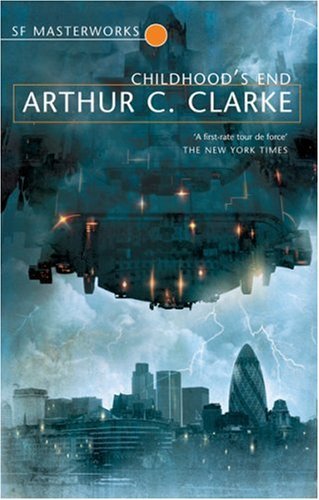
The upper image is a photoshopped (fake, fictive) image of Hurricane Sandy over New York — an image which apparently went a little viral on the web a day or two ago — while the lower one is from the cover illustration of an edition of Arthur C Clarke‘s science fiction novel, Childhood’s End, in which the aliens arrive to hover (and lord it, somewhat benignly) over us — in this case, over London.

Simply that: two images, quite different, yet curiously similar.

Form is Insight: the project

Monday, October 22nd, 2012

[ by Charles Cameron — about the (not yet titled) book (or post-book project) i seem to be writing, which offers a grand slam intro to an array of box-free contemplative and artistic approaches to creative thinking, and hence opens fresh angles on intelligence ]
.

One thing I can promise: whatever this project turns out to be, it won’t be predictable.

credit for this incredible image: Roger Dean

.

This project won’t take you over familiar territory, congratulating you on holding the same opinions as the author and adding in enough choice details to keep you interested. I’m not aiming to teach you the same thing you already know, only better, more interestingly, more precisely, or in greater detail. I’m aiming to question you, challenge you, and give you a whole new range of optics through which to view the world.

**

So, here we go.

I think I am finally at the point where the book (or whatever it is) I’ve been gathering inside me all these years is ready to be written. Some of it has already emerged in earlier posts here on Zenpundit — you don’t known and couldn’t count how many thanks, Mark — and this is certainly where I’ve been developing the style of integrated visuals and verbals that gives the project its flavor — so I’d also like to use my posts here to discuss the thing with you as I go along.

The project is about intelligence in the widest sense, including heart and mind, and with particular focus on creativity. I’m addressing this from two standpoints that mesh together well, and I’m addressing it to two audiences that I believe also mesh together well.

The standpoints are (i) meditation and (ii) the arts, and the audiences are (i) the “intelligence community” and (ii) bright people in general.

I believe that meditation cultivates a spacious mind-set in which we can hold multiple concerns in mind at the same time – the opposing needs of different people, stakeholders, sections of society, the environment, etc – thus seeing things from multiple angles and in balancing & thus balanced ways. And I think the arts serve as the primary means for expressing these balances with all their nuances and shadings, and that techniques from within the arts such as polyphony, chiaroscuro, formal constraint and pattern can teach us to shape multi-faceted insights like these into rich and complex understandings – complex patterns that respond to complex situations. I’ll go into all this in detail as we move along, with examples.

I also believe that this kind of creatively patterned insight — embodying artistic methodology in the context of complex problems with a “fresh” and open mind – will be of interest beyond the intelligence agencies and policy-makers, to business people, artists, and also — importantly — the bright general public, which I take to be a far larger subset of the population than we commonly think, and always eager for reading that doesn’t talk down to them but appreciates their own intelligence and good will.

For now let me just say that I’m very excited, because this seems (at last) to be a project that ties together my game-work with Sembl, the think-tank side of me which has been monitoring religious violence, jihad and terror and working towards nuance, understanding and peace these last dozen years — and my sense of creativity as a writer and poet.

Ripeness is all: I suspect the time for this venture has arrived.

**

Here’s the single page overview I’ve written, with a working title:

Intelligence is Zen: understanding our complex world with koans in mind

Just a few days ago, the Director of National Intelligence, James Clapper, referenced Pirsig‘s book, Zen and the Art of Motorcycle Maintenance, as key to the Intelligence Community’s work in understanding and adapting to the many, varied, intersecting problems we face in the world today. As I noted, Clapper was focused a bit more on the biker wisdom than the Zen to be found in Pirsig’s book, but he does raise a question I’ve been addressing for some years now:

What does the contemplative mind have to offer in terms of understanding a complex world?

To my mind, the creativity which is all the buzz of the business world, aimed at solving what are called “wicked problems” — problems that feature multiple stakeholders with multiple aims and objectives, aims and objectives which themselves shift over time so the problems are “never the same river twice” – requires a major mental and emotional shift. Reverie and meditation free us up to make the shift: the shift itself is poorly understood.

Our present, mostly linear way of thinking favors either/or side-taking, dubious cause-and-effect expectations which fail to take complex feedback loops into account, followed all too often by a rush to judgment. We need a whole new – old, even ancient – way of thinking.

Our problems are complex because they overlap, they ripple through one another. In Buddhist terms, they are “interdependently arising.” Not surprisingly, the way of thinking that is required to gain a deeper insight into “interdependently arising” problems can be found in explicit form in such contemplative traditions as Madhyamika & Zen, Taoism, Sufism, and their Abrahamic contemplative analogs. At the heart of these systems is fresh thinking – thought refreshed by quiet.

Furthermore, the shaping of insights in an open field of thought is something the world’s artistic traditions have long dealt with, and there are schools of insight not just available but recorded in exquisite detail in the world’s traditions of poetry, music, painting, theater, film… in patterns that are found in nature, in culture, and in the very turbulence we now must learn to flow with.

The project therefore takes a meditation-influenced approach to intelligence, both in the sense in which Clapper would use the word, relating to the intelligence analysis which develops and influences our decision-makers’ understanding of what’s needed, and in the more general sense of those capable folk with bright minds, keen insights, sharp instincts, warm hearts.

I’ll propose a series of ways of looking differently – with application for anyone, whether artist, intel analyst, businessman, policy-maker, or lover – that cut to the essence of creativity: lateral, analogical, holistic thinking, witnessing pattern beneath the surface of things. My examples will be mainly drawn from terrorism, which I have been monitoring for a dozen years: my style is that of a poet and an eccentric Englishman.

My subtext, my subliminal message, will be contemplation and artistry as profound common sense.

What eye and mind can reasonably absorb

Friday, August 24th, 2012

[ by Charles Cameron — visual thinking, graphical presentation, the magical number seven plus or minus two, human intelligence ]
.

Look:
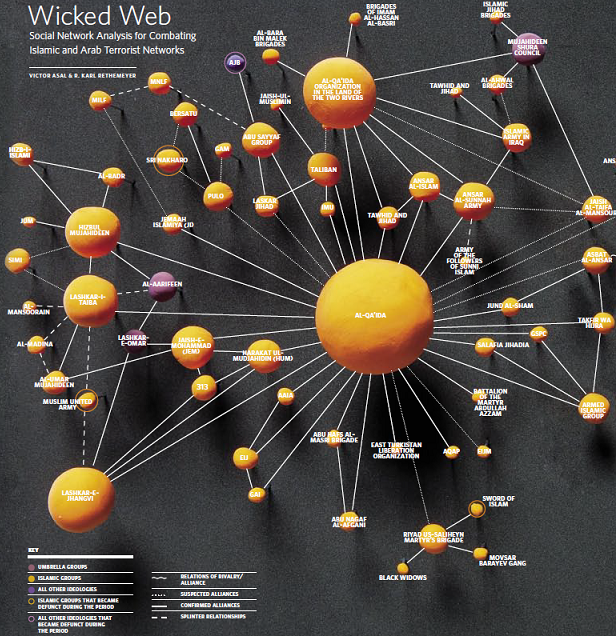
click image to download pdf & see pp 12-13 for closer, full-size look

Got it? That’s part of a double-page spread from the University of Maryland’s START Program report for 2011:

The National Consortium for the Study of Terrorism and Responses to Terrorism—better known as START – is a university-based research center committed to the scientific study of the causes and human consequences of terrorism in the United States and around the world.

Looking through the rest of the report, I’m tempted to say a snazzier, jazzier magazine I’ve seldom seen!

**

I maintain that’s far nicer to look at, but no more comprehensible than, this gorgeous and justly infamous power point slide:

click image for a closer, full size look

Got that one, too? That was a slide used to help GEN McChrystal understand that war he was fighting.

**

Watson and Crick introduced their 1953 paper in Nature, A Structure for Deoxyribose Nucleic Acid, with these words:

We wish to suggest a structure for the salt of deoxyribose nucleic acid (D.N.A.). This structure has novel features which are of considerable biological interest.

No less witty is the opening of George A. Miller‘s only somewhat less celebrated paper three years later in The Psychological Review, The Magical Number Seven, Plus or Minus Two: Some Limits on Our Capacity for Processing Information:

My problem is that I have been persecuted by an integer. For seven years this number has followed me around, has intruded in my most private data, and has assaulted me from the pages of our most public journals. This number assumes a variety of disguises, being sometimes a little larger and sometimes a little smaller than usual, but never changing so much as to be unrecognizable. The persistence with which this number plagues me is far more than a random accident. There is, to quote a famous senator, a design behind it, some pattern governing its appearances. Either there really is something unusual about the number or else I am suffering from delusions of persecution.

The gist of Miller’s piece (and by gist I explicitly mean the always misleading broad strokes version) is that we can usually manage to hold five to nine chunks of thought in mind at any given time, but that if we want to understand more than that, we need to “chunk” our thoughts in such a way that we think of “seven plus or minus two” items (Miller’s “magical number”) but can peer into any one of them and see it divided into lesser portions which we can also comprehend, in what I’ll call a tree > trunk > limb > branch > twig > leaf arrangement — always remembering that a tree may be part of a forest, and that sometimes ee just can’t see the forest for the trees…

Miller explains chunking succinctly thus:

It seems probable that even memorization can be studied in these terms. The process of memorizing may be simply the formation of chunks, or groups of items that go together, until there are few enough chunks so that we can recall all the items.

Neat, hunh? And he concludes, with another pleasant touch of wit:

And finally, what about the magical number seven? What about the seven wonders of the world, the seven seas, the seven deadly sins, the seven daughters of Atlas in the Pleiades, the seven ages of man, the seven levels of hell, the seven primary colors, the seven notes of the musical scale, and the seven days of the week? What about the seven-point rating scale, the seven categories for absolute judgment, the seven objects in the span of attention, and the seven digits in the span of immediate memory? For the present I propose to withhold judgment. Perhaps there is something deep and profound behind all these sevens, something just calling out for us to discover it. But I suspect that it is only a pernicious, Pythagorean coincidence.

**

Of course there are high-node graphics programs like Starlight Analytics (from Future Point Systems via Battelle and the Pacific Northwest National Laboratory) which allow you to sample one of a cluster of very similar nodes, or to see where the outliers are and zero in on them…
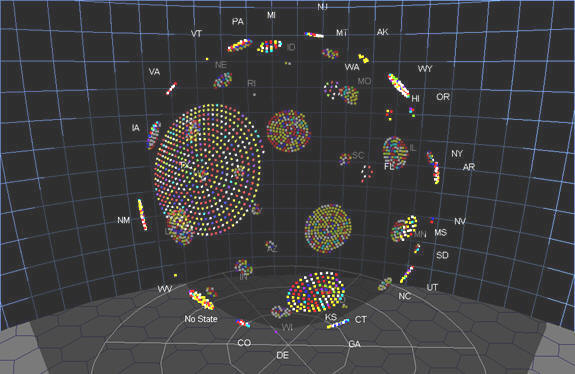
or to focus in on only those nodes connected to one particular name or place on a map:
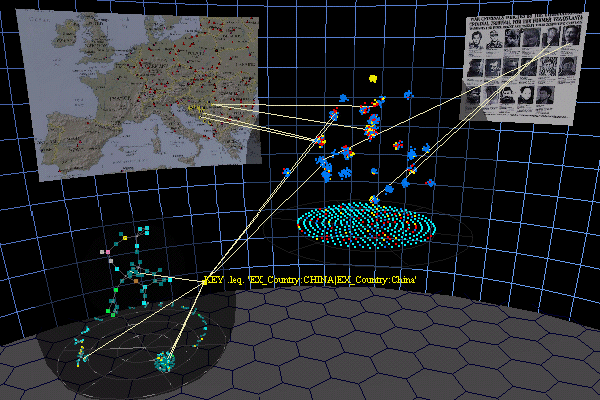
But can you find a file you’re looking for any faster by locating it somewhere in this graphic…
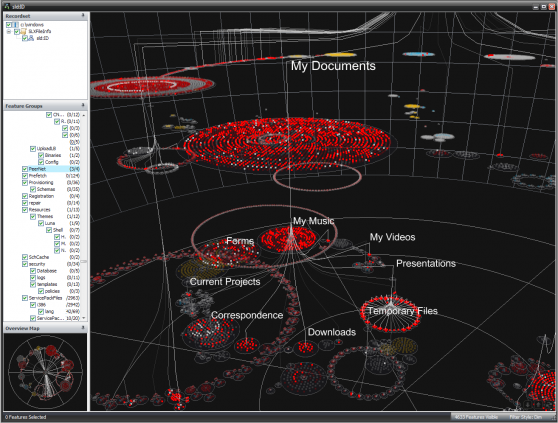
than by using your usual search methods?

So okay, high level analytics like Starlight may be useful for analysts who have the costly software and time to pinpoint and track and zoom and annotate and comprehend, become alarmed or calmed, and respond appropriately.

But people reading that glossy report from the START program? People trying to brief GEN McChrystal from a powerpoint slide?

Seven. Seven plus or minus is your number.

**

Once more, with feeling.

The moral of this tale is that graphical presentations of ideas to explain complexities should generally feature seven plus or minus two nodes, maximum, for eye and mind to consider at any one time, with perhaps an additional three or four that the eye can glide across to, forming a second chunk — thus delivering a maximum of 13 nodes without zooming in.

for the direct communication of major drivers in a complex situation — seven nodes plus or minus two is your optimal number.

**

Ah — but see, I forgot to show you the rest of that first image:

You can handle grasping the import of an image two parts, surely, can’t you?

Okay then — if you can, perhaps you can help me out…


Switch to our mobile site