zenpundit.com » counterpoint

Archive for the ‘counterpoint’ Category

Play as if your life depends on it

Sunday, June 10th, 2012

[ by Charles Cameron — from the Glass Bead Game via the HipBone Games to Sembl ]
.

.
.

Play most assiduously is how Edgar Wind translates the motto of Marsilio Ficino — the man who more or less single-handed, built the Florentine Renaissance: studiossime ludere. Play most studiously.

Play as if your life depends on it.

*

Hermann Hesse crowned his life-work with the great, boring, utterly riveting novel Das Glasperlenspiel, The Glass Bead Game, sometimes better known in the English-speaking world by the (Latin) title, Magister Ludi — which means both school-teacher and Master of the Game.

And game there is: the Glass Bead Game itself, or GBG for short.

The book centers around a game of ideas — a game in which the most profound conceptual systems of all human cultures are brought together in a grand architecture that Hesse calls “the hundred-gated cathedral of Mind”:

A Game, for example, might start from a given astronomical configuration, or from the actual theme of a Bach fugue, or from a sentence out of Leibniz or the Upanishads, and from this theme, depending on the intentions and talents of the player, it could either further explore and elaborate the initial motif or else enrich its expressiveness by allusions to kindred concepts.

Here Hesse mentions astronomical, musical and textual concepts — the game, like the digital world of the internet, allows mathematical, textual, musical and visual elements to be juxtaposed and combined, just as Sven Birkerts described in an interview with Cliff Becker:

There are tremendous opportunities, and we are probably on the brink of the birth of whole new genres of art which will work through electronic systems. These genres will likely be multi-media in ways we can’t imagine. Digitalization, the idea that the same string of digits can bring image, music, or text, is a huge revolution in and of itself. When artists begin to grasp the creative possibilities of works that are neither literary, visual, or musical, but exist using all three forms in a synthetic collage fashion, an enormous artistic boom will occur.

Birkerts was concerned that these “tremendous opportunities” might drown out “the old quiet pastime of reading mere words” — but Hesse’s great game is a contemplative one, in which Hesse proposes:

Every transition from major to minor in a sonata, every transformation of a myth or a religious cult, every classical or artistic formulation was, I realized in that flashing moment, if seen with a truly meditative mind, nothing but a direct route into the interior of the cosmic mystery, where in the alternation between inhaling and exhaling, between heaven and earth, between Yin and Yang, holiness is forever being created.

*

Play…

We play, we play games, we play music… we play wargames… all the world’s a stage, and we are (merely) players.

Consider: Play is what children do to learn, so brilliantly, language, languages, geography, mathematics, history, chess, go, music, politeness, discipline, excess, consequences, moderation… And play is what masters do to express their mastery — Picasso plays, Casals plays, Einstein plays… And the motto of Ficino, mentor to the Florentine Renaissance, is play most assiduously.

*

The Glass Bead Game is a game, then, to compare with the greatest of games — Chess, Go, name your poison — indeed, with the greatest of intellectual endeavors — the Encyclopédie, the gesamtkunstwerk, the long-sought Theory of Everything…

All the insights, noble thoughts, and works of art that the human race has produced in its creative eras, all that subsequent periods of scholarly study have reduced to concepts and converted into intellectual values the Glass Bead Game player plays like the organist on an organ. And this organ has attained an almost unimaginable perfection; its manuals and pedals range over the entire intellectual cosmos; its stops are almost beyond number. Theoretically this instrument is capable of reproducing in the Game the entire intellectual content of the universe.

How can taking that idea and making it playable not be a worthy challenge, in this world that is daily more absorbed in digital play in its arcades and cinemas, on its consoles, tablets, phones, and computers?

*

Just reading the book made me want to play the game, but I like to keep things simple. I needed to be able to play it with a pencil and paper napkin over a cup of coffee — or on an email list or in the online forums that were beginning to spring up while I was figuring out some early boards and rules. I took Hesse’s basic concept of juxtaposing ideas and applied it on simple graph-like boards, on which each circle represents an idea, and each line a resemblance. I called my playable variants the HipBone Games.

More recently, my friend and colleague Cath Styles has been working on the development of iPad and web-playable versions of the games. We call them Sembl, because they explore the resemblances between things, ideas — and at a deeper level, the patterning of the world itself.

But the game remains the same: to juxtapose one thing — an idea, an object, a work of art, song, person or event — with another, in a way that generates the aha! of creativity. And to do that repeatedly, weaving an architecture of related ideas, on our way to weaving Hesse’s cathedral of Mind.

Our world has never been in greater need of creativity and connectivity — our future depends on them — and in the Sembl game, every move you make is a further link in the pattern that connects, every move you make is a creative leap. More on that in my follow up post, The crackling energy of a Sembl move.
Osama and the flute of the devil

Wednesday, May 9th, 2012

[ by Charles Cameron — curiosity and classical music leads me on a merry chase from Bach and bin Laden via LastFM and Chorus Angelus to the heraldry of the Afridi, a Forsane Alizza video and the death of Superman ]
.

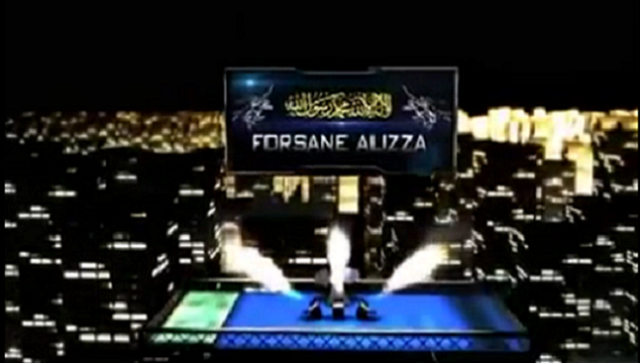
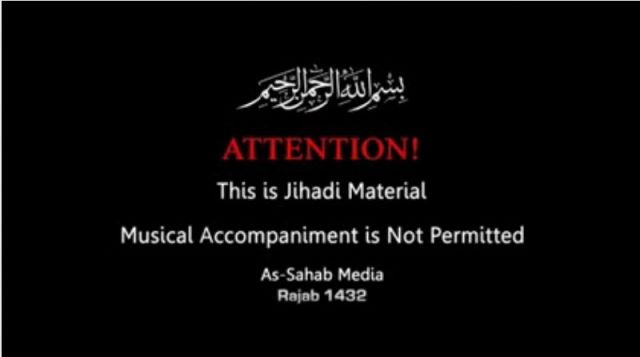
I’m grateful to JM Berger (@intelwire) and Chris Anzalone (@ibnsiqilli) for their encouragement and help with this post. JM provided the screengrab above, which shows a title card from a recent al-Zawahiri video — I suspect it may have been the one he mentioned here [text now mildly updated]:

Back in the day, when Adam Gadahn was just getting started as guru to Al Qaeda’s media operations, he released a couple of fairly slick videos designed to appeal to Western audiences by mimicking Western documentaries — up to and including the presence of a musical soundtrack.

It is therefore interesting to note that the latest release from As-Sahab (which Gadahn basically runs at this point) opens with a short disclaimer. “ATTENTION: We do not permit musical accompaniment with our productions.” One second later, a nasheed (religious song) fired up, but I guess that doesn’t count.

I’m guessing this is due to input from one of Gadahn’s Al Qaeda overseers. It’s interesting that these guys can rationalize away visits to strip clubs but they can’t handle a light orchestral score.

Chris tells me that Tehrik-i Taliban Pakistan has included similar notes in some of its videos. Indeed as JM put it in a tweet yesterday, “The odd thing is most of these guys would not be cool with music” — while as Chris noted, “Opposition to music with instruments, it should be said, isn’t unique to jihadis.”

So that’s the context: here’s the thing that interests me.

*

I can appreciate using the Old Master’s portrait of Christ that’s on the album cover to accompany a YouTube video of Bach’s B Minor Mass performed by Philippe Herreweghe (left), I can understand using a series of “nature scenes” for the Diego Fasolis performance (middle), I can even bite my lip and remain silent when someone lays a cute graphic of a wide-eyed young thing with a white rabbit (right) on top of Ton Koopman‘s version —

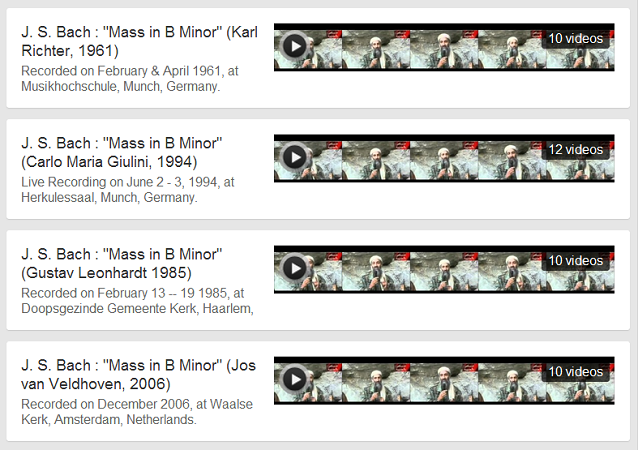
But my eyes simply bug out when I find someone has posted not one but four versions of Bach’s great Mass on YouTube, on not four but 42 separate videos, with bin Laden talking — silently, his lips moving — on each one.

Amazingly enough, that’s what someone calling themselves SOMALIAAFGHANISTAN has done.

*

Look, people, this is strange.

Lawrence Wright quotes Osama bin Laden [link, at p 167] as saying “Music is the flute of the devil”.

I was doing some research for this post on Google, and ran across this:

Fair enough, I thought, and went to Last.FM, where I found this artist featured:

Bullet for my bloody valentine.

I kid you not.

*

See, this all started because I was looking to play myself some Bach organ music and ran across a video of Marie-Claire Alain performing Bach’s BWV 767, which is pretty terrific — Alain is a great organist, it’s a remarkable work, etc etc — and found myself staring at this:

I mean, that’s not from the Bach part of my life, that’s from the part of my life that tracks jihadist utterances and theology…

*

As my friend Chris Anzalone, whose posts on jihadist graphics I always read with interest, pointed out to me, this particular video has an extensive explanation of its heraldic significance attached:

Coat of Arms Of The Famous Afridi Pashtun Afghan Pathan Tribe

Flag of the Afghan Tribe – The Afridi.

Made from historical Texts & references.

Main Circle/Islam Symbolism:

White circle: Unified, unbroken & Islam 4 stars: 4 sons of Qis/Kesh/Qais Abdur Rashid Crown: Representation of Qis/Kesh/Qais Abdur Rashid & his Bani Israel lineage which is from the Ancient Royal House of Israel Lion with Flag: The Lion of Judah/The Bravery of the Afghans & the emblem of many Afghan Kingdoms Olive Tree: Descent from the House of Israel/Bani Israel Black Background: The world in troment, pain & ignorance, showing the messianic dedication of Afghans that spread Islam through kings and Sufis throughout India.

Tribal Symbolism on Coat of Arms:

Babe Khyber/Fort: Defending the borders of Afghanistan for centuries and masters of siege warfare. They successfully held the mountain passess of Afghanistan against the counter attack of many Indian Armies. Bolt Rifle: One of the first among Afghans to master the art of local Rifle and small arms making. They were famous for their sniper marksmen skills with the 3 not 3 or .303. Camel Caravan: Afridis are skilled businessmen. AK 47: Every Afridi child is given one before passing into adulthood.
Red Background: The Traditional color of the Afridis.

Reference Material:

* The Pathans 55O B.C.-A.D. 1957 By Sir Olaf Caroe
* History of the Afghans by Bernhard Dorn
* History of the Afghans Original by Neamet Ullah (active 1613-30) in the court of the Mughal emperor Jahangir (1569-1627)
* Tareekh i Farishta
* History of the Afghans edition X by Fut’h Khan in 1718
* The Works of the Pashto Academy Peshawar University and The Pashto Dept. Islamia College Peshawar through countless publications, both online and offline, and may writers including Dr. Yusafzai, much of which you can find at Khyber.org
* History of Kohat -Gazetteer of the Kohat District
* History of Peshawar -Gazetteer of the Peshawar District
* Afghan Poetry: Selections from the poems of Khush Hal Khan Khattak., Biddulph, C.D., Saeed Book Bank, Peshawar, 1983 (reprint of 1890 ed.)
* A Grammer Of The Pukhto, Pushto: Or Language Of The Afghans, Raverty, H.G., London, 1860
* Poems from the Diwan of Khushâl Khân Khattak, MacKenzie, D.N, London, Allen & Unwin, 1965
* Notes on the Tarikh-e-Murassa, Plowden, Maj.
* Settlement Report of Bannu, Thorburn

This text, in turn, comes from a Wikipedi page on the Afridi Tribal Flag posted by a user named Afghan Historian. Who has an enviable library.

Sadly enough, Wikipedia notes “The factual accuracy of this description is disputed” — although it’s not clear by whom.

*

There are interesting references in the scholarly footnotes to the Afridi flag to “Qais Abdur Rashid & his Bani Israel lineage which is from the Ancient Royal House of Israel” and to “the messianic dedication of Afghans that spread Islam through kings and Sufis throughout India”…

The idea that the Afghans are descendants of the “lost tribes” of Israel is explored in the Jewish Virtual Library here. As to the Afghans’ “messianic dedication” — I’m not clear exactly what the word messianic means in this context, but it’s an interesting word choice in any case.

*

When I first looked up this image on TinEye, my image-search engine of choice, the only version it reported was from the site of Forsane Alizza, a now-disbanded group in France whose leader claims to preach only non-violence:

Je vous préviens dès maintenant que je n’ai ni armes, ni explosifs, ni drogues, ni même quoi que ce soit d’illégal. Si cela venait à arriver, soyez intelligent réfléchissez et souvenez vous que depuis sa création et jusqu’à la fin, Forsane Alizza use et n’usera, que de sa liberté d’expression et son droit à manifester contre des lois injustes et illégal au vu des droits de l’homme. D’ailleurs toutes nos actions sont non violentes et elles le resteront.

while the security police claim to have found weapons in his house.

The Forsane Alizza video, from which the snazzy image directly above was taken, shows members practicing martial arts and painball games…

*

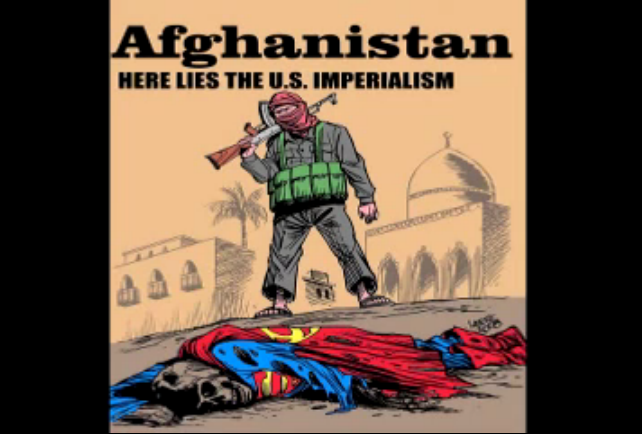
And how’s this for an illustration of Bach’s BWV 566, the C Major Toccata and Fugue — and the death of American pop culture?

To sum up: what’s all this about? Why pair Bach with bin Laden, the Afridi, the demise of superman and all the rest?

*

I don’t want to leave you with a bad taste in your mouth.

If you want to see what it’s like to hear Gustav Leonhardt conducting the Kyrie from the B Minor Mass juxtaposed with images of bin Laden, you’ll find that here. You may, of course, prefer the Herreweghe version, with another variant of his album cover with the face of Christ as the accompanying visual…

And for Marie-Claire Alain performing Bach, sans the Afridi, may I recommend this hour long recital, which I just happened upon myself thanks to this post?

Messianic symmetries

Sunday, April 29th, 2012

[ by Charles Cameron — Shin Bet’s Yuval Diskin calles Netanyahu messianic, Netanyahu called Ahmadinejad messianic, and other millenarian parallels and face-offs ]
.

One man’s Christ is another man’s Antichrist:

We’ll get to Diskin and Netanyahu, but first some background.

It is not uncommon to see the face-off between the West and Global Jihad — however you might prefer to name the opposing sides — as both asymmetrical (our kevlar vs their shalwar kameez, so to speak) and symmetrical (our crusaders vs their mujahideen, so to speak).

There are several aspects of these symmetries and asymmetries that interest me:

1.

The first is that the asymmetries are typically quantitative: one side has more firepower than the other, more troops and more sophisticated weaponry, and indeed, the conflict or flurry of conflicts in question does seem to fall under the rubric of asymmetric warfare, and those who write about asymmetries with the deepest understanding are typically those whose “loop” is to observe, orient, decide and act… while by way of contrast, the symmetries are most frequently observed by those whose “loop” is to observe, comprehend, describe and influence, and the symmetries they observe are typically qualitative, operating at the level of ideas.

I’ll get to a couple of examples shortly.

2.

The second is that within the asymmetries, it is not uncommon to find a reversal of polarities by which the lesser outsmarts and defeats the greater force. I’m thinking here of David and Goliath as the archetypal version, and of Nigel Howard, in Confrontation Analysis: how to win operations other than war, writing:

the problem of defense in the modern world is the paradoxical one of finding ways for the strong to defeat the weak.

A different aspect of asymmetry emerges when one can think of Israel as both the powerful high-tech occupier of a poorly-equipped and stateless mass of Palestinians, and a tiny emergent Jewish democracy surrounded on all sides (except the sea) by Arab and or Muslim once and future foes… a Goliath seen one way, a David the other…

What’s intriguing here is that in some ways everybody wants to be David, right?

3.

The third point of interest is the frequency with which the symmetries appear to contain explicit millenarian, messianic or apocalyptic elements.

Here are two examples. The first is from Gilles Kepel, who has been studying Muslim political movements for decades – he wrote The Prophet and the Pharaoh: Islamist movements in Sadat’s Egypt in 1984. In his 2010 Beyond Terror and Martyrdom: The Future of the Middle East, p. 10, he writes:B

ush, Cheney, and the neoconservatives on one hand, Bin Laden, Zawahiri, and Al Qaeda on the other — both sides staked their claim to power on a vision of global rectification through violent means. But the utopian ends that supposedly justified those means — universal democracy or a universal Islamist state — proved impossible to achieve, and in a few short years the opposing dreams of Bush and Bin Laden had devolved into an endless shared nightmare.

And then there’s Arundhati Roy, whose Guardian piece, The algebra of infinite justice, written less than a month after 9/11, asked:

What is Osama bin Laden? He’s America’s family secret. He is the American president’s dark doppelganger. The savage twin of all that purports to be beautiful and civilised. He has been sculpted from the spare rib of a world laid to waste by America’s foreign policy: its gunboat diplomacy, its nuclear arsenal, its vulgarly stated policy of “full-spectrum dominance”, its chilling disregard for non-American lives… Now that the family secret has been spilled, the twins are blurring into one another and gradually becoming interchangeable. … Now Bush and Bin Laden have even begun to borrow each other’s rhetoric. Each refers to the other as “the head of the snake”. Both invoke God and use the loose millenarian currency of good and evil as their terms of reference.

Note here that Kepel’s “vision of global rectification through violent means” and Roy’s “loose millenarian currency of good and evil” both have resonance that falls clearly within Richard Landes’ corpus of “varieties of millennial experience“.

4.

Even more explicitly messianic is the parallelism / opposition observed by Jean-Pierre Filiu, Kepel’s Sciences Po colleague, in his Apocalypse in Islam, where he notes that:

the emergence of al-Qaida has been accompanied by a millenarian rereading of jihadist terrorism that considers the Taliban sanctuary in Afghanistan to be only a first step toward the establishment of a universal caliphate… the Hour is near. The signs are there for all to see.

and writes with reference to Ahmadinejad and his Mahdist cohorts in the next paragraph:

These tragic visionaries share with the most farsighted of American neoconservatives the conviction that an implacable conflict is foretold in prophecy.

concluding (with regard to both, I would imagine):

It is therefor less a clash of civilizations that is now beginning to take shape than a confrontation of millenarianisms.

5.

Tim Furnish has a milder variant on the classic “One man’s Christ is another man’s Antichrist” theme as the opening sentence of his study of Mahdisms, Holiest Wars — he writes:

One man’s messiah is another man’s heretic…

which in turn reminds me of Jorge Luis Borges and his short classic, The Theologians, in which he describes the vicissitudes of two men deeply concerned with the nature of God — the heretic John of Panonia and the heresy-hunter Aurelian, his nemesis: Borges concludes his tale of these two intertwined lives with an extraordinary symmetry:

The end of this story can only be related in metaphors since it takes place in the kingdom of heaven, where there is no time. Perhaps it would be correct to say that Aurelian spoke with God and that He was so little interested in religious differences that He took him for John of Pannonia. This, however, would imply a confusion in the divine mind. It is more correct to say that in Paradise, Aurelian learned that, for the unfathomable divinity, he and John of Pannonia (the orthodox believer and the heretic, the abhorrer and the abhorred, the accuser and the accused) formed one single person.

But let there be no mistake about it, theologies differ. Safar Al-Hawali may use some of Hal Lindsey‘s exegetical devices to elucidate the end times from an Islamic perspective and proclaim “the Messiah = Christ Jesus Son of Mary, Allah’s servant and messenger” — but Islam’s Mahdi is pretty clearly Joel Richardson‘s Antichrist.

6.

What I hope to have accomplished thus far is to show two things: that keeping an eye out for symmetries and antitheses is a powerful tool for exploring conflict, especially at the qualitative and ideological level, and that messianic juxtapositions in particular have great force, and crop up with significant frequency in the literature of the “sacred vs secular war” also known to some as “jihad vs crusade”.

7.

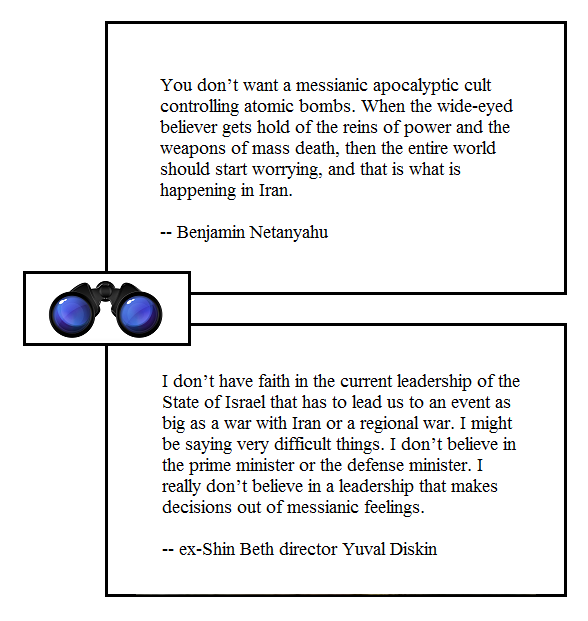
But hey, we came here to talk about Netanyahu and his spy, right? I find the juxtaposition of these two quotes — one from the current Israeli Prime Minister shortly before he was elected, the other just a few days ago by the man who was recently his spy-chief — striking, particularly in the contex provided above:

I try to read carefully. When I first saw the Yuval Diskin quote it was contextualized as suggesting that Benjamin Netanyahu and Ehud Barak were the leaders making “decisions out of messianic feelings” – but then for a moment it occurred to me that Diskin might have been saying “I don’t believe the prime minister’s accusation that the leadership of Iran makes decisions based on messianic feelings is correct – I see them as rational, persuadable actors.”

But no: Yuval Diskin is quite clear that it is Netanyahu and Barak he is talking about in this extended quote from Ha’Aretz:

My major problem is that I have no faith in the current leadership, which must lead us in an event on the scale of war with Iran or a regional war. I don’t believe in either the prime minister or the defense minister. I don’t believe in a leadership that makes decisions based on messianic feelings. They are two messianics – the one from Akirov or the Assuta project and the other from Gaza Street or Caesarea. Believe me, I have observed them from up close… They are not people who I, on a personal level, trust to lead Israel to an event on that scale and carry it off. These are not people who I would want to have holding the wheel in such an event.

Perhaps because I am more than usually sensitive to apocalyptic and messianic fervor, I find the implications of both Netanyahu’s and Diskin’s observations – if accurate as to the respective temperaments of the leaders concerned — quite chilling.

8.

As so often, I’m hoping to raise questions here — to prompt deliberative thinking, not to argue or persuade.

Of the real and the imaginal

Monday, April 9th, 2012

[ by Charles Cameron — from sight to vision? ]
.

*

Which of these two images — the photo above, the MC Escher print below — calls you closer? Which takes you deeper?

*

And which draws you closer here — the MC Escher print above, or the Tenniel illustration for Alice, below? Which carries you deeper?

Where does the realistic end, and the imaginal begin?

*

Marina Warner writes in the introduction to her recently reviewed book, Stranger Magic:

The faculties of imagination — dream, projection, fantasy — are bound up with the faculties of reasoning and essential to making the leap beyond the known into the unknown. At one pole (myth), magic is associated with poetic truth, at another (the history of science) with inquiry and speculation. It was bound up with understanding physical forces in nature and led to technical ingenuity and discoveries. Magical thinking structures the processes of imagination, and imagining something can and sometimes must precede the fact or the act; it has shaped many features of Western civilization. But its influence has been constantly disavowed since the Enlightenment and its action and effects consequently misunderstood.

*

For the brilliant juxtaposition of images in the upper pair, I am grateful to http://www.giovis.com/atrani.htm, with an h/t to http://www.log24.com.

Simultaneity I: the palimpsest

Sunday, April 8th, 2012

[ by Charles Cameron — simultaneity in art, life, theology, war and thought ]
.

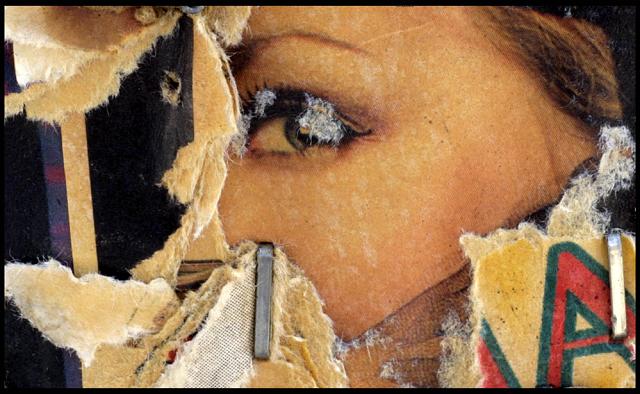
We rip up the past to make room for the present, we staple the present onto the past, we lose much of the meaning our words and images once had in fragments, snatches and colors…


image credit: MR McDonald

Even the staples eventually rust.

*

Still the past can at times be seen in the present, as earlier writing can still be seen in a palimpsest.

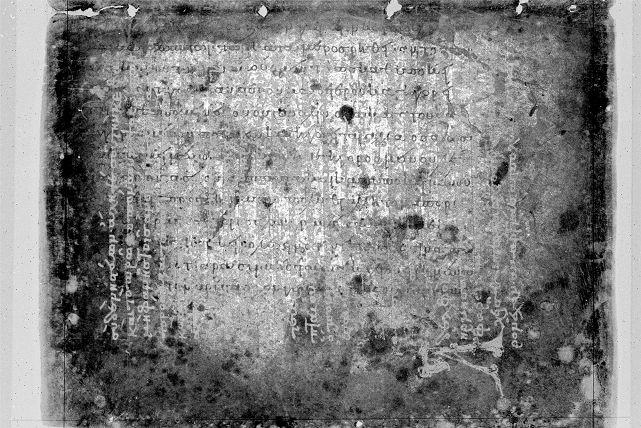
The Archimedes Palimpsest is [and I paraphrase] a Byzantine euchologion or prayer book manuscript, thought to have been completed by April 1229, and probably made in Jerusalem. Much of the parchment the scribes used in making the prayer book came from a earlier book of works by Archimedes, including his “On Floating Bodies” – a treatise of which no other copy survives. It seems the Archimedes manuscript dates back to tenth century Constantinople.


image credit: Archimedes Palimpsest Project

Erase Constantinople from your parchment, cut it and rotate it 90°, and you can build Jerusalem in its place. Peer deeply into prayer using multispectral imaging several hundred years later — and you may find combinatorial mathematics dating back more than two millennia…

What you are seeing in this image above is the workings of a mind two centuries BCE, transcribed in the tenth century CE, and made visible beneath and through other writing from the thirteenth, by twenty-first century tech.

So it is that Archimedes speaks to us today.

*

A palimpsest, then, is a layering of time on time, and the world we walk and talk in is itself a palimpsest.


image credit: MR McDonald

The enduring, you might say, can be seen through the transient — the zebra crossing through the snow.

*

To see two times at once — to see history, accurately or otherwise, as a metaphor for today — is to see simultaneously.

As in Sergey Larenkov‘s celebrated photos, in which World War II and the present day coexist:


image credit: Larenkov, Wrecked tank “Tiger” in Tiergarten park

[ edited to add: Larenkov takes black and white photos from WW II, shoots the same scene in color from the same position today, and masterfully stitches them together digitally to create an image that allows the ghost of the past to seen in the present — brilliant! ]

Here again, as in the magically surreal sculptures of Nancy Fouts, we see the power of mapping one thing onto a kindred other of which Koestler wrote.

*

To tie all this back into the question of Which world is more vivid? This, or the next?Stanley Hauerwas in his book, War and the American Difference: Theological Reflections on Violence and National Identity, suggests:

There is another world that is more real than a world determined by war: the world that has been redeemed by Christ.

He then clarifies his intent in saying:

The statement that there is a world without war in a war-determined world is an eschatological remark. Christians live in two ages in which, as Oliver O’Donovan puts it, “the passing age of the principalities and powers has overlapped with the coming age of God’s kingdom.” O’Donovan calls this the “doctrine of the Two” because it expresses the Christian conviction that Christ has triumphed over the rulers of this age by making the rule of God triumphantly present in the mission of the church. Accordingly the church is not at liberty to withdraw from the world but must undertake its mission in the confident hope of success.

*

Indeed, both Christianity and Zen would say that the greatest palimpsest is the palimpsest in which the transient circumstances of one’s life can all but obliterate the imperishable truth that underlies them — a palimpsest whose deepest layers may be read not with x-rays but by insight.

Christ lived in two times, or more accurately, time and eternity — to him the palimpsest was transparent, and thus he spoke (in John 8:58) what I suspect are the most profound five words in the Gospels:

Before Abraham was, I am.

Happy Easter!


Switch to our mobile site