zenpundit.com » mathematics

Archive for the ‘mathematics’ Category

Having eyes to see…

Saturday, March 31st, 2012

[ by Charles Cameron — looking through the eyes of tech, math, art, flies, and intelligence ]
.

Imaging the winds and the waters

I’ve been raising questions about the varieties of ways of seeing here — asking whether guardian angels can be more than guys on night watch and if so what that “more” means, invoking William Blake’s fourfold vision [see move 4], and so forth. And I tend to emphasize the visionary over against the material.

I thought I’d do something different this time, and show you two views of the world that science brings us, that we couldn’t have seen half a century ago unless you were Theodore von Kármán (below, upper image)…

let alone a century ago, unless you were Vincent van Gogh (lower image).

*

In descending order, these four images are:

  • the winds over a portion of the Americas, as depicted by Fernanda Viégas and Martin Wattenberg a few days ago, see also their current live feed
  • a NASA image drawn from the Goddard Scientific Visualization Studio‘s Perpetual Ocean animation, hi-res Gulf Stream image
  • a diagram of a Kármán vortex street, from Arthur E. Bryson, Jr., Demetri P. Telionis, “Kármán vortex street,” in AccessScience, ©McGraw-Hill Companies, 2008
  • and Vincent van Gogh, Starry Night, in the Museum of Modern Art, New York.

The gentleman in the meditation goggles — he calls them “eye-bags” — featured in the “mini-SPECS” section of the Winds and Waters SPECS is my friend David Woolley, who alerted me to these simulations on his Just think of it blog today. David, btw, is the fellow who designed and wrote PLATO Notes, the first permanent, general-purpose online conferencing system, back in 1973.

The eyes features in the “mini-SPECS” of the Kármán / van Gogh SPECS are a fly’s “compound” eyes — “compound meaning that each eye has hundreds of facets (ommatidia or simple eyes).

*

And that’s the point, isn’t it?

We as the human community have many eyes, many perspectives — the visionary, the technological, the abstract, the photographic, the artistic, the consensus, the minority opinion — such as that of Mr Justice Douglas in Sierra Club vs Morton, perhaps? …

Our intelligence — our intel too — should build on a rich and wide array of ways of seeing. After all…

… unless the above is just a recruitment slogan.

Iconic: compare and contrast

Thursday, December 22nd, 2011

[ by Charles Cameron — iconic images, riot police, compare and contrast, repetition with variation ]
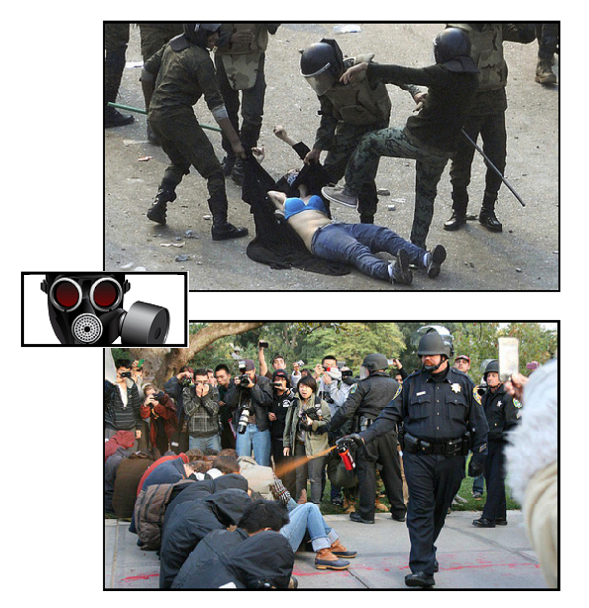
First, let’s be clear that both these images have been widely considered iconic.

Thus NPR reported of the first photo:

There have been countless accounts of violence recorded during the uprisings in Egypt but the image that perhaps has captured the most attention is the most recent. The image has been widely referred to as the “girl in the blue bra.”

While Real Clear Politics quotes Michael Moore on the second:

“The images have resonated around the world in the same way that the lone man standing in front of the tanks at Tiananmen Square resonated. It is an iconic movement in Occupy Wall Street history,” Michael Moore declared on MSNBC’s “Last Word” program.

Moore was referring to police pepper spraying students at an “Occupy” protest at UC Davis.

So we have two similarities between the two images: they both show police in riot gear taking action against demonstrators, and they have both caught the public eye as somehow being representations that can “stand in” for the events they seek to portray.

Beyond that, it’s all compare and contrast territory — or variations on a theme, perhaps — and different people will find different reasons to attack or defend the demonstrators or the police in one, the other, or both cases.

1.

These are, for many of us, “home” and “away” incidents, to borrow from sports terminology, and some of our reactions may reflect our opinions in general of what’s going on in Egypt, or in the United States.

We may or may not know the rules of engagement in effect in either case, on either side.

In a way, then, what the photos tell us about those two events, in Tahrir Square and on the UC Davis campus, may tell us much about ourselves and our inclinations, too.

2.

As I’ve indicated before, I am very interested in the process of comparison and contrast that the juxtaposition of two images — or two quotes — seems to generate. And I’ve quoted my friend Cath Styles, too:

A general principle can be distilled from this. Perhaps: In the very moment we identify a similarity between two objects, we recognise their difference. In other words, the process of drawing two things together creates an equal opposite force that draws attention to their natural distance. So the act of seeking resemblance – consistency, or patterns – simultaneously renders visible the inconsistencies, the structures and textures of our social world. And the greater the conceptual distance between the two likened objects, the more interesting the likening – and the greater the understanding to be found.

I’d like to examine these two particular photographs, then, not as images of behaviors we approve or disapprove of, but as examples of juxtaposition, of similarity and difference — and see what we might learn from reading them in a “neutral” light.

3.

What I am really trying to see is whether we can use analogy — a very powerful mental tool — with something of the same rigor we customarily apply to questions of causality and proof, and thus turn it into a method of insight that draws on our aha! pattern recognition and analogy-finding intuitions, rather than the application of inductive and deductive reason.

And that requires that we should know more about how the mind perceives likenesses — a topic that is often obscured by our strong emotional responses — you’re making a false moral equivalence there! or look, one’s as bad as the oither, and it’s sheer hypocrisy to suggest otherwise!

So among other things, we’re up against the phenomenon I call “sibling pea rivalry” — where two things, places, institutions, whatever, that are about as similar as two peas in a pod, have intense antagonism between them, real or playful — Oxford and Cambridge, say, and I’m thinking here of the Boat Race, or West Point and Annapolis in the US, and the Army-Navy game.

Oxford is far more “like” Cambridge than it is “like” a mechanic’s wrench, more like Cambridge than it is a Volkswagen or even a high school, more like it even than Harvard, Yale, Princeton or Stanford — more like it than any of the so-called “redbrick universities” in the UK — so like it, in fact, that the term “Oxbridge” has been coined to refer to the two of them together, in contrast to any other schools or colleges.

And yet on the day of the Boat Race, feelings run high — and the two places couldn’t seem more different. Or let me put that another way — an individual might be ill-advised to walk into a pub overflowing with partisans of the “dark blue” of Oxford wearing the “light blue” of Cambridge, or vice versa.  Not quite at the level of the Zetas and the Gulf Cartel, perhaps, but getting there…

4.

So one of the things I’ve thought a bunch about is the kind of analogy that says a : A :: b : B.

As in: Egyptian cop is to Egyptian protester as UC Davis cop is to UC Davis protester.

Which you may think is absolutely right — or cause for impeachment — or just plain old kufr!

And I’ve figured out that the reason people often have different “takes” on that kind of analogy — takes so different that they can get extremely steamed about it, and whistle like kettles and bubble over like pots — has to do with the perceptual phenomenon of parallax, whereby some distances get foreshortened in a way that others don’t.

5.

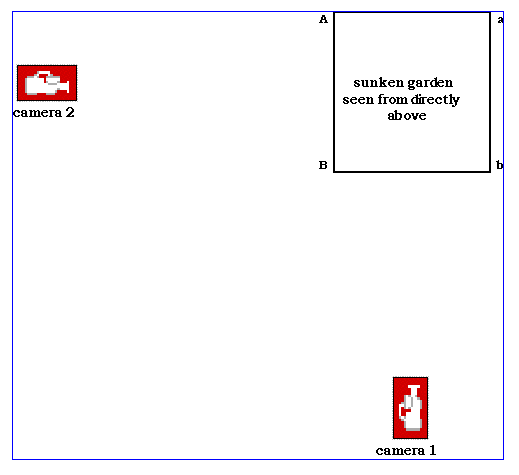
So my thought experiment sets up a sunken garden — always a pleasure, with two video cameras observing it, as in this diagram:
And from the two cameras, the respective views look like this:
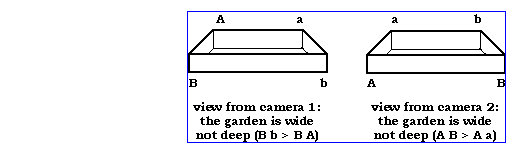
In this scheme of things, Aa (Oxford) seems very close to Bb (Cambridge) seen from the viewpoint of camera 1 — but from camera 2’s standpoint, Aa (Oxford) and Bb (Cambridge) are at opposite ends of the garden, and simply couldn’t be father apart.

6.

Now, my thinking here is either so obvious and simple as to be a platitude verging on tautology — or one of those subtle places where the closer examination of what looks tautological and obvious leads to the emergence of a new insight, a new “difference that makes a difference” in Bateson’s classic phrase.

And clearly, I hope that the latter will prove to be the case here.

7.

What can we learn from juxtapositions? What can we learn from our agreements about specific juxtapositions — and what can we learn from our specific disagreements?

Because it’s my sense that samenesses and differences both jump out at us, as Cath Styles suggested — and that both have a part to play in understanding a given juxtaposition or proposed likeness.

Each juxtaposition will, in my view, suggest both a “sameness” and a “difference” — in much the same way that an arithmetic division of integers, a = qd + r, gives both quotient and dividend.

And then we have two or more observers of the juxtaposition, who may bring their own parallax to the situation, and have their own differences.

8.

Tahrir is to Tienanmen as Qutb is to Mao?

Or is pepper spray just a food additive?

And how do icons become iconic anyway? Are they always juxtapositions, cops against college kids, girl vs napalm, man against line of tanks?  Even in the iconic photo of Kennedy from the Zapruder film, the sudden eruption of violence into the stateliness of a presidential parade is there — a morality play in miniature.

Any thoughts?

Idle thoughts: on wars, justice and banking

Sunday, September 18th, 2011

[ by Charles Cameron — reality, appearance and virtuality ]

.

quo-functions.gif

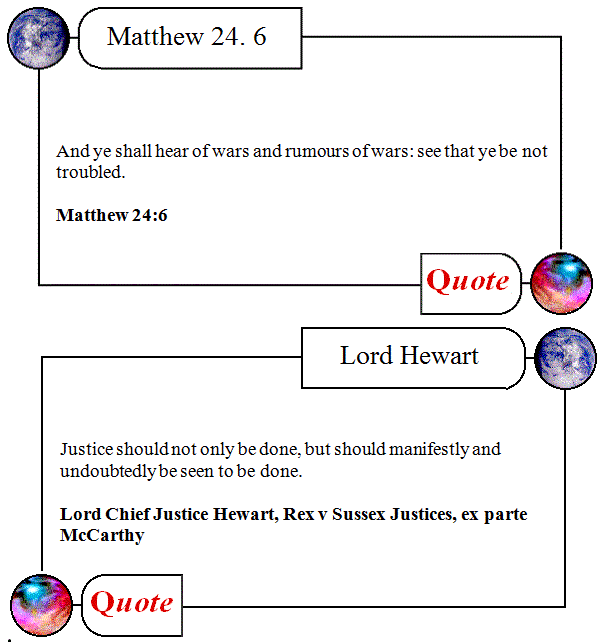
These two phrases, wars and rumors of wars and done and seen to be done have apparently been rattling around in my head for long enough that they finally dodged all the other stuff about Mahdis and Glass Bead Games and met.

Okay, I’d already thought of the first one in terms of “Cameron’s Function”:

f(x) = x + rumors of x           (i)

because it seemed to “apply” to other things than war — the instance that gave me that insight was the run-up to the Year 2000, during which it became abundantly clear that rumors of bank runs were precisely what bank runs themselves were about — which in turn became my classic instance of the need for mapping that “crossed over” between the subjective and objective realms — or morale and materiel, as I called them in a recent post.

And so here comes “Cameron’s Function #2”:

f(x) = x + seen to be x         (ii)

What I’m wondering now is whether the two of them are essentially the same “function” — any thoughts? They’re twins — but are they identical?

Historical footnotes to game theory

Sunday, August 21st, 2011

[ by Charles Cameron — philosophy, psychology, history, game theory, dilemma, commons cooperation, analogy, 9/11 ]

.

I have an interest in game theory that is much like my interest in music: I can’t play, but I can whistle. And so it is that I’ve substituted curiosity about the history of the thing, and whatever analogical patterns I can discern there, for any actual ability at the thing itself.

Somewhere in my analogy-collector’s mind, then, I have these two quotes, cut from the living tissue of their writer’s thoughts, and prepped fpor contemplation. I find them, in retrospect, quite remarkable.

Jean-Jacques Rousseau, in On the Inequality among Mankind, wrote:

Such was the manner in which men might have insensibly acquired some gross idea of their mutual engagements and the advantage of fulfilling them, but this only as far as their present and sensible interest required; for as to foresight they were utter strangers to it, and far from troubling their heads about a distant futurity, they scarce thought of the day following. Was a deer to be taken? Every one saw that to succeed he must faithfully stand to his post; but suppose a hare to have slipped by within reach of any one of them, it is not to be doubted but he pursued it without scruple, and when he had seized his prey never reproached himself with having made his companions miss theirs.

And David Hume, in A Treatise of Human Nature:

Your corn is ripe today; mine will be so tomorrow. ‘Tis profitable for us both that I shou’d labour with you today, and that you shou’d aid me tomorrow. I have no kindness for you, and know that you have as little for me. I will not, therefore, take any pains on your account; and should I labour with you on my account, I know I shou’d be disappointed, and that I shou’d in vain depend upon your gratitude. Here then I leave you to labour alone: You treat me in the same manner. The seasons change; and both of us lose our harvests for want of mutual confidence and security.

*

Those two, I believe, are fairly well known – I was delighted the other day to run across a third sample for my collection. William James, in The Will to Believe, writes:

Wherever a desired result is achieved by the co-operation of many independent persons, its existence as a fact is a pure consequence of the precursive faith in one another of those immediately concerned. A government, an army, a commercial system, a ship, a college, an athletic team, all exist on this condition, without which not only is nothing achieved, but nothing is even attempted. A whole train of passengers (individually brave enough) will be looted by a few highwaymen, simply because the latter can count on one another, while each passenger fears that if he makes a movement of resistance, he will be shot before any one else backs him up. If we believed that the whole car-full would rise at once with us, we should each severally rise, and train-robbing would never even be attempted.

*

The first two quotes are of interest as showing the forms that an idea which will later be mathematized can take.  They are, if you like, precursors of game theoretic constructs, although neither Hume nor Rousseau appears to be mentioned in von Neumann and Morgenstern‘s Theory of Games and Economic Behavior.

The third, I think, is even more interesting..  Consider the eerie and heroic “fulfillment” of that third paragraph if read “as prophecy” – in this account from the 9/11 Commission Report of the events on United Flight 93:

During at least five of the passengers’ phone calls, information was shared about the attacks that had occurred earlier that morning at the World Trade Center. Five calls described the intent of passengers and surviving crew members to revolt against the hijackers. According to one call, they voted on whether to rush the terrorists in an attempt to retake the plane. They decided, and acted. At 9:57, the passenger assault began. Several passengers had terminated phone calls with loved ones in order to join the revolt. One of the callers ended her message as follows:

“Everyone’s running up to first class. I’ve got to go. Bye.” The cockpit voice recorder captured the sounds of the passenger assault muffled by the intervening cockpit door.

Yesterday’s highwayman is today’s hijacker, yesterday’s train is today’s plane…

*

If there’s anything to be learned here, it’s not a novel way of protecting trains or aircraft from passengers of malicious intent —

It’s that there’s a subtle thread running from something akin to instinct that’s also close to unspoken common sense, surfacing for a moment in the writings of thoughtful individuals, leading on occasion to the formulation of exact mathematical principles — but also (i) available, (ii) in the human repertoire, (iii) to be acted upon, (iv) cooperatively, (v) as required, (vi) via the medium of human common interest, (vii) which provides the resultant trust.

Which may in turn offer some reason for hope — for a humanity in various forms of communal distress…


Switch to our mobile site