zenpundit.com » Zen

Archive for the ‘Zen’ Category

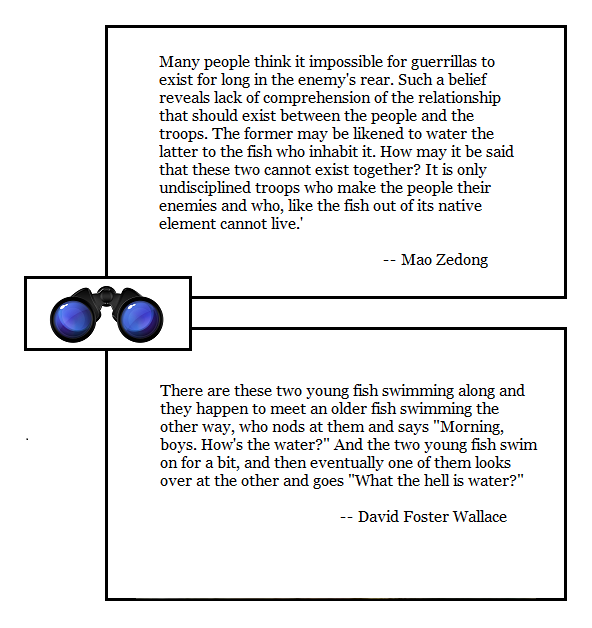
David Foster Wallace whispers to Mao Zedong

Wednesday, March 30th, 2016

[ by Charles Cameron — but Dogen has the last word ]
.

DQ David Foster Wallace & Mao

— and if Mao’s guerrillas don’t know they’re swimming in the general population, doesn’t even know there is a genpop, whose liberation are they fighting for?

**

Ah, but David Foster Wallace and Mao were just the bail I threw around, to reel you into some Dogen Zenji:

A fish swims in the ocean, and no matter how far it swims there is no end to the water. A bird flies in the sky, and no matter how far it flies there is no end to the air. However, the fish and the bird have never left their elements.

When their activity is large their field is large. When their need is small their field is small. Thus, each of them totally covers its full range, and each of them totally experiences its realm. If the bird leaves the air it will die at once. If the fish leaves the water it will die at once.

Know that water is life and air is life. The bird is life and the fish is life. Life must be the bird and life must be the fish.

The old is new again, this time with bots

Sunday, February 21st, 2016

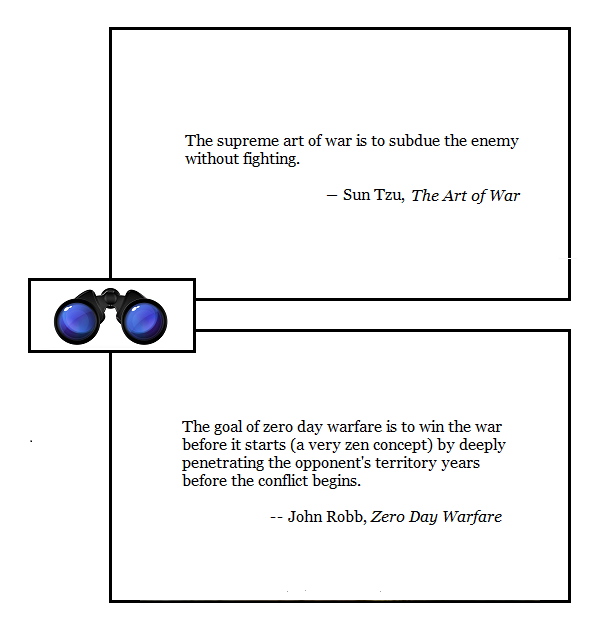
[ by Charles Cameron — John Robb updates Sun Tzu ]
.

SPEC DQ Sun Tzu Robb

Two paras from John‘s post:

Autonomous robots and software bots (collectively “bots”) deeply penetrate the opponent’s territory both physically (territory) and logically (their computer systems). Most would be hidden and remain dormant until activation. Some would actively or passively map opponent networks, analyze them for vulnerabilities, and take advantage of opportunities for stealthy exploitation.

When activated, these forward bots conduct a coordinated attack from inside the opponent’s territory and systems. Damaging, degrading, or taking control of computer systems and physical infrastructure. Advanced robots would emerge from stealth to kinetically engage with opponent forces or physically seize points (airports, ports, etc.) to enable the rapid entry of conventional forces.

Oh, and for additional points, it’s “a very zen concept”!!

Umberto Eco, RIP

Saturday, February 20th, 2016

[ by Charles Cameron — he was a man of word, wit and wisdom ]
.

The world was chastened last evening to learn of the passing from among us of Umberto Eco.

**

Zen has long admired Eco, as readers here will know, if for no other reason then as the original exponent of the concept of the antilibrary, here described by Nassim Nicholas Taleb in his book, The Black Swan:

The writer Umberto Eco belongs to that small class of scholars who are encyclopedic, insightful, and nondull. He is the owner of a large personal library (containing thirty thousand books), and separates visitors into two categories: those who react with “Wow! Signore professore dottore Eco, what a library you have! How many of these books have you read?” and the others — a very small minority — who get the point that a private library is not an ego-boosting appendage but a research tool. Read books are far less valuable than unread ones. The library should contain as much of what you do not know as your financial means, mortgage rates, and the currently tight real-estate market allows you to put there. You will accumulate more knowledge and more books as you grow older, and the growing number of unread books on the shelves will look at you menacingly. Indeed, the more you know, the larger the rows of unread books. Let us call this collection of unread books an antilibrary.

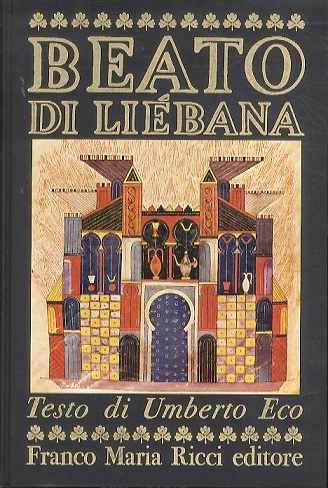
beato liebana

My own taste, as you know, runs to th apocalyptic, and I have long lusted for his sumptuous edition for Franco Maria Ricci of the Beatus of Liebana commentary on the Book of Revelation. I am grateful to discover I do have in my possession the second issue of FMR magazine, with Eco’s essay Waiting for the Millennium (pp 63-92) containing a number of the plates from that larger work.

It was blog-friend Laura Walker who alerted me to Eco’s passing, with the graceful comment:

He is the best ambassador of the Middle Ages – thought, aesthetics, philosophy, humor, humanity – it’s as if he sends his works from there..

Indeed. We lament his passing.

Polishing the heart: full circle

Sunday, February 14th, 2016

[ by Charles Cameron — happy daze! from Joan Halifax via Henry Corbin to Hui Neng & David Remnick ]
.

From Roshi Joan Halifax:

**

Steven Nouriani, The Meeting of Two Rivers, in Copenhagen 2013 – 100 Years On:

As Corbin (1969) indicated, the heart is thought to be like a mirror in which every moment the various manifestations of the Divine Forms can be reflected on a microcosmic level. The more we polish the heart, the more we develop the Himma (aptitude) to experience Divine epiphanies out of Mundus Imaginalis.

Henry Corbin, Creative Imagination in the Sufism of Ibn Arabi, p 222.

In its unveiled state, the heart of the gnostic is like a mirror in which the microcosm from of the Divine Being is reflected

**

Sachiko Murata, Chinese Gleams of Sufi Light, p. 225, n. 8:

The Sufi path is rather to empty oneself of all causes, to “polish the heart” by cleansing it of the rust of things, and to find God’s light in the heart.

**

Luang Pu Thuat, quoted in Dharma Legacy of Ajaan Dune Atulo:

To make yourself a good-looking wandering monk isn’t proper at all. It goes against the purpose of going out to wander. Each of you should reflect a great deal on this. The purpose of wandering in meditation is only one thing: to train and polish the heart so that it’s free of defilements. To go wandering in meditation only in body, but without taking along the heart, is nothing excellent at all.

**

Morihei Ueshiba, founder of Aikido:

The only cure for materialism is the cleansing of the six senses (eyes, ears, nose, tongue, body, and mind). If the senses are clogged, one’s perception is stifled. The more it is stifled, the more contaminated the senses become. This creates disorder in the world, and that is the greatest evil of all. Polish the heart, free the six senses and let them function without obstruction, and your entire body and soul will glow.

**

Shen-hsiu, in The Platform Sutra: The Zen Teaching of Hui-neng, Red Pine, tr.:

The venerable Shen-hsiu held up a lantern and wrote his gatha on the middle of the south corridor wall at midnight, and no one saw him. His gatha went:

The body is a bodhi tree
the mind is like a standing mirror
always try to keep it clean
don’t let it gather dust.

to which Hui Neng‘s responds, from the same source:

Unless you know your own mind, studying the Dharma is useless. But once you know your mind and see your nature, you understand what is truly important. My gatha went:

Bodhi doesn’t have any trees
this mirror doesn’t have a stand
our buddha nature is forever pure
where do you get this dust?

Then I composed another one:

The mind is the bodhi tree
the body is the mirror’s stand
the mirror itself is so clean
dust has no place to land.

**

BBC, Valentine’s Day: Countries that don’t love February romance

Last year, there were clashes at a university in Peshawar over Valentine’s Day.
Liberal students were celebrating with red balloons and cake while another group felt such a show was un-Islamic.
Dozens of students threw rocks in the scuffle, leading to gunshots being fired by both sides and rooms in a student dormitory being set on fire.

**

David Remnick, Dangerous Liaisons:

Love is wonderful; Valentine’s Day, less so. Often, it’s cheesy and boring. Here’s your antidote: a collection of stories about dangerous love, doomed love, and other forms of bad romance. … Consider these pieces a Valentine from us.

**

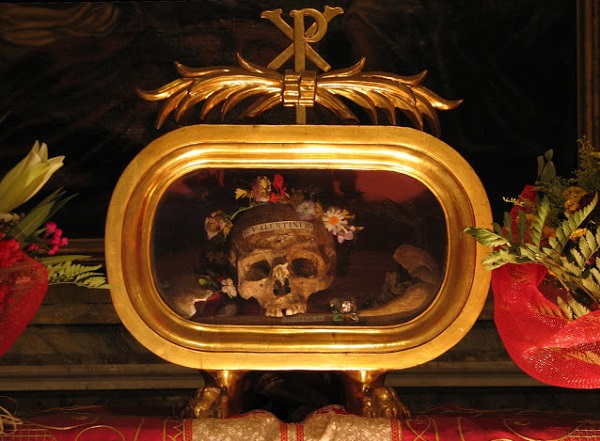
Veneration of relics:
2262875989_948afb24d8_b
Relics of St. Valentine, Santa Maria in Cosmedin, Rome, photo by Fr Lawrence Lew OP
On the orthogonality of rabbit and duck

Monday, February 1st, 2016

[ by Charles Cameron — a brief comic digression about them and us ]
.

Generally, we’re stuck with this:

It is a good one, I’ll admit.

I’m inclined, however, to agree with this analysis on occasion:

What I hadn’t realized, though, is that the theriomorphic rabbit and duck divinities in question are orthogonally related:

Very clever!

**

Two sides to every coin, two hands for every koan?


Switch to our mobile site