zenpundit.com » monarchy

Archive for the ‘monarchy’ Category

Between the warrior and the monk (ii): Fr Trevor Huddleston

Friday, May 25th, 2012

[ by Charles Cameron — a warrior, a monk, and where that leaves me ]
.

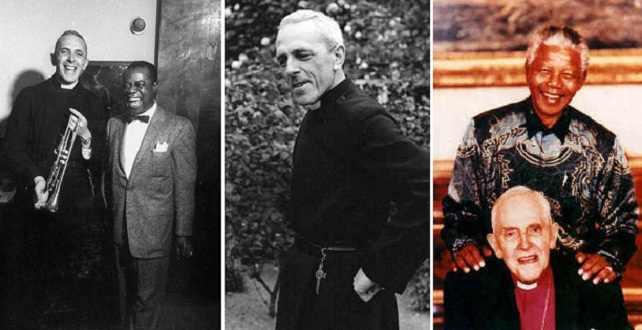
In the first part of this post I introduced you to my father, Captain OG Cameron DSC, RN, the man who fueled my keen interest in gallantry and the martial side of things. The other great influence in my early life was Fr. Trevor Huddleston CR, pictured below:

.

Trevor Huddleston CR:

Archbishop the Most Reverend Sir Ernest Urban Trevor Huddleston CR, KCMG – it’s hard even to know how to string his titles together, this monk, priest, schoolteacher, activist, archbishop, finally knighted by Her Majesty towards the end of his long and eventful life was the man who became a second father, guardian, mentor and spiritual guide to me shortly after my father died when I was nine.

That’s the man as I knew him, Father Trevor — simple, caring, intelligent, perhaps a little austere even — in the middle image above.

Austerity, simplicity: two more words to set beside gallantry in the lexicon of admiration and gratitude.
.

Satchmo:

To the left in the same image, he’s shown with Louis Armstrong — Satchmo — who has just presented him with a trumpet.

The story goes like this: as a monk in an Anglican monastic order, the Community of the Resurrection popularly known as the Mirfield Fathers, Father Trevor was sent to South Africa while still a young man, and worked in Sophiatown, just outside Johannesberg, as a priest and teacher.

A young black kid in one of his classes, Hugh, aged 12 or 13, fell ill and was taken to hospital, where Trevor Huddleston visited him. Trevor asked him what he would like more than anything in this world, what would so thrill and please him that he would have the greatest possible motive for getting better, getting out of the hospital and back to school. Hugh said, “a trumpet, Father” — so Trevor got hold of a trumpet which he then presented to the boy: now known the world over as the great jazz trumpeter, Hugh Masekela.

That wasn’t quite enough, though. A year or three later, Trevor was in the United States, and met Satchmo, who asked if there was anything he could do to help… Trevor told Satchmo he’d started a jazz band for the kids in his school, and knew a boy who would just love a trumpet…

Trevor was a hard man to refuse.
.

Hugh Masekela:

Here’s Hugh Masekela, just a little older, with the trumpet Trevor brought him from Louis Armstrong:

And here’s the sound…

When I was maybe 15, and Trevor had returned from South Africa to England, he gave me a 7″ “45” record of the Huddleston Jazz Band — now long lost. Imagine my amazed delight to be able to hear that sound again, fifty years later, through the good graces of the internet —

Hugh Masekela and the Huddleston Jazz Band play Ndenzeni na?


.

Desmond Tutu:

Another story I like to tell about Trevor and his time in South Africa has to do with a lady…

It seems this young black kid aged about 8 or 9 was sitting with his mother on the “stoop” outside his house in a South African shanty-town when a white priest walked by and doffed his hat to the boy’s mother.

The boy could hardly grasp how this had happened — his mother was a black woman, as one might say, “of no special acount”. But the priest in question was Trevor Huddleston, and it was a natural courtesy for him to lift his hat in greeting a lady…

The young boy never quite recovered from this encounter. We know him now as the Nobel Peace laureate, Archbishop Desmond Tutu.
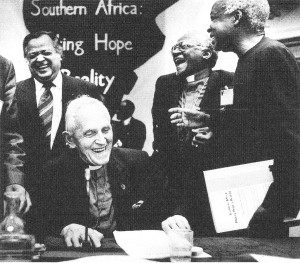
Here’s a photo of four old friends — Huddleston, Tutu, Julius Nyerere of Tanzania, and former Commonwealth Secretary General Shridath Ramphal.
.

From individuals to the world:

These are two simple stories of how Fr Trevor simply and straightforwardly loved whomever was before him, regardless of the enormous pressure at the time to discriminate between “real” and “insignificant” people — a love which made an indelible mark on those whose lives it touched.

And when Father Trevor touched you, as Lord Buckley might say, you stayed touched.

Thus far I’ve been focusing on individuals that Trevor touched. I do not think he in fact saw more than one person at a time, and his responses to situations were geared directly to the service of his love.

It was because of this that while he was in South Africa, Trevor repeatedly and quite literally put his life on the line in defence of the very simple proposition that the color of a person’s skin was immaterial in view of the love that was possible between any two people — so perhaps here’s where I should mention some of that history and some of the honors it brought him. After all, Trevor did pretty much take on the government of the South Africa he so loved, and lived to see it change.
.

Bishop Trevor of Sophiatown

Trevor Huddleston was a founding member of the African National Congress, the author of the first non-fiction work (Naught for Your Comfort, more on that later) to critique his beloved South Africa’s apartheid policy, reviled publically for meddling in politics by an Archbishop of Canterbury who later declared he had been in error and that Fr Trevor was about as close to a saint as one could find.

In 1955, Father Trevor, along with Yusuf Dadoo and Chief Albert Luthuli, was awarded the Isitwalandwe, the highest award given by the African National Congress. He was awarded the United Nations Gold Medal in recognition of his contribution to the international campaign against apartheid, the highest awards from both Zambia and Nigeria, the Dag Hammerskjold Award for Peace, the Indira Gandhi Memorial Prize, and ten honorary doctorates, including that of his alma mater, Oxford.

Archbishop Huddleston initiated the “International Declaration for the Release of Nelson Mandela and all Political Prisoners” in 1982, took part in the televised “International Tribute for a Free South Africa” held at Wembley Stadium, London in 1990 during which he introduced the address by Nelson Mandela (see below), entered South Africa House, Trafalgar Square, London in 1994 to vote in the first South African democratic election, and was a guest at President Mandela’s inauguration in Pretoria that year.

He received the KCMG (Knight Commander of the Order of St. Michael and St. George) in the 1998 New Year Honours list, for “Services to UK-South African Relations”, and attended an Investiture at Buckingham Palace on March 24th, 1998, to receive this honour from HM the Queen.

He chose the designation, “Bishop Trevor of Sophiatown”.
.

Nelson Mandela:

But let’s go back to individuals, and to Nelson Mandela in particular.

Mandela and Trevor were comrades in the fight against apartheid from the beginning — and the richness of their friendship is visible in the photo of Mandela with his arms on Trevor’s shoulders in the right hand panel at the top of this page.

In his autobiography, Long Walk to Freedom, Mandela tells the story of a time when he and Walter Sisulu were approached by a group of South African police who had been ordered to arrest them. Trevor, who was talking with with the two of them, called out to the cops, “No, you must arrest me instead, my dears.”

It’s that “my dears” that gives the game away. I can hear those words in Trevor’s voice. Even the cops were dear to Trevor: he might be utterly opposed to what they were doing, and risk his life to oppose them – but they were children of God.

Here’s a video of Trevor’s speech introducing Mandela at Wembley — a political speech, to be sure, but one powered by religious conviction:


.

Mandela’s tribute:

I’m saving the best of what Fr. Trevor taught me for the third post in this series, and hope to wrap the series up with some of my own reflections in a fourth; here I’d like to close with the words Mandela wrote about his friend after Trevor’s death in 1998:

It is humbling for an ordinary mortal like myself to express the deep sense of loss one feels at the death of so great and venerable figure as Father Trevor Huddleston.

Father Huddleston was a pillar of wisdom, humility and sacrifice to the legions of freedom fighters in the darkest moments of the struggle against apartheid. At a time when identifying with the cause of equality for all South Africans was seen as the height of betrayal by the privileged, Father Huddleston embraced the downtrodden. He forsook all that apartheid South Africa offered the privileged minority. And he did so at great risk to his personal safety and well-being.

On behalf of the people of South Africa and anti-apartheid campaigners across the world, I convey my deepest condolences to his Church, his friends and his colleagues. Isithwalandwe Trevor Huddleston belonged to that category of men and women who make the world the theatre of their operation in pursuit of freedom and justice.

He brought hope, sunshine and comfort to the poorest of the poor. Not only was he a leader in the fight against oppression. He was also father and mentor to many leaders of the liberation movement, most of whom now occupy leading positions in all spheres of public life in our country. His memory will live in the hearts of our people.

Christmas blessings — or Bonnie Prince Charlie…

Sunday, December 25th, 2011

[ by Charles Cameron — a carol for the faithful, a paean to the Bonnie Prince for the unbelievers — and a Happy Christmas to Zen, Scott and all our readers ]

.

First the carol, because I think it’s only fitting at Christmas, with Bonnie Prince Charlie to follow for those who’d like to enjoy the music without subscribing to the belief…

1.

Okay, that was the Latin which, being something of a cultural snob, I prefer — the English version goes as follows:

O come, all ye faithful, joyful and triumphant, O come ye, O come ye, to Bethlehem. Come and behold Him, born the King of angels; O come, let us adore Him, O come, let us adore Him, O come, let us adore Him, Christ the Lord.

2.

And for disbelievers, agnostic and otherwise, here’s an alternative interpretation of the carol that doesn’t require a credal affirmation…

According to Professor Bennett Zon, Head of the Department of Music at Durham University:

Adeste Fideles, the song which became O Come All Ye Faithful, is recognised as being the work of the 18th century music scribe, John Francis Wade, but there’s far more to this beloved song than meets the eye. The lyrics written by John Wade have clear Jacobite references to the restoration to the British throne of Charles Edward Stuart – the exiled King also known as ‘Bonnie Prince Charlie’.

In its earliest forms, from the 1740s to 70s, Adeste Fideles is often found in English Roman Catholic liturgical books next to, or physically very near, prayers for the exiled monarch. In John Francis Wade’s books it and other liturgical texts with ‘hidden’ Jacobite meaning are often strewn – even laden – with Jacobite floral imagery.

One important book including Adeste Fideles, to be shown on The Truth About Carols, reveals a wealth of Jacobite imagery. Amongst other things, it portrays a colourful image of Bonnie Prince Charlie, set over the image of a diagonal cross, imitating the text on the opposite page, the great Battle Hymn, Vexilla Regis Prodeunt – ‘Behold the Royal Ensigns Fly, Now Shines the Cross’s Mystery! The same book has a Jacobite cryptogram in Latin on its title page, which when deciphered gives a very clear sense of its Jacobite connections.

The meaning of the Christmas carol is clear: ‘Come and Behold Him, Born the King of Angels’ really means, Come and Behold Him, Born the King of the English – Bonnie Prince Charlie! “Fideles is Faithful Catholic Jacobites. Bethlehem is a common Jacobite cipher for England, and Regem Angelorum is a well-known pun on Angelorum (angels)/Anglorum (English).

Adeste Fideles seems to have lost its Jacobite meanings not long after Wade’s last published book in 1773, perhaps as Jacobitism ebbed in popular consciousness and as Roman Catholics neared religious freedom in the late 1770s. The real meaning of the Carol, remains, however, although whose birth we choose to celebrate in it remains a matter of personal decision.

As a Scotsman, I can raise a wee dram tae that.

Professor Zon’s reasoning can be viewed (by non-subscribers) in The Musical Quarterly, Volume XXIV, Issue 2 Pp. 279-289 for a mere $25 per day.

The choice is yours.

3.

Happy Christmas, Season’s Greetings!

The Forum and The Tower, a review

Sunday, November 20th, 2011

[by J. Scott Shipman]

the-forum-and-the-tower.jpeg

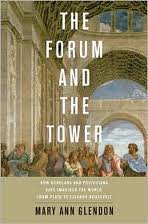
The Forum and The Tower by Mary Ann Glendon

“The relationship between politics and the academy has been marked by mutual fascination and wariness since the time of Plato.”

The first sentence on the flap of the dust jacket of this very good and informative small book. Professor Glendon, who is the Learned Hand Professor of Law at Harvard Law school, set out to write a book for her students that would answer ageless questions such as:

“Is politics such a dirty business, or are conditions so unfavorable, that couldn’t make a difference? What kinds of compromises can one make for the sake of getting and keeping a position from which one might be able to have influence on the course of events? What kinds of compromises can one make for the sake of achieving a higher political goal? When does prudent accommodation become pandering? When should one speak truth to power no matter what the risk, and when is it acceptable, as Burke put it, to speak the truth with measure that one may speak it longer? When does one reach the point at which one concludes, as Plato finally did, that circumstances are so unfavorable that only the reasonable course of action is to “keep quiet and offer up prayers for one’s own welfare and for that of one’s country”?”

Professor Glendon answers these questions and more through brief examinations of the lives and works of some of history’s most important figures:

Plato

Cicero

Justinian, Tribonian, and Irnerius

Machiavelli

Thomas Hobbs and Edward Coke

John Locke

Jean-Jacques Rousseau

Edmund Burke

Tocqueville

Max Weber

Oliver Wendell Holmes

Eleanor Roosevelt and Charles Malik

All in all, I believe Professor Glendon has provided a uniquely valuable book to help her students and other readers to answers those questions. In short but focused chapters of about 20 pages each, she provides mini-biographies of the subjects above and how they answered the some of the questions both in their lives and in their philosophy. Some of her subjects were thinkers lacking the abilities for the public square, Plato, for instance, but were enormously influential just the same. Rare were those like Cicero and Burke who were equally comfortable in the political arena or the academy.

My favorite chapters were on Plato, Cicero, Machiavelli, and Burke—mostly because I’ve read a respectable amount of their work. That said, I have not read Plato’s The Laws—and Professor Glendon suggests it is much better than The Republic—which I have read and did not much enjoy. Not surprisingly, The Laws will be on my list for this winter.

The inclusion of Eleanor Roosevelt and Charles Malik was something of a surprise, but Professor Glendon is weaving a sub-story through each chapter and illustrating how Roosevelt and Malik’s work on the Universal Declaration of Human Rights was something of culmination and extension of over 2,000 years of thinking and political action—not in the context of human progress towards a utopia of sorts, which she wisely rejects,  but rather a reflection the common threads of political thought throughout history.

While this is not criticism, I would have liked to have seen a chapter on John Adams and Thomas Jefferson, and a chapter on Karl Marx, whom she frequently mentions.

This is a book that is approachable and readable, and in our tumultuous domestic and global political climate, important.

She closes with this illuminating sentence:

“If one message emerges from the stories collected here, it is that just because one does not see the results of one’s best efforts in one’s own lifetime does not mean those efforts were in vain.”

Professor Glendon is to be commended for a job “well done!”

The book comes with my highest recommendation and may be the best book I’ve read this calendar year. Add this book to your must read list.

.
Referenced works you may find of interest (some of these works are out of print and expensive—for simplicity I’ve used Amazon links): 

The Laws of Plato, translated by Thomas Pangle

Cicero: The Life and Times of Rome’s Greatest Politician, by Anthony Everitt

Cicero, A Portrait, by Elizabeth Rawson (Glendon praised this book.)

A Panorama of the World’s Legal Systems, John Henry Wigmore

The Life of Nicolo Machiavelli, Roberto Ridolfi

The Prince, translated by Harvy Mansfield

Machiavelli, by Quentin Skinner

The Lion and the Throne, Catherine Drinker Bowen

The Spirit of Modern Republicanism, by Thomas Pangle

Statesmanship and Party Government, by Harvy Mansfield

The Great Melody, A Thematic biography of Edmund Burke, by Conor Cruise O’Brien (I read this wonderful book in 1992 when it was released: highly recommended.)

Guest Post: Pundita: Missing Something?

Sunday, August 28th, 2011

We’re delighted here at Zenpundit to present a cross-post from our blog-friend Pundita — of whom it has been said that “What Julia Child did for French cooking, Pundita is doing for foreign policy discussion. She’s opened a haute pursuit to ordinary people.”

Pundita quotes Mark in this post, and also raises some interesting issues with regard to America and monarchism — and as I have been prepping a series of posts on “the impact of ritual and ceremonial in church, military and state,” we all agreed it would be good to bring this post across to ZP in the hope of stirring some discussion — and see how things develop from there.

Pundita’s epigraph for this post is as follows:

Alan Rickman‘s Sheriff of Nottingham to a scribe: “Wait a minute. Robin Hood steals money from my pocket, forcing me to hurt the public, and they love him for it? That’s it then. Cancel the kitchen scraps for lepers and orphans, no more merciful beheadings, and call off Christmas.”

We bid her welcome.

— Charles Cameron

___________________________________________________________________________________________

Pundita writes:

The title of this post refers to the punch line in a series of TV commercials in the USA for Sears Optical eyeglasses. The ads feature amusing skits of people in serious need of a pair of glasses, such as the woman who mistakes a police patrol car for a taxicab. But helped along by bravura performances from Tara L. Clark as a blind-as-a-bat cat owner and Squirty as a wild racoon who can’t believe his luck, one of the skits is so funny it’s gone viral on the internet:

 Oh look it’s a democracy! Come snuggle with the United States!

There is nothing funny, however, about American officials who are so blind to what the United States stands for they snuggle with governments that march to a very different drumbeat than their own. Yet the officials are supported in their blindness by an equally blind populace. So in this post I’m going to break a taboo and wrestle with topics that are only whispered about in this country: monarchism and America’s involvement with it. To set the stage I’ll start with quotes from two recent news reports:

From the Globe and Mail (Canada), August 19, 2011:

Stephen Harper is working to recast the Canadian identity, undoing 40 years of a Liberal narrative and instead creating a new patriotism viewed through a conservative lens.Restoring the “royal” prefix to the navy and air force this week is just part of the Prime Minister’s attempt at “creating a new frame” for Canada and Canadians. …

From the New York Times, August 17:

A photograph taken last Friday of Gary F. Locke, the new United States ambassador to China, buying coffee with his 6-year-old daughter and carrying a black backpack at a Starbucks in the Seattle airport, has gone viral on the Chinese Internet. The seemingly banal scene has bewildered and disarmed Chinese because they are used to seeing their own officials indulge in privileged lives often propped up by graft and bribery and lavish expense accounts.

[…]

The first impression from the Starbucks episode has been bolstered by another photograph that shows Mr. Locke, his wife, Mona, and their three children carrying their own luggage after landing at Beijing Capital International Airport.Chinese who saw them then spread the word that the family had gotten into an anonymous minivan because a formal sedan that had been sent to pick them up was too small.

“To most Chinese people, the scene was so unusual it almost defied belief,” Chen Weihua, an editor at China Daily, an official English-language newspaper, wrote in an article Wednesday.

Cheng Li, a scholar at the Brookings Institution who studies Chinese elite politics, said in an e-mail: “Ambassador Locke’s photo contrasts sharply with the image of the Chinese officials who often live in a secret, insulated, very privileged fashion.

Often I’ve heard it asked why Britain’s political Right doesn’t seem much less socialist than the country’s Left. I’d say the answer is that the United Kingdom’s welfare state has as much to do with Marxism as bread and circus did under the Roman emperors. I’d also say the same answer would apply to the welfare state in the Kingdom of Norway and the Kingdom of Sweden and a number of other countries that are constitutional monarchies.

Yet my fellow Americans have such difficulty seeing monarchism that they confuse it with something else. The same blindness can afflict Americans who insist that China is not much different from the United States. In his 2008 article for the May/June issue of Good magazine (Ten Reasons Why China Matters To You), Thomas P.M. Barnett, an American security analyst, wrote that “China’s transformation echoes much of America’s past. … right now, China is somewhere in the historical vicinity of ‘rising America’ circa 1880.”

In my retort (The National Petition Bureau will see you now, Dr Barnett), I pointed out that Chinese make the pilgrimage to a bureau that’s a CCP placemarker for an emperor’s go-fers. I added in exasperation, “Ah yes, I remember as if just yesterday the tens of millions of American peasants in the 1880s who pilgrimaged to the nation’s capital every year to seek redress from the emperor.”

Dr Barnett turned out to have a sense of humor or at least a fair-minded attitude about receiving criticism because he linked my post at his blog. Yet that did little to allay my concern that Washington’s foreign policy establishment was blind as a bat to the fact that modern China is an imperial society with a frownie face of Communist Party dictatorship painted on it, and that modern Britain and a good number of other NATO-member countries are basically monarchist societies with a smiley face of democracy plastered on them.

One could even make an argument that modern Mexico’s most entrenched problems are rooted not in the rule of the Spanish but in indigenous imperial civilizations that predated Spain by thousands of years.

In fact, the more one starts looking around the world for societies that are not holdovers from the days of kings the more one appreciates that the United States of America has very few natural allies; i.e., countries that represent a real break with monarchism and the class systems that uphold it.

Norwegians might bristle at their society being described as monarchist. They would point out that their noble class has no political power anymore and that Norway today is an egalitarian society. However, it is an egalitarianism so rigidly enforced that the Norwegian mass murderer Anders Behring Breivik believed after he set off a bomb in Oslo that he would be caught and killed by the police before he reached Utoya island.

His faith in the omniscience of Norway’s government was dashed but the point is that the country’s egalitarian “open society” is maintained by the second largest deployment of public-space CCTV cameras outside the United Kingdom. And Norway’s generous public welfare system means that from cradle to grave Norwegians are easily monitored by the state, which helps the government make sure Norway stays an open, egalitarian society.

Yet Americans insist on describing such states as Leftist! Karl Marx would roll in his grave if he saw what passes today for many Leftist governments.

These same Americans decry their government’s close alliance with absolute monarchies such as the Kingdom of Saudi Arabia. They do so without realizing that there is a long history of the United States being closely allied with monarchies; that many of these are no longer “absolute” but “constitutional” with parliamentary forms of government and voting rights makes them no less monarchist.

Americans were also miffed at what they considered snobbishness when they heard the Swedish Chairman of BP, Carl-Henric Svanberg, expressing concern for the victims of the Gulf oil spill by referring to them as “the small people.”

Translation malfunction, explained his apologists. There was no malfunction; English is Svanberg’s second language. And he wasn’t being snobbish, he was being Swedish. Noblesse oblige and all that; one must always look after the basic needs of the small people so they don’t revolt.

None of the above is meant as a criticism of the countries I’ve mentioned or their people, and one would be hard-pressed to find nicer peoples than the majority of Swedes or Norwegians — and Canadians for that matter, who also live under a constitutional monarchy. I see no harm in people upholding traditions that provide them with a sense of order and give them continuity with their past, which is why I cheered on the royal pomp associated with the marriage of William and Kate. If it helped Britons get clearer on their values I was all for that.

The harm comes when Americans are so unclear on their own values, their own past and traditions, they can’t engage closely with the rest of the world without becoming terribly confused. One consequence is that the more the U.S. government has tried to mesh with the “international community,” the lower America’s standing in the world has fallen.

Americans can’t turn the situation around without first acknowledging that the international community is in large measure of bunch of royalists. Arriving at this realization doesn’t mean Americans should eschew friendly relations with people in such societies or that official Washington should spurn engaging with the governments on issues of mutual interest. It does mean that Americans are asking for ever greater trouble by lumping “democratic” monarchies” with American democracy.

Over at ZenPundit, Mark Safranski has again expressed concern about what he calls an emerging American oligarchy, an elite that’s manipulating the rest of the American populace to accept its rule. Meanwhile, Fareed Zakaria is seriously proposing that America replace its president with a prime minister and Congress with a parliament — with an upper house, I suppose, to be stuffed with Mark’s oligarchs, duly elected of course, so that Americans will stop the troublesome habit of vehemently disagreeing with one another.

Now just see how one thing leads to another. First you’re snuggling with liberal monarchies, then authoritarian ones, then one day you’re asking, ‘Why is there no USA anymore? Why is there only the international community?’

Missing something?


Switch to our mobile site
