zenpundit.com » ceremonial

Archive for the ‘ceremonial’ Category

Recruitment, poetry and tears

Thursday, January 31st, 2013

[ by Charles Cameron — Hegghammer on testing and trusting as precursors to AQ recuitment ]
.

I’ve been having trouble finding any of the anasheed Ibn Siqilli was posting on his site, many of which have been taken down — but this one, found in a comment of his on Leah Farrall‘s site, has somehow survived:

Craftsmanship in search of emotion, in service to the jihad.

Thomas Hegghammer has a fascinating article out titled The recruiter’s dilemma: Signalling and rebel recruitment tactics from which I’ll only tease you with the bits of special interest to me, viz those that speak to religion (roughly, scripture and ritual), and culture (narrative, music and poetry).

**

First, matters clearly involving religious piety and its expressions:

At the same time, personal piety at the time of recruitment was certainly a necessary condition for joining. Failure to observe any of the basic rituals or engaging in sinful behaviour – by skipping prayers, smoking, or watching Hollywood films – would have constituted a very negative sign. Moreover, even at the far end of the piety spectrum there were small signs that distinguished the extremely pious from the very pious. These signs were not in material objects such as clothes, but rather in body language and habits. QAP martyrdom biographies would highlight the piety of some but not of others, which suggests some variation. Judging from texts and videos, the behaviours that were appreciated included reading the Qur’an at every available spare moment, weeping while reciting the Qur’an, frequent minor pilgrimages (umra) to Mecca, efforts to acquire religious knowledge, etc. However, to observe these signs, recruiters needed to already be in direct contact with the recruit.

Piety, however, was not enough. Recruiters would also need to see signs of ideological commitment of a more political nature, in particular approval of violent activism.

Particularly interesting to me here is the sentence, These signs were not in material objects such as clothes, but rather in body language and habits.

**

And then, culture…

To find out whether a person had really been abroad for jihad, recruiters would solicit signs of jihad experience, either by engaging the recruit in conversation, or if in a larger group, steer the conversation toward the topic of foreign jihad fronts. They would presumably look for displays of three types of knowledge, the combination of which would be very hard to acquire for a person who had not been to any of the major battlefronts.

The first was knowledge of people, places and events specific to the conflict in which the recruit claimed to have taken part. [ more … ]

The second type of distinctive knowledge was weapons expertise. [ more … ]

The third type was familiarity with ‘jihad culture’, a set of peculiar practices and artistic expressions that emerged in the Arab Afghan community in the 1980s and developed in subsequent jihad fronts. One important component was anashid, battle hymns sung a capella during training and socializing. A similar component was poetry. Arab fighters in Afghanistan, Bosnia and Chechnya would continuously compose new poems and recite them in the camps. Veterans would be familiar with at least part of this material and would share it during social gatherings in the kingdom. Yet another aspect of jihad culture was the telling of war stories from the time of the Prophet Muhammad and his immediate successors. While some of these stories were part of the basic religious education of most Saudis, it required extra effort to learn many or all of them, and to be able to cite them verbatim, as custom required. In the training camps and the trenches, such stories were told all the time (Nasiri, 2006), so jihad veterans typically knew many more such stories than the average Saudi.

Of course, non-veterans could acquire some of this knowledge if they wanted to, but to mimic jihad experience, impostors would need to emit large and consistent clusters of correct signs – a considerable challenge.

I’m reminded of Abdullah Azzam‘s book The signs of Ar-Rahmaan in the Jihad of Afghanistan, which I quoted in an earlier post Of war and miracle: the poetics, spirituality and narratives of jihad.

**

Here’s how bad we are at learning the local mores of the various war zones we keep dropping in on, in the words of FPRI’s Adam Garfinkle, in Mali: Understanding the Chessboard, posted recently:

As the article says, when the Tuareg rebellion in Mali gained steam after the denouement of the Libya caper, greatly stimulated by the return of heavily armed Tuareg brethren from that fight, these three Tuareg commanders defected to the rebels, bringing soldiers, vehicles, ammunition and more to the anti-government side. Anyone who was surprised by this is at the very least a terminal ignoramus. And anyone in the U.S. military who failed to understand the ethnic composition of the country’s politico-military cleavages, such that he let U.S. Special Forces training be lavished on Tuareg commanders, was clearly insufficiently trained to do his job. And believe me, that’s about as nice a way to put that as I can summon.

How do things like this (still) happen, after what we should have learned from years of dealing with Iraqis and Afghans and others on their home turf? I happen to know someone who teaches in the U.S. military education system, and this person happens to be a field-experienced Harvard Ph.D. in anthropology. This person tries very hard to clear away the thick fog created by the innocent Enlightenment universalism that pervades the American mind—the toxic fog that tries to convince us that all people, everywhere, are basically the same, have the same value hierarchies, the same habits of moral and tactical judgment, and mean the same things by roughly comparable translated words.

Now imagine how good we’d be at infiltration, getting the anasheed, poetry and stories right…
Happy Birthday, Sir Isaac Newton and …

Tuesday, December 25th, 2012

[ by Charles Cameron — season’s greetings in a couple of different contexts ]
.

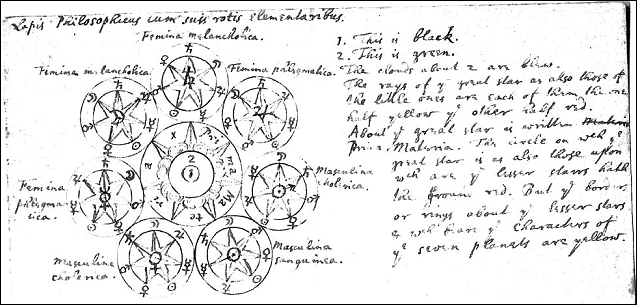
Lapis Philosphicus / The Philosopher's Stone, from Sir Isaac Newton, MS 416

.

It is Sir Isaac Newton‘s birthday today, December 25th, and that’s surely cause for some celebration.

Shakespeare‘s birthday is unknown, but was probably around April 23rd, Bach‘s is celebrated on March 31st, Galileo‘s on February 15th, Buddha‘s is mostly celebrated on April 28th, and HM the Queen‘s on April 21st, making April — TS Eliot‘s “cruelest month” — a powerful time for moving from womb into world.

If you’re a cricketer, you might celebrate WG Grace‘s birthday, 18th July, it takes all kinds to make a world. But December 25th? If you don’t also make a big deal about Leibniz on July 1st, what’s so special about Newton on December 25th?

**

There are some great aggregator blogs out there, and frankly I favor 3 Quarks Daily for their blend of culture, science and an accent from the subcontinent.

Today, as in other years, 3QD is celebrating Isaac Newton’s birthday, and I’ll raise a toast to him too. There are a great many things in our world that I am grateful for, that wouldn’t have been possible without his great and inquiring mind — though it’s his alchemical and apocalyptic interests that capture my own imagination.

What hath Newton wrought? You could do worse than to consult 3QD on this day across the years, 2004, 2005, 2006, 2007, 2008, 2009 — but you know, part of celebrating Newton’s Day (rather than that of Shakespeare, Leibniz, WG Grace, Dante, Marilyn Monroe or whomever) is that you can celebrate it on Christmas Day, on the day assigned conventionally to the birth of Christ — without getting all religious.

So it’s a sort of escape hatch for seculars, in a sacred season. As if all the gifts we give to commerce and each other weren’t enough.

**

In honor, therefore, of the child whose nominal birthday makes Sir Isaac Newton’s so much more easily memorable — this poem:

The birth of phoenix bliss
.

Gallows humor was implicit from the start
in the tiny child, in the newborn universe, in the
very heart of all that breathes and hopes,
evident then, at that first beginning, more so
in the tool shed behind the motel, most
now if we clear the rubble of malls and ads
from our eyes, blink a bit in the light, so
steady, so other than flash and glitter, so very

divinely human unfolding in each folded heart:
for oh, we are pilgrims, zeros traveling in
from earth to infinity, infinity itself
two zeros, two virgins intersecting, breeding,
filling the abyss: believe me, no phoenix
bliss is born, save from the ashes of crucifixion.

**

I know, I know, some of you will wonder WTF Charles is on about.

A lot of people have folded their Sunday suits away and mothballed them, I know — I just happen to think that the finest story in the world tells of an infant conquering men at arms, mighty empires, with love alone in his eyes.

I am not of the opinion that this obliges me to expect greybeards in space, to follow the culinary restrictions of some desert tribe, or to condemn those whose attitudes are different from mine: on the contrary, I find liberty in the childlike gaze, liberty and clarity, depth and profundity, and at bottom a deep mystery.

I wish you all whatever blessings may befall you, now and always.

Ashura: the Passion of Husayn

Sunday, November 25th, 2012

[ by Charles Cameron — today’s solemn commemorations in Iraq, Afghanistan, Pakistan and India in comparative religious perspective ]
.

I was listening to Mozart‘s Requiem last night, and it is rich in grief shot through with glory. That’s the thing about mourning celebrations in which death is accompanied by the “sure and certain hope of the Resurrection into eternal life”.

One such observance is found in Shia Islam, and falls this year on the 25th of November — today. It is the day of Ashura, the 10th day of Muharram in the Islamic calendar, and its epicenter is at Karbala in Iraq. As the saying goes:

Every day is Ashura and every land is Karbala.

For the Shia, Ashura commemorates the martyrdom of Husayn, grandson of the Prophet, at the Battle of Karbala, when he refused to give allegiance to the Umayyad caliph Yazid. Husayn’s martyrdom is dramatized in Ta’zieh, passion plays, giving us a hint that the martyrdom of Husayn at Ashura figures in the devotional life of the Shia much as the passion and death of Christ figures within Christianity, both in passion plays such as that at Oberammergau and in Catholic rituals such as the Stations of the Cross. This may seem a far-fetched analogy to some of my readers, but both deaths are viewed as redemptive. As another saying has it:

A single tear shed for Husayn washes away a hundred sins.

**

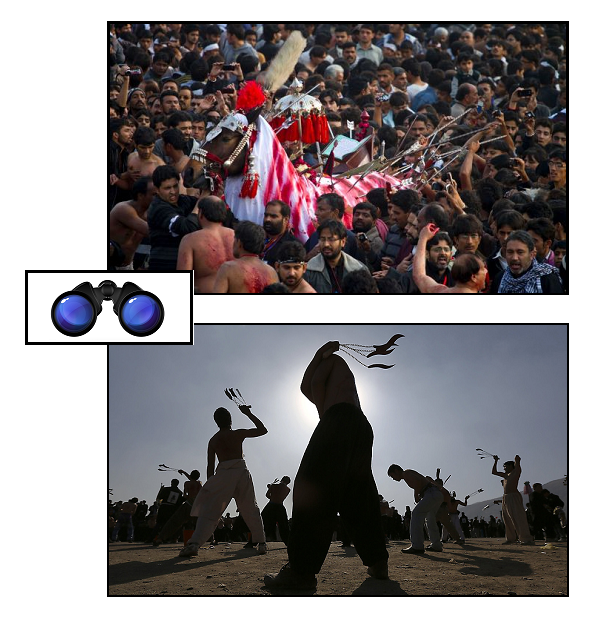
As you can see depicted in the lower panel above, Shiite mourning can include flagellation with chained blades, not something that sits easily with most westerners — yet as Roy Mottahedeh has said (quoted in SA Hayder, Reliving Karbala: Martyrdom in South Asian Memory):

Self-mutilation in emulation of the “passion” of heroes who are human yet divine is no stranger to the West: flagellants who whipped themselves both in penance and in remembrance of the scourging and crucifixion of Jesus appeared in almost every western European country in the Middle Ages…

The upper panel above depicts Husayn’s horse, riderless and bloody, and can perhaps give us some sense of the dark ceremonial beauty of the occasion for those whose grief transcends time and unites them in aspiration with Husayn himself — their flagellation attesting to their wish that they themselves could have stood beside him on that day so long ago, standing for truth against an army of injustice.

**

Their grief may be trans-temporal, but the possibility of dying for their faith persists to this day, for Sunni militants of the jihadist sort view Ashura differently — primarily as a day of fasting first performed by Moses and continued by Muhammad — and detest the breakaway sect of the Shia as rafidun, heretics.

In Iraq, Ashura there has seen millions of pilgrims visiting Karbala this year, with comparatively little violence:

Millions of Shiites flooded the Iraqi shrine city of Karbala on Sunday for the peak of Ashura rituals, which have been largely spared the attacks that struck pilgrims in past years. A bomb wounded 10 pilgrims in Diyala province, north of Baghdad, but it was the first such attack since a car bomb against pilgrims killed three people on November 17.

Farther afield, what the Pakstani police describe as a “major terror plot to attack the Muharram processions in Karachi” was avoided this year when “large amounts of explosive material, two suicide jackets and grenades” were confiscated during a raid, with the Minister for Religious Affairs declaring that the Tehreek-e-Taliban were behind the plots. Elsewhere in Pakistan:

At least five persons were killed and over 70 others injured on Sunday when a Shia procession was targeted with a bomb at Dera Ismail Khan in Pakistan’s restive northwest, the second such attack in the city in as many days.

Meanwhile in Kabul:

For the past week, the Afghan capital has been draped with black cloth arches and festooned with huge colored banners. Mournful, pounding chants pour from loudspeakers across the city, filling the air with slow martial intensity.

The dramatic display is all part of Muharram and the 10-day Shiite festival that commemorates the slaying of Imam Hussein, a 7th-century holy figure and early champion of Islam. But it is also a symbol of the growing religious and political freedom that Afghanistan’s long-ostracized Shiites have had in the past decade.

That’s from a Washington Post piece yesterday titled Afghan’s Shiite minority fears a return to old ostracism — and the next two paragraphs bear out the title:

Now, as Western military forces prepare to leave the country by 2014, Afghan Shiites, most of whom are from the Hazara ethnic minority, fear that their window of opportunity may slam shut again, leaving larger rival ethnic groups as well as Taliban insurgents, who are radical Sunni Muslims, dominating power.

“Everything we have achieved, our ability to come out and participate in society, has been in the shade of the international community and forces,” said Mohammed Alizada, a Hazara Shiite who was elected to parliament in 2009. “We are very concerned that once they leave, the fundamentalists will reemerge, ethnic issues will return, and we will lose what we have gained.”

Tribal politics, sectarian issues, the impending departure of US forces, the Taliban, cross-border alliances — and the sheer power of devotion — all these are intricately intertwined in today’s Afghanistan and its future. We may do well to understand something of the meaning of this day of Ashura, in our own calendar, 25th November 2012.

**

Annemarie Schimmel, the great Harvard scholar of Islamic mysticism, has a fine essay on the poetry of Ashura, encompassing both Sunni and (strongly Shia-influenced) Sufi traditions, Karbala and the Imam Husayn in Persian and Indo-Muslim literature. The mindset is very different from contemporary secular westernism, seeing death itself — and the grief that accompanies it — as a prelude to resurrection, and thus part of the timeless love-play of God with those who love him:

In having his beloved suffer, the divine Beloved seems to show his coquetry, trying and examining their faith and love, and thus even the most cruel manifestations of the battle in which the ‘youthful heroes’, as Shah Latif calls them, are enmeshed, are signs of divine love.

The earth trembles, shakes; the skies are in uproar;
This is not a war, this is the manifestation of Love.

The poet knows that affliction is a special gift for the friends of God, Those who are afflicted most are the prophets, then the saints, then the others in degrees’, and so he continues:

The Friend kills the darlings, the lovers are slain,
For the elect friends He prepares difficulties.
God, the Eternal, without need what He wants, He does.

**

The spirit here is not too far from that of the Greek philosopher Plotinus, who wrote in his Enneads [III.ii.15]:

Men directing their weapons against each other- under doom of death yet neatly lined up to fight as in the pyrrhic sword-dances of their sport- this is enough to tell us that all human intentions are but play, that death is nothing terrible, that to die in a war or in a fight is but to taste a little beforehand what old age has in store, to go away earlier and come back the sooner.

together with that of the early Christian Father, Origen, who wrote [De Martyrio, 39]:

And let each of us remember how many times we have been in danger of an ordinary death, and then let us ask ourselves whether we have not been preserved for something better, for the baptism in blood which washes away our sins and allows us to take our place at the heavenly altar together with all the companions of our warfare.

**

In India, indeed, the martyrdom of Husayn takes on an interfaith character in some places, as Hindus and Christians join Muslims in Ashura commemorations, as Naim Naqvi relates:

One can observe the richness and beauty of the diversity of Indian Culture at the occasion of Muharram. Since the martyrdom of Imam Hussain, Muharram ceremonies are observed all over the world including India. Hindus take part in them with great reverence and devotion. The tragedy of Karbala has become the harbinger for interfaith understanding in the Indian sub-continent. Participation of Hindus in the mourning rituals of Imam Hussain has been a feature of Hinduism for centuries in large parts of India. Hindus, Sikhs, Jains and even Christians observe Muharram. In the city of Varanasi which is the holiest city for Hindus many Hindu families participate in Muharram processions.

Describing the participation of one such Hindu family in Orissa, we read:

District police chief Lalit Das said Padhihary family has been doing this every year for the last 338 years, adding other local Hindu families also participate in the procession.

Muslims said it reflected the perfect harmony between the two communities in the area.

Thanksgiving and Kasab: pardon and penalty

Thursday, November 22nd, 2012

[ by Charles Cameron — i suppose this is about the state’s claim to a monopoly of violence, seen from both ends ]
.

I don’t want to go too far with this one, and I’ll start with the turkey and pardon, because pardon and forgiveness and thanksgiving all fit together and might as well be celebrated at this season — but as you’ll see, pardon has its dark side, even if it takes an anthropologist named Magnus Fiskesjö and his pamphlet titled The Thanksgiving Turkey Pardon, the Death of Teddy’s Bear, and the Sovereign Exception of Guantánamo to point it out:
.

But around the same time a turkey gets a reprieve in the US, a terrorist in India gets the death penalty.

I think it’s important to remember the Mumbai atrocities of 2008,and of which Ajmal Kasab (depicted below, and recently deceased) was the sole surviving perpetrator — if for no other reason than because he’s considered a martyr by some, and will be avenged.

But first, let me wish a Happy Thanksgiving! to all Zenpundit’s American readers, and good wishes to all others.

**

The problem with martyrdom… is that it’s a force-multiplier. Okay when the force is purely spiritual, not so much when it runs to violence and terror…

photo credit: Outlook India

Retired Indian intelligence chief Bahukutumbi Raman, whose tweets I often follow to articles on his Raman’s strategic analysis blog, warned us all:

Before the execution of Ajmal Kasab, the Pakistani terrorist of the Lashkar-e-Toiba (LET), who had participated in the 26/11 terrorist strikes in Mumbai, at Pune on the morning of November 21, 2012, our security agencies must have examined the likelihood of retaliation by jihadi terrorists in Pakistan and India and strengthened security precautions to prevent retaliatory attacks.

The LET and the organisations associated with it would want a quick retaliation.

And then he went into detail

Sure enough, Reuters then tells us:

Pakistan’s Taliban movement threatened on Thursday to attack Indian targets to avenge the country’s execution of Mohammad Ajmal Kasab, the lone survivor of the militant squad responsible for a rampage through Mumbai that killed 166 people in 2008. Kasab was hanged on Wednesday amid great secrecy, underscoring the political sensitivity of the November 26, 2008, massacre, which still casts a pall over relations between nuclear-armed rivals Pakistan and India.

“We have decided to target Indians to avenge the killing of Ajmal Kasab,” said Taliban spokesman Ehsanullah Ehsan by telephone from an undisclosed location.

**

In the course of the coronation liturgy for Queen Elizabeth II, the words justice and mercy crop up quite often — justly and justice 8 times, and merciful and mercy 28. It appears to be a sovereign’s right and obligation to administer both, and during the ceremonial they are brought together as a symbolic pair.

The Sceptre with the Cross is given into her right hand, with the words:

Receive the Royal Sceptre, the ensign of kingly power and justice

while the Rod with the Dove is given into her left hand, with the words:

Receive the Rod of equity and mercy.
Be so merciful that you be not too remiss,
so execute justice that you forget not mercy.
Punish the wicked, protect and cherish the just,
and lead your people in the way wherein they should go.

Justice is only fair: it seems, however, that it should be tempered with mercy.

**

Let me simply add that my own preference would be to have remitted the death penalty in Kasab’s case, and given him a life term in which to think about the lives he took. As for the turkey — happy stuffings!

I remember too, today, my friend and mentor Wallace Black Elk, and his wife, Grace Spotted Eagle. It was Wallace who — at least once — said:

They called us “Indians” when they came, so we have a nickname. But we are Earth people, we are original. When they come here, I welcome them with open arms, give them a turkey dinner, corn, and all the vegetables, all the greens.

Because this is a land of abundance…

Pussy Riot, British style

Monday, October 15th, 2012

[ by Charles Cameron — comparative images, Russian and British, with videos of Sunday’s Occupy-related protest during Evensong at St Paul’s in London ]
.

By way of contrast with the bright balaclavas of the Pussy Riot grrls, the British protesters wore white, and chained themselves to the pulpit steps during the Sunday service of Evensong.

**

Here’s a short video featuring the way St Paul’s integrates their protest into a ceremonial procession, so that it’s just a little odd in about the same way that Elton John playing piano during a service in the same cathedral is just a little odd.

Or let’s just say, eccentric… British.

Here’s the 30-minute official St Paul’s version, including the sermon, some muffled protester voices, and some blasts from the great cathedral organ…


.

**

Essentially, the protesters get co-opted by the clerics — with an offer of a little chat, probably over a cuppa tea, to follow…


Switch to our mobile site