zenpundit.com » blog-friends

Archive for the ‘blog-friends’ Category

A little diligence makes for a long post, 1: Kahlili

Wednesday, October 24th, 2012

[ by Charles Cameron — first part of a post on misreading Mahdism in Iran ]
.

book credit: amazon -- Mahdist graphic credit: Tim Furnish / MahdiWatch

.

Our blog friend Pundita has been relying on Reza Kahlili, the pseudonymous Iranian author of A Time to Betray: The Astonishing Double Life of a CIA Agent Inside the Revolutionary Guards of Iran, quite a bit recently, pointing to his recent discussion with John Batchelor and some reports of his on World Net Daily.

There are a number of people whose views on the religious issues surrounding an Iranian nuclear weapons program interest me — I leave other aspects of the problem to others better informed than I — some because they have insight, some because they have megaphones, and so on.

I’m not the person you’d want to ask whether Reza Kahlili was a CIA source, whether he was trusted, and if so, on what issues – issues which might range from troop movements to popular opinion of the IRG rank and file to theology and apocalyptic, a range that no single source is likely to be omnicompetent in – but WND is a media source I’ve followed off and on for a dozen years, it’s strongly associated with one of the strands of recent Christian apocalyptic with its own messianic take on Islam and Mahdism, and it isn’t necessarily a source I’d trust without verification…

**

So I did some checking of my own on Reza Kahlili, and found that he, or more likely some ghost writer employed to write his book for him (along with his publisher’s copy editor), simply doesn’t know what a hadith is. A hadith is a statement attributed to the Prophet (or in the Shi’a case, one of the infallible Imams who succeeded him) and passed down through an authoritative train of transmission (isnad). For a practicing Muslim, the corpus of hadith is second only to the Qur’an, and knowing what a hadith is is like knowing what the Epistles are for a practicing Christian: basic. For a theologically nuanced scholar from Qom or Najaf, it’s kindergarten.

Kahlili gets the use of the word “hadith” right early on in his book, but when he starts talking about the return of the Twelfth Imam or Mahdi he writes (p. 334.):

Like others who think as he does, Ahmadinejad believes that many of the signs of Mahdi’s return have emerged. Known as hadiths, these signs include the invasion of Afghanistan, the bloodshed in Iraq, and the global economic meltdown. According to prophecy, the hadiths will grow increasingly furious as Mahdi’s return comes closer, including “persecution and injustice” engulfing the earth, “chaos and famine,” and “many wars.” The hadiths predict that “many will be killed and the rest will suffer hunger and lawlessness.” People like Ahmadinejad so completely believed that these conditions would hasten the return of the twelfth Imam that they were willing to foment universal war, chaos, and famine to bring it about.

That’s at best very sloppy writing — the signs are known as ayat (as are the verses of the Quran), and the Quran states (28.59):

Nor was thy Lord the one to destroy a population until He had sent to its centre a messenger, rehearsing to them Our Signs; nor are We going to destroy a population except when its members practise iniquity.

Some translators actually render what this translation calls “signs” as “verses”.

Giving this passage from Kahlili a charitable reading, it could be understood to mean that signs as described in reliable hadith “include the invasion of Afghanistan, the bloodshed in Iraq, and the global economic meltdown” – though there’s a lot of interpretive scope in there, as there is in locating Gog and Magog (are both place names, or is one a prince of the other?) in comparable Christian eschatological circles.

Taliban recruiters (Sunni) certainly take “Khorasan” as mentioned in some Mahdist hadith as referring to “Afghanistan” – see Ali Soufan‘s book, The Black Banners – but an Iranian would read “Khorasan” as referencing the region of that name in Iran, or perhaps a wider zone that includes it, but also encompasses portions of Afghanistan and other neighboring states – it was, after all, the name of Iran’s largest province until divided in three parts, North, South and Razavi Khorasan in 2004:
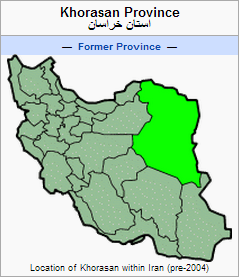
Interestingly too, the hadith traditions in question are considered likely to have been written by and for the Abbasids. David Cook, for instance, in his magisterial Contemporary Islamic Apocalyptic Literature writes of Khorasan (p. 173.):

The ‘Abbasids sought to present their movement as the fulfillment of messianic expectations, and so they produced a great quantity of materials given in the form of hadith traditions to indicate that the Mahdi would come from this region.

— not that scholarship of this kind is liable to influence popular apocalyptic sentiment…

**

Okay, so with a little creative forgiveness, we can read that first passage of Kahlili’s as saying that within the hadith can be found signs such mentions of Afghanistan / Khorasan, bloodshed in Iraq, and economic woes. But then we read this (p. 337.):

With the eyes of the world on them, the mullahs and the thugs who took orders from them fought mercilessly to hold on to the power that had never been their right, using extreme force to deny that their time was over. In their minds, Mahdi was coming and the blood they shed now was yet another hadith.

C’mon, now, has Kahlili even read his own book? Blood shed equals hadith?

The most charitable thing I can find to say is that Reza Kahlili may or may not have been some level of CIA source, but his credibility in matters involving any aspect of Iranian theology is utterly unconvincing.

**

Jeff Stern, in a WaPo piece from 2010, doesn’t sound any too convinced that Kahlili is worth our trust in other matters either, writing:

Reza Kahlili, a self-proclaimed former CIA “double agent” inside Iran’s Revolutionary Guards, appeared in disguise at a Washington think tank Friday claiming that Iran has developed weapons-grade uranium and missiles ready to carry nuclear warheads.

The pseudonymous Kahlili, whose previous accounts have been greeted with widespread skepticism, also said Iran was planning nuclear suicide bombings with “a thousand suitcase bombs spread around Europe and the U.S..

and:

Several current and former U.S. intelligence officials in the audience “rolled their eyes” at Kahlili’s claims, said one observer who was present.

Some in attendance compared Kahlili with Ahmed Chalabi, the former Iraqi exile who helped convince the George W. Bush administration that Iraqi leader Saddam Hussein had weapons of mass destruction. After the U.S.-led invasion of Iraq, the claims were proved false.

My personal knowledge-map features huge areas of ignorance where many others have strong opinions. On matters religious, Kahlili is not to be believed. On the siting of nuclear labs, or weapons development and deployment, we’re in areas that bear the legend “Here there be Smoke and Mirrors” on my map.

Thus endeth my blog-epistle to Pundita, whose knowledge of many of the other moving parts in the wider geopolitical situation far exceeds my own.

**

I’ll follow up with part II of this essay, in which I’ll talk a bit about Glenn Beck and Joel Rosenberg, and some other significant ways in which Shi’ite eschatology is being misrepresented via popular media in the west.

For those following the development of my book / media project, I am hoping the project will include a section of longer essays such as this one, in which I pull apart some of the myths currently surrounding western understanding of Islam, while pulling together major strands of a more nuanced view.


A Handy intro to Networks

Monday, October 22nd, 2012

Blogfriend Rob Paterson has two concise posts up on understanding networks and network theory. If this is a subject you want to know more about, they are must-reads.

My Network Revealed – Now what can you learn about yours?


….Here is my social network as created by the Mapping tool on Linkedin. It’s not the 100% true picture but it looks like 90% to me. You can use their mapping tool by going here.

If I am right and we are moving to an economy that depends on our networks, then it is essential that we learn what each of our networks means and what we can do to make them healthier. So, with that in mind, let’s look at mine and I will share some lessons with you.

Next week, I will post a podcast that I recorded yesterday with the Master of Networks, Valdis Krebs. Anything I know is because of him. He will go much deeper than I – so this is an introduction.

Diversity – In nature diversity is a good thing – so it is with our social networks. You can see that I am connected to a series of worlds. PEI , Public Media, Network Thinkers, Family and I have 2 outside nets of New Military Thinkers and my legacy Corporate connections.

I think that this does not look too bad – I have good links into many fields. How does your world look? 

Our networks are like gardens, we can always make them better. We can always add and remove. We can always pay attention. ….

Read the rest here.

Human Networks – A masterclass by the Master Valdis Krebs – Podcast #networks

This is Valdis Krebs – The Galileo of human Social Networks – ie the person who shows us what they look like, when before they were invisible, and who shows us the simple rules that drive them. 

The few nations that were early into navigation and exploration in the 16th century, did very well. As we ourselves move into a world where all the advantages will accrue to those that understand Networks, I think it is vital that we understand how to navigate in the Network world. 

The problem that many of us have is that when we hear the work “Network” we think of TV networks or Telephone networks that are driven by the old rules of engineering. What Valdis talks about mainly are Natural Networks, of which human social networks are a part. These are driven by the rules of Emergence and Nature and NOT by the rules of the CEO.

The good news is that the Rules of Nature in this regard are simple to understand and to operate. 

Network copy
This is the “Map” that we are now going to explore.

Read the rest here.

Valdis Krebs is indeed the master of network-mapping and leveraging social networks


On Eric Hobsbawm

Wednesday, October 3rd, 2012

I was going to comment on the death of the famed historian who was the Soviet Union’s most venerable and shameless apologist, but I was beaten to it in a brilliant piece by British blogger and fellow Chicago Boyz member, Helen Szamuely:

A great Communist crime denier dies

On my way to and from Manchester yesterday and today I read Anne Applebaum’s latest book Iron Curtain about the subjugation of Eastern Europe between 1944 and 1956. Ms Applebaum’s knowledge and understanding of the European Union is not quite what it ought to be, given that she usually appears in the guise of one of our leading political commentators but she does know the history of Communism and what it did to the countries and peoples who, for various reasons, found themselves under its rule. The first few chapters describe in some detail the brutality, violence, whole scale looting and widespread rapine that marked the Red Army’s route across Eastern and Central Europe, regardless of whether they were in enemy or friendly countries, with soldiers or civilians, men or women, adults or children, friend or foe. And then came the NKVD and the organized violence and looting. How many people know, for instance, that several of the Nazi camps, Auschwitz and Buchenwald included, were reopened by the Soviets for their own purposes? Not a few of the people they imprisoned there had been liberated only a few weeks previously.

As I was reading this horrible tale I got a text message from somebody who saw on the news that Professor Eric Hobsbawm, the best known apologist for Stalin and denier of Communist crimes, has died. We are entering a period of unrestrained mourning for this man who has on various occasions been described as the greatest living historian and one of the most influential ones. Sadly, the last part of it is true. He has been influential.

While Holocaust deniers are rightly excoriated Professor Hobsbawm has been treated in life and will be in death with the greatest adulation. Channel 4 lists some of the misguided souls who are pronouncing sorrowfully on the demise of this supposedly great man and asks rather disingenuously whether he was an apologist for tyranny.

Well, yes, as a matter of fact, he was….

Read the rest here.


When the rivers run red

Sunday, September 9th, 2012

[ by Charles Cameron — science and / or apocalypse, quirky, not analytic ]
.

The upper image of this par shows the Yangtze River recently, as reported by the Daily Telegraph under the delightful header, Red China:

I got it from Scence, Space & Robots, which commented:

NDTV reports that Chongqing’s Environmental Protect Bureau is blaming sand for the color change in the river. They claim flooding upstream washed sand downstream which turned the river red.

Okay, so as anyone who has stirred watercolors with their fingers knows, water can be all kinds of colors…

But what it it’s the apocalypse?

That was one possible conclusion Live Science found whehn they asked people about the red color of a lake in Texas (lower image):

The color has some apocalypse believers suggesting that OC Fisher is an early sign of the end of the world, but Texas Parks and Wildlife Inland Fisheries officials say the bloody look is the result of Chromatiaceae bacteria, which thrive in oxygen-deprived water.

So — when you see red water, do you think “aha! daub time” or “ooh, chromatiaceae” — or “OMG, it’s the end, it must be”?

**

Do you prefer to get your explanations for curious events from science, or from religion?

As Caitlin Fitz Gerald — who has an impressive acquaintance with watercolors as the artist behind the Clausewitz for Kids project — kindly tweeted:

John the Revelator puts it this way, in Revelation 16.4:

And the third angel poured out his vial upon the rivers and fountains of waters; and they became blood.

Even the Onion mentions the streets running red, though out of concern for good taste, I won’t quote…

Iwo Jihad?

Thursday, September 6th, 2012

[ by Charles Cameron — our stuff turned against us once again, this time it’s our symbolism ]
.

.

**

Richard Clarke, at that time Chair of the President’s Critical Infrastructure Protection Board and Special Advisor to the President for CyberSpace Security, said in December 2001:

Just as Al-Qaeda used 767s, transforming them into effective missiles, our future enemies will turn our technology against us.

It’s a recurring theme: as Seth Baum noted in April of this year in an article titled When Our Technology Is Used Against Us:

The 2008 Mumbai terrorist attacks, which killed 164 people, were made possible by the sophisticated use of information technology.

Baum links to an AP piece by Kathy Gannon, in which she writes:

In an Internet age, al-Qaeda prizes geek jihadis as much as would-be suicide bombers and gunmen. The terror network is recruiting computer-savvy technicians to produce sophisticated Web documentaries and multimedia products aimed at Muslim audiences in the United States, Britain and other Western countries.

**

So far, this is all techno-heavy stuff.

But they’re using our symbolism too, and turning it against us, as Ibn Siqilli notes in his blog post today, IN PICTURES: “Jihad Is Not Terrorism”:

Sad but true: Iwo Jihad.

**

To be honest, I don’t think this works for them. Using clips from the Lord of the Rings works far better, IMO, because it’s a symbol-system that can appeal to youth, and because it draws on a fantasy realm whose “good” and “evil” characters can be mapped directly onto their own identifications.

Propaganda is a subtle business. Still, kudos once more to Chris at Ibn Siqilli for spotting this and posting it.


Switch to our mobile site

