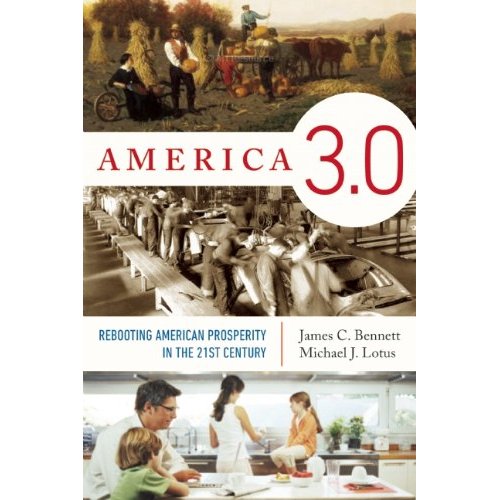
[by Charles Cameron — a very preliminary salute to James Bennett and Michael Lotus’ new book, with blues harp to match ]
.
.
Okay, I’m a snapper-up of unconsidered trifles, a jackdaw, not the most consistent of readers — but I did stumble upon something…
I’ll admit, I cannot even see how “the actual time and materials cost of the hammer might be $60 a hammer” when its “functional equivalent might cost $20 in a hardware store” — but let’s overlook that 200% markup for a moment, and chew on the rest of this dazzling paragraph from James C. Bennett and Michael J. Lotus, America 3.0: Rebooting American Prosperity in the 21st Century — Why America’s Greatest Days Are Yet to Come, pp. 266-67:
The Department of Defense requires that the labor time and materials used in building defense items on a “time and materials” basis, which is the great majority of all such items, be documented in excruciating detail. The costs of doing this are themselves allowed as expenses, so that the government ultimately pays for the costs of this proof. Therefore, when lurid accounts of $600 hammers procured by the Pentagon surface in the press, what is actually happening is a hammer whose functional equivalent might cost $20 in a hardware store is purchased in the Pentagon system, the actual time and materials cost of the hammer might be $60, with an additional $540 in documentation costs to ensure that the government is not being over¬charged for the item.
I admit, I am not Kafka.
But if that isn’t a snake biting its own tail arrangement, I don’t know what is.
**
What can I say?
**
Interesting, btw — I’ll bet there’s a story behind the decision to switch book covers from the one proposed earlier (at the top of the post, left) to the one the book now carries (right)!
Mike Lotus will be on the Bob Dutko radio show tomorrow, May 31, 2013 at 12:40 p.m. EST. Bob hosts Detroit’s #1 Christian Talk Radio Show on WMUZS 103.5 FM.
Please listen in if you can!
Many thanks to the Bob Dutko Show for having me on.
This weekend we will post an updated list of upcoming appearances by Jim Bennett, Mike Lotus, and occasionally both of us together, talking about America 3.0.
….But serious as these problems are, they’re all short-term things. So while at the moment a lot of our political leaders may be wearing sunglasses so as not to be recognized, there’s a pretty good argument that, over the longer time, our future’s so bright that we have to wear shades.
That’s the thesis of a new book, America 3.0: Rebooting American Prosperity In The 21st Century.The book’s authors, James Bennett and Michael Lotus, argue that things seem rough because we’re in a period of transition, like those after the Civil War and during the New Deal era. Such transitions are necessarily bumpy, but once they’re navigated the country comes back stronger than ever.
America 1.0, in their analysis, was the America of small farmers, Yankee ingenuity, and almost nonexistent national government that prevailed for the first hundred years or so of our nation’s existence. The hallmarks were self-reliance, localism, and free markets.
At the end of the 19th century and the beginning of the 20th, people were getting unhappy. The country was in its fastest-ever period of economic growth, but the wealth was unevenly distributed and the economy was volatile. This led to calls for what became America 2.0: an America based on centralization, technocratic/bureaucratic oversight, and economies of scale. This took off in the Depression and hit its peak in the 1950s and 1960s, when people saw Big Government and Big Corporations as promising safety and stability. You didn’t have to be afraid: There were Top Men on the job, and there were Big Institutions like the FHA, General Motors, and Social Security to serve as shock absorbers against the vicissitudes of fate.
It worked for a while. But in time, the Top Men looked more like those bureaucrats at the end of Raiders Of The Lost Ark, and the Big Institutions . . . well, they’re mostly bankrupt, or close to it. “Bigger is better” doesn’t seem so true anymore.
To me, the leitmotif for the current decade is supplied by Stein’s Law, coined by economist Herb Stein: “Something that can’t go on forever, won’t.” There are a lot of things that can’t go on forever, and, soon enough, they won’t. Chief among them are too-big-to-fail businesses and too-big-to-succeed government.
But as Bennett and Lotus note, the problems of America 2.0 are all soluble, and, in what they call America 3.0, they will be solved. The solutions will be as different from America 2.0 as America 2.0 was from America 1.0. We’ll see a focus on smaller government, nimbler organization, and living within our means — because, frankly, we’ll have no choice. Something that can’t go on forever, won’t. If America 2.0 was a fit for the world of giant steel mills and monolithic corporations, America 3.0 will be fit for the world of consumer choice and Internet speed.
Every so often, a “political” book comes around that has the potential to be a “game changer” in public debate. Bennett and Lotus have not limited themselves to describing or diagnosing America’s ills – instead, they present solutions in a historical framework that stresses the continuity and adaptive resilience of the American idea. If America”s “City on a Hill” today looks too much like post-industrial Detroit they point to the coming renewal; if the Hand of the State is heavy and it’s Eye lately is dangerously creepy, they point to a reinvigorated private sector and robust civil society; if the future for the young looks bleak, Bennett and Lotus explain why this generation and the next will conquer the world.
Bennett and Lotus bring to the table something Americans have not heard nearly enough from the Right – a positive vision of an American future that works for everyone and a strategy to make it happen.
In 1940, French historian Marcel Bloch wrote a slim volume entitled Strange Defeat, on the incomprehensible defeat of the superior French Army at the hands of the Wehrmacht. 60 years later, Ernest May wrote the complementary version in Strange Victory, an account of the improbable German success in defeating France. Many have written on the utter failure of the Imperial Navy to successfully crush the Rebellion once and for all at the Battle of Hoth, but few have bothered to explore the rather unlikely escape the Rebels made from their icy fortress. “How did they not lose?” Contrary to Spencer Ackerman’s view, the Alliance was faced with dire options and chose mostly the best available.
Ackerman critiques the Alliance for keeping virtually all of their key military players in the same location at Echo Base, but ignores the value of face-to-face, instantaneous communication among Rebel leaders. Collaboration is key to any successful insurgency, and while distributed cells might have a better chance of survival, they still require a core group to perform key coordination and planning functions. This is most effectively provided through close, personal cooperation….
The Battle of Hoth and Grand Strategy by Mark Safranski
The key to understanding the Battle of Hoth is not in tactical minutia on the icy surface of the planet, nor in confused imperial strategic objectives or even in the quixotic leadership of Lord Vader, but in grand strategy. As a self-contained polity facing no external foes and only a scattered and poorly armed insurgency, the greatest potential threat to the Empire’s two-man Sith regime would likely emerge from the ranks of the imperial military itself. It was not that the Galactic Empire could not have fielded a vast, overwhelmingly powerful and incomparably competent armada against the Rebellion, it was that Darth Sidious did not dare to do so…..
The Star Wars world is a bleak one. Aside from the standard strata of humans, the aristocrats like Leia to the paupers like Solo, there exists a more distinct separation. The Force-enabled and the not. Able to summon electricity from thin air, jump great heights, wield weapons of light, it is no surprise that the Empire is run by those able to use the Force. Or that the Rebel Alliance, filled with battle-hardened veterans who fought day in and day out, for days, months, years in some of the most challenging environments the universe has to offer, suddenly promote the Force-empowered Luke Skywalker despite his lack of combat experience.
In a world where a wave of a hand can change minds, it is hard to say technology matters. But as the Battle of Hoth demonstrates, it invariably does. That particular engagement was an exercise in terrible technology decision making. Tanks with weapons that don’t rotate, raised onto legs reminiscent of ostriches, and move with all the finesse of an overweight wampa. Laser blasts that detonate on impact without consistent grouping. A lack of even basic infrared overlays on a ice-covered planet. The Empire’s foot-soldiers, otherwise decent men pulled from their homes and families to wage war in forsaken lands, were abandoned to the tools provided by the lowest bidder. Minor modifications could have addressed a vulnerability to harpoons. Major platform changes could have wiped out the rebel force in minutes…..
Let’s Cut the Imperial Fleet Some Slack by Brett Friedman
It’s difficult to tell from the original three movies, but the Imperial Fleet is a very new organization. Their operational and strategic missteps make much more sense in this light. A galactic fleet cannot be built in a day. Although we see a Star Destroyer at the end Revenge of the Sith, a fleet is comprised of more than just ships. Doctrine, tradition, staff work, planning processes, and institutional experience are just as important as the ships themselves. Even though decades elapse between Revenge of the Sith and The Empire Strikes Back, it was just not enough time for the Imperial Fleet to become an elite force.
The Battle of Hoth occurs twenty-two years after Palpatine seized power.The first expeditionary operation conducted by the US Navy after their formative battles during the American Revolution occurred between 1801-1805, twenty six years after its formation. Both of these conflicts were waged against non-state actors by very new nations. Although the First Barbary War was successful for the American Fleet(thanks to a few Marines) there was an embarrassing mistake. The USS Philadelphia was run aground and captured, along with its entire crew, without a fight. Additionally the expeditionary force had to depend on third party support from the Kingdom of the Two Sicilies. Presuming that years in the Star Wars galaxy are identical to our own, the two young fleets had a similar amount of time to develop. The Imperial Fleet that we see in Empire, while presumably leavened with clone-veterans from its formative battles, just did not have the know-how to conduct counterinsurgency on a galactic scale. The tactical and strategic situation that the fleet faced at Hoth was, to them, a new one…..
Missed Opportunity: Rieekan’s Failure at Hoth by Mike Forbes
The conventional wisdom regarding the Battle of Hoth is that it was a major Imperial victory, described in terms of the Rebels as the massively overmatched ragtag band scattering before the unstoppable Imperial juggernaut. Thecontrary wisdom of sci-fi strategists focuses both on the tactical blunders made by the Imperial force, and thestrategic factors that influenced the decision-making of key leaders. Both narratives are wrong. The Rebel Alliance was anything but a ragged insurgent mob; they were a well-equipped and well-organized hybrid threat# at the time. The Battle of Hoth should have been a decisive victory for the Rebels, perhaps even as significant as the Battle of Yavin had been. The Imperial forces bungled what should have been a fairly simple HVT capture or kill mission, their staggering incompetence playing right to the Rebels’ strengths. However, the Alliance only managed to scrape by with a strategic draw due to their failure to take advantage of key opportunities during the battle to strike a massive blow to the Imperial fleet and the Empire’s key leadership. Hoth was also not a total tactical failure for the Empire; in fact they managed to pull off a partial victory, since Echo Base was indeed reduced to rubble, and the Rebels lost a large amount of materiel in the process of their hasty withdrawal under fire. The Imperial forces managed to salvage a partial success out of what by all rights should have been a crushing defeat, thanks to the even greater failures of their Rebel opponents, in particular the criminal negligence of General Rieekan….
Political scientists are frequently told their research is too arcane, mathematical, and self-involved to be of possible value to anyone in Washington dealing with real-world policy problems. There’s a grain of truth here. As international political economy whiz Kindred Winecoff observes, political scientists need to make a better “elevator pitch.” But here’s the problem: at the end of the day, there is a difference between what Max Weber dubbed science as a vocation and the subjective policy lessons we can take from our study. Part of that gap is reflected in the difficulties that people with purely policy interests inevitably encounter in PhD programs.
From my own (minor) experience so far, it is grueling, necessitates the assimilation of difficult methodologies, and involves having to think about intellectual questions that many people would regard as hopelessly arcane. Even a good PhD program that directly tackles policy questions will likely demand the student grapple with questions of esoteric theory and method. And not all research that tackles highly abstract questions is policy-irrelevant. Highly technical analysis of game theory and economics generated useful policy applications form the World War II convoy system to nuclear strategy and wargaming.
All of these advances began from the desire to grapple with difficult questions to produce knowledge, something many critics of political science research do not acknowledge. Take Greg Ferenstein, who penned an article supporting Eric Cantor’s call to defund the NSF. His gripe is familiar. Political science is obscuratist, hyper-mathematical, and disconnected from the policy world. Political scientists don’t do enough to make their research accessible to policymakers. Ferenstein wants a political science that his mother-in-law can understand, and he thinks starving academia of resources will motivate hungry researchers to do better. So is modern political science irrelevant to policy needs?
Contra Ferenstein, policymakers have thrown substantial $$ at the kind of research he regards as navel-gazing arcana. The RAND Corporation got a lot of mileage using what Ferenstein derides as “clever mathematical models” during the Cold War. I’m not sure that Jay Ulfelder, who worked for the intelligence community-funded Political Instability Task Force, would agree that his quantitative forecasting methodologies must pass a mother-in-law test to be valuable. And when New York University’s game theory guru Bruce Bueno De Mesquita speaks, the CIA listens. Drew Conway, a man that could easily teach a computer programming course just as well as poli-sci 101, gives invited talks at West Point on analyzing terrorist networks. I don’t think Ulfelder, Mesquita, or Conway have sleepless nights pondering the relevance of their research to the govermment!
Zenpundit is a blog dedicated to exploring the intersections of foreign policy, history, military theory, national security,strategic thinking, futurism, cognition and a number of other esoteric pursuits.