[ by Charles Cameron — Robert Redford and Brad Pitt on a Berlin rooftop ]
.
how do you draw a circle in an entirely linear medium?
**
The movie is Spy Game, with Robert Redford and Brad Pitt.
To my mind, it’s a brilliant piece of film making: director Tony Scott chose a terrific location for Nathan Muir (Redford)’s debrief reaming of Tom Bishop (Pitt), in the course of which Muir very pointedly tells Bishop:
Listen to this, because this is important. If you’d pulled a stunt there and got nabbed, I wouldn’t come after you. You go off the reservation, I will not come after you.
That’s the heart of the movie, right there, in negative — because the whole movie is about Bishop going off reservation in China, pulling a stunt there, and getting nabbed by the Chinese, and Muir coming after Bishop and rescuing him, with great shenanigans and flashbacks along the way.
Scott wants to draw a circle around that point, to drive it home — but this is a movie, a totally linear sequence frames, whether celluloid or digital, so how do you draw a circle in a linear medium?
Scott shoots the scene atop a circular roof, and before, during and after the conversation between the two men, has the camera circle the building:
**
I know, I stretch the limits of this blog mercilessly — and I’m spending this post on a piece of cinema technique. Let’s just say that I take Adam Elkus‘ words seriously:
Clausewitz himself was heavily inspired by ideas from other fields and any aspiring Clausewitzian ought to mimic the dead Prussian’s habit of reading widely and promiscuously.
I’m being promiscuous.
**
There are two other major points caught in Scott’s tight circle. One offers the essence of Spy Game, emphasis on the spy:
Bishop: Okay, help me understand this one. Nathan, what are we doing here? Don’t bullshit me about the greater good. Muir: That’s exactly what it’s about. Because what we do is, unfortunately, very necessary.
The other gets to the other half of the name Spy Game — game:
Bishop: It’s not a fucking game! Muir: Yes, it is. That’s exactly what it is. It’s no kid’s game, either, but a whole other game. And it’s serious, and it’s dangerous, and it’s not one you want to lose.
So, in the gospel according to Spy Game, espionage is a deadly and death-dealing game, played unfortunately but very necessarily for the greater good. All that in three short minutes, with a circle drawn around it for emphasis.
**
Thus a problem in geometry is artfully transcended.
[ by Charles Cameron — as a poet, i love the term “triple canopy” — okay? ]
.
I was watching The Big Lebowski — a great film that’s all the better because it features a cameo of my old buddy Jimmie Dale Gilmore — and was caught off-guard when I saw this particular segment:
Once again, the arts — my side of the house, you might say — are bringing me intelligence of strategy — the main course here at Zenpundit, which creativity a close second — and I was pretty sure I’d read much the same thing somewhere in the last few days..
A quick query on FaceBook revealed that I wasn’t making things up out of whole cloth. Stephanie Chenault and Laura Walker had seen it, too.
And then Mark brought the whole thing back home, with this FaceBook post of his:
Very likely, that’s what we all saw..
**
It’s still Sunday here, and I’ve been pleasantly surprised — so this can still be the Sunday surprise I meant it to be, even though you likely won’t see it till Monday.
And mebbe in future we should simply refer to The Big Safranski as The Dude.
[ by Charles Cameron — philosophy during a bank heist — and its implications in terms of military doctrine ]
.
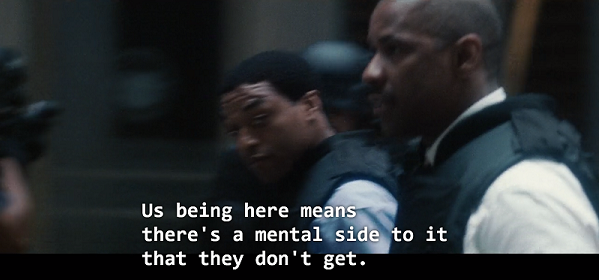
Two screenshots in sequence from the Denzel Washington movie, Inside Man, bring me back to the philosophical fissures and fusions between mind and brain, subjective and objective, quantitative and qualitative, man half-angel and half-beast — in a law enforcement context.
**
When one side has reached the limits of its material strength, it can always add to its military efforts by mobilizing all possible moral strength.
I often need to talk about this. As material, for Clausewitz, is the counterpart to moral, what for TRADOC is the counterpart to Human Terrain?
Like a Bach fugue, the counterpoint rivaled, and then overtook, the original melody.
**
I’m always interested in non-musical forms of counterpoint, whether we’re talking Glenn Gould‘s radio dramas, Claude Levi-Strauss‘s structure for his Mytholoogiques, Tufte‘s Rushdie‘s Kathasaritsagara, or the various attempts to make Hermann Hesse‘s Glass Bead Game playable. Hesse himself invokes both fugue and counterpoint in the passage in which he describes actual moves in his game about as clearly as anywhere:
A Game, for example, might start from a given astronomical configuration, or from the actual theme of a Bach fugue, or from a sentence out of Leibniz or the Upanishads, and from this theme, depending on the intentions and talents of the player, it could either further explore and elaborate the initial motif or else enrich its expressiveness by allusions to kindred concepts. Beginners learned how to establish parallels, by means of the Game’s symbols, between a piece of classical music and the formula for some law of nature. Experts and Masters of the Game freely wove the initial theme into unlimited combinations. For a long time one school of players favored the technique of stating ide by side, developing in counterpoint, and finally harmoniously ombining two hostile themes or ideas, such as law and freedom, individual and community. In such a Game the goal was to develop both themes or theses with complete equality and impartiality, to
evolve out of thesis and antithesis the purest possible synthesis.
**
I was accordingly interested to read this paragraph, ending as it does with the sentence I quoted above:
The Christie videos were just the latest installment in what might be the defining video format of this election. Call it marginal media, in which background activity overwhelms the intended subject. Most candidates have found themselves inadvertently sidelined at some point. Hillary Clinton was overshadowed by the surreal stylings of “Sticker Kid,” who mugged, jerked, and danced throughout her stump speech. Another short video treated Bernie Sanders’ endorsement of marijuana decriminalization as a preamble to an audience member’s startled reaction. Another Trump rally was undercut when a member of the crowd behind the lectern began reading a copy of Claudia Rankine’s Citizen. The drama unfolded over the course of Trump’s speech, as the reader’s neighbors began to argue with her, then brought their neighbors into the fray. Soon, the tension made it impossible to pay attention to Trump at all. Like a Bach fugue, the counterpoint rivaled, and then overtook, the original melody.
**
We need, it seems to me, to get used to thinking contrapuntally — and accordingly it is instructive to see just how many of the great artists of recent times have employed some measure of contrapuntal thinking in their work. From the same Wired piece:
The frames of Robert Altman’s Nashville are packed with overlapping dialogue and activity—it’s often hard to determine which storyline should dominate—granting his aspiring losers the same weight as the country-music superstars they idolize. Tom Stoppard applied the same lens to Hamlet when he made two lackeys — whose off-stage death was barely remarked upon in Shakespeare’s play — the heroes of his fan-fic spin-off, Rosencrantz and Guildenstern Are Dead.
[ by Charles Cameron — on abuses of word and image ]
.
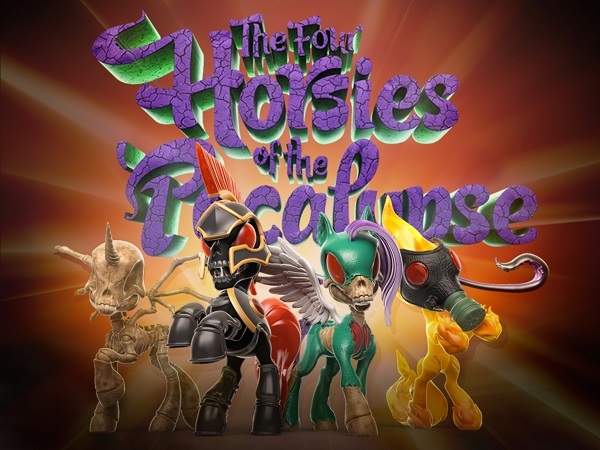
Exhinit A, The Four Horsies of the ‘Pocapypse:
Meet Calamity (Pestilence), Raven (Famine), Clash (War) and Ghost (Death). They’re the Four Horsies of the ‘Pocalypse (or at least they would be if they could only get their act together)! This next-generation of doombringers are on a mission to destroy the Earth, but to do so, they’ll have to beat the likes of Queen Chroma and her rainbow sprite army! Too bad they can’t crack teamwork to save their lives.
Armageddon? No, that would be near Haifa, not Mosul. And besides, for IS to take a battle seriously it would need to be at or near Dabiq, not Tel Megiddo.
**
Exhibit C, the Urban Dictionary:
-pocalypse
a suffix that is affixed to any word that describes the cause of a situation of relative discomfort derived from the last 3 syllables of ‘armageddon.’
As of late, the suffix “-pocalypse” has been popularized in the media, trying to make a minor event bigger than it is. Interestingly, an actual apocalypse would likely go by another name, or receive the suffix anyway. i.e. ‘Armageddonopalypse.’
Related suffix: “-mageddon”
The Hyphen is not always used.
Someone left the ‘fridge open, now were having the mold-pocalypse of ’11
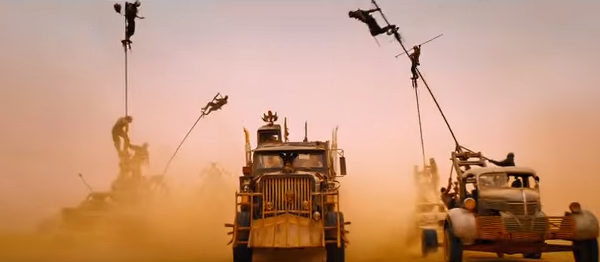
A woman rebels against a tyrannical ruler in postapocalyptic Australia in search for her home-land with the help of a group of female prisoners, a psychotic worshipper, and a drifter named Max.
But it sounds like fun. PostApocapyptic, though?
**
Please. Apocalypse means Revelation or Unveiling, and although the revelation itself may cause upheavals up to and specifically including a series of trumpets accompanied by a series of plagues and woes —
And the seven angels which had the seven trumpets prepared themselves to sound.
The first angel sounded, and there followed hail and fire mingled with blood, and they were cast upon the earth: and the third part of trees was burnt up, and all green grass was burnt up.
And the second angel sounded, and as it were a great mountain burning with fire was cast into the sea: and the third part of the sea became blood; 9And the third part of the creatures which were in the sea, and had life, died; and the third part of the ships were destroyed.
And the third angel sounded, and there fell a great star from heaven, burning as it were a lamp, and it fell upon the third part of the rivers, and upon the fountains of waters; And the name of the star is called Wormwood: and the third part of the waters became wormwood; and many men died of the waters, because they were made bitter.
And the fourth angel sounded, and the third part of the sun was smitten, and the third part of the moon, and the third part of the stars; so as the third part of them was darkened, and the day shone not for a third part of it, and the night likewise.
and so forth —
And the fifth angel sounded, and I saw a star fall from heaven unto the earth: and to him was given the key of the bottomless pit. And he opened the bottomless pit; and there arose a smoke out of the pit, as the smoke of a great furnace; and the sun and the air were darkened by reason of the smoke of the pit. And there came out of the smoke locusts upon the earth: and unto them was given power, as the scorpions of the earth have power. 4And it was commanded them that they should not hurt the grass of the earth, neither any green thing, neither any tree; but only those men which have not the seal of God in their foreheads. 5And to them it was given that they should not kill them, but that they should be tormented five months: and their torment was as the torment of a scorpion, when he striketh a man. And in those days shall men seek death, and shall not find it; and shall desire to die, and death shall flee from them.
terminating with the end of this world — the post-Apocalyptic scene is serene and glorious —
And I saw a new heaven and a new earth: for the first heaven and the first earth were passed away; and there was no more sea.
Or as St Paul and Handel have it —
Or as the Qur’an says —
For the Trumpet shall be blown, and whosoever is in the heavens and whosoever is in the earth shall swoon, save whom God wills. Then it shall be blown again, and lo, they shall stand, beholding.
**
Hence — when you say postapocalyptic, please don’t mean “after the snowploughs” or even “post-Hiroshima” — agreed?
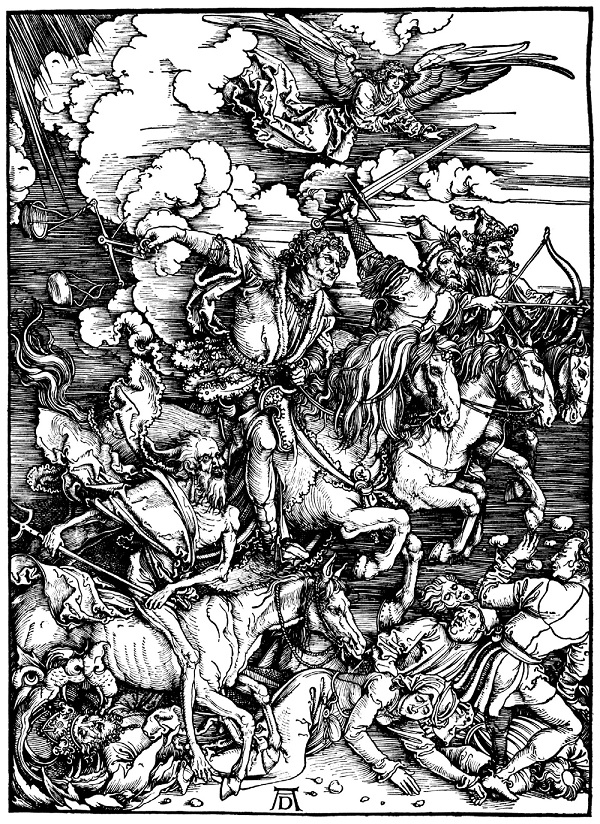
And the word apocalypse is best left to the imagination not of the toymaker but of the artist:
Zenpundit is a blog dedicated to exploring the intersections of foreign policy, history, military theory, national security,strategic thinking, futurism, cognition and a number of other esoteric pursuits.