zenpundit.com » movies

Archive for the ‘movies’ Category

A certain symmetry in malls

Tuesday, November 19th, 2013

[ by Charles Cameron — Gezi Park and Westgate Mall through the lens of the Garden of Good and Evil ]
.

Sheer madness, I know — but there’s a method to it.

I was watching Clint Eastwood‘s brilliantly funny film Midnight in the Garden of Good and Evil last night, and noted with delight the symmtery between two of his Savannah characters — one a gentleman who walks an invisible dog through a park on a leash [upper panel, above], and the other a fellow who attaches house-flies on threads to his lapels, so that he can walk his pets to the nearby diner for breakfast [lower panel]…

**

Here’s where the sheer madness comes in, and the method it encourages.

With symmetry still on a back burner in my mind, I was reading Michael Klare‘s post Planet Tahrir: The Coming Mass Demonstrations against Climate Change (Klare) on Juan Cole‘s blog this morning, and ran across this sentence:

on May 27th, a handful of environmental activists blocked bulldozers sent by the government to level Gezi Park, a tiny oasis of greenery in the heart of Istanbul, and prepare the way for the construction of an upscale mall.

An upscale mall.

Beth Gill‘s essay, Temples of Consumption: Shopping Malls as Secular Cathedrals details a central analogy of our time, and it’s only fitting that the desire to replace an “oasis of greenery” by building an “upscale mall” was what triggered the Gezi Park uprising, just as the destruction of an “upscale mall” in Nairobi, Kenya, was the recent target and mise-en-scene of al-Shabaab’s recent “martyrdom brigade” and their murderous rampage.

The symmetries and ratios of garden and mall, cathedral and mall, construction and destruction, paradise and consumption are thrown up for our consideration by this juxtaposition of Gezi and Westgate.

What can we learn from them?

Of death and children, one way or the other

Wednesday, November 13th, 2013

[ by Charles Cameron — thoughts triggered by the Jeremy Scahill & Lawrence Wright documentaries ]
.

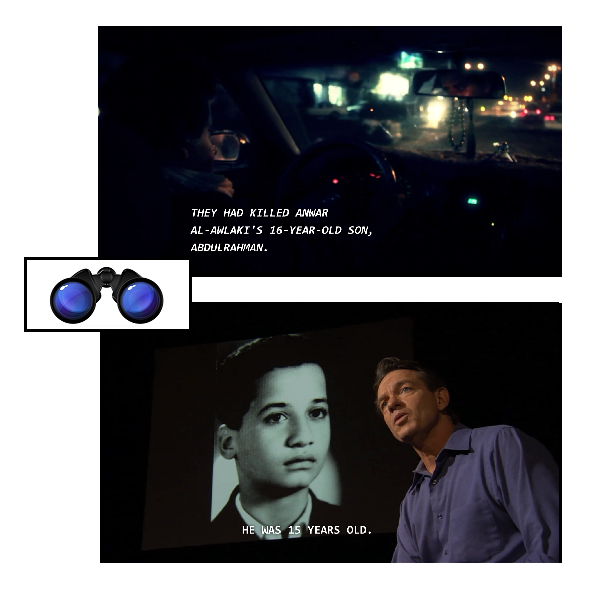
I don’t really enjoy writing this, because I’m loath to suggest that sixteen year old Abdulrahman al-Awlaki was in fact a combatant, though it seems to me that he might have been. I was viewing documentaries the other night, though, and when Jeremy Scahill‘s Dirty Wars [upper panel, below], which deals with Abdulrahman, was followed directly by Lawrence Wright‘s My Trip to Al-Qaeda [lower panel, below], the age at which Ayman al-Zawahiri began his career as a radical stuck out like a sore thumb:

Here, then, is Wright’s commentary on the young al-Zawahiri:

Ayman al-Zawahiri, the man behind Bin Laden, a doctor, product of a distinguished family, from an exclusive suburb of Cairo called Maadi, his father was a professor of pharmacology; his mother — the daughter of a diplomat… Ayman had started a cell to overthrow the Egyptian government in 1966. He was 15 years old.

How much agency do we believe fifteen and sixteen year olds have, anyway? Do we allow them to drink a beer?

If we are ever going to have a debate as to the moral high ground in matters of the extrajudicial killing of US citizens, it seems to me that Abdulrahman al-Awlaki rather than his father Anwar should be the test case we focus in on.

The truth is that young people, sometimes very young people, do on occasion play with fire. I don’t think that means we should “burn” them on suspicion, but I do think it’s part of the larger picture. And in this case, that means “drone warfare” and “targeted killings” aren’t the only relevant categories: we may need to factor the issue of “child soldiers” into our considerations as well.

**

Here, to give the Awlaki family’s side of the story, is an ACLU video with Abdulrahman Awlaki’s grandfather:

**

And how did I wind up here?

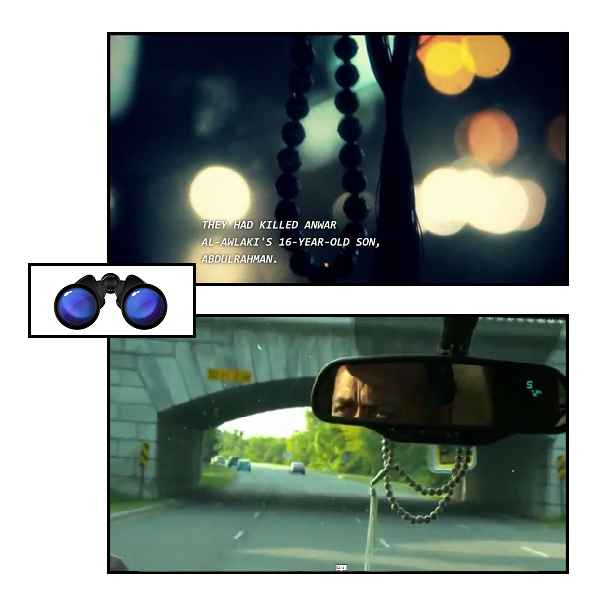
Well, as I said, I was watching documentaries… but the first thing that caught my eye, to be honest, was this shot from Dirty Wars [upper panel, below], which ineitably reminded me of the rosary-and-rear-view-mirror shot from Manhunt [lower panel]…

which I’d talked about in an earlier post, Manhunt: religion and the director’s eye.

I’m beginning to think no documentary about jihad and counterterrorism is complete without one…

Myanmar between Woolwich and Al-Aqsa 2: graphical innovation

Wednesday, October 23rd, 2013

[ by Charles Cameron — in which jihadis utilize the graphical technique known as kinetic typography for what may be the first time — follow on to part 1: interfaith hatred ]
.

**

Today the Combating Terrorism Center at West Point notified their mailing list of the launch of their Militant Imagery Project online. It’s a very helpful resource, covering much of the same issues as Artur Beifuss & Francesco Trivini Bellini, Branding Terror: The Logotypes and Iconography of Insurgent Groups and Terrorist Organizations and Asiem El Difraoui, The Jihad of Images — which I discussed briefly in Jottings 7: Two for the iconography of terror a while back.

The CTC explains:

The use of propaganda and imagery by terrorist groups has long been an understudied dimension of the broader field of political violence. This project explores the use of imagery and visual themes by militant groups, focusing largely on jihadist media production. Jihadist organizations and individuals inspired by their message are prolific producers and distributors of visual propaganda, and their efforts have expanded exponentially online. However, these images frequently utilize themes which can be inscrutable to those not familiar with the sub-culture. It is our hope that this project will provide academics, practitioners, and students with a basic contextual understanding of the ideas these images convey before they turn to the larger questions of why they are employed, how they work, and what responses they may elicit.

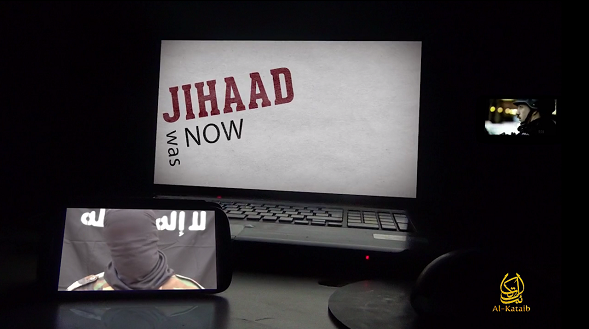
It is in that spirit that I would point you to the following three screengrabs from the Al-Shabaab video I discussed in my previous post…

**

Imagine the images tilting and changing, as the words spoken on the soundtrack are gradually spelled out typographically on screen in this sequence:

Jihad was now global. Jihad in the West — Madrid — London — Paris — Boston — Jihad was now coming home to the West, And it was making a dramatic entrance… WOOLWICH ATTACK

Here are the screengrabs:

**

These three screengrabs illustrate what may well be the first use of the technology called “kinetic typography” or more simply “moving text” in jihadist propaganda. Somali news outlet Harar24‘s Editorials team claim it’s a first, writing:

It is not unusual for jihadi videos to be laden with high graphics and effects. However Al-Shabaab this time used a never technique never adopted before in any jihadi videos, kinetic typography.

The best way to investigate kinetic typography in depth is via Marco Papale‘s video site, the Kinetic typography Channel on Vimeo.

**

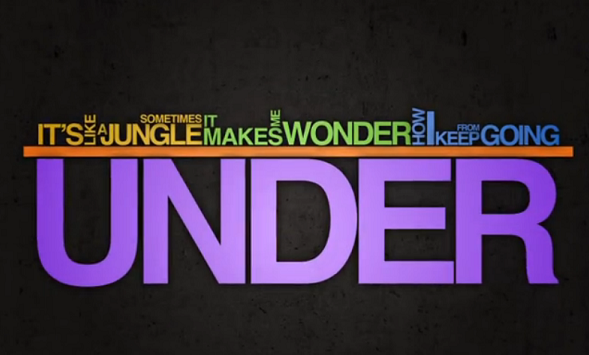
I don’t intend to embed the Shabaab piece itself, but here for your further illumination is the Grandmaster Flash sample rom which the screengrab at the top of this post was taken, in full:

That’s kinetic typography!

Some poems, Madhu

Saturday, September 28th, 2013

[ by Charles Cameron — some of my own poems, some of my own theology, and a damn fine French police procedural on Netflix ]
.

Engrenages / Sprial, season 4 episode 9

**

Madhu, a wonderful friend of this blog, encouraged me some while back to post some of my poems here. I don’t do it often, and I hope you will at least tolerate it when I do.

This one, for instance:

The rolling dice
.

That there is a murder to be committed, this the god knows, that the car
travelling through the woods contains victim and victor paired like dice strung
on a rear-view mirror, this the god knows, but it is the tops of trees
the god attends to, oblivious of the car which moves on its inerrant way
between them, the topmost branches it she or he observes, the upper
and as the car is first heard approaching, middle, and as it rolls into view
in left field, lower branches, the car now drawing his attention, riddle
of the two men still obscured by deflecting windows, roof doors tyres and

the leaves, the fallen, as though the two men from their high estate had fallen
to this, to the ground, among leaves which become mulch, the one sooner
and the other later, man become mulch as the god had become man, a
seasoning, of the ground, fall, a leavening of the earth, spring, in that primal
and primordial turning of planets and years on which between tree top
and mulch, between before and when with no after, two men’s dice are rolled.

**

As you know, I’m interested in the workings of the imagination, and find much of its power concentrated in the specific theologies and rituals of the world’s religions. My poems, accordingly, allow me to explore themes at the intersection of human behavior in all its light and shade, with the divine, in all its brilliant clarity, depth of heart, and, well, ineffableness, inscrutablemness, indescribability.

Indescribable? The word the Athanasian Creed uses is Incomprehensible:

As also there are not Three Uncreated, nor Three Incomprehensibles, but One Uncreated, and One Uncomprehensible.

You see, for my purposes the word god refers precisely to a greater unknown that nevertheless permeates and can inspire us — and simply saying that indescribable is omnipresent, omniscient and omnipotent gives us very little understanding. Inspiration and revelation are, for me, poetic openings on what cannot in any definitional sense be known, but from which our lives can glean radiance, love, clarity, courage.

**

In my attempt to glean some of that harvest for myself, and to spread some of what I glean around in words, I have found myself writing a long, continuing series of poems that take their central motif from films. If god, or whatever name you might use to point to that Incomprehensible — that medium “in which we live and move and have our being” — if that is indeed conscious of all that is, I’m inclined to wonder how it (he, she, other, all or none of the above) perceives, in a way that makes sense to me.

And the “seeing” that most extends my own outward perception of the world is the seeing done by cameras and brought to me by movies. So I give “god” in this series of poems all the zooms, overhead shots, close-ups, jump cuts, helicopter rides, narrative thrust, slomo, freezeframe and other tricks that film is capable of… to get a human glimpse of an omni-director who might even, like Hitchcock and Renoir, choose to make a cameo appearance in his (her its or other) own film.

And what films do I use? The one’s I’m watching between fatigue and sleep, for late-night entertainment — usually thrillers, and on Netflix. The poem above and the two which follow were written this last week, triggered by an episode of Engrenages, a French policier [trailer here] which shows in the UK under the title Spiral, and which has been called “France’s answer to The Wire” in this Guardian write-up from an early season: Meet Spiral’s feminist anti-hero.

I like it very much — but have to put it on pause from time to time, when a poem comes on through.

**

Okay, here are the other two poems from the set of three, drawn from my viewing of Engrenages, season 4 episode 9:

Still rolling
.

The spade wasn’t used, wasn’t needed, wasn’t necessary, the dice rolled,
no murder was committed, did the god know this, no, that the car
traveling through these trees would roll back the two men out of the woods
and into some new relation, clearer for being less fearful, though
he wild with hope and he sweating with regret might yet change course
as the god already knew or might know or might not if there be such
a they it she or he know, passionate impassive or nonexistent, or might
mightily decide — but the dice had rolled, the car parts the trees, departs

the woods, burial and the eventual arising of young two leafed tree sprouts
will continue though the car has left to right of view, and still, moved,
the god sees, observes, reflects, and builds, in his own extended image,
narratives of birth and eventful or eventless lives and meaningless or
on some perhaps many occasions meaningful deaths, and — who knows,
perhaps the god if any, rebirths after eventful nonevents, and thus onwards.

and this one:

Stopt
.

And then again the car, in the woods, its doors wide open like wings,
surely the god would lift the car above treetops, clouds, into some other,
some blue, some empyrean, yonder, where murder would no longer
be needed, necessary, where no dice would roll but puffballs,
tossed clouds. hither and yon without pattern or purpose, repeating
yet that eternal pattern, that this car so still might forever roll,
this breath so quiet might breathe, life under the trees and under these
stars continue, continue, one death less than the god expected, the

car wings watching to carry the spirit windward, deprived of the death,
the murder uncommitted is no murder but if it be committed, even
here late in the day in the woods, in this word, committed, then
there is murder under the high trees a few paces from the sad car, the
corpse carrier, the fortuneless car carriage, and a man who stood
upright yet walked crooked perhaps is fallen, flat, dead and truly buried.

**

Caroline Proust as police captain Laure Berthaud, in Engrenages

.

Please feel free to comment on any or all of this: the ideas about a greater-than-human perception, poetry, cinema, Engrenages, these particular poems…

Pope Francis and the artists who move him

Thursday, September 19th, 2013

[ by Charles Cameron — Dostoevsky, Hopkins, Caravaggio, Mozart, Bach, Fellini, Cervantes — that’s who! ]
.

For context and contrast, first read this:

Pope Francis decided at the last minute not to attend a Beethoven concert last evening, Fox News and others reported. Fox News comments, “Unlike his predecessor Benedict, who was well-known as a music lover, Francis has shown scant interest in music, liturgical or otherwise.” The concert, an event long planned for the Year of Faith, included Beethoven’s 9th symphony with choir and orchestra.

Pope Francis supposedly said “I am not a Renaissance prince who listens to music instead of working,” Vatican Insider first reported, later softening its report to preserve the general sense without quoting the pope directly.

— then this, from the first extended interview of Pope Francis, which has just been released.

While I’m sure plenty of others will mull over other aspects of what he has to say for himself, I’m taking my own insights into his character from the artists in whose work he finds inspiration:

I have really loved a diverse array of authors. I love very much Dostoevsky and Hölderlin. I remember Hölderlin for that poem written for the birthday of his grandmother that is very beautiful and was spiritually very enriching for me. The poem ends with the verse, ‘May the man hold fast to what the child has promised.’ I was also impressed because I loved my grandmother Rosa, and in that poem Hölderlin compares his grandmother to the Virgin Mary, who gave birth to Jesus, the friend of the earth who did not consider anybody a foreigner.

I have read The Betrothed, by Alessandro Manzoni, three times, and I have it now on my table because I want to read it again. Manzoni gave me so much. When I was a child, my grandmother taught me by heart the beginning of The Betrothed: ‘That branch of Lake Como that turns off to the south between two unbroken chains of mountains….’ I also liked Gerard Manley Hopkins very much.

Among the great painters, I admire Caravaggio; his paintings speak to me. But also Chagall, with his ‘White Crucifixion.’ Among musicians I love Mozart, of course. The ‘Et incarnatus est’ from his Mass in C minor is matchless; it lifts you to God! I love Mozart performed by Clara Haskil. Mozart fulfils me. But I cannot think about his music; I have to listen to it. I like listening to Beethoven, but in a Promethean way, and the most Promethean interpreter for me is Furtwängler. And then Bach’s Passions. The piece by Bach that I love so much is the ‘Erbarme Dich,’ the tears of Peter in the ‘St. Matthew Passion.’ Sublime. Then, at a different level, not intimate in the same way, I love Wagner. I like to listen to him, but not all the time. The performance of Wagner’s ‘Ring’ by Furtwängler at La Scala in Milan in 1950 is for me the best. But also the ‘Parsifal’ by Knappertsbusch in 1962.

We should also talk about the cinema. ‘La Strada,’ by Fellini, is the movie that perhaps I loved the most. I identify with this movie, in which there is an implicit reference to St. Francis. I also believe that I watched all of the Italian movies with Anna Magnani and Aldo Fabrizi when I was between 10 and 12 years old. Another film that I loved is ‘Rome, Open City.’ I owe my film culture especially to my parents who used to take us to the movies quite often.

Anyway, in general I love tragic artists, especially classical ones. There is a nice definition that Cervantes puts on the lips of the bachelor Carrasco to praise the story of Don Quixote: ‘Children have it in their hands, young people read it, adults understand it, the elderly praise it.’ For me this can be a good definition of the classics.

**

Mozart, Et incarnatus est:

Mozart, played by Clara Haskil:

Bach, Erbarme dich, from the Matthew Passion:

Fellini, La Strada, innocence:

Fellini, La Strada, despair:

No wonder, then, that he loves the poetry of his fellow Jesuit, the poet Gerard Manley Hopkins:

No worst, there is none. Pitched past pitch of grief,
More pangs will, schooled at forepangs, wilder wring.
Comforter, where, where is your comforting?
Mary, mother of us, where is your relief?
My cries heave, herds-long; huddle in a main, a chief
Woe, wórld-sorrow; on an áge-old anvil wince and sing —
Then lull, then leave off. Fury had shrieked ‘No ling-
ering! Let me be fell: force I must be brief.”‘

O the mind, mind has mountains; cliffs of fall
Frightful, sheer, no-man-fathomed. Hold them cheap
May who ne’er hung there. Nor does long our small
Durance deal with that steep or deep. Here! creep,
Wretch, under a comfort serves in a whirlwind: all
Life death does end and each day dies with sleep.

— nor the works of Caravaggio, whose rap sheet was impressive to say the least:

Arriving in Rome in 1595 at the age of 25, the hot-headed painter’s police dossier — hand-written in Latin and vernacular Italian and bound in great volumes that were stored in the archives until now — makes Caravaggio come across as almost compulsive in his lawlessness. For instance, the man was weapon-obsessed, sporting a sword, dagger, and pistol at various times. He was twice thrown in the clink for carrying arms without a permit, and known for beating strangers in late-night fights and pelting police with rocks.

The documents add fresh color to well-known parts of the Caravaggio legend. Regarding the 1606 brawl during which the artist killed one Ranuccio Tommassoni, leading the artist to flee Rome and causing Pope Paul V to issue a death warrant, the documents reveal that the fight was over a gambling debt, and not a woman, as some accounts have suggested.

It is all the more appropriate, then, to close this post with Caravaggio’s own meditation on the martyrdom by crucifixion of the first Pope, St Peter, whose chair Francis now holds:

_______________________________________________________________________________

.

h/t Damian Thompson, who tweeted “I never thought I’d hear a Pope rave about Haskil’s Mozart, Furtwängler’s Beethoven and Knappertsbusch’s legendary 62 Parsifal.”


Switch to our mobile site