zenpundit.com » movies

Archive for the ‘movies’ Category

Manhunt: religion and the director’s eye

Saturday, June 8th, 2013

[ by Charles Cameron — with an assist from Wm Benzon, under-appreciated and brilliant film and literary critic, musician, author of Beethoven’s Anvil ]
.

Screen-time is valuable: movie directors don’t just throw it away.

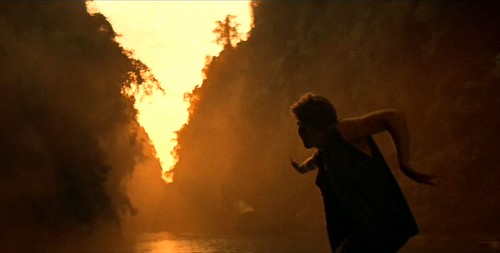
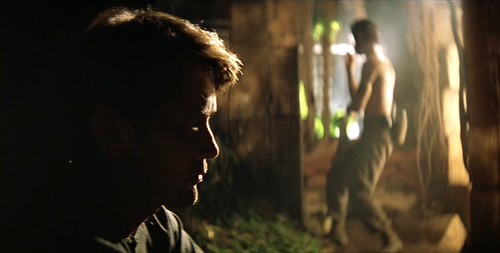
Here are screen-grabs of two moments in Greg Barker‘s HBO bin Laden documentary, Manhunt, offered for your consideration:

and:

**

As you know from my review of Battle of Algiers (Pontecorvo) and Black Friday (Kashyap), I’m a film buff.

Screen time is the life-time of story: every second counts. And thus it is that if a director uses the same shot with variations at two or more points in a movie, they don’t just follow along, the way the elements in the narrative through-line follow along, one after another — they stack up. They “mean” cumulatively, synchronically…

Putting that in musical terms, they take on the function of rhythm rather than melody — and it is rhythm that can make the body dance, just as it is melody that can make the heart soar.

So, this repetition, this striking parallelism — why?

**

Here’s my friend Bill Benzon, writing about the use of parallelism in Apocalypse Now:

The Assassin and the Surfer

Now for the less obvious parallel: Willard and Lance, the only member of the boat crew to survive. One can’t miss the parallel killings nor Willard’s statement of kinship with Kurtz. This parallelism, on the other hand, is easy to miss. That is to say, it may well elude conscious notice. Unconscious notice, on the other hand … Well, what is that?

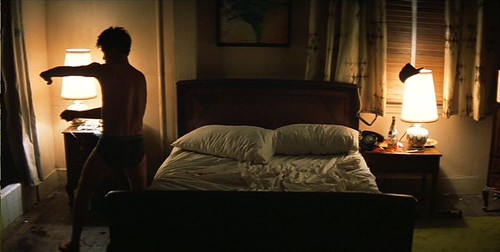
Here’s three frame-grabs that point up the parallel. The first is from the opening montage of Willard in Saigon just before he gets his orders:


Montage AN 19 martial arts

The second shot comes much later in the film. Clean has been killed (bullet), then the Chief (spear). Lance is the one who floated the Chief’s body down the river. Now they’re heading upriver toward Kurtz again, with Lance in the bow of the boat:


AN Lance dance1

He’s doing a martial arts dance. Not the same one as Willard did in the opening montage, but a martial arts dance. No one else in the film does such a thing. Clean does some dance moves while listening to the Rolling Stones, but they’re in an entirely different style; faster, jerkier, more angular.

Finally, we have this scene in Kurtz’s compound. Willard’s in the foreground, and Lance is in the background:


AN Lance dance2

One might suggest that this parallel is a mere accident, one might. And perhaps it is. In cases like this, however, my default assumption is that it is not an accident. It may not be there by conscious intent and deliberate plan; but it is not there by accident. The people who made this movie are too skilled to do such things inadvertently.
That final remark of Benzon’s makes exactly the point I was hoping to make here, before commenting on those two screen-grabs from Manhunt:

The people who made this movie are too skilled to do such things inadvertently.
**

There’s actually a third shot in Manhunt with a view of a dangling rear-view-mirror ornament — let’s take a look:

This one’s from the van Peter Bergen and his cameraman, Peter Jouvenal, took in the docu’s re-enactment / flashback to their CNN interview with bin Laden, back in 1997. I don’t think this one is a rosary-like thing though it might be — I think it’s just the sort of tassel decoration you’ll find on saddle-bags, or decorating a camel or a car in Afghanistan.

The other two, however, seem clearly religious, both of them are shots of the cars in which American counter-terrorist folks would have gone to work during their efforts to track down bin Laden — and I find it significant that one features a (Christian) cross while the other very likely shows (Muslim) prayer-beads.

I say “very likely” because the beads could be (secular, Greek) worry-beads — but they look more like a tasbih to me. And why would that be interesting — why would a film-maker be interested in such a parallelism?

Besides the fact that these shots allow voice over and show us the various folk involved going to work, they specifically point up the fact that those working to defeat bin Laden were not all kuffar but included Ali Soufan of the FBI and “Roger” — the fellow described by Greg Miller in this March 2012 piece in WaPo, At CIA, a convert to Islam leads the terrorism hunt.

Am In right? I don’t know. But the subliminal message, if I am, is that the manhunt for bin Laden was indeed not a “Crusaders against Islam” affair.

**
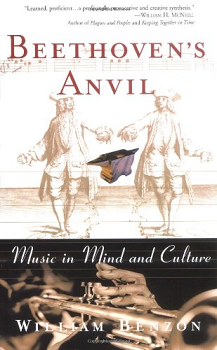
May I recommend Wm. Benzon’s Beethoven’s Anvil to all who read here who have an interest in cognition and / or music?

For more on parallelism in cinema, see David Bordwell, Julie, Julia, & the house that talked, to which Benson also pointed me.

Manhunt: Radicalization, & comprehending the full impact of dreams

Saturday, June 8th, 2013

[ by Charles Cameron — how do you intercept messages that come via dreams? I’m thinking of al-Balawi ]
.

My little graphic (below) may be kidding — but what of reality?

**

In the bin Laden documentary, Manhunt, which I mentioned before seeing it here, and discussed briefly here, another passage (at 1.22.31) that is missing from the CNN transcript concerns the dream which radicalized Humam al-Balawi, the Khost bomber. Balawi speaks, the subtitles translate for us:

God blessed me to have this dream. I dreamed I saw Zarqawi. He was in my house. His face was like a full moon. He was busy. Preparing an attack. I wishes I could fight with him. Be killed with him. I am your humble brother from Jordan. I am 32 years old and a medical doctor.

I’m not suggesting there was no prior fertilization of Balawi’s mind and heart, nor that he was influenced by no other drivers: I just wonder what the impact of such a dream would be, given that intense smuggling goes on between our waking and dream lives, of a kind that no intercepts can capture for analysis.

**

How powerful can influence can a dream exert?

Consider this example, taken from Marie-Lousie von Franz, On Dreams & Death: A Jungian Interpretation, p. 64:

She sees a candle lit on the window sill of the hospital room and finds that the candle suddenly goes out. Fear and anxiety ensue as the darkness envelops her. Fear and anxiety ensue as the darkness envelops her. Then, the candle re-lights on the other side of the window and she awakens. She died the same day.

**

If I may borrow a bit from some unpublished writings of mine…

Dreams as early indicators:

The western secular paradigm considers dreams to be of little or no significance, and it is therefore entirely possible that intelligence gleaned from the recounting of dreams will seem of little interest to western analysts. In the Islamic view, however, certain dreams are of considered to be of real significance, their importance being indicated by the hadith reported by Bukhari:

Narrated Ibn ‘Umar: Allah’s Apostle said, “The worst lie is that a person claims to have seen a dream which he has not seen.”

— Sahih Bukhari, book 87: Interpretation of Dreams, #167.

One early indicator of a Mahdist tendency in a given population, therefore, would be the presence of dreams about the Mahdi in a given discourse — in jihadist chat rooms, for instance — while the frequency of such mentions would be a useful heuristic measure of the development of such a movement. Thus Yaroslav Trofimov reports [Siege of Mecca, hb. p.50.] that in the run-up to the 1979 siege of the Grand Mosque and Ka’aba in Mecca, many followers of Juhayman al-Otaibi, the leader of the raid, dreamed dreams:

Then, one after another, hundreds of Juhayman’s supporters experienced detailed, vivid dreams. Mohammed Abdullah’s sister appears to have been the first, quickly followed by others. In their sleep, they all had the same vision: Mohammed Abdullah standing by the sacred Kaaba in Mecca’s Grand Mosque, accepting allegiance as the blessed Mahdi amid multitudes of believers. Militants from as far away as Lebanon who never encountered Mohammed Abdullah in person claimed to have had the same dream.

It is worth noting here that while, as Trofimov suggests, much of the dreaming “must have been caused by self-suggestion” this in no way invalidates their significance as indicators. Indeed, Reuven Paz writes of the mediaeval scholar Ibn Sirrin‘s still-popular Interpretation of Dreams that “high selling rates of this book can provide us an indicator for rising apocalyptic notions”. Paz also notes a “sizable number” of jihadis publishing their dreams and visions on Jihadist forums on the web [p.4..

Dream narration of this sort certainly corresponds to hikayat as discussed by Michael Vlahos in his essay Terror’s Mask: Insurgency Within Islam — still one of the most necessary pieces I have read on al-Qaeda..

**

Closer to home, in one sense, than the siege of the Grand Mosque, is the 9/11 attack on the Twin Towers and Pentagon. This too had its dream precursors, as we can tell from the video transcript of bin Laden‘s taped meeting of mid-November 2001:

UBL: He [Abu-Al-Hasan Al-Masri] told me a year ago: “I saw in a dream, we were playing a soccer game against the Americans. When our team showed up in the field, they were all pilots!” He said: “So I wondered if that was a soccer game or a pilot game? Our players were pilots.” He didn’t know anything about the operation until he heard it on the radio. He said the game went on and we defeated them. That was a good omen for us.

Shaykh: May Allah be blessed.

Unidentified Man: Abd Al Rahman Al-Ghamri said he saw a vision, before the operation, a plane crashed into a tall building. He knew nothing about it.

Shaykh: May Allah be blessed!

and notably:

UBL: We were at a camp of one of the brother’s guards in Qandahar. This brother belonged to the majority of the group. He came close and told me that he saw, in a dream, a tall building in America, and in the same dream he saw Mukhtar teaching them how to play karate. At that point, I was worried that maybe the secret would be revealed if everyone starts seeing it in their dream. So I closed the subject. I told him if he sees another dream, not to tell anybody, because people will be upset with him.

(Another person’s voice can be heard recounting his dream about two planes hitting a big building).

For your in-depth reading pleasure, see Iain R. Edgar, The Inspirational Night Dream in the Motivation and Justification of Jihad if you can get past the paywall…

**

Vlahos quotes Albert Hourani, A History of the Arab Peoples, on this point — I’ll present my own version of that quote here, because it describes a mindset that, mutatis mutandis, many of our opponents share to this day:

It was commonly held, in all cultures before the modern age, that dreams and visions could open a door into a world other than that of senses. They might bring messages from God; they might disclose a hidden dimension of a person’s own soul; they might come from jinns or devils. The desire to unravel the meaning of dreams must have been widespread, and was generally regarded as legitimate; dreams told us something which it was important to know.

Dreams are “outside the box” of waking reality — and we need to learn to appreciate the force of dream logic, if we want to think outside our own western prejudices, and inside our adversaries’ heads…

A feast of form in my twitter-stream today

Sunday, June 2nd, 2013

[ by Charles Cameron — forms & patterns, pattern recognition & creative leaps, creative leaps & connecting dots, connecting dots & node-and-edge mapping — node-and-edge mapping, link charts and Sembl-HipBone games ]
.

.

There’s no “actionable intelligence” in that tweet, but it recognizes a pattern, it makes a fine creative leap. And given the chance, that’s something bright minds do naturally, and enjoy doing, and is away more important than we think.

Yestedrday I was watching Manhunt pretty closely for an upcoming Zenpundit review, and noticed that some of the most significant quotes in the film were absent from CNN’s transcript. One gap I noticed had to do with the descriptions of the analytic process, and in particular some of the things Cindy Storer said. I’ll quote this one, which goes to the heart of the matter, but there’s plenty more left for me to chew over with you later. Here she goes:

Even in the analytical community there’s a relatively smaller percentage of people who are really good at making sense of information that doesn’t appear to be connected. So that’s what we call pattern analysis, trying to figure out what things look like. And those people, you really need those people to work on an issue like terrorism, counternarcotic, international arms trafficking, because you’ve got bits and pieces of scattered information from all over the place, and you have to try to make some sense of it. … That takes this talent, which is also a skill, and people would refer to it as magic — not the analysts doing it, but other people who didn’t have that talent referred to it as magic.

That’s a pretty exact description of what the Sembl game will eventually teach people, once it comes out of the museum prototype and onto the web — but let’s back it up with a quick quote from Wittgenstein:

A surveyable representation produces precisely that kind of understanding which consists in ‘seeing connections’ [Zusammenhänge sehen]. Hence the importance of finding and inventing connecting links. Hence the importance of finding and inventing intermediate links.

That’s from Philosophical Investigations, 122, and it’s a higher altitude / more abstract view — but it’s also the very heart of network thinking, seeing processes not just in terms of isolated nodes but of the connections between them.

**

Seeing connections — connecting the dots — happens in lines and leaps. That is to say, it can happen according to the usual linear way of thinking, the dogged 99% of perspiration that people talk about — or according to the far less common lateral move or creative leap, which moves by analogy, which is to say by pattern recognition, by the perception of similarities of form.

That’s the 1% we call inspiration. That’s the magic.

**

So a whole lot of patterning was going on in my twitter-stream today, and I thought I’d show you.

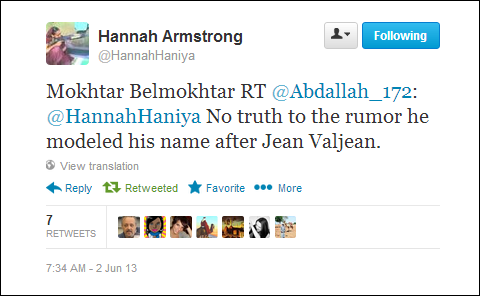
First, there was the parallel between the names Mokhtar Belmokhtar and Jean Valjean (above). If you’re hunting either fellow, the parallelism isn’t going to yield a useful clue — but the mode of recognition is what matters, and the reason its such a rare mode is precisely because it’s playful. It plays with forms — in this case, the forms of the two names — without regard for practicality.

And yet this playful spirit is what brought us Weil‘s conjecture and Pierre Deligne‘s Abel Prize, and the Taniyama-Shimura conjecture and Wiles‘ proof of Fermat’s Last Theorem.

Serious playfulness is key… to serious, magical breakthroughs. In any and all domains.

*

With that in mind, here are the rest of the patterns I recognized in todays feed.

Let’s start with self-reference, which can hardly get more succinct than the hackers hacked:

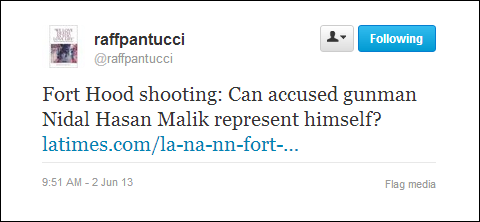
There’s also a self-referential paradox at work in the question of a defendant appearing in his own defense — something that gives judges pause, because they see how tightly the serpent is chasing its own tail. Defendant defends self, From Raff Pantucci:

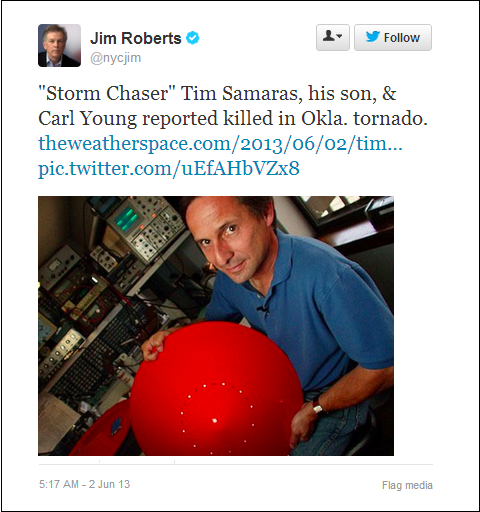
The saddest self-reference of the morning’s tweets was this one, which could be encapsulated as storm-chaser chased by storm:

Even tragedy can take self-referential form.

**

But lets move on to Turkey, which provided a rich dividend:

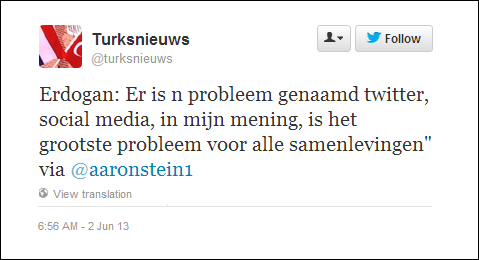
There was this problem:

Turkish I couldn’t read, Dutch I can more or less make out — but for an English tweet making the same point let’s go to Zeynep Tufekci, who has expertise in both matters Turkish and matters Internet, and tweets about Erdogan disapproving of tweeting:

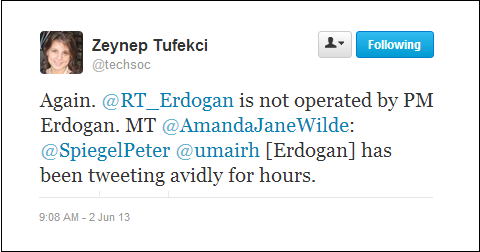
Tufekci again, this time catching an even neater self-reference which doesn’t quite pan out — because, as she says, PM Erdogan is not the same as @RT_Erdogan:

**

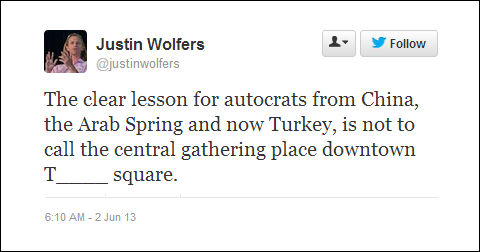
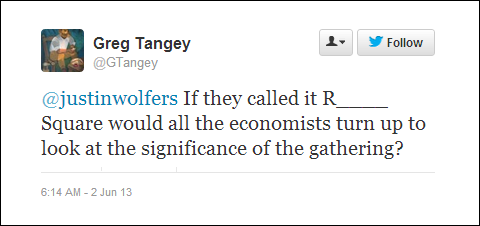
While we’re on Turkey, this tweet about Tienanmen, Tahrir and Taksim Squares gave us another example of a bright mind catching a hint of pattern…

And what a neat rejoinder!

All of the above is quite useless, entirely playful — and of deep interest if creativity and insight matter

**

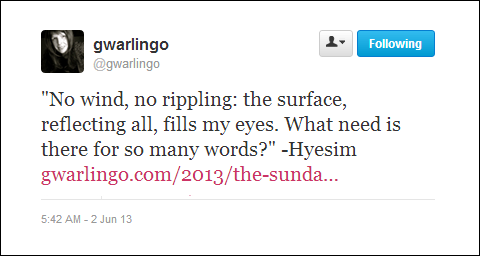
Finally, I’d like to go someplace quiet and bathe in peace. This tweet, featuring a poem by a Korean zen master, does the trick nicely:

AN appreciative bow to Gwarlingo for that one…

Of images and likenesses

Thursday, May 30th, 2013

[ by Charles Cameron — a storm in a tea-kettle, various resemblances to Hitler, how Pudovkin perceived and practiced montage, what happened when the talkies came along, and four faces of Christ ]
.

It begins with something as innocent ad a tea kettle:

Does this otherwise innocuous tea kettle resemble Hitler? Does it look enough like Hitler to merit JC Penney withdrawing it from sale?

**

Let’s take a look at a couple of other “resemblances to Hitler”:

Who most resembles Hitler — Chaplin, or Stalin?

On the face of it, that’s an easy question. If I were to just ask you the question “who is most like Hitler” in words, you might very well say Stalin, or Pol Pot perhaps — or, I suppose, if you were very focused on World War II and the Axis leaders, Mussolini.

And if I asked you “who looks most like Hitler?” you might well say Charlie Chaplin — but you’d be “thinking visually” in terms of appearances, rather than “verbally” in terms of meanings.

So there are at least two different ways someone can resemble Hitler — in terms of appearance, and in terms of behavior.

**

We don’t notice our own noses most of the time, even though they’re within our field of vision — and it’s a bit like that with likeness. We don’t have a grammar of resemblance, and that’s part of what I want to explore here, in drawing your attention to these two ways (at least) in which we can think of someone resembling Hitler.

Placing two pictures side by side — Charlie Chaplin and Hitler, Hitler and Joseph Stalin — gets us to think a bit about the parallelisms and oppositions. And that’s a large part of what my DoubleQuotes format is good for. I am interested in what the mind does with juxtapositions, and I’m interested in getting us able to hold two contrasting thoughts in mind at the same time. As F Scott Fitzgerald said:

The test of a first-rate intelligence is the ability to hold two opposed ideas in mind at the same time and still retain the ability to function.

I’m in two minds as to whether he’s right, of course.

**

So montage. So the beginnings of Russian cinema, and the great directors of the silent era in film, Vsevolod Pudovkin and Sergei Eisenstein.

Pudovkin wrote quite a bit about montage, about what he called relational editing, telling us:

editing is not merely a method of the junction of separate scenes or pieces, but is a method that controls the “psychological guidance” of the spectator.

He talked about five modes of editing, getting close to the foundations of a grammar of resemblance of the kind I mentioned above — contrast, paralleliem, symbolism, simultaneity and leit-motif. He said, for instance:

Suppose it be our task to tell of the miserable situation of a starving man; the story will impress the more vividly if associated with mention of the senseless gluttony of a well-to-do man.

and went on:

it is possible not only to relate the starving sequence to the gluttony sequence, but also to relate separate scenes and even separate shots of the scenes to one another, thus, as it were, forcing the spectator to compare the two actions all the time, one strengthening the other.

Under the heading of Symbolism, he noted:

In the final scenes of the film Strike the shooting down of workmen is punctuated by shots of the slaughter of a bull in a stockyard. The scenarist, as it were, desires to say: just as a butcher fells a bull with the swing of a pole-axe, so, cruelly and in cold blood, were shot down the workers.

I don’t suppose I’m alone in thinking here of the ending of Coppola‘s Apocalypse Now — and I doubt Coppola would have been unaware of the tribute he was paying to one of the early masters of cinematography, either. And what doe Pudovkin say about the symbolic editing together of the shooting of workmen punctuated by the slaughter of a bull?

This method is especially interesting because, by means of editing, it introduces an abstract concept into the consciousness of the spectator without use of a title.

**

All this, of course, during the silent era. And when the talkies begin…

After the advent of the talking pictures, Eisenstein, Pudovkin, Alexandrov and Vertov issue a statement, attempting to salvage the emotional impact of montage which is in danger of being capsized by the oh so new and glittery charm of verbals — of people talking:

Only a contrapuntal use of sound in relation to the visual montage piece will afford a new potentiality of montage development and perfection.

The first experimental work with sound must be directed along the line of its distinct nonsynchronization with the visual images. And only such an attack will give the necessary palpability which will later lead to the creation- of an orchestral counterpoint of visual and aural images

You see what’s going on here? Eisenstein, Pudovkin, Vertov want the mind to be working on two tracks of ideation at once — a visual track, full of emotional impact, and a verbal track, in counterpoint to the visual.

They want us to be able “to hold two opposed ideas in mind at the same time” — not in synchrony but in counterpoint.

So this business of juxtaposition, of contrapuntal thinking, goes quite deep, and it’s my contention that it’s a skill we need both to develop and to understand — hence my interest in building a grammar of resemblance, of rhyme, of fugue, of graphic match, of equation.

**

One final example. If the “likeness of Hitler” example confronted us with the “nature of likeness” as between facial resemblance and similarities of behavior, this next instance will deal more with “evidence of likeness”:

Here’s the question: are these “real” likenesses?

**

The two likenesses above are both of interest as possible “likenesses of Christ” — the top one taken from the Shroud of Turin, the lower one allegedly photographed in the snow, perhaps in China. The image on the Shroud might be a sort of “photographic negative” of the actual face of man a crucified two thousand years ago — and scientific techniques may or may not offer us evidence as to that likelihood. The other image — supposedly of the face of the same Christ, this time seen and recognized by a photographer in shadows on snow — how does one check the provenance of an image like that?

We don’t have a photographic record of what Christ looked like to compare our own images with — unless the Shroud turns out to offer us just that — so it’s likely we’re back at the distinction first drawn by theologians over a century ago, between “the Jesus of History” and “the Christ of Faith”.

Consider the two images below, neither one perhaps what a camera might have seen if a photographer could time-travel back two thousand years, but each suited to the people for whom it was produced — in China, in Africa:

The Christs these two images evoke come from a different mode of seeing to the images captured in biometric scans and on ID cards — yet they are well-suited for devotion and inspiration…

A hop and a skip, YouTube-style

Saturday, May 25th, 2013

[ by Charles Cameron — on a brief random walk through YouTube, an ambulation for a sedentary soul — nothing serious, I promise ]
.

Back when I was a wee lad at Oxford there was another wee lad, also of a poetic disposition, named Heathcote Williams. For some reason, the other evening I stumbled on a clip of Heathcote performing the role of a psychiatrist in a movie I haven’t seen, but will probably keep an eye out for.

Here’s that (somewhat ob)scene:

Well, I’m the nomadic type, and my eye somehow strayed from there to this:

Okay? I get the sense I’m on a roll here, Salma Hayek is compellingly beautiful, and so I compulsively gamble away a few more minutes of my precious time, and find… You’ll forgive me, I hope, and see this clip through to the end, because in its own light-hearted way it’s about miracles.

And as you know, I have theological interests:

**

So that was my evening’s delectation a couple of days ago, delivered here today for yours.

If, however, you are willing to take a grander leap into anti-monarchical, pro-poetic, anti-theological polemic, you might take a look at Heathcote’s fiery account of Shelley, his volatile predecessor at Oxford, in seven parts beginning on YouTube here: Shelley at Oxford.

Heathcote takes the liberty of speaking his mind, and consequently several of my own sacred cows get scorched to steak along the way — you have been warned.


Switch to our mobile site