zenpundit.com » movies

Archive for the ‘movies’ Category

Numbers by the numbers: Twone?

Saturday, November 10th, 2012

[ by Charles Cameron — parallels and opposites, with a pinch of Shakespeare and a digression into philosophical theology ]
.

My friend Peter Feltham steered me towards an intriguing Telegraph piece about something called the Rolling Jubilee project. The accompanying image caught my eye —

because it reminded me of another image I’d seen years ago, when I took a class in movie directing at UCLA extension.

The upper image (above) illustrates the Telegraph piece, which depicts the Rolling Jubilee thus:

The Rolling Jubilee project is seeking donations to help it buy-up distressed debts, including student loans and outstanding medical bills, and then wipe the slate clean by writing them off.

The lower image is from Jean-Luc Godard‘s film, La Chinoise, which is apparently about a bunch of French Maoist radicals in the 1960s — the “wall” in the image is made of countless copies of Chairman Mao‘s Little Red Book.

And bundles of twenty dollar bills are pretty much the intellectual opposite of stacks of Little Red Books, no?

**

So what? Where do we go from here? Is there anything actionable about those two images?

Does the lower one mean the Rolling Jubilee project is Maoist? Or that capitalism has triumphed over Marxism in the 45 years since Godard’s film was produced? In China? Or in the world at large? Or (ironically?) that capitalism, like communism, is a failed system? That there’s a Hole in the Wall?

Should we be thinking of Pyramus and Thisbe, the play within a play in Shakespeare‘s Midsummer Night’s Dream?

This man, with lime and rough-cast, doth present
Wall, that vile Wall which did these lovers sunder;
And through Wall’s chink, poor souls, they are content
To whisper.

Is there idea that there’s a chink in Wall Street?

**

I’m asking all this because we can take all manner of conclusions from a juxtaposition — it naturally lends the mind to associative thinking, extrapolation, the derivation of one or more meanings. And I surely want to emphasize the “or more” here.

But also because it brings up, with force, the issue of parallels and oppositions.

We don’t say Oxford is the opposite of a Fouquieria columnaris cactus in the Huntington Gardens — they’re too disparate to be opposite. No, we think of Cambridge as the opposite of Oxford because they’re so similar, they’re almost the same — as I’ve said elsewhere on ZP, there’s even a single word for both: Oxbridge.

Opposites are similars with difference, while parallels are differents with similarities — and is that one insight, or two?

We talk about a “two-way street” — in city traffic terms, that’s just one street, but the traffic flows in two directions — and it’s probably best to keep ’em separate.

**

Zoom in, and you’ll see differences, zoom out, and you’ll see samenesses — is that true? true when applied to concepts, debates, arguments, elections, partisanship, wars? day and night? sun and moon? war and peace? life and death?

Apples and oranges?

I don’t think we’re terribly good at thinking about this sort of thing — and I also think binary thinking is both a primary and a frequently divisive factor in the human condition, so we’d best get better at it.

Sun and moon are an interesting pair, because even though they are vastly different both in size and distance from our planet, they each subtend almost exactly the same angle on the eye — thus allowing for the brilliant halo effects of full eclipses of the sun.

Alchemists see in that sameness a marriage of opposites or coincidentia oppositorum. But here’s my pair of questions for you:

  • is that similarity a matter of entirely random coincidence, or is it evidence of immaculate care and design?
  • and how different would the entire history of human belief be, if the moon and sun were not even close to the same as each other in (apparent) size?
  • For one thing, if the moon seemed smaller than the sun, we’d have no total solar eclipses — the impact of that alone would be interesting to consider.

    Form is Insight: the project

    Monday, October 22nd, 2012

    [ by Charles Cameron — about the (not yet titled) book (or post-book project) i seem to be writing, which offers a grand slam intro to an array of box-free contemplative and artistic approaches to creative thinking, and hence opens fresh angles on intelligence ]
    .

    One thing I can promise: whatever this project turns out to be, it won’t be predictable.

    credit for this incredible image: Roger Dean

    .

    This project won’t take you over familiar territory, congratulating you on holding the same opinions as the author and adding in enough choice details to keep you interested. I’m not aiming to teach you the same thing you already know, only better, more interestingly, more precisely, or in greater detail. I’m aiming to question you, challenge you, and give you a whole new range of optics through which to view the world.

    **

    So, here we go.

    I think I am finally at the point where the book (or whatever it is) I’ve been gathering inside me all these years is ready to be written. Some of it has already emerged in earlier posts here on Zenpundit — you don’t known and couldn’t count how many thanks, Mark — and this is certainly where I’ve been developing the style of integrated visuals and verbals that gives the project its flavor — so I’d also like to use my posts here to discuss the thing with you as I go along.

    The project is about intelligence in the widest sense, including heart and mind, and with particular focus on creativity. I’m addressing this from two standpoints that mesh together well, and I’m addressing it to two audiences that I believe also mesh together well.

    The standpoints are (i) meditation and (ii) the arts, and the audiences are (i) the “intelligence community” and (ii) bright people in general.

    I believe that meditation cultivates a spacious mind-set in which we can hold multiple concerns in mind at the same time – the opposing needs of different people, stakeholders, sections of society, the environment, etc – thus seeing things from multiple angles and in balancing & thus balanced ways. And I think the arts serve as the primary means for expressing these balances with all their nuances and shadings, and that techniques from within the arts such as polyphony, chiaroscuro, formal constraint and pattern can teach us to shape multi-faceted insights like these into rich and complex understandings – complex patterns that respond to complex situations. I’ll go into all this in detail as we move along, with examples.

    I also believe that this kind of creatively patterned insight — embodying artistic methodology in the context of complex problems with a “fresh” and open mind – will be of interest beyond the intelligence agencies and policy-makers, to business people, artists, and also — importantly — the bright general public, which I take to be a far larger subset of the population than we commonly think, and always eager for reading that doesn’t talk down to them but appreciates their own intelligence and good will.

    For now let me just say that I’m very excited, because this seems (at last) to be a project that ties together my game-work with Sembl, the think-tank side of me which has been monitoring religious violence, jihad and terror and working towards nuance, understanding and peace these last dozen years — and my sense of creativity as a writer and poet.

    Ripeness is all: I suspect the time for this venture has arrived.

    **

    Here’s the single page overview I’ve written, with a working title:

    Intelligence is Zen: understanding our complex world with koans in mind

    Just a few days ago, the Director of National Intelligence, James Clapper, referenced Pirsig‘s book, Zen and the Art of Motorcycle Maintenance, as key to the Intelligence Community’s work in understanding and adapting to the many, varied, intersecting problems we face in the world today. As I noted, Clapper was focused a bit more on the biker wisdom than the Zen to be found in Pirsig’s book, but he does raise a question I’ve been addressing for some years now:

    What does the contemplative mind have to offer in terms of understanding a complex world?

    To my mind, the creativity which is all the buzz of the business world, aimed at solving what are called “wicked problems” — problems that feature multiple stakeholders with multiple aims and objectives, aims and objectives which themselves shift over time so the problems are “never the same river twice” – requires a major mental and emotional shift. Reverie and meditation free us up to make the shift: the shift itself is poorly understood.

    Our present, mostly linear way of thinking favors either/or side-taking, dubious cause-and-effect expectations which fail to take complex feedback loops into account, followed all too often by a rush to judgment. We need a whole new – old, even ancient – way of thinking.

    Our problems are complex because they overlap, they ripple through one another. In Buddhist terms, they are “interdependently arising.” Not surprisingly, the way of thinking that is required to gain a deeper insight into “interdependently arising” problems can be found in explicit form in such contemplative traditions as Madhyamika & Zen, Taoism, Sufism, and their Abrahamic contemplative analogs. At the heart of these systems is fresh thinking – thought refreshed by quiet.

    Furthermore, the shaping of insights in an open field of thought is something the world’s artistic traditions have long dealt with, and there are schools of insight not just available but recorded in exquisite detail in the world’s traditions of poetry, music, painting, theater, film… in patterns that are found in nature, in culture, and in the very turbulence we now must learn to flow with.

    The project therefore takes a meditation-influenced approach to intelligence, both in the sense in which Clapper would use the word, relating to the intelligence analysis which develops and influences our decision-makers’ understanding of what’s needed, and in the more general sense of those capable folk with bright minds, keen insights, sharp instincts, warm hearts.

    I’ll propose a series of ways of looking differently – with application for anyone, whether artist, intel analyst, businessman, policy-maker, or lover – that cut to the essence of creativity: lateral, analogical, holistic thinking, witnessing pattern beneath the surface of things. My examples will be mainly drawn from terrorism, which I have been monitoring for a dozen years: my style is that of a poet and an eccentric Englishman.

    My subtext, my subliminal message, will be contemplation and artistry as profound common sense.

    Of films, riots and hatred III: Scorsese and Verhoeven

    Monday, September 17th, 2012

    [ by Charles Cameron — The Last Temptation of Christ troubles, an early warning re the upcoming Jesus of Nazareth movie — the blood libel and more ]
    .

    American and European Christians, too, can react violently to films they perceive as blasphemous, and this too we should remember as we weigh our own responses to the rioting in Cairo and elsewhere.

    Martin Scorsese‘s Last Temptation of Christ gives us a sense of how modern American and European Christians can react to perceived blasphemy, while the forthcoming Paul Verhoeven movie of his own book Jesus of Nazareth will test the degree to which we’ve learned the lessons of a quarter century ago — and of this last week.


    .

    **

    Martin Scorsese’s The Last Temptation of Christ: stirred strong feelings when it opened. I was in LA at the time, and was following the controversy fairly closely having attended an early screening, and having both literary and theological interests.

    The short video clip below is a little choppy, it doesn’t make it particularly clear that the clips you see are from the film Martin Scorsese made of a novel — written by the Nobel laureate Nikos Kazantzakis — which makes no attempt nor pretense to be a historical or religiously orthodox portrayal of Christ. IMO, it is worth watching for the glimpse it gives of just how strong the undercurrents of emotion aroused by Scorsese’s film were at the time:

    **

    I’m bringing this subject up and attending to it in some detail because NBC World News mentioned Martin Scorsese’s movie on the 13th of this month, in an explanation as to Why films and cartoons of Muhammad spark violence, but without gwetting the picture quite right:

    Director Martin Scorsese’s adaptation of a book by the same name showed Jesus struggling with lust, depression and doubt, and engaging in sex — in his imaginings — before snapping back to reality and dying on the cross. That movie was seen as blasphemy by some Christians, who — though not violent — were vocal enough to prevent the film from being shown in many parts of the United States.

    There may have been no violence done to humans in the US — but there as certainly damage to property, and some vicious threats made, as The Encyclopedia of Religion and Film records:

    At the Cineplex Odeon Showcase Theater in New York City, vandals slashed seats and spray-painted threats aimed at the chairman of MCA: “Lew Wasserman: If you release ‘The Last Temptation of Christ,’ we will wait years and decimate all Universal property. This message is for your insurance company.”

    In parts of Europe, the violence was more intense:

    Overseas, at the September 28 opening in Paris, demonstrators who had gathered for a prayer vigil threw tear gas canisters at the theater’s entrance. Catholic clergy led rock-throwing and fire-bombing assaults on theaters in many French municipalities. A thousand rioters in Athens trashed the Opera cinema, ripping apart the screen and destroying the projection equipment.

    In Paris, specifically, the violence severely injured some human targets. From Wikipedia (with their footnotes removed — you can track the various quotes from the original page):

    On October 22, 1988, a French Christian fundamentalist group launched Molotov cocktails inside the Parisian Saint Michel movie theater while it was showing the film. This attack injured thirteen people, four of whom were severely burned. The Saint Michel theater was heavily damaged, and reopened 3 years later after restoration. Following the attack, a representative of the film’s distributor, United International Pictures, said, “The opponents of the film have largely won. They have massacred the film’s success, and they have scared the public.” Jack Lang, France’s Minister of Culture, went to the St.-Michel theater after the fire, and said, “Freedom of speech is threatened, and we must not be intimidated by such acts.”

    The Catholic response — from the Cardinal Archbishop of Paris among others — reproved both the blasphemy and the rioting:

    The Archbishop of Paris, Jean-Marie Cardinal Lustiger, said “One doesn’t have the right to shock the sensibilities of millions of people for whom Jesus is more important than their father or mother.” After the fire he condemned the attack, saying, “You don’t behave as Christians but as enemies of Christ. From the Christian point of view, one doesn’t defend Christ with arms. Christ himself forbade it.” The leader of Christian Solidarity, a Roman Catholic group that had promised to stop the film from being shown, said, “We will not hesitate to go to prison if it is necessary.”

    There was apparently a connection with French far-right politics, too:

    The attack was subsequently blamed on a Christian fundamentalist group linked to Bernard Antony, a representative of the far-right National Front to the European Parliament in Strasbourg, and the excommunicated followers of Archbishop Marcel Lefebvre. Lefebvre had been excommunicated from the Catholic Church on July 2, 1988. Similar attacks against theatres included graffiti, setting off tear-gas canisters and stink bombs, and assaulting filmgoers.

    There were legal proceedings following the Saint Michel incident, and it’s notable that Fr. Gérard Calvet OSB, founder and Prior of the Benedictine Abbaye Sainte-Madeleine du Barroux, testified at the tribunal on behalf of the convicted youths, describing their motives if not their mode of expression as “noble”. Would that term be equally applicable to protesters of blasphemies against other faiths? We now live in a dense-packed world where such comparisons are easily made.

    Let’s pause for a minute over the twinned remarks of the late (and widely respected) Cardinal Lustiger concerning Last Temptation

    Jean-Marie Cardinal Lustiger, said “One doesn’t have the right to shock the sensibilities of millions of people for whom Jesus is more important than their father or mother.” After the fire he condemned the attack, saying, “You don’t behave as Christians but as enemies of Christ. From the Christian point of view, one doesn’t defend Christ with arms. Christ himself forbade it.”

    and compare the remarks of a similarly authoritative religious figure in Libya to the Innocence of Muslims video:

    Libya’s Grand Mufti, Sheikh Sadeq Al-Ghariani, has issued a fatwa condemning Tuesday’s killing of US Ambassador Chris Stevens along with three other American diplomatic staff and a number of Libya security guards. He said those involved were criminals who were damned by their action.

    He also condemned the production of any film, picture or article insulting the Prophet Mohammad or any of the prophets by “extreme fanatics” in the US or elsewhere. The Prophet Muhammad, Ghariani said, had specifically forbidden the killing of ambassadors and envoys.

    **

    Almost a quarter century has passed since Scorsese’s movie opened, but as I said above, we will soon have an opportunity to show what we have learned from those lamentable events in Paris and the more recent tragedies in Benghazi, Cairo and elsewhere.

    Paul Verhoeven — the director of such blockbusters as RoboCop, the original Total Recall, and Basic Instinct — has raised the financing for his upcoming movie Jesus of Nazareth, based on his book of the same name, and scripted by Roger Avary, who shared an Oscar with Quentin Tarrentino for their Pulp Fiction screenplay.

    Verhoeven, be it noted, is not only a writer and movie director, but also a member of the Jesus Seminar — a group of scholars which, as Wikipedia nicely puts it, “treats the canonical gospels as historical sources that represent Jesus’ actual words and deeds as well as elaborations of the early Christian community and of the gospel authors” and prepares color-coded editions of the gospels suggesting which sayings of Jesus should be considered original, and which are better understood as later additions.

    Here, to give you an idea of what may be on the horizon, is an excerpt from a quick and informal take on the upcoming movie by an admirer of Verhoeven:

    Deadline reports that the legendary Paul Verhoeven — a guy who, amazingly, only directed three movies in the past fifteen years — has received financing to adapt his own book, Jesus of Nazareth, which discounts every mythical story surrounding Christ and, instead, opts to present him as a simple human figure with a message powerful enough to radiate throughout time. Roger Avary (Tarantino‘s story partner on Pulp Fiction) will write the film, while Muse Productions are doing the proper backing.

    Almost any work going against the long-held Biblical grain will get groups up in arms — no, I don’t even need to provide examples — but the claims of Nazareth are, even in this context, still mighty contentious. Most notable is the idea that Jesus is not the son of God, but was actually the product of Mary being raped by a Roman soldier; so, right off the bat, you’re discounting the entire foundation of his story.

    I am pointing this out because right now would be a good time for the various churches to begin a general conversation about the film-maker’s right to hold an opinion, write a book and make a movie, the hurt that may be felt by believers, and the importance of responding without hatred or violence when offended.

    **

    In our concern with matters of Christian and Muslim issues, let us not lose sight of the fact that Jews too have movies made about them that may not only hurt feelings but also represent real threats against them, reminiscent of Nazi and earlier Russian antisemitic propaganda fabrications.

    From the copious “blood libel” entry in Wikipedia:

    In 2003 a private Syrian film company created a 29-part television series Ash-Shatat (“The Diaspora”). This series originally aired in Lebanon in late 2003 and was broadcast by Al-Manar, a satellite television network owned by Hezbollah. This TV series, based on the antisemitic forgery The Protocols of the Learned Elders of Zion, shows the Jewish people as engaging in a conspiracy to rule the world, and presents Jews as people who murder Christian children, drain their blood and use this blood to bake matzah.

    MEMRI has a report with further details, and a MEMRI clip of the scene in which a Christian child is killed by Jews has been posted on YouTube, with the comment:

    Al-Shatat: Jews Murder A Christian Child and Use His Blood for Passover Matzos. anti Semite Arab propaganda against Jews, Judaism and Israel.

    The following is a scene from the Syrian-produced TV series Al-Shatat. Al-Shatat was first aired on Hizbullah’s Al-Manar TV during the month of Ramadan 2003, and then on two Iranian channels during Ramadan 2004. Al-Mamnou’ TV, a new Jordanian channel, is airing Al-Shatat during Ramadan 2005.

    It is worth recalling, too, that Mel Gibson‘s film, The Passion of the Christ, was perceived by many Jews, Christians and others as anti-Semitic — and that nonetheless the Orthodox Jew and conservative movie critic Michael Medved wrote:

    The possibility of anti-Jewish violence in response to the film has been irresponsibly emphasized and has become, self-fulfilling prophecy. In parts of Europe and the Islamic world, anti-Semitic vandalism and violence occur daily, and hardly need a film by a Hollywood superstar to encourage them. In this context, Jewish denunciations of the movie only increase the likelihood that those who hate us will seize on the movie as an excuse for more of hatred.

    **

    I trust it is not too late to wish our Jewish readers l’shana tova: may your apples be dipped in honey and all our days bathed in peace.

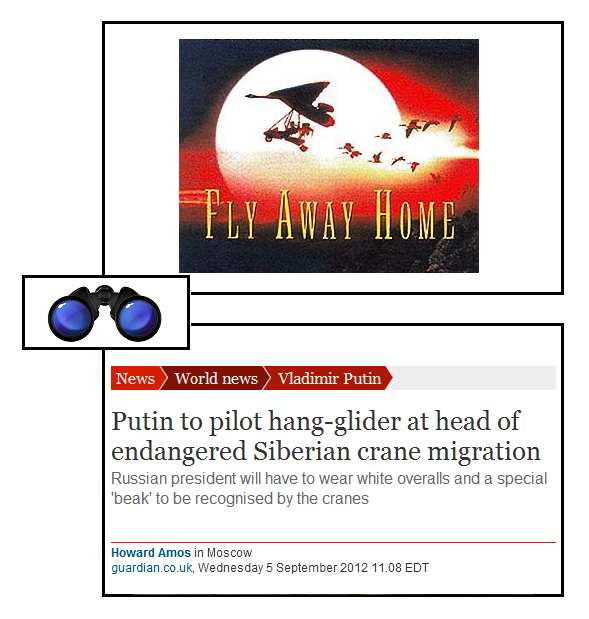
    Fly away home, 007

    Thursday, September 6th, 2012

    [ by Charles Cameron — Putin the Magnificent and his gaggle of geese ]
    .

    --- upper image from the motion picture soundtrack album

    In the film version, according to Wikipedia, there’s “an emergency landing at a U.S. Air Force base on Lake Ontario”

    **

    [ nothing too original here, the Guardian story mentioned the film ]

    The Anonymous movie Top Ten

    Saturday, August 25th, 2012

    [ by Charles Cameron — Anonymous use of sound clips from movies ]
    .


    .

    Taste in movies varies. As the Hollywood Reporter reported just the other day:

    Orson WellesCitizen Kane no longer enjoys the moniker of greatest film of all time, a plaudit it has held for 50 years. The movie has occupied top billing in the British Film Institute-published magazine Sight & Sound‘s once-a-decade international critics’ film poll since 1962. But that crown, according to Sight & Sound‘s 2012 survey of 846 movie experts who participate, has now passed to Alfred Hitchcock’s Vertigo.

    I thought it might be interesting to look at the recently released Anonymous YouTube video encouraging people to do whatever it is they do — “only you know what is right for yourself” — at the Republican National Convention.

    To see where their taste in movies takes us.

    I’ll include a few screen shots and some of their own techno-voice commentary, but it’s only the borrowed clips I’m really after — taking a look at what they choose to quote, what they leave out, and where there may be questionable truths or conflicting assertions.

    **

    Their opening line is:

    Greetings, world. We are Anonymous.

    Then, over some chest-thumping music, one of those rotating globe thingies that let’s you know what’s coming next is Important — the Onion has a good one — resolves into the Anonymous question mark logo:

    A techno-voice speaks:

    We are not terrorists, but are your greatest allies. We wish to liberate you from suppression and oppression, and no matter how many of us fall in battle, Anonymous cannot be defeated. We are Anonymous, we are legion, we do not forgive, we do not forget. Expect us.

    Then, in white text over some groovy graphics:

    Each of us has our own path but each of us share the same goal… a free Humanity. Together we stand…

    The groovy graphics then add a small inset frame from Tonight, on CNN Presents, very cool:

    The clip has some neat journo-thrilled-to-be-important-speak:

    Anonymous — they live in the shadows.

    an (anonymous) quote:

    This is the closest thing to a global revolution that we have ever gotten.

    and more journo-thrill:

    But their message and tactics have ignited a movement around the world.

    We then cut, after some thunder-like sounds, to a mechanical nodding and smiling anonymask speaking in techno-voice:

    We are the ideology of truth , we are uncompromising, we are the most powerful underground resistance the world has ever seen. We were once a minority but now we are the majority. No matter how hard they try they cannot stop us now.

    It’s right around here that things get filmic.

    We have Al Pacino as Tony D’Amato in Any given Sunday, voice over:

    We’re in hell right now, gentlemen. Believe me. And, we can stay here, get the ** kicked out of us, or we can fight our way back into the light. We can climb outta hell… one inch at a time.

    More of the mech-nodding techno-voice:

    We all are angry, very very angry…

    Which segues nicely into Peter Finch as Howard Beale in Paddy Chayevsky‘s Network saying, over images of one guy jumping on the roof of a cop car and others smashing the windows:

    I want you to get mad! … First you’ve got to get mad. You’ve got to say, ‘I’m a HUMAN BEING, God damn it! My life has VALUE!’ … I want all of you to get up out of your chairs. I want you to get up right now and go to the window. Open it, and stick your head out, and yell, ‘I’M AS MAD AS HELL, AND I’M NOT GOING TO TAKE THIS ANYMORE!’

    Classic!

    More inspirational movie sound clips follow in voice over.

    There’s Sylvester Stallone as Rocky Balboa in Rocky Balboa:

    But it ain’t about how hard ya hit. It’s about how hard you can get it and keep moving forward. How much you can take and keep moving forward. That’s how winning is done! Now if you know what you’re worth then go out and get what you’re worth. But ya gotta be willing to take the hits,

    Vince Lombardi — I’m not sure where this one comes from, a newsreel perhaps?

    I firmly believe that any man’s finest hour, the greatest fulfillment of all that he holds dear, is the moment when he has worked his heart out in a good cause and lies exhausted on the field of battle – victorious

    Winston Churchill — yes, the late military historian and Conservative Prime Minister of the undaunted British, addressing the boys of Harrow (a private school roughly equivalent to Phillips Academy or Groton in the US):

    Never give in, never give in, never, never, never, never-in nothing, great or small, large or petty – never give in except to convictions of honour and good sense. Never yield to force; never yield to the apparently overwhelming might of the enemy.

    — spoken with true British upper-class schoolboy fortitude!

    Then we go back back to Anonymous’ own text, noting that “main stream news media”:

    have labeled us all as domestic terrorists. We are here to tell the public to not be afraid of Anonymous, to not be afraid of Black Block or [techno-mumble] Block. Our aim is not to cause violence to the public. We are no danger at all to American citizens. The people of america need to know we are on their side. We fight for true freedom, we take a stand for the hungry, the poor, the suffering citizens of this country, who are sick of politicians doing what they please at our expense.

    The only difference between us and protesters of the past is that we believe in fighting for our rights. We indeed are not pacifistic: if the oppressors fight us we will fight back ten-fold. … Do not believe the lies your government feeds you. Instead, join us at RNC and take a stand with us. United by one, divided by zero.

    Okay, that’s the invitation. And then, whoosh back into an American (I suppose you might say) equivalent to the Churchill news clip — this one from MLK, complete with the original visual:

    I have a dream, that one day this nation will rise up..

    Another classic! But we’ll talk about that a bit later.

    Next up, over video of cops in riot gear, we have Will Smith as Christopher Gardner in The Pursuit of Happyness:

    Don’t ever let somebody tell you… You can’t do something. [ … ] You got a dream… You gotta protect it. People can’t do somethin’ themselves, they wanna tell you you can’t do it. If you want somethin’, go get it. Period.

    And Kurt Russell as Herb Brooks in Miracle, over an image of the streets aflame:

    Great moments, are born from great opportunity. And that’s what you have here, tonight.

    Okay, we’re coming to the close. The music shifts to some semi-classical piano, and the nodding technanonymity says a few words… then, over some tranquil shots of the globe we live on…

    Billy Bob Thornton as Coach Gaines in Friday Night Lights tells us:

    Being perfect is about being able to look your friends in the eye and know that you didn’t let them down, because you told them the truth. And that truth is that you did everything that you could. There wasn’t one more thing that you could’ve done.

    Can you live in that moment, as best you can, with clear eyes and love in your heart? With joy in your heart?

    Fade…

    **

    Okay, we got — what? American football, boxing, hockey, a Conservative politician, a non-violent Civil Rights leader, a salesman-entrepreneur, lots of police and rioting, no military that I could detect, unless you count Churchill’s speech…

    Funnily enough, V for Vendetta (image at the top of the post) isn’t among the movies they’ve clipped from, although the Anonymous mask is a Vendetta Guy Fawkes mask.

    Interesting that in the quote from Network, after the words “I want you to get mad!” and before “first you’ve got to get mad” they’ve omitted the words:

    I don’t want you to protest. I don’t want you to riot…

    Funny that in quoting Any Given Sunday, they chose a version that has “shit” bleeped out of the soundtrack, so Pacino says:

    We’re in hell right now, gentlemen. Believe me. And, we can stay here, get the ** kicked out of us, or we can fight our way back into the light…

    Funny that they say:

    The only difference between us and protesters of the past is that we believe in fighting for our rights. We indeed are not pacifistic: if the oppressors fight us we will fight back ten-fold.

    and then quote Martin Luther King Jr, the Gandhian practitioner of satyagraha

    Funny that they say, “now we are the majority” and a little later, “we can not win this fight alone”.

    Ooh! And that’s a great (math) line at the end, though I don’t know quite what it means:

    United by one, divided by zero.

    **

    I’m more of a Gandhian, pacifistic, lay down on my back and let them roll over me, foolish school myself — and I don’t watch many sports movies, so I wasn’t the ideal target audience here.

    The Martin Luther King speech might just take my “best documentary” award. And I’m with the critics on Vertigo.

    **

    Look, you close with the question:

    Can you live in that moment, as best you can, with clear eyes and love in your heart? With joy in your heart?

    While you are “very, very angry”? I don’t know, I’m inclined to doubt it. But I’m pretty sure that if, as you claim, you “don’t forgive” you can’t.

    That’s just not the way “love in your heart” works.


    Switch to our mobile site