zenpundit.com » scriptures

Archive for the ‘scriptures’ Category

Serpent logics: the marathon

Sunday, November 24th, 2013

[ by Charles Cameron — oh, the sheer delightful drudgery of finding patterns everywhere ]
.

I’ll start this post, as I did the previous one to which this is a sort of appendix, with a (deeply strange, tell me about it) example of the…

Matrioshka pattern:


That’s a piece of jewelry made out of disembodied pieces of Barbies from the extraordinary designer’s mind of Margaux Lange, FWIW.

**

This post is the hard core follow up to my earlier piece today, Serpent logics: a ramble, and offers you the chance to laugh and groan your way through all the other “patterns” I’ve been collecting over the last few months. My hope is that repeated (over)exposure to these patterns will make the same patterns leap out at you when you encounter them in “real life”.

Most of the examples you run across may prove humorous — but if you’re monitoring news feeds for serious matters, my hunch is that you’ll find some of them helpful in grasping “big pictures” or gestalts, noting analomalies and seeing parallels you might otherwise have missed.

Have at it!

**

Here’s another Matrioshka, from the structural end of lit crit that my friend Wm. Benzon attacks with gusto over at New Savannah:

**

Enantiodromia:

You’ll recall this is the pattern where something turns into its opposite… as described in this quote from the movie Prozac Nation:

I dream about all the things I wish I’d said.
The opposite of what came out of my mouth.
I wish I’d said
“Please forgive me. Please help me.
I know I have no right to behave this way?”

Here are a few examples…

Ahmed Akkari Repents Violent Opposition to Danish Cartoons Lampooning Islam:

After a Danish newspaper published cartoons satirizing the Muslim Prophet Muhammad, Ahmed Akkari spearheaded protests that ultimately cost the lives of 200 people. Now he says he’s sorry. Michael Moynihan on what changed Akkari’s mind.

That’s impressive!

That one’s run of the media mill…

And this one’s from my delightful, delicious boss, Danielle LaPorte:

**

A friend sent me this:

**

Let’s just plough ahead…

Nominalism:

Nominalism is the category where the distinction between a word and what it represents gets blurry — a very significant distinction in some cases —

How’s this for naming your donkey after your President?

Consider this one, another instance of nominalism in action, from the French justice system:

A mother who sent her three-year-old son Jihad to school wearing a sweater with the words “I am a bomb” on the front, along with his name and ‘Born on September 11th’ on the back, was handed a suspended jail sentence on Friday for “glorifying a crime”. A court of appeal in the city of Nimes, southern France, convicted Jihad’s mother Bouchra Bagour and his uncle Zeyad for “glorifying a crime” in relation to the terrorist attacks in the United States on September 11th 2001.

The classic nominalist image — with which I’d compare and contrast the French three-year-old with the unfortunate name and tsee-shirt — is Magritte’s cdelebrated “Ceci n’est pas une pipe”:

And here’s one final nominalist example:

**

The spiral:

Here’s a potential downwards spiral, for those watching India:

**

Straight parallelism:

This one’s from Jonathan Franzen:

And meanwhile the overheating of the atmosphere, meanwhile the calamitous overuse of antibiotics by agribusiness, meanwhile the widespread tinkering with cell nucleii, which may well prove to be as disastrous as tinkering with atomic nucleii. And, yes, the thermonuclear warheads are still in their silos and subs.

**

Simple Opposition:

**

Some of these categories seem pretty fluid — or to put that another way, some of these examples might fit with equal ease into several doifferent categories. Here’s another oppositional class:

Arms crossed:

From Ezra Klein and Evan Solta blogging at WaPo’s Wonkbook: The Republican Party’s problem, in two sentences:

It would be a disaster for the party to shut down the government over Obamacare. But it’s good for every individual Republican politician to support shutting down the government over Obamacare.

A great “values” juxtaposition:

And hey, nice phrasing:

**

Here’s an example of one of the central patterns of violence and justice:

Tit for Tat:

[ the account this tweet came from, which was a media outlet for Shabaab, has since been closed — hence the less than euqal graphical appearance of this particular tweet… ]

**

And here, without too much further ado, is a whole concatenation of…

Serpents biting their tails:

[ … and that last one of Nein‘s appears to have been withdrawn from circulation ]

This one I love for its lesson on biblical pick-and-choose:

This one is also a DoubleQuote:

when closely followed by:

And this one really bites:

**

To close the series out with more of a bang than a whimper, here’s Serpent bites Tail with apocalypse & gameplay for additional spice:

Monk Wirathu’s 969 quotes the Dalai Lama’s Kalachakra

Sunday, October 27th, 2013

[ by Charles Cameron — a Buddhist instance of the widespread use of sacred texts as offering sanction for religious violence, with Muslims depicted as the enemy on this occasion ]
.

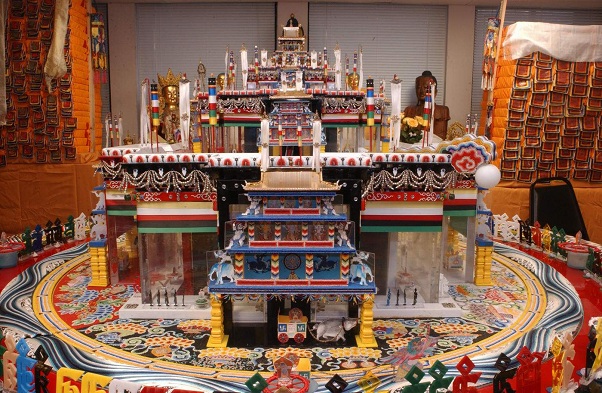
Three dimensional Kalachakra mandala by Arjia Rinpoche, photo credit kalachakranet.org

.

I have commented a couple of times on texts from the Kalachakra Tantra literature about a future war between Buddhism and Islam, first in In a time of Religious Arousal and later more fully in Apocalypse Not Yet? — and today I ran across a reference to the same texts on the web page of the 969 movement in Myanmar.

969 is the monk-led Buddhist movement which has been rioting recently against the Rohingya Muslims, and the monks concerned are Therevadins. The Kalachakra Tantra is the empowerment HH the Dalai Lama gives in the cause of peace, and the tantras are Vajrayana teachings. I think this para from the current Wikipedia article on Buddhism gives the relevant distinctions in a non-contentious form:

Two major branches of Buddhism are generally recognized: Theravada (“The School of the Elders”) and Mahayana (“The Great Vehicle”). Theravada has a widespread following in Sri Lanka and Southeast Asia (Cambodia, Laos, Thailand, Myanmar etc.). Mahayana is found throughout East Asia (China, Korea, Japan, Vietnam, Singapore, Taiwan etc.) and includes the traditions of Pure Land, Zen, Nichiren Buddhism, Tibetan Buddhism, Shingon, and Tiantai (Tendai). In some classifications, Vajrayana — practiced mainly in Tibet and Mongolia, and adjacent parts of China and Russia — is recognized as a third branch, while others classify it as a part of Mahayana.

I won’t go into the theological, philosophical and ritual differences, which are considerable, complex — and somewhat contested.

**

To refresh your memory of the relevant details regarding the Kalachakra’s treatment of “holy war”, here are my key paragraphs on the topic from Apocalypse Not Yet?:

Alexander Berzin has been tutored by HH the Dalai Lama and HHDLs own tutors on the interpretation of the Kalachakra Tantra, and served for some years as HHDL’s translator when HHDL was giving the Kalachakra initiation: indeed his book on the Kalachakra initiation carries a Foreword by HHDL.  His writings are thus among the most scholarly and trustworthy available in the western world on the topic of the initiation which the Dalai Lama will impart for world peace again this July.

Berzin’s words introducing the topic of Holy Wars in relation to the Kalachakra, Buddhism and Islam, are therefore important:

Often, when people think of the Muslim concept of jihad or holy war, they associate with it the negative connotation of a self-righteous campaign of vengeful destruction in the name of God to convert others by force. They may acknowledge that Christianity had an equivalent with the Crusades, but do not usually view Buddhism as having anything similar. After all, they say, Buddhism is a religion of peace and does not have the technical term holy war.

A careful examination of the Buddhist texts, however, particularly The Kalachakra Tantra literature, reveals both external and internal levels of battle that could easily be called “holy wars.” An unbiased study of Islam reveals the same. In both religions, leaders may exploit the external dimensions of holy war for political, economic, or personal gain, by using it to rouse their troops to battle. Historical examples regarding Islam are well known; but one must not be rosy-eyed about Buddhism and think that it has been immune to this phenomenon. Nevertheless, in both religions, the main emphasis is on the internal spiritual battle against one’s own ignorance and destructive ways.

Specifically, he writes:

In The Abridged Kalachakra Tantra, Manjushri Yashas explains that the fight with the non-Indic people of Mecca is not an actual war, since the real battle is within the body. The fifteenth-century CE Gelug commentator Kaydrubjey elaborates that Manjushri Yashas’s words do not suggest an actual campaign to kill the followers of the non-Indic religion. The First Kalki’s intention in describing the details of the war was to provide a metaphor for the inner battle…

**

That, then, is the context — “the fight with the non-Indic people of Mecca is not an actual war” but a metaphorical one. Here, by contrast, is the interpretation given to the same text by the 969 movement in an article titled Kalachakra Tantra and 969, posted on their website two months ago (Sept 1st, 2013):

The Kalachakra is a Tibetan Buddhist doctrine on the cycles of time. In addition to being a text, meditation practice, and initiation ritual, Kalachakra is a prophecy for the victory of the Buddhist religion in a war with Islam.

Beginning in 712AD and continuing through 1030AD, India was subject to massive annual invasions from Muslims who eventually conquered and destroyed much of the cultural heritage of India. In a final desperate act to annihilate Buddhism, in 1193, Nalanda University which was home to the greatest center of learnings in the East was destroyed, with thousands of monks beheaded. The destruction of the temples, monasteries, centres of learning at Nalanda and northern India to be responsible for the demise of ancient Indian scientific thought in mathematics, astronomy, alchemy, and anatomy. Much of what modern scholarship of Buddhist studies puzzles over today was contained in the manuscripts and minds of those who were lost during this calamity. However as the Kalachakra Tantra shows, the war between Dhamma and Islam is not over, nor is it. The prophecy includes detailed descriptions of the future invaders as well as suggested ways for the Buddhist teachings to survive these onslaughts.

The Dalai Lama has stated that the public exposition of this tantra is necessary in the current degenerate age. The initiation may be received simply as a blessing for the majority of those attending, however, many of the more qualified attendees do take the commitments and subsequently engage in the practice.

In a phrase, “Kalachakra is a prophecy for the victory of the Buddhist religion in a war with Islam”.

That’s the opening of the article, clearly identifying the Kalachakra as a text about Buddhism vs Islam. There follows a curious incomplete sentence:

We must be diligent in reminding the

I’d love to know what the author wanted to remind us of, and what the rest of that paragraph — or group of paras? — had to say about the Kalachakra, but the rest of the text as printed is no longer talking about warfare, but explaining some basic notions in Buddhism:

It is important to notice what Alexander Berzin wrote how “Karmic potentials, in fact, give rise to a broad array of impulses that affect our lives. Collective karmic potentials from previous actions of a huge number of beings – including ourselves – give rise, for example, to the impulse for a universe to evolve with specific environments and life forms into which we and these beings subsequently take rebirth.” Collective karma can be seen as the actions that have generated us in our present bodies, from the decisions of our parents, ancestors, and peers that gives us the appearance of our lives (Janaka kamma or the kamma that determines birth). We are all recipients of karma beyond our control. Put in another way, our DNA contains a vast storehouse of kamma.

This sad state of affairs is where the Kalachakra initiation takes its cue. By harnessing ritual and intention, the Kalachakra initiation at its highest level bestows a daily practice for awakening that an army of practioners around the world are also engaging in. This collective kamma has the subtle effect of making the conditions of purifying bad kamma’s and unwholesome dhamma’s into virtuous ones.

Ultimately we feel this will have the eventual effect of producing a Dhamma centered world based on the natural laws of mind that the founders of the 969 Movement are striving to achieve.

Whether or not warfare, as suggested in the first section of the article, is compatible with Buddhism, as expressed in the second, is a matter for Buddhist theological debate — as is the nature of “war” as envisioned in the Kalachakra itself.

My own purpose in making this post is to point out that the 969 movement, led by Buddhist monks in Myanmar, is now quoting a prophecy of war against Islam, found in the Kalachakra literature, which in turn is taught as a instrument of peace by HH the Dalai Lama. To my ears, that sets up a howl of cognitive dissonance.

And a little child shall lead them…

Monday, October 14th, 2013

[ by Charles Cameron — on two viral videos of children ]
.

Malala Yousafzai has been in many hearts and minds recently, and deservedly so. Her speech before the United Nations Youth Assembly, like her John Stewart interview, went viral on YouTube– here’s a version that has the grace to include her opening invocation of the Name of God:

Thinking idly about her the other day I was reminded of anither video of a schoolchild that went viral just a few months ago — this one the more off-the-cuff speech of a boy, Ali Ahmed, interviewed on the street. He’s twelve, Malala spoke at the UN on her sixteenth birthday, but he testifies eloquently to Malala’s point by his own obvious clarity and intelligence:

I think it’s worth holding these two video clips in mind together, the young woman and the young man, she almost fatally wounded and now recovered, he happening to be at the right spot on the right moment to be interviewed, her words reaching us directly in her fluent English, his coming to us only via sub-titles, as in an art-house “foreign” movie… If she has eclipsed him, let us remember him again.

The intelligence, the clarity. the education. And how many thousands more must there be, unviral and unsung, but no less intelligent?

**

Unless ye become as little children, saith the Gospel, and a little child shall lead them, saith the Prophet.

The purpose of war

Saturday, October 12th, 2013

[ by Charles Cameron — breaking the grip of the war and peace, militant vs pacifist duality, with justice as the proposed “missing” third ingredient ]
.

**

The purpose of war is never peace in the beginning, or there’d be no need of it, no starting point.

Similarly, the purpose of war once initiated is generally peace, but with qualifications — peace that’s in the national interest first and foremost among them, especially if you’re willing to include “the Ummah” among the nations in making that statement.

But I keep getting the feeling there’s more that needs to be untangled. As my example of the Ummah shows — and Christendom or the Anglosphere would suit my point equally well — all manner of identifiers from the tribal to the global can be the ones in need of defense (or adduced in favor of aggressive attack).

**

Here, I want to zoom in and look for a global imperative that respects both Western and Islamic sensibilities, and is simple enough to make sense to me, sense of my own basic perplexity.

And I think I have it.

The purpose of war is justice, and the purpose of justice is peace.

That formulation doesn’t admit of wars of aggression — which at the simplistic level I am dealing at are inherently unjust (Jus ad bellum i: Just cause) — but it comprehends that wars (and we arrive on the scene in media res) lead to peace, but with an intervening caveat: with justice.

And it fits the explicit statement in the Qur’an, 2.190:

Fight in the way of Allah against those who fight against you, but begin not hostilities. Lo! Allah loveth not aggressors.

and also this very interesting verse, 57.25, which gives the other one context:

We have already sent Our messengers with clear evidences and sent down with them the Scripture and the balance that the people may maintain [their affairs] in justice. And We sent down iron, wherein is great military might and benefits for the people, and so that Allah may make evident those who support Him and His messengers unseen. Indeed, Allah is Powerful and Exalted in Might.

**

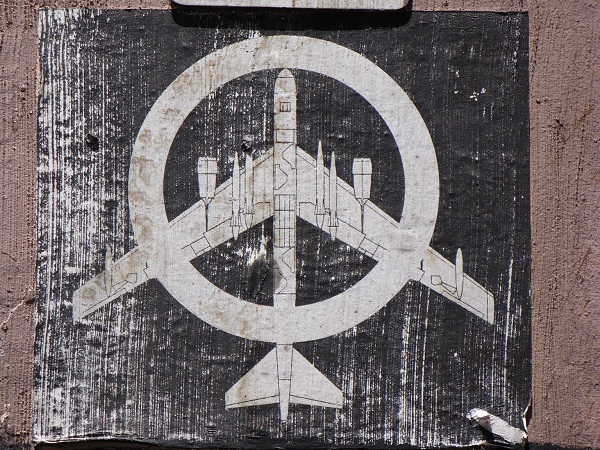
I’m a simple soul, and no doubt these thoughts of mine have been preceded by others — some in agreement, some in opposition to my line of thinking. I’m naturally interested in your own views, and in those of earlier thinkers that you can quote to me either way — but I am posting this here, as my first post in the role of ZP’s managing editor, because I feel far too much thought goes into the dualism of war and peace — from Tolstoy‘s celebrated novel via George Orwell‘s War is Peace in 1984 to Strategic Air Command‘s Peace is our Profession

— when the simplest level at which we begin to understand its loops, recursions and possible exit signs requires a three-fold logic that includes justice along with war and peace on an equal footing.

Have at it, friends!

Quick one: Death to America is not in the Quran

Monday, September 30th, 2013

[ by Charles Cameron — a sign of the times? ]
.

Definitely of interest, implications to be discovered:

Excellent theology, that, at the very least!


Switch to our mobile site