zenpundit.com » scriptures

Archive for the ‘scriptures’ Category

Hayder al-Khoei and the sword of St Paul

Sunday, September 29th, 2013

[ by Charles Cameron — when is a sword just a metaphor, when does it spill blood, and what can be done about it when it does? ]
.

Hayder al-Khoei is presently in Rome for an interfaith conference on “Religions and Cultures in Dialogue” organised by the Community of Sant’Egidio, attended Mass this morning at the Basilica of Saint Paul Outside the Walls, and posted this fascinating comment on Twitter:

**

According to one of his recent bio notes, Hayder al-Khoei is “an associate fellow of the Middle East and North Africa Programme at Chatham House, a London-based think tank on international affairs. He holds a masters degree in international studies and diplomacy from the School of Oriental and African Studies, University of London.” He’s generally considered highly qualified to speak on issues relating to Shi’a Islam — he’s also the scion of an illustrious clerical family, son of Sayyid Abdul Majid Al-Khoei and the grandson of Grand Ayatollah Abdul-Qasim Al-Khoei.

I can’t tell whether it was just the sight of St Paul’s sword in this particular statue that gave al-Khoei this thought, or whether it’s an idea more generally found among Muslims — that the early Christians in general were a militant bunch, or St Paul in particular. But al-Khoei’s comment is worth reflecting on.

Here are two counter-factuals to consider — not as statements of belief or historical fact, but as historical fictions that may yet give us glimpses ointo tje parallelisms and divergences between the two religions.

**

What of Christianity if Christ had not been crucified?

What would Christianity have looked like at 100 CE — or look like today, perhaps — if Christ hadn’t died on the cross (Muslims believe he didn’t), but had lived to see his followers persecuted and killed and the Jerusalem Temple destroyed by the Romans ikn 70 CE? Might his instructions gto his disciples have moved from an emphasis on peace to instructions for insurrection andd self defence over that period of time? See Luke 22. 35-36:

And he said unto them, When I sent you without purse, and scrip, and shoes, lacked ye any thing? And they said, Nothing. Then said he unto them, But now, he that hath a purse, let him take it, and likewise his scrip: and he that hath no sword, let him sell his garment, and buy one.

In the Gospel narrative, this instruction lasts for only a short while — Luke 22 continues:

And he said unto them, When I sent you without purse, and scrip, and shoes, lacked ye any thing? And they said, Nothing. Then said he unto them, But now, he that hath a purse, let him take it, and likewise his scrip: and he that hath no sword, let him sell his garment, and buy one. For I say unto you, that this that is written must yet be accomplished in me, And he was reckoned among the transgressors: for the things concerning me have an end. mAnd they said, Lord, behold, here are two swords. And he said unto them, It is enough.

and then, after the episode called agony in the garden, in verse s 47-51 of the same chapter:

And while he yet spake, behold a multitude, and he that was called Judas, one of the twelve, went before them, and drew near unto Jesus to kiss him. But Jesus said unto him, Judas, betrayest thou the Son of man with a kiss? When they which were about him saw what would follow, they said unto him, Lord, shall we smite with the sword? And one of them smote the servant of the high priest, and cut off his right ear. And Jesus answered and said, Suffer ye thus far. And he touched his ear, and healed him.

**

And what of Islam, if Muhammad had not been persecuted in Mecca?

And what might Islam have looked like in 710 CE — or look like today, maybe — if the persecution of the Prophet and his disciples had not driven him from Mecca to Medina, and his teachings had continued to be peaceable as they were in his earlier Meccan suras of the Qur’an?

**

To my mind, each of these stories of what never happened opens a possibility for mutual understanding between the two faith narratives: I offer them for this purpose.

Swords have been drawn, and blood spilled, in matters of conflict between religions. It is my hope and prayer, and that of those at the conference al-Khoei is attending, that the time will not be long in coming when the swords are sheathed and healings performed…

Ghost posts from Omar Hammami via the Twitter Medium

Saturday, September 28th, 2013

[ Charles Cameron — receiving messages from the dead via Twitter ]
.

I was surprised late last night when a tweet from the account of the late American jihadi Omar Hammami showed up in my Twitter stream:

It was in Arabic as you can see, so I took it to Google Translate — which never quite makes sense but almost — and thought I recognized it, checked it out with the Quranic Arabic Corpus translation section, and it did look very much as though what @abumamerican had posted was from the Quran 7. 43:

Praise to Allah, who has guided us to this; and we would never have been guided if Allah had not guided us.

I checked with whoever was posting in @abumamerican’s name, and got the reply “you r right. Sura E Alaraf”.

**

Okay, that’s one part of any Islamist communication that interests me a great deal, and others often not so much — the epigraph, the scriptural basis on which the communication in question is based. Everything that follows should be read as a possible variation on that theme — see my earlier ZP posts Speak the Languages, Know the Modes of Thought and especially Close reading, Synoptic- and Sembl-style, for parallels, patterns.

**

In any case…

After that first, epigraphic tweet, a whole stream of further tweets from @abumamerican followed, many of them in English, and many of them indeed dealing with the notion that Omar Hammami had died remaining faithful to the Guidance, while his killer, Zubeyr / Godane, had gone wildly astray from it.

Others are better qualified than I to discuss the details of what the spectral @abumamerican said and will perhaps continue to tell us. For the moment, I can recommend these two sources:

  • Clint Watts post, Omar Hammami’s Ghost Tweets On Westgate, Kenya & Shabaab
  • Sahan Journal’s 8 Reasons Why al-Shabaab Killed al-Amriki
  • **

    Keep your eyes open, there will be more…

    Raqqa, Syria: the Stations of the Cross

    Saturday, September 28th, 2013

    [ by Charles Cameron — a small devotional exercise for our sometimes too-secular world ]
    .

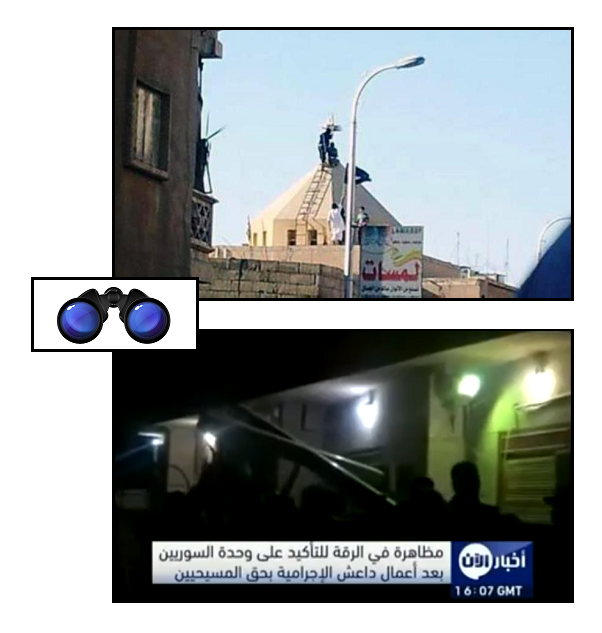
    In the upper image of the pair above, a crowd in Raqqa, Syria, is protesting the desecration of a church by Islamist enthusiasts who had pulled down the cross atop a church. The people of Raqaa took to the streets in protest, chanting:

    Syria belongs to Muslims & Christians.

    The Roman Catholic devotion known as the Stations of the Cross involves a prayerful mini-pilgrimage around fourteen “stations” representing stages in the passion and crucifixion of Christ — each of which is traditionally marked with an image of the “station” in question. In the case illustrated in the lower panel above, the station is that of Simon of Cyrene, who was pressganged into bearing the weight of the cross on his shoulders for part of the way, to give the agonized Christ some relief.

    The good people of Raqqa are thus enacting, informally, with courage and grace, the Station in which Simon of Cyrene is made to bear the cross. And there’s an echo here, too, of Christ’s injunction recorded at Luke 9.23:

    And he said to them all, If any man will come after me, let him deny himself, and take up his cross daily, and follow me.

    There’s a spontaneous beauty that crosses the lines between two world religions — and secularism — in all this.

    **

    But the cross itself also suffers its indignities, and thus the two images of the pair that follows can also be considered Stations of the Cross.

    In the upper image (below), the cross is removed by State of Iraq and al-Sham militants from its proper station atop the church, to be replaced with their black banner one of their number is holding, while in the lower image we see another screen cap of the townspeople, who have retrieved the cross and are carrying it through the streets to safety:

    The people are chanting:

    Syria belongs to Muslims & Christians.

    Obama mentions Khamenei “nuclear fatwa”

    Tuesday, September 24th, 2013

    [ by Charles Cameron — I believe this is the first time a US President — perhaps even a senior US official — has affirmed the existence of Ayatollah’s Khamanei’s previously disputed so-called “nuclear fatwa” ]
    .

    Here, from the Washington Post‘s full transcript of President Obama‘s address to the UN General Assembly, is the relevant section — I’ve emphasized his reference to the fatwa in red:

    Since I took office, I’ve made it clear in letters to the supreme leader in Iran and more recently to President Rouhani that America prefers to resolve our concerns over Iran’s nuclear program peacefully — although we are determined to prevent Iran from developing a nuclear weapon. We are not seeking regime change, and we respect the right of the Iranian people to access peaceful nuclear energy. Instead, we insist that the Iranian government meet its responsibilities under the Nuclear Non-proliferation treaty and U.N. Security Council resolutions.

    Meanwhile, the supreme leader has issued a fatwah against the development of nuclear weapons. And President Rouhani has just recently reiterated that the Islamic republic will never develop a nuclear weapon. So these statements made by our respective governments should offer the basis for a meaningful agreement. We should be able to achieve a resolution that respects the rights of the Iranian people while giving the world confidence that the Iranian program is peaceful. But to succeed, conciliatory words will have to be matched by actions that are transparent and verifiable.

    **

    Further reading:

    I believe we tend to underestimate the significance of religious and apocalyptic influences in international affairs, since the development of Iranian nuclear weaponry is a potential casus belli, and since the use of nuclear weapons has a distinctly apocalyptic aura, I’ve tried to take an interest — here’s my lengthy overview of “religion and nukes” in religion and myth worldwide, from 2008.

  • I catalogued my own understandings about the fatwa here on Zenpundit in a 2011 post, Striking Iran — response to Cheryl. I lack access to both Iranian language and classified sources, however, so that post represented a best effort to corral what I could find, but kis far from definitive.

  • Cheryl Rofer has also been following this discussion with interest, and her two posts for Nuclear Diner, The Fatwa Against Nuclear Weapons of January this year and The Nuclear Fatwa of March present her latest understandings — Cheryl, please correct me if you have written anything more recent or more comprehensive.

  • Selfscholar claims to be a “portal for unique, pertinent research on law and human rights in the Middle East”. I cannot speak to the particular interests, influences, credentials or biases of those who posts there, but the materials on our topic, that I have found there — in English but with extensive citations of original texts — will surely provide any researcher who possesses the appropriate language skills with many further pointers to track down… My starting point would be a search of the site for the keywords “nuclear fatwa”. The most recent post there would be Radioactive Fatwas: The Growing Islamist Legitimization of Nuclear Weapons from the 17th of this month. And Go, Learn About Atoms: Iranian Discourse on Nuclear Weapons, 1962-Present, at 32 pp. and posted in June 2013, would appear to offer a detailed historical presentation.

  • **

    And for further context:

  • Yesterday’s Financial Times brought us a piece by Najmeh Bozorgmehr titled Words of seventh-century imam signal Iran’s change of approach, which begins:

    The Iranian regime’s sudden focus on a seventh-century Shia imam may be the strongest indicator yet that Tehran is serious about negotiating on its nuclear programme. Imam Hassan, grandchild of the Prophet Mohammed and the second of 12 Shia imams, is famous for negotiating a peace treaty with those opposed to the principle that only descendants of the prophet could rule over Muslims. In Shia texts, his actions are defended as a compromise for the greater good of the religion, rather than a defeat.

    When Ayatollah Ali Khamenei, Iran’s top decision maker, called last week for “heroic flexibility” in talks over the nuclear programme, he was echoing the title of a religious text about Imam Hassan that he translated decades ago: Imam Hassan’s Peace: the Most Glorious Heroic Flexibility in History. The comment boosted hopes in Iran and the west of a possible nuclear deal, even though the ayatollah added that any flexibility was simply a tactic, presumably to deal with a difficult period and head off more economic sanctions or the possible threat of military confrontation with Israel or the US.

  • **

    I’d particularly welcome a post or comment from Selfscholar responding to Pres. Obama’s remarks today, and informed commentary on the Selfscholar site from those with appropriate skills to set it in religious, political, and scholarly context — as well as the usual fine interplay of views in the ZP comments section.

    Nairobi tweets 2: Sun Tzu and more

    Sunday, September 22nd, 2013

    [ by Charles Cameron — further hints from the HSM Press twitter stream, following on from part 1 on bullet-proofing ]

    Update:


    As of Monday morning 11am California time:

    I now think it’s clear that the twitter stream I was commenting on in this post and the first in the series was not an official Shabaab feed, and thus untrustworthy as to its statements — although it’s exact status (fan, mimic, troll, loosely connected?) is undetermined.

    I am leaving the post up (a) for the record, and (b) for whatever minor interest it may still have.

    Original post:


    .

    Okay, let’s pick up the thread from my earlier post in this series with this sheer poetry — sheer Anglo-Chinese poetry in fact, the poetry of Sun Tzu from The Art of War — Chapter 7, “Maneuvering”, # 19 in the Lionel Giles translation.

    I won’t be presenting the rest of these tweets in graphical form, since that would be labor intensive and I’m trying to be conservative about my labor, but there’s one more Sun Tzu quote I noticed in their stream, and we’ll come to it.

    In the meantime, HSM Press tweeted on a variety of topics, all of which seem relevant to them:

    **

    Let’s note first the importance given to prayer in these tweets:

  • our mujahideen just prayed salat dhuhr! #westgate #alshabaab #Nairobi
  • our mujahideen are preparing to pray salat maghrib! #westgate #AlShabaab #Nairobi
  • The Qur’an is cited:

  • and kill them wherever you find them! ring a bell? #westgate #AlShabaab
  • Their Islam is a religion of peace —

  • yes islam is a religion of peace! thats undebatable. the debate here is who hit first? #westgate #AlShabaab
  • dont blame islam! islam never told you wage war on another country! #westgate
  • — but peace comes arms-in-arms with justice.

    There are matters of logistics:

  • we tweeted arrival of 2 squads and they are replacing our first two now. hooo-ah! #Westgate
  • update: our third mujahideen squad just crossed the border, enroute to #garisa and other undisclosed locations. #Westgate #AlShabaab
  • update: 4th mujahideen squad rendezvous to undisclosed location! brace yourselves #kenya #westgate #AlShabaab
  • Here’s that other Sun Tzu quote, along with a mention of training camps:

  • the first thing they taught us in training camps: know your enemy! #AlShabaab #Westgate
  • and there, making a fine DoubleQuote, is Margaret Atwood‘s nifty variant on Clausewitz:

  • “War is what happens when language fails.” #westgate @nairobi
  • Now, about those “training camps”?

  • have we mentioned we trained in this same building months ago! our mujahideen know every corner of this building! #alshabaab #westgate
  • But also:

  • our mujahideen are all under 25 years old. 7 of them having completed training in black water facility in north california! #Westgate
  • So they train with Blackwater / Academi and in situ, eh? And they’re all under 25 — when they started naming namesa bit later, they identified at least one 27 year old, but you get the drift — and at least one is a young woman:

  • our female combatant took out 15 kenyan soldier! what an amazing woman! #Westgate
  • They count the cost — though unlike AQC in the case of 9/11, they don’t do so to show what a huge ROI they have, just to be glad it wasn’t a flop:

  • the vast amount of time, money and dedication we contributed to this operation were glad it was carried successfully! #westgate #AlShabaab
  • They call it an op here, but their view of its size and importance is pretty flexible as to scale…

    It’s a game — the “war as game meme” once again!:

  • lets see how yall enjoy this game! #westgate #alshabaab #Nairobi
  • They also call it a war:

  • this is a war and its not going to end well. #westgate #AlShabaab
  • It’s not a Jihad, though:

  • #JIHAD is a big word to use for this drill. #kneyans you will know when jihad is happening its unevitable! #westgate #AlShabaab
  • It’s gonna get worse:

  • you call few hundred death a deadly attack. well see what a deadly attack is. brace yourselves #lenya #westgate #AlShabaab
  • — and hey, it looks as though they have their eye on S Africa as a target further down the road:

  • #southafrica gere we come!!! #Westgate
  • **

    Those are the tweets I found interesting on a first read. HSM followed up with the names and home cities of three American participants, and then their feed was suspended and I was invited to return to my home timeline…

    Credit goes to JM Berger for getting Twitter to be a whole lot quicker in disabling their feeds, but it’s all a bit whack-a-mole, and I suspect they’re probably back up by now, under some variant name or other.


    Switch to our mobile site

