zenpundit.com » scriptures

Archive for the ‘scriptures’ Category

Jottings 3: Espionage on the chess board

Friday, May 3rd, 2013

[ by Charles Cameron — playing the two great games, from Caxton to Le Carré ]
.

.

Karla, the Russian spymaster in John Le Carré‘s Smiley novels, is represented as the white queen in the 2011 Tomas Alfredson / Gary Oldman film of Tinker Tailor Soldier Spy (lower panel, above).

In chess terms, that’s quite a step up for spies — pawn promoted to queen.

**

Before the digital age, in the early years of printing, way back in 1474, Thomas Caxton‘s press issued the second book ever printed in England — his Game and Playe of the Chesse — and things were subtly different. The eight pawns, for instance, differed one from another, each representing a different human type or craft, and named accordingly: “Labourer, Smith, Clerk, Merchant, Physician, Taverner, Guard and Ribald.”

It’s the Ribald (in the upper panel, above) who interests us here — for he’s the spy on the chessboard, as surely as Joshua the son of Nun and Caleb the son of Jephunneh were spies in the land of milk and honey. Caxton describes the Ribald, stationing him in front of the Rook, thus:

The rybaulders, players of dyse and of messagers and corrours ought to be sette to fore the rook/ For hit apperteyneth to the rook whiche is vicayre & lieutenant of the kynge to haue men couenable for to renne here and there for tenquyre & espie the place and cytees that myght be contrarye to the kynge/ And thys pawn that representeth thys peple ought to be formed in this maner/ he must haue the forme of a man that hath longe heeris and black and holdeth in his ryght hand a lityll monoye And in his lyfte hande thre Dyse And aboute hym a corde in stede of a gyrdell/ and ought to haue a boxe full o lettres

And what should be the appearance of such a one?

And thys pawn that representeth thys peple ought to be formed in this maner/ he must haue the forme of a man that hath longe heeris and black and holdeth in his ryght hand a lityll monoye And in his lyfte hande thre Dyse And aboute hym a corde in stede of a gyrdell/ and ought to haue a boxe full o lettres

Let’s go over that first part one more time, and make sure we understand it:

It pertains to the Rook, which is vicar and lieutenant of the King, to have men available to run hither and yon to make inquiries and spy out the place and cities that might be contrary to the King.

**

And isn’t that precisely what Moses sent Joshua and Caleb out to do, when he instructed them in Numbers 13.17-20:

Get you up this way southward, and go up into the mountain: And see the land, what it is, and the people that dwelleth therein, whether they be strong or weak, few or many; And what the land is that they dwell in, whether it be good or bad; and what cities they be that they dwell in, whether in tents, or in strong holds; And what the land is, whether it be fat or lean, whether there be wood therein, or not. And be ye of good courage, and bring of the fruit of the land.

**

Espionage has been around longer than chess: some things never change — and some things have changed significantly.

Today, you can’t tell one pawn from the next…

Furnish on Pew findings re: Islam

Thursday, May 2nd, 2013

[ Charles Cameron presenting guest-blogger Timothy Furnish ]
.

.

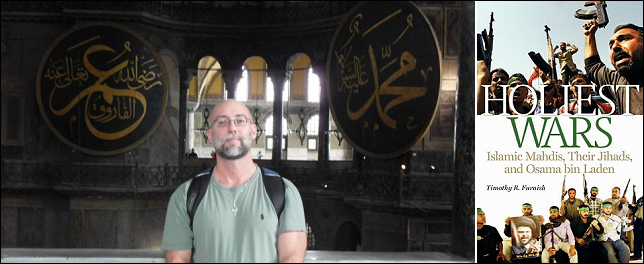
I’m delighted to welcome Dr Timothy Furnish as a guest-blogger here on Zenpundit. Dr Furnish has served as an Arabic linguist with the 101st Airborne and as an Army chaplain, holds a PhD in Islamic history from Ohio State, is the author of Holiest Wars: Islamic Mahdis, Their Jihads, and Osama bin Laden (2005), and blogs at MahdiWatch. His extended piece for the History News Network, The Ideology Behind the Boston Marathon Bombing, recently received “top billing” in Zen’s Recommended Reading of April 24th.

**

Does This Paint It Black, or Am I A Fool to Cry? Breaking Down the New Pew Study of Muslims
by Timothy R. Furnish, PhD
.

Pew has released another massive installment of data from its research, 2008-2012, into Muslim attitudes, entitled “The World’s Muslims: Religion, Politics and Society.” Over 38,000 Muslims in almost 40 countries were surveyed, thus constituting a survey both statistically sound and geographically expansive. Herewith is an analysis of that information and what seem to be its major ramifications.

The first section deals with shari`a, usually rendered simply as “Islamic law” but more accurately defined as “the rules of correct practice” which “cover every possible human contingency, social and individual, from birth to death” and based upon the Qur’an and hadiths (sayings and practices attributed to Muhammad) as interpreted by Islamic religious scholars (Marshal G.S. Hodgson, The Venture of Islam, Vol 1: The Classical Age of Islam, p. 74). Asked “should sharia [as Pew anglicizes it] be the law of the land,” 57% of Muslims across 38 countries answered “yes” — including, most problematically for the US: 99% of Afghans, 91% of Iraqis, 89% of Palestinians, 84% of Pakistanis and even 74% of Egyptians. Should sharia apply to non-Muslims as well as Muslims? Across 21 countries surveyed on this question, 40% answered affirmatively — with the highest positive response coming from Egypt (its 74% exceeding even Afghanistan’s 61%). And on the question whether sharia punishments — such as whippings and cutting off of thieves’ hands — should be enacted, the 20-country average was 52%, led by Pakistan (88%), Afghanistan (81%), the Palestinian Territories [PT] (76%) and Egypt (70-%). On the specific penalty of stoning for adultery, the 20-country average was 51% — with, again, Pakistan (89%), Afghanistan (85%), the PT (84%) and Egypt (71%) highest in approval. Finally, 38% of Muslims, across those same 20 nations, support the death penalty for those leaving Islam for another religion.

Huge majorities of Muslims across most of these surveyed nations say that “it’s good others can practice their faith” — but Pew’s imprecise terminology on this topic makes possible that this simply mean many Muslims are willing to grant non-Muslims the tolerated, but second-class, ancient status of the dhimmi. Majorities, too, in most countries say that “democracy is better than a powerful leader;” however, the latter was actually preferred by most surveyed in Russia, Bosnia-Hercegovina, Kyrgyzstan, Afghanistan and Pakistan, as well as by 42% of Iraqis, 40% of Palestinians and 36% of Egyptians. Most Afghans, Egyptians and Tunisians (and even 1/3 of Turks) believe that “Islamic political parties” are better than other ones, although 53% of Indonesians and 45% of Iraqis are also worried about “Muslim extremists.” (Curiously, 31% of Malaysians are, on the other hand, worried about “Christian extremists” — although evidence of such existing in that country is practically non-existent.) There is good news on the question of suicide bombing, however: across 20 countries, only 13.5% think it is ever justified — although the support is much higher in the PT (40%), Afghanistan (39%) and Egypt (29%).

In terms of morality, large majorities in most Muslim countries (especially outside Sub-Saharan Africa) think drinking alcohol is morally repugnant, notably in Malaysia (93%), Pakistan and Indonesia (both 91%). Most Muslims in most countries surveyed consider abortion wrong, as well as pre- and extra-marital sex and, almost needless to say, homosexuality. (Although one wishes Pew had asked about mu`tah, or “temporary marriage” — a practice originally Twelver Shi`i which has increasingly become used by Sunnis.) Yet, simultaneously — following Qur’anic rubrics — some 30% of Muslims in 21 countries support polygamy, including almost half of Palestinians, 46% of Iraqis and 41% of Egyptians. There is also significant support for honor killings in not just Afghanistan and Iraq but also Egypt and the PT. Over ¾ of Muslims across 23 countries says that “wives must always obey their husbands:” an average of 77%. And Pew notes that there is a statistically very significant correlation between sharia-support and believing women have few(er) rights.

Asked whether they believed they were “following Muhammad’s example,” 75% of Afghans and 55% of Iraqis answered affirmatively — although most Muslims were not nearly so confident. On the question “are Sunni-Shi`i tensions a problem,” 38% of Lebanese, 34% of Pakistanis, 23% of Iraqis and 20% of Afghans said “yes.”

It is no surprise that huge majorities of Muslims in most surveyed countries believe that Islam is the only path to salvation, nor that most also say “it’s a duty to convert others” to Islam. It is somewhat counterintuitive, however, that many Muslims say they “know little about Christianity” — even in places with large Christian minorities, such as Egypt. Muslims in Sub-Saharan Africa are the most likely to agree that “Islam and Christianity have a lot in common,” and so are 42% of Palestianians, as well as some 1/3 of Lebanese and Egyptians. But only 10% of Pakistanis agree. Asked whether they ever engaged in “interfaith meetings,” many Muslims in Sub-Saharan Africa said that they did (with Christians), and a majority of Thais said likewise (albeit with Buddhists). But only 8% of Palestinians, 5% of Iraqis, and 4% of Egyptians said they ever do so—despite substantial Christian populations in each of those areas.

Regarding the question “are religion and science in conflict,” most Muslims said “no” — with the exceptions of Lebanon, Bangladesh, Tunisia and Turkey where over 40% in each country (and, actually, a majority in Lebanon) said that they were at loggerheads. Most Muslims also say they have no problems with believing in Allah and evolution — the exceptions being the majority of Afghans and Indonesians. Regarding popular culture, clear majorities of Muslims in many countries say they like Western music, TV and movies—but, at the same time, similar majorities say that such things undermine morality (although Bollywood less so than Hollywood).

Observations:

1) The high degree of support for sharia is the red flag here. Contra media and adminstration (both Obama and Bush) assurances that most Muslims are “moderate,” empirical data now exists that clearly shows most Muslims, in point of fact, support not just sharia in general but its brutal punishments. Perhaps just as disturbing, almost four in ten Muslims are in favor of killing those who choose to follow another religion. And countries in which the US is heavily involved either diplomatically or militarily (or both) are the very ones where such sentiments run most high: Pakistan, Afghanistan, Egypt, the Palestinian Territories. So are the “extremists” these very Muslims who want to follow, literally, the Qur’an and hadiths? Messers Brennan, Holder and Obama have some explaining to do.

2) Afghanistan would appear to be a lost cause. Afghans are at the top of almost every list in support for not just sharia, suicide bombing, honor killing and — ironically (or perhaps not) — confidence that they are emulating Islam’s founder, as well as dislike for democracy. In light of this clear data, two points about Afghanistan become clear: tactically, ostensible American befuddlement as to the causes of “green on blue” attacks and the continuing popularity of the Taliban in Afghanistan appears as willful ignorance; strategically, the US decision to stay there after taking out the al-Qa`ida [AQ] staging, post-9/11, and attempt to modernize Afghanistan was a huge, neo-Wilsonian mistake. 2014 cannot come soon enough.

3) In some ways Islam in Southeastern Europe, and to a lesser extent in Central Asia, seems to be a more tolerant brand of the faith than the Middle Eastern variety. For example, the SE European and Central Asian Muslims are the least likely to support the death penalty for “apostasy,” and the most supportive of letting women decide for themselves whether to veil. And Muslims in Sub-Saharan Africa are the most likely to know about Christianity, and to interact with Christians. On the other hand, African Muslims are among the most enamored of sharia, and Central Asian ones fond of letting qadis (Islamic judges) decide family and property disputes. So there does not seem to be a direct link between Westernization and moderation; in fact, the influence of Sufism — Islamic mysticism — in the regard needs to be correlated and studied (beyond what Pew did on the topic in last year’s analysis).

4) One bit of prognostication based on this data: Malaysia may be the next breeding ground of Islamic terrorism. It’s home to some 17 million Muslims (61% of its 28 million people), who hold a congeries of unsettling views: 86% want sharia the law of the land; 67% favor the death penalty for apostasy; 66% like sharia-compliant corporal punishments; 60% support stoning for adultery; and 18% think suicide bombing is justified. PACOM, SOCOM and the intelligence agencies need to ramp up hiring of Malay linguists and analysts.

5) Finally, some words for those — like FNC’s Megyn Kelly and Julie Roginsky (on the former’s show “American Live,” 4/30/13) — who pose a sociopolitical and moral equivalence between Muslim support for sharia and Evangelical Protestant Christian support for wives’ obedience to husbands: that’s a bit too much sympathy for the devil. Yes, Evangelical Christian pastors hold some pretty conservative views of the family, as per a 2011 Pew study of them; for example, 55% of them do agree that “a wife must always obey her husband” (compared to 77% of Muslims). And, ironically, many such Evangelicals agree in large measure with Muslims on issues such as the immorality of alcohol, abortion and homosexuality. However, one searches in vain for any Evangelical (or other) Christian support for whippings, stonings, amputation of thieves’ limbs, polygamy or suicide bombing.

Islam is the world’s second-largest religion, numbering some 1.6 billion humans (behind only Christianity’s 2.2 billion). There is, thus, enormous diversity of opinion on many issues of doctrine and practice, and essentializing Islam as either “peaceful” or “violent” is fraught with peril. Nonetheless, this latest Pew study provides empirical evidence that many — far too many — Muslims cling to a literalist, supremacist and indeed brutal view of their religion. Insha’allah, this will change eventually — but time is not necessarily on our side.

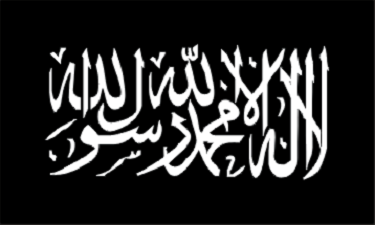
Inscription on the flag of the Mahdi’s army?

Tuesday, April 30th, 2013

[ by Charles Cameron — how to tell an authentic Mahdist “black banner” — from a false flag, perhaps? ]
.

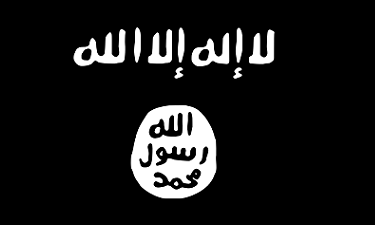
There has been considerable talk about black flags featuring the Shahada:

This is the creed of Islam, and reads, “There is not God but God, and Muhammad is the Prophet of Allah.”

And more recently, of black flags featuring the seal of Muhammad:

Will McCants wrote of this:

When the ISI adopted the flag, it issued a statement in 2007 explaining its design. In the statement, the group relates oral traditions portraying Mohammad’s battle flag as either black or white (other traditions say yellow) with the words “No god but God, Mohammad is the messenger of God” written on it. The ISI chose black for its flag because most accounts say the Prophet’s flag was black, and chose the Muslim testimony of faith because many accounts said it was written on the Prophet’s flag.

For the second half of the testimony of faith, “Mohammad is the messenger of God,” the ISI reproduces the Prophet’s seal. They contend that the seal’s design is preserved in Ottoman manuscripts and its three-lined text, “God/Messenger/Mohammad,” is mentioned in oral traditions about the Prophet. They have added this seal to their flag, they explain, because some Muslim scholars say that it appeared on the Prophet’s flag.

**

I therefore thought it worth noting that al-Islam.org — which presents Islam “with particular emphasis on Twelver Shia Islamic school of thought” — has a section on The Slogan on the Flag of the Uprising in Chapter 7, The Uprising of the Imam of the Time (‘atfs) of Najmuddin Tabasi‘s An Overview of the Mahdi’s (‘atfs) Government, which reads:

Every government has a flag by which it can be recognized, and uprisings and revolutions also have particular flags whose logos bespeak of the objectives of their leaders. The global revolution of Hadrat al-Mahdi (‘a) has also a specific flag on which a slogan has been inscribed. Of course, although there are differences with respect to the slogan on his flag, there is a common point in all the statements and that is: It invites the people to obey him (‘a).

Now, it would suffice to mention some pertinent instances:

It has been recorded in a hadith: “It is thus written on the flag of Hadrat al-Mahdi (‘atfs): ‘Listen and obey him’.”

Elsewhere, we read: “The slogan of al-Mahdi’s (‘atfs) flag is al-bay‘atu lillah (the allegiance for the sake of Allah).”

**

Just a little different, eh?

Well, that’s it — just a footnote to ponder.

A religious footnote to the pro-life / pro-choice issue

Monday, April 29th, 2013

[ by Charles Cameron — with cites from the Qur’an and Bukhari, together with a concerto by Saint-Saëns ]
.


.

Stephen Hough is a classical pianist of note recording on the Hyperion label, the recipient of a MacArthur Fellowship, and one of twenty living polymaths listed as “Pianist, poet, composer, writer on religion” in a 2009 survey by The Economist’s 2009 Intelligent Life blog.

Hough — a Catholic — blogs at The Telegraph, and today he wrote something that caught my eye in his post Why haven’t you written anything about Gosnell?:

I think that without religious faith it is hard to accept a zygote as equivalent in value to a fully formed child. I can understand that a non-religious person is going to see a scale of development in the nine months of pregnancy.

**

To broaden Hough’s discussion a little, I’d like to gently point out that not all religious faiths perceive these matters in the same way. Islam, for instance, has a Qur’anic passage that’s apposite in Sura 20, The Believers, 12-16:

Man We did create from a quintessence (of clay); Then We placed him as (a drop of) sperm in a place of rest, firmly fixed; Then We made the sperm into a clot of congealed blood; then of that clot We made a (foetus) lump; then we made out of that lump bones and clothed the bones with flesh; then we developed out of it another creature. So blessed be Allah, the best to create! After that, at length ye will die Again, on the Day of Judgment, will ye be raised up.

Getting into more detail, we find these ahadith — the first in Bukhari, Chapter 6, The Book of Menstruation, 312:

It is related from Anas ibn Malik that the Prophet, may Allah bless him and grant him peace, said, “Allah the Mighty and Majestic appoints an angel to every womb who says, ‘O Lord! A sperm drop! O Lord A clot! O Lord! A lump of flesh! ‘ Then if He desires to complete His creation, He does so and the angel asks, ‘Is it to be male or female? Wretched or happy? What is its provision? What is its life-span?’ This is all decreed in the mother’s womb.”

and the second in Bukhari Chapter 63, The Book of the Beginning of Creation, 3036:

It is related that ‘Abdullah said, “The Messenger of Allah, may Allah bless him and grant him peace, who is the truthful confirmed one, said, ‘The way that each of you is created is that you are gathered in your mother’s womb for forty days as a sperm-drop and then for a similar length of time as a blood-clot and then for a similar length of time as a lump of flesh. Then an angel is sent and he breathes the spirit into you and is encharged with four commandments: to write down your provision, your life-span, your actions, and whether you will be wretched or happy.

*

My Sources:

  • Qur’an 20, in the Yusuf Ali rendition
  • Bukhari, Book of Menstruation 312 the Aisha Bewley translation
  • Bukhari, Book of the Beginning of Creation, 3036 also in the Bewley translation
  • **

    Here Stephen Hough plays Camille Saint-Saëns‘ Piano Concerto 2 in G minor Op. 22 with the City of Birmingham Symphony Orchestra, Sakari Oramo conducting:

    blockquote>

    Of Omar Hammami — and dying more than once?

    Friday, April 26th, 2013

    [ by Charles Cameron — dying more than once in hadith, in press reports, in Rumi and John of the Cross ]
    .

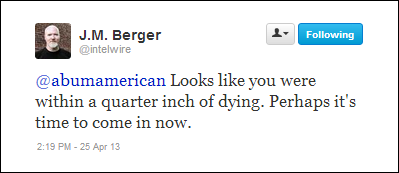
    The American mujahid in Somalia, Omar Hammami [see his Wikipedia bio], who has been tweeting back and forth with various “U.S. national security professionals” [see this Wired piece], reported yesterday that he had been shot in the neck “by Shabab assassin” [see this piece by Clint Watts at Selected Wisdom]. JM Berger, who has been in close correspondence with him, tweeted:

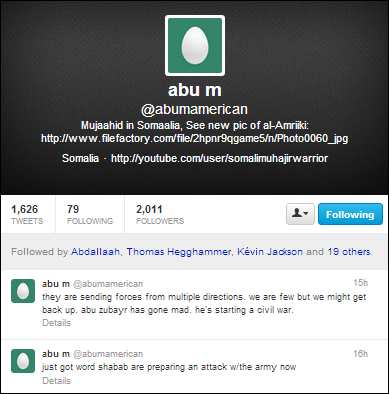
    Omar has indeed been in dispute with Shabab, the group he originally joined [see this LWJ post], and his own most recent tweets, sent eighteen hours ago as I write this, were these:

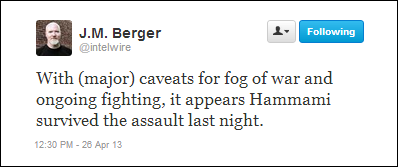
    Omar Hammami may or may not still be among us, although recent reports suggest with caveats that he survived the attack…

    That’s the background.

    **

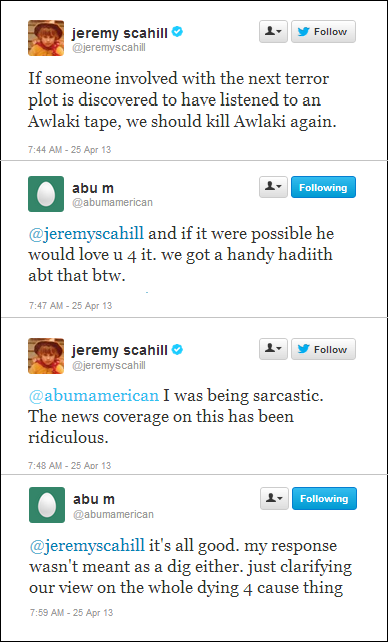
    From my point of view, the most interesting discussion anyone had with Hammami in the last day or two was this exchange between Hammami and Jeremy Scahill, whose book Dirty Wars has just hit the stands:

    Characteristically, Omar has a light tone — yet speaks to the issue in the context of his theology…

    **

    There are, it seems to me, basically three ways that one might imagine dying more than once. The first — and it’s the one Hammami himself was referring to — is found in the hadith in Bukhari [Volume 4, Book 52, Number 54]:

    Narrated Abu Huraira:

    The Prophet said, “… By Him in Whose Hands my life is! I would love to be martyred in Allah’s Cause and then get resurrected and then get martyred, and then get resurrected again and then get martyred and then get resurrected again and then get martyred.

    Let the intensity of that hadith — and Hammami’s reference to it, a little earlier [?] on the same day he was shot — sink in.

    **

    The second, “secular” way to have “died” more than once is through faulty intelligence and / or journalism — and that’s what JM Berger is on about when he tweets:

    Indeed, such reports led to the 2011 release of a nasheed in his name, though he may not have sung it himself:

    Now Hammami has apparently resurfaced, with two new a cappella songs that appeared on the web earlier this week. In “Send Me A Cruise,” Hammami begs to be plastered by a tank shell, a drone attack or a cruise missile, so that he can martyred like some of the heroes he names, including Al Qaeda leaders Abu Musab al-Zarqawi and Abu Laith al-Libi. In his trademark tuneless drone, he claims “an amazing martyrdom” is what he “strive(s) for and adore(s).” “Send me a cruise like Maa’lam Adam al Ansari/ And send me a couple of tons like Zarqawi,” chants Hammami. “Send me four and send me more, that’s what I implore.”

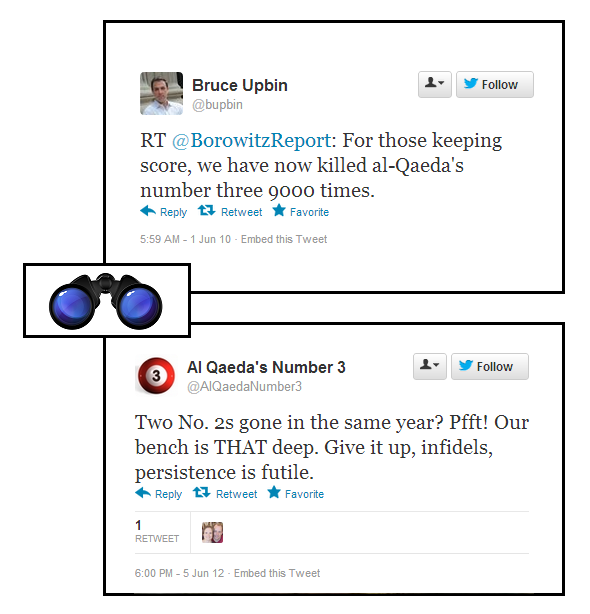
    More generally, false reports of AQ leaders dying hither and yon have become so common that I posted a DoubleQuote about it last year:

    **

    Here’s where it get’s most interesting…

    For a third view of dying more than once, we can turn to the mystical tradition. Thus the Prophet Muhammad is credited with the hadith “Die before death” by Jalaluddin Rumi, who in his Mathnawi, VI, 3837-38 writes:

    The mystery of “Die before death” is this, that the prizes come after dying (and not before).
    Except dying, no other skill avails with God, O artful schemer.

    The death before death here is the death of the nafs, the “self” — the true martyrdom of the greater jihad. As Peter Lamborn Wilson puts it in his Introduction to the Sufi Path:

    Man’s authentic existence is in the Divine; he has a higher Self, which is true; he can attain felicity, even before death (“Die before you die,” said the Prophet). The call comes: to flight, migration, a journey beyond the limitations of world and self.

    Of course, St John of the Cross wrote in much the same vein:

    This life I live in vital strength
    Is loss of life unless I win You:
    And thus to die I shall continue
    Until in You I live at length.
    Listen (my God!) my life is in You.
    This life I do not want, for I
    Am dying that I do not die.


    Switch to our mobile site