zenpundit.com » scriptures

Archive for the ‘scriptures’ Category

Key bin Laden para raises translation and other questions

Sunday, May 6th, 2012

[ by Charles Cameron — bin Laden on oath breaking, translation issues, failure of secular viewpoint to comprehend importance of Islam to jihadists, mild countering violent extremism issues, etc etc ]

.

This para from bin Laden writing as “Your brother, Zamray” to “Shaykh Mahmud, may God protect him” (ie Abu Abd al-Rahman Atiyyat Allah) on 21 October 2010 looks to me like an astounding windfall:

Perhaps you monitored the trial of brother Faysal Shahzad. In it he was asked about the oath that he took when he got American citizenship. And he responded by saying that he lied. You should know that it is not permissible in Islam to betray trust and break a covenant. Perhaps the brother was not aware of this. Please ask the brothers in Taliban Pakistan to explain this point to their members. In one of the pictures, brother Faysal Shahzad was with commander Mahsud; please find out if Mahsud knows that getting the American citizenship requires talking an oath to not harm America. This is a very important matter because we do not want al-Mujahidn to be accused of breaking a covenant.

*

This raises a whole number of issues for me. But first, let’s read another translation:

You have perhaps followed the media trial of brother Faisal Shahzad, may God release him, during which the brother was asked to explain his attack [against the United States] in view of having taken an oath [not to harm it] when he was awarded his American citizenship. He responded that he lied [when he took the oath]. It does not escape you [Shaykh `Atiyya] that [Shahzad’s lie] amounts to betrayal (ghadr) and does not fall under permissible lying to [evade] the enemy [during times of war]…please request from our Pakistani Taliban brothers to redress this matter…also draw their attention to the fact that brother Faisal Shahzad appeared in a photograph alongside Commander Mahsud. I would like to verify whether Mahsud knew that when a person acquires an American citizenship, this involves taking an oath, swearing not to harm America. If he is unaware of this matter, he should be informed of it. Unless this matter is addressed, its negative consequences are known to you. [We must therefore act swiftly] to remove the suspicion that jihadis violate their oath and engage in
ghadr.

That one is almost half as long again as the first, at 182 vs 122 words — and even with the bracketed words removed, runs to 156.

Both versions come from West Point’s CTC, the first from page 7 of SOCOM-2012-0000015 [link to single letter] in the folder of documents released [link opens .zip file], and the second, longer version from p. 36 of CTC’s accompanying report titled Letters from Abbottabad: Bin Ladin Sidelined? [link opens .pdf]

It seems to me that the second is far more informative than the first — essentially the first is a stepped down, pop version of the second, more easily reader-digested. All of which makes me wish I had ten additional years orthogonal to the time-stream in which to immerse myself in Arabic, but no dice.

Here’s the explanation, from page 10, footnote 3 of the CTC commentary:

The quality of the English translation provided to the CTC is not adequate throughout. When the translation was deemed inadequate, quotations cited in this report have either been amended or translated anew by Nelly Lahoud.

which leaves me wondering what a Nelly Lahoud translation of the entire batch would look like? — indeed, very much wishing I could read it — and who depends on the pop versions for their understanding of documents such as these? — myself all too often sadly included.

When in any case, as AP’s Matt Apuzzo tweeted (h/t Daveed G-R):

Drawing conclusions about Al Qaeda from these docs is like letting your ex-girlfriend go thru all your emails and choose 17 to release.

No complaints about the CTC from me, incidentally — their entire Harmony Program is nonpareil.

Okay, onward to the content (& contextual) issues.

*

The first has to do with the significance of religion to bin Laden, Al-Qaida, and the jihadist current more generally.

Leah Farrall gets succinctly to two readings that can be taken from this paragraph by western analysts:

It is very clear [that bin Laden was] trying to control acts of violence that fall outside of what he views as morally acceptable, but also that are counterproductive to Al Qaeda’s strategic agenda

There’s a public relations issue here for bin Ladin, in other words — but there’s also a moral issue from the standpoint of Islamic theology. Theology — not just any old ideology borrowed from Marx or whoever, but theology<, the logos pertaining to theos, and thus in Islamic terms transmitted and revealed Word of God, “an Arabic Qur’an that you might understand” (Q 12.2).

Note that the CTC analysis, unlike Leah’s, is focused entirely on the secular, PR side of things and fails to address the religious. Immediately before quoting the paragraph in question (the second version above) in their commentary, the authors write:

Bin Ladin was following Shahzad’s trial in the news and was disappointed by his performance, which he thought distorted the image of jihadis.

Immediately following it, we find:

This is not the only instance that Bin Ladin worried about jihadis violating their oaths. The letter addressed to Abu Basir in which he is asked to focus on operations inside the United States (instead of Yemen) alerted him to focus on Yemenis “who hold either visas or U.S. citizenships to carry out operations inside America as long as they did not take an oath not to harm America.” Underlying Bin Ladin’s thinking is a distinction between a visa (ishara), acquired citizenship — which involves taking an oath (`ahd) — and citizenship by birth — which does not entail taking an oath. From an Islamic law perspective, it is not lawful to violate one’s oath (naqd al-`ahd or naqd al-mithaq).

Bin Ladin wanted to promote the image that jihadis are disciplined and conform to Islamic Law. Faisal Shahzad’s boasting that he lied during his oath not to harm the United States, therefore, is antithetical to the image of jihadis that Bin Ladin wanted the world to see.

Bin Laden wants “to promote the image that jihadis are disciplined and conform to Islamic Law” — but doesn’t he also perhaps want them to “conform to Islamic Law” for the sake of Allah, who commanded that law, and in whose path they are fighting?

What is the Caliphate, if it makes Islamic law the law of the Islamic world, or of the world entire, and obedience to that law is a matter purely of appearances?

*

The second issue that this paragraph beings up for me is that of taqiyya or religiously sanctioned dissembling.

Shariah: The Threat to America (An Exercise in Competitive Analysis—Report of Team ‘B’ II) [link to .pdf], which I take to be the closest thing yet to an indepth, scholarly presentation of the Boykin-Gaffney-Woolsey-Yerushalmi view of Islam, makes a big deal of taqiyya, the Islamic doctrine that permits dissembling under certain circumstances, quoting the Qur’an (3:28):

Let not the believers take the disbelievers as friends instead of the believers, and whoever does that, will never be helped by Allah in any way, unless you indeed fear a danger from them. And Allah warns you against Himself, and to Allah is the final return.

and commenting:

it is imperative that those whose duty it is to protect the United States. from shariah grasp the centrality of taqiyya in the arsenal of its adherents. This is critical because the consequences of taqiyya extend to real world issues related, for example, to Muslim overtures for interfaith dialogue, peace and mutual tolerance – all of which must be viewed in the light of Islamic doctrine on lying.

Bin Laden, in his letter to Mahmud / ‘Atiyya, is not writing to a an audience of non-Muslims to deceive them, he is writing to a comrade in faith and in arms. And he clearly does not believe that either taqiyya or the necessities of war (which often involves deceit) give jihadists the option to lie under oath — even for purposes of jihad, even within the enemy camp. Taqiyya, in bin Laden’s mind, appears to be a far more restricted doctrine than Gaffney and cohort take it for…

As Juan Cole puts it, taqiyya is “not a license to just lie about anything at all, or to commit perfidy. It is just a permission to avoid dying uselessly because of sectarian prejudice.” Corrie ten Boom lying to the Gestapo to protect the Jews hiding in her house might be a somewhat similar situation — as an analogy worth considering, though, not an equation.

*

Then there’s the question of oaths. CTC not surprisingly is interested in exactly what oaths, pledges, promises or words of honor exactly are covered by this sort of restriction, noting:

Bin Ladin may also have had in mind the debate between Ayman al-Zawahiri and his former mentor, Dr. Fadl. The latter reneged on his jihadi views and among the accusations he made was that the 9/11 hijackers violated the terms of their visa, interpreting it as a form of aman (safe passage) from an Islamic law of war perspective. Thus, from Bin Ladin’s perspective, it is only when a Muslim takes an oath that he must be bound by it; a visa and citizenship by birth do not qualify as an oath.

It’s an intriguing question. Murad Batal Shishani @muradbatal tweeted yesterday:

#OBL against using ppl 2 attack US if they paid oath of allegiances 2 it. (what would some “experts” & “intel” say if u said that earlier?)

And what, I wonder, would Anwar al-Awlaki have said to Nidal Hasan if he’d read that particular paragraph?

Thinking about Nidal Hasan puts me in mind of at least two oaths that Hasan, an officer and a physician, presumably took — the US Army Oath of Commissioned Officers, which interestingly enough contains the phrasing:

I take this obligation freely, without any mental reservations or purpose of evasion … So help me God

— and the Hippocratic Oath required of all physicians.

What would their status be, I wonder? And would al-Balawi, the Jordanian physician and triple agent, have taken the Hippocratic Oath?

Come to that, would the Pledge of Allegiance bind those who — “under God” and with their hands on their hearts — recite it to refrain from attacking the United Sates?

I don’t know, but these are questions whose answers have significance in terms of what can and cannot be considered permitted or even obligatory within Islam — which is surely why both bin Laden and Dr. Fadl take the time to address the issue of visas. Such things are important to them.

They are what I’d call “mild” or “light touch” CVE issues — meaning issues to be aware of, not challenges to be shouted from rooftops or forced down anyone’s throat.

And I too would appreciate some answers, pointers, appropriate corrections, clarifications and further insight…
Of Quantity and Quality II: Holocaust, torture and sacrament

Thursday, April 19th, 2012

[ by Charles Cameron — Yom HaShoah, quality vs quantity, sacramental value of life, continuing from Q&Q I, long, intense ]
.

Today is Yom HaShoah, Holocaust Remembrance Day.


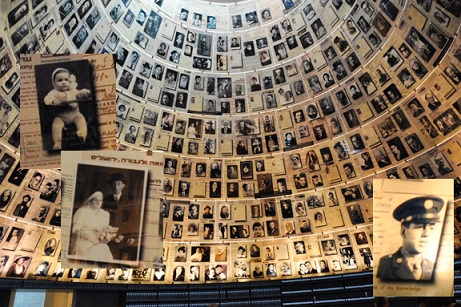
photo credit: Joni B Hannigan

The mind is struck dumb.

Six million individuals is too vast a gathering to contemplate. Even to think of ten people we know well if they are in the room with us requires us to move from face to face, person to person, picking up where we left off with each one, perhaps with this couple or these four colleagues from a remembered journey or project.

Six million.

Six million people is more than a crowd, it’s a blur — it is, approximately, the entire population of Arizona, of Rio or Lahore, of entire nations, El Salvador, Libya or Sierra Leone.

Today we remember those who died in the Shoah, as individuals and together.

*

I believe the Shoah to be one of those topics where we humans need to use the cognitive equivalent of a zoom lens – the capacity to hold magnitude in mind while exploring at the level of the individual, and to feel for the individual while not losing sight of the magnitude of the larger picture.

Consider the rabbinic opinion given in the Babylonian Talmud, Sanhedrin 37a:

For this reason was man created alone, to teach thee that whosoever destroys a single soul of Israel, scripture imputes [guilt] to him as though he had destroyed a complete world; and whosoever preserves a single soul of Israel, scripture ascribes [merit] to him as though he had preserved a complete world.

How do you magnify that “complete world” by six million?

*

Another such topic involving the individual and the group is torture.

Here the issue is, at best, not one of innate cruelty or hatred or disregard for values, but a considered weighing of alternatives — the brutal interrogation of a Khalid Sheikh Mohammed, say, against the chance to avoid a second 9/11. Torture, too, is a matter of the relationship of the many to the one, and I suspect people’s opinion of torture pretty much rests on each person’s understanding of when and indeed whether the need of the group ever trumps that of the individual.

Again, I think we need a cognitive zoom capability, if we are to begin to grasp the subtlety of the issue — and to be able to countenance those who see it differently from ourselves.

*

I suggest that the core question is that of the relationship of quality to quantity — which I have argued before, is essentially the same as the deep question in consciousness, that of the relationship between (subjective) mind and (objective) brain.

Can a sheer quantity of people saved from some hateful end ever really compare to the quality — radiant suchness of the Tathagata (Diamond Sutra), image and likeness of God (Genesis) — of a single willfully tortured human?

For some people this is a no-brainer. Of course: you weigh the likely impacts, and on occasions when torturing one is liable to reveal information that saves thousands of others, do it. Reuel Marc Gerecht, lately of the CIA, posed the issue this way:

… if you had been confronted on 7 September 2001 with a captured Khalid Shaykh Muhammad or Abu Zubaydah and you knew that a major, mass-casualty terrorist strike was about to go down in the United States, and you had plenipotentiary authority for the nation’s security …

For some, it is a no-brainer. Of course not: if you treat others that way, even in the heat of battle, you’ve lost already — you’ve become what you hate. John Kiriakou, lately of the CIA, wrote:

even if torture works, it cannot be tolerated – not in one case or a thousand or a million. If their efficacy becomes the measure of abhorrent acts, all sorts of unspeakable crimes somehow become acceptable. … There are things we should not do, even in the name of national security.

*


.

In the Egyptian scene above — taken from the Papyrus of Ani in the British Museum — judgment is rendered on a single human soul when it is weighed against the feather of Maat:

The goddess Maat, shown as a feather in the scale pan, is the deification of the concept of maat: truth, justice and cosmic order.

Is the heart light enough to balance justice herself?

The jackal-headed Anubis is weighing the heart of the supplicant as the ugly beast Ammit, known as “The Devourer,” “Bringer of the Second Death” — a hybrid monster, part lion, part hippopotamus, part crocodile — crouches by the scales drooling, waiting to gulp down the failed soul. The ibis-headed Thoth is poised to record the verdict on his slate. Various deities are ranged around the scene, serving as Judges or in other roles important to the ritual or the ideology that had developed over the span of many centuries. Overlooking this scene is the Ba — the winged representation of the personality of the deceased — perched and ready but not yet able to take flight as a risen being.

Even though Osiris is pictured at the far end of the Judgment scene, indicating the conclusion of the proceedings, his presence nonetheless dominates the scene, as a confirmation of the ultimate purpose of all this.

*

Mary Qualit and Martha Quant…

A number of significant thinkers have weighed in on the scales which measure human lives… basically asking if a quality can be quantified, added, multiplied.

The philosopher Wittgenstein, in a selection of his posthumous writings, says:

The whole earth cannot be in greater distress than one soul.

The writer CS Lewis concurs:

We must never make the problem of pain worse than it is by vague talk about the “unimaginable sum of human misery.” … There is no such thing as a sum of suffering, for no one suffers it. When we have reached the maximum that a single person can suffer, we have, no doubt, reached something very horrible, but we have reached all the suffering there ever can be in the universe. The addition of a million fellow-sufferers adds no more pain.

And Arne Naess, the “father” of Deep Ecology, in his Philosophy of Wolf Policies says:

We should be careful when talking about greater suffering. Referring to a consciously experienced suffering, including simple pain, we have to do with a quality admitting degrees of intensity, but in an important sense unquantifiable and nonadditive.

Strictly speaking, experienced suffering is not additive.

In my view — or perhaps I should say, with my mind — it is hard even to fully grasp what these three distinguished and diverse folk are saying. And yet I feel as if they are bringing me a truth, bringing it right to the edge of my awareness.

*

Tarek Mehanna wrote in his sentencing statement, given in court last week:

I learned about the American-led sanctions that prevented food, medicine, and medical equipment from entering Iraq, and how – according to the United Nations – over half a million children perished as a result. I remember a clip from a ’60 Minutes’ interview of Madeline Albright where she expressed her view that these dead children were “worth it.”

I can understand that, the reluctance to accept that particular policies are “worth” the loss of children. Where is Maat, to weigh such matters for us?

*

Here are four quotations having to do with the value of sparrows, one way or another:

Are not two sparrows sold for a farthing? and one of them shall not fall on the ground without your Father. But the very hairs of your head are all numbered. Fear ye not therefore, ye are of more value than many sparrows. — Matthew 10.29-31.

Whoever uselessly kills a sparrow, on the Day of Judgment, it will come and shout in front of the throne and say, “Oh my Lord, ask this person why he uselessly killed me.” — Hadith of the Prophet, quoted in Kazemi, Environmental Rights and the Teachings of Mahdism

There is a special providence in the fall of a sparrow. — Shakespeare, Hamlet, V.2

If a sparrow dies in Central Park, I feel responsible. — Mayor Fiorello La Guardia

*

There’s a streak of paradox running through the heart of Christianity, in which two values are simultaneously present: one temporal and moral, the other atemporal / eternal and transcendent. Thus Christ can say “Before Abraham was, I am” — situating himself in both eternal and temporal realms simultaneously. Thus also, he can say of himself and his betrayal by Judas, “The Son of man goeth as it is written of him: but woe unto that man by whom the Son of man is betrayed! it had been good for that man if he had not been born.”

And thus also, in a masterful paradox, St John’s Gospel recounts how the High Priest Caiaphas argued for the death of Christ:

Then gathered the chief priests and the Pharisees a council, and said, What do we? for this man doeth many miracles. If we let him thus alone, all men will believe on him: and the Romans shall come and take away both our place and nation. And one of them, named Caiaphas, being the high priest that same year, said unto them, Ye know nothing at all, Nor consider that it is expedient for us, that one man should die for the people, and that the whole nation perish not. And this spake he not of himself: but being high priest that year, he prophesied that Jesus should die for that nation; And not for that nation only, but that also he should gather together in one the children of God that were scattered abroad. Then from that day forth they took counsel together for to put him to death.

On the one hand, Caiaphas is arguing that one troublesome young rabbi’s life is expendable if it will avoid a Roman crackdown not unlike the one that did in fact occur some forty years later, with the destruction of the Temple in 70 CE. This is, in Christian terms, a vile argument, and one respondible for the death by execution of the Christ.

On the other, though — and the brilliance of the paradox lies in the way that John weaves the two perspectives together — God thinks it preferable that he himself, incarnate, should die as a once-for-all sacrifice to save his many creatures who — and here I can’t help but hear the strains of Handel’s Messiah — like sheep have gone astray…

Putting it mildly.

So, whether you’re Christian or not — and I wouldn’t claim to be, though I’m clearly influenced — the notions of sacrifice and self-sacrifice belong in here somehow.

*

I quoted the Talmudic Tractate Sanhedrin at the top of this post. The Qur’an recalls this passage in Sura 5.32:

Therefore We prescribed for the Children of Israel that whoso slays a soul not to retaliate for a soul slain, nor for corruption done in the land, shall be as if he had slain mankind altogether; and whoso gives life to a soul, shall be as if he had given life to mankind altogether.

It is my suggestion that the difference between Quantity and Quality is as profound (in Bateson’s terms, makes as great a difference as) as the difference between mind and brain, subjective and objective or inner and outer worlds — which itself revovles around the “deep problem” in consciousness.

If I’m right about this — and “right” may not be the best term in any case — then the quality / quantity issue is one facet of the great mystery at the heart of things that religion approaches and derives from, but can never fully define or express.

Morality is our attempt to work in the world with some of the insight gleaned from that mystery, and it may well be that dualistic, propositional thinking is inherently unsuited to the task.

I’d like to return at this point to a quote I’ve used here before, and find very insightful. It’s from Lin Jensen, An Ear to the Ground: Uncovering the living source of Zen ethics, and it tells us:

Judgments on right and wrong are a nearly irresistible enticement to pick sides. And that’s exactly why the old Zen masters warned against becoming a person of right and wrong. It isn’t that the masters were indifferent to questions of ethics, but for them ethical conduct went beyond simply taking the prescribed right side. For these masters, the source of ethical conduct is found in the way things are, circumstance itself: unfiltered immediate reality reveals what is needed.

*

In closing, I would like to return to the issue of torture, and to offer you another quote, this one from one of the most powerful works of theology known to me, William T Cavanaugh‘s Torture and Eucharist: Theology, Politics and the Body of Christ:

by making the seeking of important answers seem like the motive for the torture, the torturer seems able to justify his brutality. No one would think of defending the sheer physical act of torture, the merciless inflicting of pain on a helpless victim. However, once we consider the verbal aspect, the question and answer which seem of such great urgency, the moral contours of torture seem less clear, and utilitarian justifications of torture become thinkable, provided the motive for the questions is of sufficient importance.

Cavanaugh is writing about those who were “disappeared” in Pinochet‘s Chile, and his broader argument is that torture is the antithesis of the sacramental nature of human identity — and here we return full circle to the “image and likeness” of the divine in the mortal, the human.

The deeper we can penetrate into the central mystery, it seems to me, the better we will be enabled to love, to understand, and to forgive.

Games and doctrines, scriptures and interpretations

Tuesday, April 10th, 2012

[ by Charles Cameron — exploring a possible parallel between the interpretation of prophecies and the simulation of irregular operations ]
.

Well, not exactly, but you get the drift…

We seem to have been in the business of prophesying or predicting the future, especially with regard to warfare, for millennia. Wargaming and scenario planning are at least arguably just the latest souped-up, hi-tech versions of an age-old trade…

1.

The other day on Zenpundit, I quoted Bernard McGinn, the dean of apocalyptic studies, contrasting Martin Luther‘s approach to interpreting Revelation with that of such earlier eschatologists as Joachim of Fiore:

Earlier interpreters, such as Joachim (but not Augustine), had also claimed to find a consonance between Revelation’s prophecies and the events of Church history, but they had begun with Scripture and used it as a key to unlock history. Paradoxically, Luther, the great champion of the biblical word, claimed that history enabled him to make sense of Revelation…

Translating that into contemporary terms – does the believer scour the news media in search of evidence of “where we are” in an already defined end times scenario based on Revelation, or search Revelation to find a way to make sense of current events and breaking news?

That may seem a tricky question, and the empirical answer may be that believers shift back and forth between scripture and news, constantly adjusting their interpretation of each to fit the other.

2.

And yet there are some issues where the question comes more sharply into focus. If the 1948 creation of the State of Israel is a significant marker in the prophetic timeline –- as it is both for many Christian readers of apocalyptic literature and for many Muslims too -– then certain other things must happen.

Thus J. Daniel Hays and colleagues write in the Dictionary of Biblical Prophecy and End Times (Zondervan, 2009):

One of the more popular views among Christians in the United States and Canada is that the creation of the modern state of Israel is a literal fulfillment of Old Testament prophecy. In this view, a literal understanding of the Old Testament prophecies of the end times demands a physical state of Israel in Palestine; thus the creation of this state after hundreds of years is seen not only as a fulfillment, but as a sign that the end times are drawing near.

Many writers, primarily classic dispensationalists, state that with the formation of modern Israel, the world political stage is set for the unfolding of end-time events (see DISPENSATIONALISM, CLASSICAL). Some early writers went so far as to argue that when Israel was created in 1948, an end-times “time clock” began that would be fulfilled within one generation. They derived this understanding primarily from Mark 13:30, where after speaking of the end times, Jesus stated that “this generation will not pass away until all these things have happened.” Some writers believed that the end would come before 1988, or forty years (ie, one generation) after 1948.

3.

In line with this, Hal Lindsey discusses the fig tree parable of Matthew 24.32-34 in his best-selling Late Great Planet Earth, published in 1970:

Now learn the parable from the fig tree: when its branch has already become tender and puts forth its leaves, you know that summer is near; so, you too, when you see all these things, recognize that He is near, right at the door. Truly I say to you, this generation will not pass away until all these things take place.

Lindsey then writes:

But the most important sign in Matthew has to be the restoration of the Jews to the land in the rebirth of Israel… When the Jewish people, after nearly 2,000 years of exile, under relentless persecutiomn, became a nation again on 14 May 1948 the “fig tree” put forth its first leaves.

Jesus said that this would indicate that He was “at the door,” ready to return. Then He said, “Truly I say to you, this generation will not pass away until all these things take place” (Matthew 24:34 NASB).

What generation? Obviously, in context, the generation that would see the signs – chief among them the rebirth of Israel. A generation in the Bible is something like forty years. If this is a correct deduction, then within forty years or so of 1948, all these things could take place…

Within forty years or so of 1948 — and now it’s 2012.

4.

Indeed, one of Lindsey’s readers quoted Lindsey’s Late Great Plan Earth in his own book, The Day of Wrath, published at the tun of the millennium in 2000:

The large Jewish presence in Palestine which has not been seen in two thousand years. Hal Lindsey says in The Late Great Planet Earth that before the establishment of the State of Israel none of the future events were clearly understood, but now that that has occurred, the countdown has begun for the occurrence of the indicator events connected to all of the types of prophecy, and on the basis of the prophecies, the entire world will focus on the middle-east, and especially Israel in the last days.

That reader was Sheikh Safar al-Hawali — a writer known to bin Laden, who had read at least one of his earlier books — and in The Day of Wrath al-Hawali, using techniques of scriptural interpretation he borrowed from Hal Lindsey, calculated that the victorious armies of the jihad would re-take Jerusalem in 2012.

Which would fit nicely with a certain hadith — al-Hawali does not mention it — which describes a victorious army sweeping from Khorasan to Jerusalem under black banners …

Happily, both authors are wise enough to note that their own scriptures declare that “But of that day and hour no one knows, not even the angels of heaven, nor the Son, but the Father alone” (Matthew 24.36) and “Verily the knowledge of the Hour is with Allah alone” (Qur’an 31.34).

5.

And all this is what sprang to mind, when I read NDU CASL roundtable and talk in Rex Bynum Rex Brynen‘s fine PAXsims blog today.

Perhaps that’s not so surprising: the human mind is still the human mind, still driven by what al-Hawali calls the “innate yearning of mankind to unveil the future”.

6.

Bynum Brynen’s post describes Mike Markowitz of the Center for Naval Analyses talking about some research CNA had been doing into wargaming “irregular operations” and notes:

In his presentation, Mike drew a distinction at one point between simulation “modeling” and “representation,” the former more appropriate for the physics of kinetic operations, while the latter highlights the importance of narrative (as well as the inherent “fuzziness” of diplomatic, social, and economic factors — especially in irregular warfare). A large part of Joe’s presentation also touched upon the challenge of validating simulations of insurgency with their substantial DIME (Diplomatic/ Information/Military/Economic) or PMESII (Political/Military/Economic/Social/Infrastructure/ Information) elements.

We’re getting pretty close to the qualitative modeling or mapping of thoughts here, which interests me a great deal as the designer of “thinking games” — so Bynum Brynen definitely had my attention here.

But it was his next point that seemed to me to offer a close parallel to Bernard McGinn’s contrast between Joachim’s and Luther’s methods of interpreting Revelation:

With regard to gaming COIN, then, one is faced with a challenge. Does one build dynamics into the game that reflect doctrinal assumptions about the way the world works? Or does one build a model of the world and then see how doctrine (or alternative doctrinal approaches) work, thereby encouraging original, critical thinking? In the former case, how does one avoid building a simulation that confirms existing approaches because it is, in essence, biased from the outset to do so? In the latter case, where does one derive that alternative model from?

7.

Obviously, in both cases it’s best to find a shoe that fits the foot, rather than to shoe-horn a foot into a shoe that really doesn’t fit it.

But the same question needs to be answered in each case: which is to be the shoe, and which the foot?

Of Solomon and the Ant

Thursday, April 5th, 2012

[ by Charles Cameron — King Solomon’s battle order in the Qur’an, the speech of ants, science confirms scripture, two possible directions of scriptural interpretation ]
.


.

If I might connect two recent strands of my thinking here on Zenpundit:

1.

One thing I have been puzzling over is the relationship between highly charged metaphysical realities in battle, and the physical personnel and materiel of war, in posts such as Quantity and Quality: angelic hosts at Badr and / or Armageddon and More “night watch” than “guardian angels” perhaps.

This Qur’anic passage, 27.16-19 which I shall quote in the Marmaduke Pickthall version, presents an interesting “battle order” in this regard:

And Solomon was David’s heir. And he said: O mankind! Lo! we have been taught the language of birds, and have been given (abundance) of all things. This surely is evident favour. And there were gathered together unto Solomon his armies of the jinn and humankind, and of the birds, and they were set in battle order; Till, when they reached the Valley of the Ants, an ant exclaimed: O ants! Enter your dwellings lest Solomon and his armies crush you, unperceiving. And (Solomon) smiled, laughing at her speech, and said: My Lord, arouse me to be thankful for Thy favour wherewith Thou hast favoured me and my parents, and to do good that shall be pleasing unto Thee, and include me in (the number of) Thy righteous slaves.

How’s that? “Armies of the jinn and humankind, and of the birds, and they were set in battle order…”

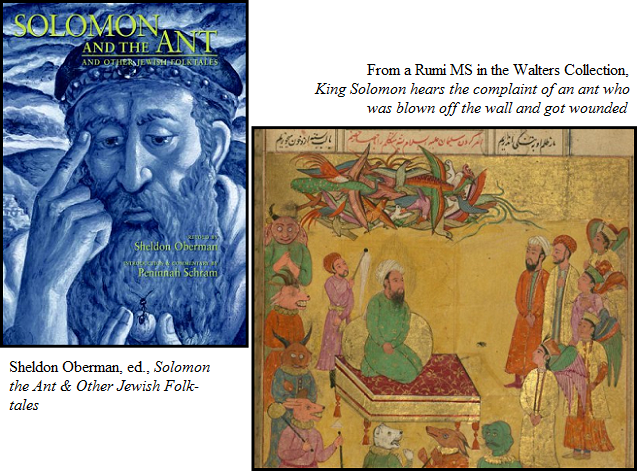
Note also the Jewish folk-tale concerning King Solomon and the ant… and Rumi’s telling, illustrated above from Walters manuscript W.626

2.

I have also been talking about mapping the conceptual way-stations that are found in conversations leading to radicalization – but that’s really just a target of opportunity for me, I am interested in mapping concepts in general. Here again, that Qur’anic passage is of interest.

That’s because it “maps” – in a very double-quote-ish way – to recent findings in science, as exemplified by:

Francesca Barbero, Jeremy A Thomas, Simona Bonelli, Emilio Balletto, Karsten Schönrogge, Queen Ants Make Distinctive Sounds That Are Mimicked by a Butterfly Social Parasite, in Science, Vol. 323 no. 5915 pp. 782-785 (2009).

Ants, it appears, talk among themselves, but the voices of their queens are distinctive: and the Maculinea rebeli butterfly larvae can mimic the speech of a Myrmica schencki queen. As reporter Jeremy Hance discussing this study puts it:

While ant vocalizations had not been as widely studied as their chemical communications, the researchers believed this might hold the key to the butterfly’s success. They recorded the vocalizations of both the ant workers and the queens, and discovered significant differences in the queens’ “dominant frequency and overall acoustics”. When the queen’s vocalizations were replayed, worker ants would gather around the caller and guard it. The researchers found that this was “consistent with the exalted status and protection afforded to queens in the hierarchy of a colony”.

Researchers then turned to the parasitical butterfly larvae, whose vocalizations were mimics of their hosts’. However, the scientists discovered that the sounds were 23 to 27 percent closer to the queens’ over the workers’, thus providing them with first-class treatment. While the butterfly larvae may use chemical resemblance to infiltrate the colony, once inside the colony it is the mimicked vocalizations that allow it to rise to the top, often at the expense of its hosts’ offspring.

3.

So ants talk, and butterfly larvae can communicate with them – successfully enough, in fact, that “living M. rebeli larvae are rescued in preference to ant larvae when a colony is disturbed,” and “nurse workers kill and feed their own brood to the social parasite if food is scarce”.

And so ants talk, and Solomon can understand them – enough so that their concerns about his army bring a laugh to his lips.

And the overlap between those two ideas – one scripturally based and dating back fourteen hundred years, the other a product of recent science – is of the kind that provides confirmation for believers of their belief along these lines:

the Qur’an says that ants speak, now science has shown this to be literally true… and this provides additional evidence that the Qur’an is Truth.

4.

Here, then, is yet another use of the “overlapping concepts” notion that I’ve explored in posts on Ada Lovelace, and more recently Nancy Fouts, Walter Benjamin, and the confluence of Hamlet and the Heart Sutra in a poem of mine…

Arthur Koestler affirms in The Act of Creation that such intersections are to be found at the heart of tragedy and catharsis, humor and laughter, and discovery and eureka: here we find them providing confirmation for religious belief.

5.

Such intersections can in practice be read in two directions, as Bernard McGinn notes in the article on Revelation he wrote for Robert Alter and Frank Kermode‘s Literary Guide to the Bible – here’s his comment on Martin Luther‘s interpretive process:

Earlier interpreters, such as Joachim (but not Augustine), had also claimed to find a consonance between Revelation’s prophecies and the events of Church history, but they had begun with Scripture and used it as a key to unlock history. Paradoxically, Luther, the great champion of the biblical word, claimed that history enabled him to make sense of Revelation…

When the overlaps are between scientific knowledge and scriptural statements, believers tend to read science as an empirical support for scripture – they don’t read scripture as supporting the findings of science.

When it comes to prophecy and fulfillment, however, the danger exists that current events will be forced into the Procrustean bed of scripture – as when JF Kennedy, Jimmy Carter, Ronald Reagan, and Barack Obama have each in turn been accused of being the Antichrist…

6.
.

.
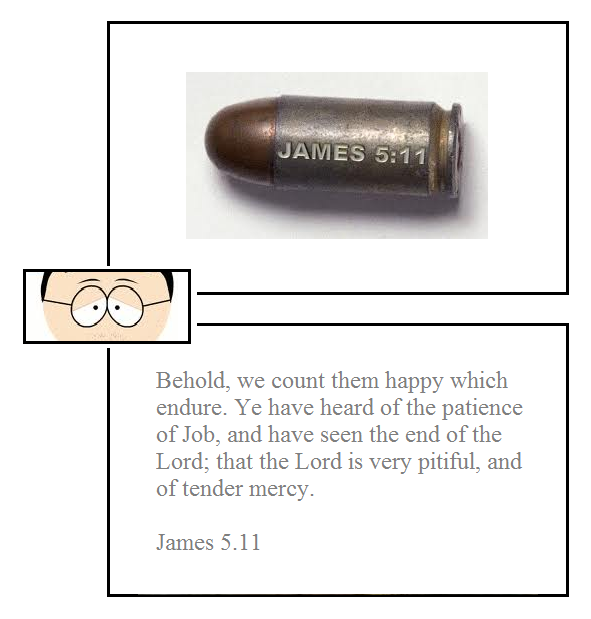
The bullet image above is available from Way 2 Worship as wallpaper for your computer screen. The verse below it, James 5.11, is the verse the bullet “cites”.

Comedy, tragedy — or inspiration?

Al-Awlaki and the former and latter rains

Saturday, March 31st, 2012

[ by Charles Cameron — former and latter rain in OT, NT and hadith, also YouTube eulogy for Anwar al-Awlaki ]
.

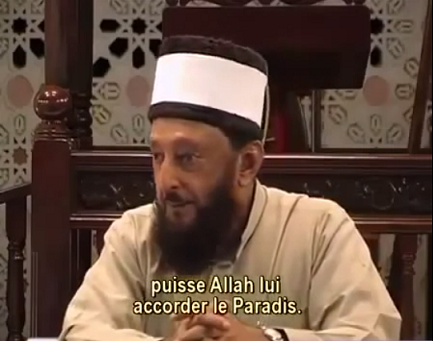
I’ve posted more than once about Sheikh Imran Nazar Hosein [eg: The United States of Islam and Iran or Afghanistan? The Black Flags of Khorasan]: today I saw a clip (screen-cap above) in which he eulogizes Anwar al-Awlaki.

What interests me in Sheikh Imran Hosein’s eulogy is that he references a hadith of the Prophet about the first and last showers of rain

*

So first, some background.

The imagery of “the first rain and the latter rain” dates back at least to the Torah.

In Deuteronomy 11.13-14, we read:

And it shall come to pass, if ye shall hearken diligently unto my commandments which I command you this day, to love the Lord your God, and to serve him with all your heart and with all your soul, that I will give you the rain of your land in his due season, the first rain and the latter rain, that thou mayest gather in thy corn, and thy wine, and thine oil.

That seems to be a fairly straight forward agricultural usage, although as I mentioned recently, scriptural exegesis under the PaRDeS system involves four levels of interpretation.

Joel 2.23 picks up the theme:

Be glad then, ye children of Zion, and rejoice in the LORD your God: for he hath given you the former rain moderately, and he will cause to come down for you the rain, the former rain, and the latter rain in the first month.

But this comes in a celebrated chapter which begins with the sounding of an apocalyptic trumpet and the declaration that “the day of the LORD cometh, for it is nigh at hand” – and which also contains the prophecy (verses 28-30):

I will pour out my spirit upon all flesh; and your sons and your daughters shall prophesy, your old men shall dream dreams, your young men shall see visions: And also upon the servants and upon the handmaids in those days will I pour out my spirit. And I will shew wonders in the heavens and in the earth, blood, and fire, and pillars of smoke…

By the time we reach the New Testament, the theme is clearly used (James 5.7) with a Christian eschatological implication:

Be patient therefore, brethren, unto the coming of the Lord. Behold, the husbandman waiteth for the precious fruit of the earth, and hath long patience for it, until he receive the early and latter rain

And indeed, the imagery of the Latter Rain as an outpouring of the Spirit to occur in the end times has given rise to a movement or series of Pentecostal movements going under the name of the Latter Rain, which have at times drawn the disapproval of apologetics scholars and even fellow Pentecostals.

*

Bearing that in mind, it is interesting to note the following hadith of the Prophet:

The Prophet, sallaallaahu `alaihi wa sallam, further said:

“The example of my Ummah is like that of rain. It is not known whether the initial part (of the rain) is good or the latter part.”

Ibn Taymiyyah, the medieval theologian whose previously somewhat obscure work strongly influenced ‘Abd al-Wahhab, and thus the modern Wahhabi current, commented on this hadith:

..what it means is that among those who come later there will be those who are similar to those who came before, and they will be so close that the one who tries to compare them will not know which is better, even though one of them is in fact better.

This is glad tidings for those who come later, that among them will be those who are close to those who came before them, as it says in another hadeeth: “The best of my ummah are the first and the last, and between them there will be some crookedness. Would that I could see my brethren.” They said, “Are we not your brethren?” He said, “You are my companions.” This shows that precedence was given to the Sahaabah, because they alone are his companions, which is a higher status than merely being brothers.”

*

In his tribute to “our brother Sheikh Anwar al-Awlaki” Sheikh Imran Hosein says “I don’t think there’s need to say more than one statement about Anwar al-Awlaki.” He then quotes the same hadith, repeating the first phrase for emphasis:

My Ummah is like the rain. My Ummah is like the rain: I do not know which shower is better, the first or the last.

And concludes:

Anwar Awlaki belongs to the last shower. That is his status, may Allah grant him Jannah.

— Jannah being the garden of Paradise.

*

But see for yourself — the video clip is only a minute long, and the hadith and commentary are provided below it on the YouTube site:


Switch to our mobile site