zenpundit.com » scriptures

Archive for the ‘scriptures’ Category

Apocalyptic Updates I: Warren Jeffs and a troubled world

Thursday, December 15th, 2011

[ by Charles Cameron — prophecy, Warren Jeffs, FLDS, Zion in the US, the future, mapped ]

.

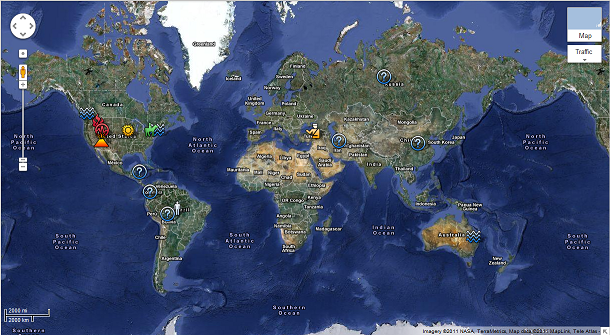
Well, there you have it: a map of where Warren Jeffs, the imprisoned president of the Fundamentalist Church of Jesus Christ of Latter-Day Saints (FLDS), prophesies there will be major problems soon, if his life sentence for child sexual assault isn’t quickly rescinded.

I’ll bet our meteorologists, intel folks and policy-makers wish they had this kind of insight into just where and what will happen next.

*

Let’s take a closer look.

That’s Africa, the Middle East and a good bit of Asia and Australasia, with not a whole lot going on to be honest.  Turkey?

Turkey helps Israel

“Let Turkey aid Israel in day of great attack against my Israel, lest you also fall and become a subject nation. Amen.”

Iran?

Iran warning

“Let the nation of Iran cease all aggressive power against neighboring lands and peoples, lest you become a nation no more; only to be of subjugation to a foreign power, to no longer be of aggression”

And that’s it for the ever-contentious Middle East.

*

And there’s good reason for that.  The Middle East isn’t where Zion is.

Take a look at the US  now, and see how much more dire the prophetic warnings are here…

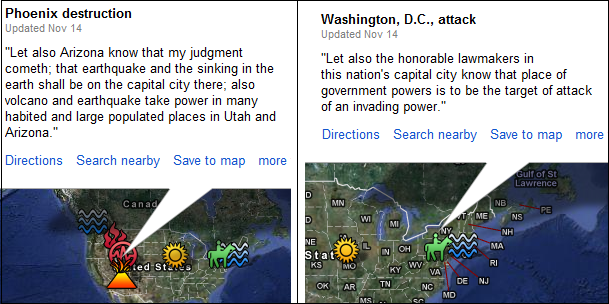
An earthquake and tidal wave in Seattle, a “melting fire of such powers to cleanse my land of all evil” in Idaho, a tsunami off the East coast (Californians should be relieved) in which “great and noticeable cities on the coast shall be swept off the land ” — and more.

And that’s because the center of gravity shifts to the US when (a) Christ appears here as well as in Israel, according to the Book of Mormon, and (b) Joseph Smith receives his revelations and founds the Mormon church here.

And if that’s not enough, here are two especially significant events to be on the lookout for:

An attack on Washington, the destruction of Phoenix, and volcanoes across Arizona and Utah…

…which points us to the sites especially sacred to the FLDS — and indeed other churches in the tradition of Joseph Smith:

So that’s the hub of this whole thing, what the Temple Mount / Noble Sanctuary is to potent prophetic and apocalyptic influences in the Middle East: New Jerusalem in  Missouri.

*

So that’s your update on our future prospects as Warren Jeffs sees them.

The map was kindly provided by Lindsay Whitehurst on her Salt Lake Tribune blog, and can be found here.  Three of Jeff’s recent prophecies, containing materials used in these maps, have been made public by the Utah Attorney General’s office, and can be downloaded here and here.

Coming up shortly: Apocalyptic Updates II: Iran, the Mahdi and the Vilayat

There’s been some new analysis of the Ahmadinejad / Khamenei split at MEMRI that makes it clear that Ahmadinejad’s Mahdist claims are very much at the root of the issue, so that we have what is essentially a Mahdist vs Velayat standoff on the theological level, and a clerical elite vs populist standoff on the political.  Watch this space…

A “Big Dream” attributed to Osama bin Laden

Tuesday, December 13th, 2011

[ by Charles Cameron — hadith, Aden-Abyan, Abu M. al-Maqdisi, major dream of young bin Laden, role of narration 1 month after his death, any comments? ]

.

.

I was trying to follow up on a hadith which declares:

An army of twelve-thousand will come out of Aden-Abyan. They will give victory to Allah and His messenger. They are the best between myself and them.

There’s an extensive discussion of it on Somalinet offered by Sheikh Abu Muhammad al-Maqdisi [teh Sheikh Abu M al-Maqdisi?] and posted on June 4 of this year, but it doesn’t answer my question as to how this narration fits in with the various narrations about the army from Khorasan.

1.

While reading in and around this topic, however, I ran across this account of a dream on the young bin Laden, which appears on a number of sites favorable to jihad around June 4, 2011, i.e. after bin Laden’s death, and which I have not seen discussed on those analysts’ sites that I manage to follow.

It’s extremely interesting to me not only because dreams are potentially important vehicles for divine guidance in Islam, but also because it ties bin Laden specifically to the Khorasan / black banners hadith, and to the Mahdi.  In this dream, I( don’t think it’s going too far to say that bin Laden himself plays a preparatory role with regard to the Mahdi that we can perhaps understand in the west as equivalent to that of John the Baptist in preparation for Christ.

2. 

If this dream narrative has been explored in the open source analytic literature, I would be very interested to see what has been said.  In  the meantime, I will simply post the narration as I found it:

3.

This incident was narrated to me by a student of knowledge who spent more than 20 years in the company of scholars acquiring knowledge. He told me about a dream that Shaykh Osama bin Laden had when he was 9 years old, which indicated that Allah swt was preparing Shaykh Osama bin Laden, may Allah have mercy on him, since childhood, for battles against the Crusaders.

He told me that once he was sitting with a companion and discussing the deplorable condition of the Ummah but that all the incidents taking place in the Muslim Ummah are going according to Allah’s plan and that it is certain that the victory of Allah the Almighty will come. He will surely send a Leader and a Guide from amongst our Ummah who will deliver the humiliated and pitiful Ummah to the enlightened path of ascent and loftiness. We started thinking that who could be such a person!

Immediately, the thought of Shaykh Osama bin Laden came to our minds, since he has made innumerable sacrifices for the sake of the Ummah. On this, my companion smiled and said, “I will narrate to you a dream of Shaykh Osama bin Laden; you will be pleased to hear it, and your love for the mujahideen will only increase.”

He said, I was in al-Madinah al-Munawwarah at the house of a Scholar who used to lecture at the Prophet’s masjid. We had just arrived at his house when someone knocked on the door. The Shaykh returned with a person of luminous and honorable appearance who was about 80 years old.

The host welcomed him and requested the Tafsir of a few verses from the Qur’an. We quietly listened to him while the guest Shaykh recited a few verses, and then he gave the Tafsir of those verses. By Allah, I had studied a number of Tafsirs, but that Shaykh was a sea of knowledge. When he completed his lesson, the host invited him for a meal, but he declined politely, and we came to understand that he was fasting.

Eventually, the guest asked for permission to leave, but the host insisted, ‘Until you narrate to us the dream of Shaykh Osama bin Laden once more, you will not get the permission to leave.’

The Shaykh smiled and asked, ‘The dream that Shaykh Osama bin Laden had when he was 9 years old?’ The host replied in the affirmative.

This is how that Shaykh narrated the incident:

I was a close friend of Muhammed bin Laden, the father of Osama bin Laden. Many times I would be in his company. And many times, I used to visit his house regarding work related to construction. During the discussions, our talk would be disturbed by the playing of his children, and then he would ask them to go out and play.

But I was surprised to see that he would always ask one particular son to sit beside him. I asked him, “Why don’t you let this son of yours to play with his other brothers? Is he sick?”

Mohammed bin Laden smiled and said, “No, there something special about this son of mine.”’

When I asked his name, he said, “His name is Osama, and he is 9 years old. Let me share with you something strange which happened a few days ago. My son woke me up few minutes before the morning prayer and told me, ‘Dear father, I want to tell you about a dream that I had.’ I thought he must have had a nightmare. I made ablution and took him along with me to Masjid.

On the way, he told me, ‘In the dream, I saw myself in a huge, flat area. I saw an army mounted on white horses moving towards me. All of them were wearing black turbans. One of the horsemen, who had shiny eyes, came up to me and asked me, “Are you Osama bin Muhammed bin Laden?” I replied, “Yes.” He then asked me again, “Are you Osama bin Muhammed bin Laden?” I again replied, “Yes, that is me.” He again asked, “Are you Osama bin Muhammed bin Laden?” Then I said, “By Allah, I am Osama bin Laden.” He moved a flag towards me and said, “Hand this flag over to Imam Mahdi Muhammad bin Abdullah at the gates of Al-Quds.” I took the flag from him, and I saw that the army started marching behind me.’

Muhammed bin Laden said, “I was surprised at that but, due to business at work, I forgot about the dream. The next morning, he woke me up just before the morning prayer and narrated the same dream. The same thing happened on the third morning also. Now, I began to worry for my son. I decided to take him with me to a knowledgeable person who can interpret dreams.

Accordingly, I took Osama to a person of knowledge and informed him about the whole incident. He looked at us with surprise and asked, ‘Is this your same son who had the dream?’ I said, ‘Yes.’ He kept staring at Osama for some time. My concern multiplied. He comforted me and said, ‘I will ask you a few questions. I am sure that you will answer them truthfully.’

He asked Osama, ‘Son, do you remember anything about that flag which that horseman gave you?’ Osama replied, ‘Yes, I remember it.’

He asked him, ‘Can you describe it, how it was?’

Osama said, ‘It was similar to the flag of Saudi Arabia, but its color was not green but black, and there was something written on it in white color.’

He then put the next question to Osama, ‘Did you ever see yourself also fighting?’

Osama replied, ‘I commonly see such dreams.’ He then asked Osama to go out of the room and do recitation of the Qur’an.

Then that person of knowledge turned towards me and asked, ‘Where is your ancestry from?’

I replied from Hadramawt in Yemen. Then, he asked me to tell him something about my tribe. I replied that we are related to the tribe of Shanwah which is a Qahtani tribe from Yemen. He then cried out the Takbir loudly and called in Osama and kissed him while crying. He also said that the signs of the hour are near.

‘O Muhammed bin Laden, this son of yours will prepare an army for Imam Mahdi and for the sake of protecting his religion, he will migrate to the region of Khurasan. O Osama ! Blessed is he who will do Jihad by your side and undone and disappointed be he who leaves you alone and fights against you.’

4.

It is notable that this account appears to have surfaced in the English-language literature about a month after the Abbottabad raid of May 2.  At least in this English-language form, it seems to be a posthumous account, hagiographic in tone, and directly linking  bin Laden and those who fought with him to the fulfillment of Mahdist prediction.

My questions would be whether anyone knows of an earlier appearance of this narrative, perhaps in Arabic — and if it indeed is first found after bin Laden’s death, how the readers of signs, both Islamist and  Western-analytic, read this particular text.

I have seen this narrative featured on sites relating to the Netherlands, Egypt, Somalia, South Africa, Kashmir, and Pakistan — and as a text video with nasheed accompaniment on YouTube – so it seems to have spread pretty rapidly, which suggests it “fits” powerfully with the needs of the jihadizing internet shortly after bin Laden’s death.

5.

Sources include:


We spend far too much time on content, and not enough time on form

Tuesday, December 13th, 2011

[ by Charles Cameron — recursion as form — this one’s for analysts: poets should know it already ]

.

We spend far too much time on content, and not enough time on form.

We spend far too much time on the data, and not enough time on relationships. It is pattern that connects the dots with accuracy, not more dots – quality of insight, not quantity of information.

And pattern is underlying form.

Haiku is a form. The sonnet is a form, the sonata is a form. And just to juxtapose sonnet and sonata is to recognize the formal relationship between them.

1.

Recursion is the form that Doug Hofstadter explores in his book, Godel Escher Bach, and you’ll find it every time one mirror reflects another mirror (what color does a chameleon turn when placed on a mirror?), every time there’s a doll inside a doll inside a Matrioshka doll, often in the form of a paradox (“this sentence is meaningless”) – and when people take photos of themselves holding photos of themselves…

as in the pic of Noam Chomsky and Morris Halle and (in case your politics doesn’t agree so much with Chomsky) the one below them of Jacob Appelbaum and Donald Knuth in my “specs” image at the top of this post.

2.

Content can be powerful, but form really doubles up on the power. Here’s one way of thinking about it: form is what tightens information into meaning.

A couple of news reports in the last couple of days have caught my attention because of their form:

Charter of Open Source Org is Classified, CIA Says

Open Source Works, which is the CIA’s in-house open source analysis component, is devoted to intelligence analysis of unclassified, open source information. Oddly, however, the directive that established Open Source Works is classified, as is the charter of the organization. In fact, CIA says the very existence of any such records is a classified fact.

“The CIA can neither confirm nor deny the existence or nonexistence of records responsive to your request,” wrote Susan Viscuso, CIA Information and Privacy Coordinator, in a November 29 response to a Freedom of Information Act request from Jeffrey Richelson of the National Security Archive for the Open Source Works directive and charter.

“The fact of the existence or nonexistence of requested records is currently and properly classified and is intelligence sources and methods information that is protected from disclosure,” Dr. Viscuso wrote.

This is a surprising development since Open Source Works — by definition — does not engage in clandestine collection of intelligence. Rather, it performs analysis based on unclassified, open source materials.

That’s hilarious, it’s so misguided: I don’t know whether to laugh or barf (not a word I ever expected to use in my writings, but there you go).

3.

That’s sad, this one’s just plain tragic:

Protesters calling for religious tolerance attacked with stones, threatened with death

Police are investigating a violent attack on a ‘silent protest’ calling for religious tolerance, held at the Artificial Beach to mark Human Rights Day.

Witnesses said a group of men threw rocks at the 15-30 demonstrators, calling out threats and vowing to kill them.

One witness who took photos of the attacked said he was “threatened with death if these pictures were leaked. He said we should never been seen in the streets or we will be sorry.”

Killing your enemies for reasons of religion is one thing: killing those who work for peace between you and your religious enemies is no worse of the face of it – it’s religious killing, no more and no less, in both cases — but it drives the point home with considerable, poignant force.

Keep your eye out for recursion, it’s an interesting business. And respect form – it empowers content.

4.

You’ll find recursion right at the heart of Shakespeare: his plays were performed in a round theater (the “wooden O” of Henry V) called the Globe, whose motto was “totus mundus agit histrionem” – roughly, “the whole world enacts a play” – a notion which Shakespeare put into the mouth of the melancholy Jaques in As You Like It:

All the world’s a stage,
And all the men and women merely players.
They have their exits and their entrances,
And one man in his time plays many parts…

A martial version of this idea, indeed, can be found in the philosopher Plotinus, who wrote in his Enneads (3.ii.15):

Men directing their weapons against each other — under doom of death yet neatly lined up to fight as in the pyrrhic sword-dances of their sport — this is enough to tell us that all human intentions are but play, that death is nothing terrible, that to die in a war or in a fight is but to taste a little beforehand what old age has in store, to go away earlier and come back the sooner. So for misfortunes that may accompany life, the loss of property, for instance; the loser will see that there was a time when it was not his, that its possession is but a mock boon to the robbers, who will in their turn lose it to others, and even that to retain property is a greater loss than to forfeit it.

Murders, death in all its guises, the reduction and sacking of cities, all must be to us just such a spectacle as the changing scenes of a play; all is but the varied incident of a plot, costume on and off, acted grief and lament. For on earth, in all the succession of life, it is not the Soul within but the Shadow outside of the authentic man, that grieves and complains and acts out the plot on this world stage which men have dotted with stages of their own constructing.

5.

I thought it would be interesting to see if recursion had power, too, in the field of religion, and this passage from Ephesians (4.8) sprang to mind…

When he ascended up on high, he led captivity captive, and gave gifts unto men…

That’s a lovely recursion, “leading captivity captive”. But I think we can go deeper. John Donne‘s sonnet Death be not proud reaches to the very heart of the Christian message, it seems to me –it parallels the passage from Ephesians closely, while focusing in on the hope of resurrection with its stunning conclusion:

Death, thou shalt die.

Here’s the whole thing: profound content in impeccable form:

Death be not proud

Death be not proud, though some have called thee
Mighty and dreadfull, for, thou art not so,
For, those, whom thou think’st, thou dost overthrow,
Die not, poore death, nor yet canst thou kill me.
From rest and sleepe, which but thy pictures bee,
Much pleasure, then from thee, much more must flow,
And soonest our best men with thee doe goe,
Rest of their bones, and soules deliverie.
Thou art slave to Fate, Chance, kings, and desperate men,
And dost with poyson, warre, and sicknesse dwell,
And poppie, or charmes can make us sleepe as well,
And better then thy stroake; why swell’st thou then;
One short sleepe past, wee wake eternally,
And death shall be no more; death, thou shalt die.

6.

What do you think?

Lex Talionis II: the matter of Israelis, Palestinians and more

Saturday, December 10th, 2011

[ by Charles Cameron — vendetta, vengeance, an eye for an eye, compensation, forgiveness, and the question of limits ]
.

I didn’t want this pair of events to slip by entirely unnoticed.

The first image above shows part of the “wanted” poster with which Rabbi Menachem Liebman offered a $100,000 reward to whoever would kill Huliad and Nidar Ramadan, recently released by Israeli authorities as part of the prisoner-swap for Gilad Shalit, who had previously been convicted of killing his own son, Shlomo Liebman, a settlement security guard.

The second, lower image is taken from the reciprocating offer of a $100,000 reward made by Dr Awad al-Qarni on Facebook, to whoever who would capture an(other) Israeli soldier.

These things tend to escalate.  According to this AllGov report, Prince Khaled bin Talal of Saudi Arabia commented that “Dr Awad al-Qarni said he was offering $100,000 to only take a prisoner but they [unnamed in the original Reuters report, but presumably Israelis] responded by offering $1 million to kill Awad al-Qarni” – and himself pledged an additional $900,000 to the bounty on the capture of Israeli soldiers, bringing the total to $1 million.

Accompanying this story on the AllGov site, appositely enough, was this illustrated quote from Mohandas Gandhi:

For those who have trouble killing Ramadan brothers or capturing Israeli soldiers, lesser rewards are also available in the United States: this article reports that a “$4,000 reward has been offered for the identity of the police officer who may have been responsible for the injuries sustained by former Iraq war veteran Scott Olsen” during the Oakland Occupy protests recently.

*

Juvenal wrote Semper et infirmi est animi exiguique voluptas Ultio — “revenge is the weak pleasure of a narrow mind”.

*

Let’s think about this for a moment.

Lex talionis is the law of limited retribution – one eye for one eye – found (following similar texts in the code of Hammurabi) in the Mosaic law, Exodus 21.23-25 requiring “life for life, eye for eye, tooth for tooth, hand for hand, foot for foot, burn for burn, wound for wound, bruise for bruise.”  The rabbis, however, commented that “inasmuch as the law seeks equity, its literal enforcement would frequently lead to gross inequity” [W Gunther Plaut, The Torah: A Modern Commentary, p 571. n. 6.] – and chose to interpret the text as mandating equivalent monetary compensation for value lost.

Tit for tat is a common expression of the same idea, and has also been used in a technical sense in strategies for the iterative playing of Prisoners Dilemma games referred to in my previous post.

Christ‘s injunction in Matthew 5.38-39 reads:

Ye have heard that it hath been said, An eye for an eye, and a tooth for a tooth: But I say unto you, That ye resist not evil: but whosoever shall smite thee on thy right cheek, turn to him the other also.

Similarly in the Qur’an, 41:34-35, Muslims are instructed:

Nor can goodness and Evil be equal. Repel (evil) with what is better: Then will he between whom and thee was hatred become as it were thy friend and intimate!

Joseph Smith, the first Mormon prophet, suggests in Journal of Discourses vol 2, pg 165-166 that such forbearance is appropriate the first time, but not thereafter:

Our enemies have prophesied that we would establish our religion by the sword; is it true? No, but if Missouri will not stay her cruel hand in her unhallowed persecutions against us, I restrain you not any longer: I say, in the name of Jesus Christ, by the authority of the Holy Priesthood, I this day turn the key that opens the heavens to restrain you no longer from this time forth. I will lead you to battle; and if you are not afraid to die, and feel disposed to spill your blood in your own defence, you will not offend me. Be not the aggressor—bear until they strike you on the one cheek; then offer the other and they will be sure to strike that then defend yourselves, and God will bear you off, and you shall stand forth clear before His tribunal.

The New Testament, however, suggests that this forbearance is not to be exercised only on the first occasion…  Thus in Matthew 18.21-22 we read:

Then came Peter to him, and said, Lord, how oft shall my brother sin against me, and I forgive him? till seven times? Jesus said to him, I say not to you, Until seven times: but, Until seventy times seven.

Also of interest is here the (possibly apocryphal) story of the Dalai Lama, who was asked how he would deal with a mosquito. “Brush it away,” he replied. “But what if it comes back?” “Brush it away again.” “But what if it comes back again?” “I crush it, and say ‘Come back as the Buddha!'”

For a detailed consideration of these issues in Islam, see Abdullah bin Hamid Ali‘s Islam and Turning the Other Cheek [.pdf], where this interesting discussion featuring the idea of forgiveness “seventy times” is also featured:

The Koran directs the Prophet — God’s mercy and peace be upon him — concerning the hypocrites, “Whether you ask for their forgiveness, or not, [their sin is unforgiveable]: if you ask seventy times for their forgiveness, Allah will not forgive them because they have rejected Allah and His messenger, and Allah guides not those who are perversely rebellious” (9: 80). After the death of the chief hypocrite, ‘Abd Allah ibn Ubayy, the Prophet — mercy and peace on him — saw no decisive prohibition in this verse against praying for hypocrites. This was, firstly, because outwardly the words give him a choice between asking forgiveness or not (Whether you ask for their forgiveness, or not…). Secondly, the verse mentions that God would not forgive even if he was to ask seventy times. His hope was that if he asked more than seventy times, it might be enough to secure forgiveness for Ibn Ubayy in spite of his open and insidious antagonism of the Prophet — mercy and peace on him. His companion, ‘Umar, contested this understanding of the Prophet’s — God’s mercy and peace be upon him. Later, the following verse was revealed confirming ‘Umar’s stance, “Nor do you ever pray for any of them that dies, nor stand at his grave; for they rejected Allah and His messenger, and died in a state of perverse rebellion” (9: 84)

*

Perhaps Koholeth (Ecclesiastes 3.1) should have the last word:

To every thing there is a season, and a time to every purpose under the heaven

Lex Talionis I: the matter of Subramaniam Swamy and Harvard

Friday, December 9th, 2011

[ by Charles Cameron — Harvard controversy, free speech vs hate speech, Hindutva, moral high ground & sanctions for and against violence ]

.

I am grateful to various members of the New Religious Movements list for pointing me to the recent events in Harvard, where a group of scholars led by the formidable Diana Eck (her book on Banaras is a masterpiece and greatly treasured) have persuaded the Faculty of Arts and Sciences to omit two courses in economics usually taught by Subramaniam Swamy from their Summer School offerings next year, on the ground that an op-ed he published in Daily News and Analysis titled “How to Wipe Out Islamic Terror” fell under the category of hate-speech (as opposed to free speech).

The article in question is no longer available on the DNA site, but can be found on Pamela Geller‘s Atlas Shrugged blog.  An account of the controversy can be found on Inside Higher Ed, and Harvard Faculty’s debate was reported in the Harvard Magazine.

Subramaniam Swamy is President of what remains of the once powerful Janata Party and former Union Cabinet Minister.

With that as background, I would like to address the issue of the varying principles and rule-sets invoked as offering a moral high ground – or a necessary safeguard – in various religious and other traditions.

*

I have read Dr Subramaniam Swamy’s article, and while the various quotes in it recommending specific actions — such as “Remove the masjid in Kashi Vishwanath temple complex, and 300 others in other sites as a tit-for-tat” and “Enact a national law prohibiting conversion from Hindu religion to any other religion” – give western readers a sense of Swamy’s overall mindset and intentions, it was another quote that held my attention:

This is Kaliyug, and hence there is no room for sattvic responses to evil people. Hindu religion has a concept of apat dharma and we should invoke it. This is the moment of truth for us.

I suspect the reason this quote has not been featured in the reports I’ve read of the debate have to do with the number of words in it that are unfamiliar to the western reader.

I’m acquainted with Kaliyug (the Age of Darkness) and with the concept of the sattvic (“Sattva is a state of mind in which the mind is steady, calm and peaceful” to quote the sacred Wiki), but had to dig a bit to discover that apat dharma is essentially “righteousness in emergencies”:

There are special Dharmas during critical and dangerous circumstances. They are called Apat-Dharma.

Swami Sivananda

Apat Dharma: They are duties that come to one under extraordinary circumstances, in crisis or in emergencies (apatmulakah). In such circumstances, even that which under normal circumstance is deemed wrong becomes dharma (tatra adharmo’pi dharmah). Here the righteous motives guide our actions (bhava-suddhimattvat). Normally a doctor gives anaesthesia before operating the patient but an emergency operation performed on the battlefield to save the life or limb of a soldier on the battlefield may be done without anaesthesia and with the instruments available, be they sterilized or not. When emergency is declared in the country, the elected parliament can be dismissed, the Constitution suspended and the ruler assumes extra-ordinary powers to deal with the situation. When peace prevails, the youth of a country should get education and work, but during war, the country may call upon its youth to sacrifice their education and fight in defence of the country, sometimes with hardly any training.

Sanjeev Nayyar

So that quote – “This is Kaliyug, and hence there is no room for sattvic responses to evil people. Hindu religion has a concept of apat dharma and we should invoke it. This is the moment of truth for us” – is essentially the abstract principle on which Swamy’s various proposals are based, and thus corresponds to the principles articulated by PM Netanyahu in his recent opening of the Knesset as underlying his government’s policies with regard to national security:

Our policy is guided by two main principles: the first is “if someone comes to kill you, rise up and kill him first,” and the second is “if anyone harms us, his blood is on his own hands.”

If you want a sense of how important that quote about apat dharma is to a Hindu (and a fortiori, a Hindutva) reader, see the way it is singled out and quoted with an illustration of Krishna driving Arjuna‘s chariot into battle by “Sanchithere (I’ve used the same illustration at the head of this post):

*

What am I after here?

It seems to me that we could use a brief yet definitive scholarly account of what the guiding principles of the various religions and secular worldviews allow their adherents, in terms of justice, forgiveness, pre-emption, retribution and retaliation.

This would need to include, compare and contrast such principles as:

  • The Judaic notions of pre-emptive killing (Netanyahu’s first principle, found in the Talmud and commonly quoted as ‘ha’Ba Lehorgecha, Hashkem Lehorgo, If someone tries to kill you, rise up and kill him first) and the injunction, in fighting the Amalekites, “Now go and smite Amalek, and utterly destroy all that they have, and spare them not; but slay both man and woman, infant and suckling, ox and sheep, camel and ass” (1 Samuel 15:3).
  • Christ’s “But I say unto you which hear, Love your enemies, do good to them which hate you.” (Luke 6.27)
  • Christian “just war” theology.
  • The western / UN “norm” that some actions are simply beyond the pale, unacceptable under any circumstances (essentially the basis for war crimes tribunals)
  • Game theory’s “tit for tat” strategy in an iterated Prisoners’ Dilemma as proposed by Anatol Rapaport and articulated by Robert Axelrod in his book, The Evolution of Cooperation.
  • The Islamic tradition’s notion of response in kind (Qur’an: 2.194, “and so for all things prohibited, — there is the Law of Equality. If then anyone transgresses the prohibition against you, transgress ye likewise against him but fear Allah, and know that Allah is with those who restrain themselves”) – which would appear to imply that actions that would not normally be acceptable may be appropriate in response to an enemy that has already “transgressed” in that specific manner
  • Gandhi’s ahimsa, together with his corollaries, “An eye for an eye makes the whole world blind” (attributed) and “It is better to be violent, if there is violence in our hearts, than to put on the cloak of nonviolence to cover impotence.”
  • Swamy’s own “This is Kaliyug, and hence there is no room for sattvic responses to evil people” and “the nation must retaliate — not by measured and ‘sober’ responses but by massive retaliation.”
  • Buddha’s “Victory breeds hatred. The defeated live in pain. Happily the peaceful live giving up victory and defeat” (Dhammapada15,5)…

… and so forth.

*

I am grateful for further pointers and comments you may care to offer.

I hope to follow this post up with another, Lex Talionis II, which will address the use of private rewards for revenge killings in the Israeli / Palestinian matter.


Switch to our mobile site