zenpundit.com » Australia

Archive for the ‘Australia’ Category

Black Banners in Sydney 2: on flags and their meanings

Monday, December 22nd, 2014

[ by Charles Cameron — the history and dwindling significance of a sign ]
.
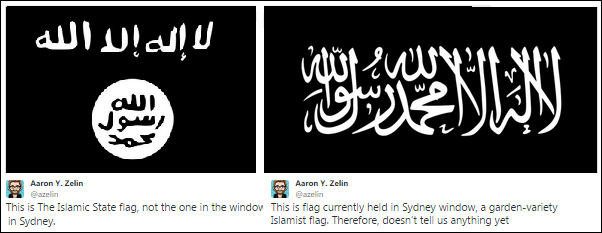
two flags

**

In my previous post in this series, Black Banners in Sydney 1: a DoubleQuote in the Wild from Ardeet, I wrote:

The flag in the image from the Lindt cafe is not in fact the Daesh / Islamic State flag, and indeed the hostage-taker appears to have asked for a genuine Daesh / IS flag as one of his demands. The flag shown is a black flag containing the Shahada or Islamic profession of faith in white, and black flags in Islam have a history as war flags dating back to the time of the Prophet himself.

The banners are black, and there are implications.

**

First, the black banner was the Prophet’s flag, the raya.

The Islamic Imagery Project at West Point’s Combating Terrorism Center lists “Black Flag” under the heading “Warfare Motifs“, saying:

The Black Flag (al-raya) traces its roots to the very beginning of Islam. It was the battle (jihad) flag of the Prophet Muhammad, carried into battle by many of his companions, including his nephew ‘Ali ibn Abi Talib. The flag regained prominence in the 8th century with its use by the leader of the Abbasid revolution, Abu Muslim, who led a revolt against the Umayyad clan and its Caliphate. The Umayyads, the ruling establishment of the Islamic world at the time, were seen as greedy, gluttonous, and religiously wayward leaders. The Abbasid revolution, then, was aimed at installing a new, more properly Islamic ruling house that would keep orthodox Islam at the center of its regime. Since then, the image of the black flag has been used as a symbol of religious revolt and battle (i.e. jihad). In Shiite belief, the black flag also evokes expectations about the afterlife. In the contemporary Islamist movement, the black flag is used to symbolize both offensive jihad and the proponents of reestablishing the Islamic Caliphate.

The Abbasids flew black banners, and were therefore known as the musawwids, or “wearers of the black”.

**

There are ahadith, considered by the scholar David Cook and others to be Abbasid forgeries, which claim that black banners from the east are a sign of the Mahdi’s coming. One such hadith reads:

If you see the black flags coming from Khurasan, join that army, even if you have to crawl over ice, for this is the army of the Caliph, the Mahdi and no one can stop that army until it reaches Jerusalem.

In Understanding Jihad, Cook writes:

Since Afghanistan, as Khurasan, has powerful resonance with many Muslims because of the messianic expectations focused on that region, this gave the globalist radical Muslims associated with al-Qa’ida under the leadership of Bin Ladin additional moral authority to proclaim jihad and call for the purification of the present Muslim governments and elites.

And as I have said before, Cook notes in his Contemporary Muslim Apocalyptic Literature that bin Laden’s mentor, Abdullah Azzam, made fresh use of this line of messianic tradition and “popularized the position of Afghanistan as the messianic precursor to the future liberation of Palestine” in his book, From Kabul to Jerusalem, while bin Laden refers to finding “a safe base in Khurasan, high in the peaks of the Hindu Kush” in his 1996 Declaration of Jihad.

**

There are many variants on the black flag, some of them carrying the Shahada or proclamation of faith, some decorated with the Prophet’s seal, some identifying particular jihadist factions. And while AQ in particular has capitalized on the hadith for recruitment as Ali Soufan detailed in his book The Black Banners, the breakaway “caliphate” use of black banners has been so prominently reported in the media that what used to be termed “the Al-Qaida flag” is now often called “the ISIS” (or “Islamic State”) flag.

It is against that somewhat confused background that we must understand Man Haron Monis’ demand, once he realized that the black flag with Shahada he was forcing hostages to hold in the window of the Lindt café was not the “right” black flag, that he be brought an “Islamic State” black flag – presumably the one with the Prophet’s seal, which had in fact been known as the “Al-Qaeda flag” before Daesh / IS took it up.

I once asked the American jihadist Omar Hammami, late of Al-Shabaab – who used that same black flag with Shahada and Prophetic seal in Somalia – whether their choice of flag referred only to Muhammad’s banner, or to the “black banners of Khorasan” ahadith also? – to which he replied:

the raayah is something general in religion regardless of color, but obviously those hadiths influenced black choice

**

I have been harping on the “end times” and specifically Mahdist significance of black banners in the contemporary context for seven years now, and lamenting that so little mention is made of the black banners’ apocalyptic connotations.

For the Islamic State / Daesh, there is no need to question its apocalyptic significance – all five issues to date of their magazine Dabiq have focused on the great “end times” battle to be fought at Dabiq in Syria – a name to compare with Har Megiddo, where the battle of Armageddon will be fought in the equivalent Christian “end times” narrative.

But for some demented guy taking hostages in a café in Sydney?

**

It now appears to me that the “meme” of black flags simply meaning “jihadist” is now so wide-spread, that the apocalyptic resonances may no longer be intended when someone picks up such a flag – or photographs it in some new context —

— no more so than the sign of a Che Guevara poster in a college dorm betokens a serious adherent to Marxist revolution.
Black Banners in Sydney 1: a DoubleQuote in the Wild from Ardeet

Monday, December 22nd, 2014

[ by Charles Cameron — feeling kinship with the cartoonist who calls himself Ardeet ]
.

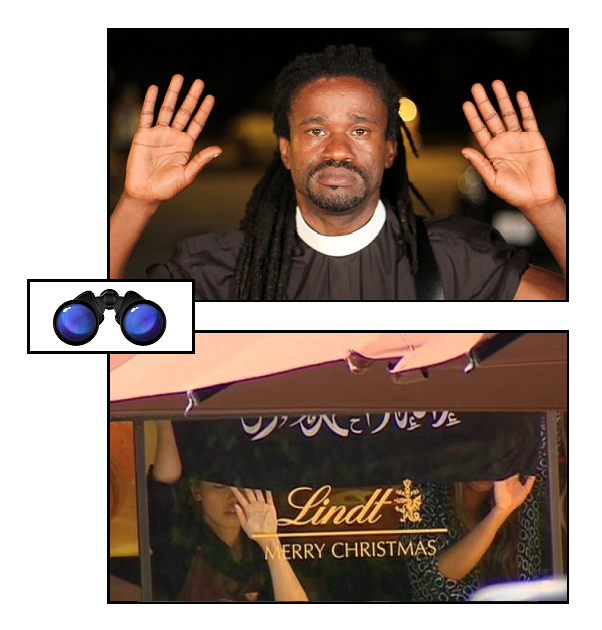
two images

**

As my regular readers know by now, I have a “form” I use for juxtaposing ideas — verbal, visual, and even mathematical on occasion — that I term DoubleQuotes, and I believe that juxtaposition, whether it be used to make a point of raise a question, is a standard feature of human thinking and a very powerful rhetorical device, yet little explored, critiqued, explained and appreciated.

In my view, when humans consistently use a certain way of doing things on many otherwise unrelated occasions, it’s a good bet that “sharpening” that way of doing things into a tool — making a point of it, if you like — will result in both practical and educational benefit.

Thus when I spot others using juxtapositions in a similar way, I call them DoubleQuotes in the Wild. They are an inspiration to me, confirming my hunch of the general utility and ongoing prevalence of the DQ principle.

**

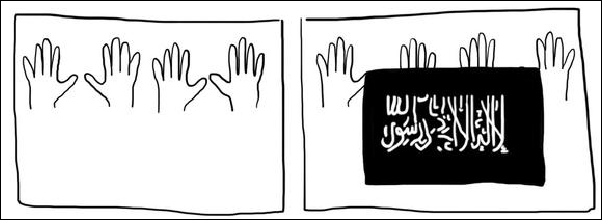
Here, then, is a “DQ in the Wild” from cartoonist Ardeet:

Local situation

That’s powerful, the suggestion being that the world press takes an event where there’s a suggestion of possible jihadist involvement (“terrorism”) a lot more seriously than one where that is not the case (“spree killing”). While the hostage situation was playing out in Sydney, for instance, a US vet killed “his ex-wife and five of her relatives” in Pennsylvania, drawing far less media interest.

**

I could see how Ardeet’s cartoon could be read in that sense, but I wasn’t sure how he intended it, having been exposed recently to dozens of images of hands raised as a sign of the Ferguson protests.

A somwhat different pairing therefore suggested itself to me, one with a different emphasis:

SPEC DQ hands & banner

Here the point is not that an event moves from local to global interest when the jihadist’s black banner appears, but that the hostage-taking in Sydney offers a curious and ironic (albeit unintended) take on one of the chief symbols of the protests in and about Ferguson, while the Ferguson protest gesture adds resonance to the image of hostages forced to hold up the black banner in Sydney.

**

I have been talking about the “black banners from Khorasan” hadith an its Mahdist implications online since 2007 if not earlier, and on Zenpundit since September 2009, and I think a clarification is in order at this point.

The flag in the image from the Lindt cafe is not in fact the Daesh / Islamic State flag, and indeed the hostage-taker appears to have asked for a genuine Daesh / IS flag as one of his demands. The flag shown is a black flag containing the Shahada or Islamic profession of faith in white, and black flags in Islam have a history as war flags dating back to the time of the Prophet himself.

Two tweets from Aaron Zelin will clarify the matter visually:

**

More on this in Black Banners in Sydney 2: on flags and their meanings.

A most curious YouTube quotation

Tuesday, December 16th, 2014

[ by Charles Cameron — total clash or bizarre agreement? Sydney hostage-taker Man Haron Monis quoted Christian apologist David Wood video on his Twitter feed ]
.

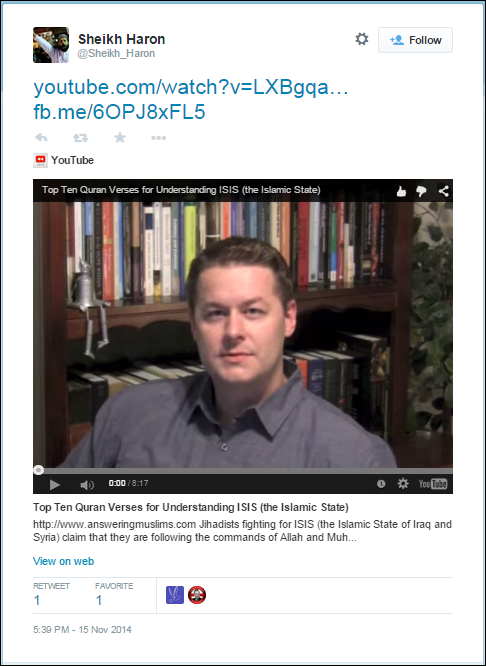
I am really not sure quite what to make of this. Sheikh Haron, aka Man Haron Monis, the disturbed ex-Shia convert to “Islam” who was the Sydney “hostage-taker” had a Twitter-feed, still up as I was researching this piece, which included this tweet:

**

Somewhat to my amazement, Haron is posting a video by the Christian apologist David Wood of Acts 17 Apologetics — a gentleman I’ve run across before, strongly opposed to Islam. Here’s the video in question, as featured on the Acts 17 Apologetics YouTube channel

Is Haron quoting Wood like this because he agrees (??!!) with Wood’s analysis of IS in terms of Quranic injunctions — or to show how disdainfully opposed to Islam, western views or Christian apologetics “really are”? — perhaps even both simultaneously?

No matter how you read Haron’s use of Wood’s video, or the various versions of the two Abrahamic faiths under discussion, the appearance of a Christian apologeticist on Haron’s website should give us pause for thought.

For an insight into Wood himself, the redemptive bio on the Moral Apologetics website under the title On Psychopathy and Moral Apologetics is worth your attention.

**

In case Haron’s feed gets taken down — I’m amazed it hasn’t been taken down already — here is a screen cap of that tweet:

Sheikh Haron's tweet

For more on Haron’s online presence, see Zack Beauchamp quoting Daveed Gartenstein-Ross in Sydney hostage taker Man Haron Monis pledged allegiance to ISIS on his website

American Caesar — a reread after 30 years

Wednesday, September 4th, 2013

[by J. Scott Shipman]

American Caesar, Douglas MacArthur 188-1964, by William Manchester

Often on weekends my wife allows me to tag along as she takes in area estate sales. She’s interested in vintage furniture, and I hope for a decent collection of books. A sale we visited a couple months ago had very few books, but of those few was a hardback copy of American Caesar. I purchased the copy for $1 and mentioned to my wife, “I’ll get to this again someday…” as I’d first read Manchester’s classic biography of General Douglas MacArthur in the early 1980’s while stationed on my first submarine. “Someday” started on the car ride home (she was driving), and I must admit: American Caesar was even better thirty years later. Manchester is a masterful biographer, and equal to the task of such a larger-than-life subject.

MacArthur still evokes passion among admirers and detractors. One take-away from the second reading was just how well-read MacArthur and his father were. When MacArthur the elder died, he left over 4,000 books in his library—both seemed to possess an encyclopedic knowledge of history and warfare. Highly recommended.

PS: I visited the MacArthur Memorial, in Norfolk, Virginia, recently while in town for business and would recommend as well.

Bouleversé by forgiveness

Tuesday, January 8th, 2013

[ by Charles Cameron — not just “thinking outside the box” — how about upending the whole thing and seeing what shakes out? ]
.

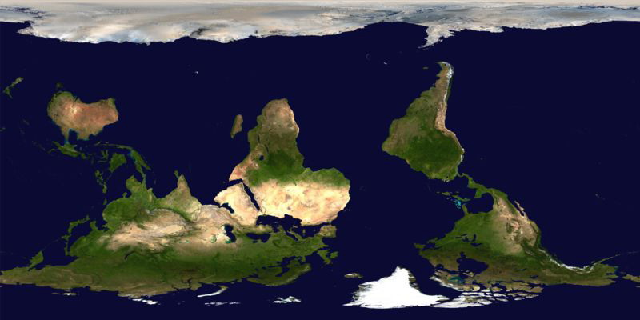
FWIW, this isn't the world, nor is it upside down -- it's just a rather different map, eh?

.

A celebrated stanza by the Indian poet-saint Kabir — beloved of both Hindus and Muslims — asks:

Is there any guru in the world wise enough
to understand the upside-down Veda?

There’s a style of poetry used by Kabir and others to describe experience of the divine called “ulatbamsi” or the “upside down language” — and Linda Hess, Kabir’s great translator, writes of it as a language “of paradoxes and enigmas” — not too dissimilar, perhaps, to the koans or meditation paradoxes often encountered in zen training.

**

Boom! The French have the word “bouleversé” to cover the way we feel when suddenly our whole world seems turned upside down.

Maybe it’s a modern idea? Bob Dylan, I’m delighted to say, no longer belongs to Robert Zimmerman except for purposes of copyright — his songs have entered the cultural bloodstream. Here’s his version:

The battle outside ragin’
Will soon shake your windows
And rattle your walls
For the times they are a-changin’

The world often seems upside down, our values are often quite the reverse of what they might be if we had the kind of clarity that is implied in Samuel Johnson‘s celebrated quote:

Depend upon it, sir, when a man knows he is to be hanged in a fortnight, it concentrates his mind wonderfully.

And then there are those great ones for whom our world is manifestly unjust, manifestly topsy-turvy — or “through the looking-glass”, if you prefer.

I mean, what else can being “in the world, but not of it” be all about, if it’s not about a major shift in perspective?

**

I’m writing about this at such length because I just read one of those paragraphs that turns my own world upside down. It came in the middle of a long piece on “restorative justice” and it focuses on the power of forgiveness.

This particular paragraph describes how an Indian-American woman, Sujatha Baliga, came to see the unexpected power of forgiveness, and for her it occurred in a Buddhist context — but the power itself is beyond the boundaries of specific religions:

Baliga had been in therapy in New York, but while in India she had what she calls “a total breakdown.” She remembers thinking, Oh, my God, I’ve got to fix myself before I start law school. She decided to take a train to Dharamsala, the Himalayan city that is home to a large Tibetan exile community. There she heard Tibetans recount “horrific stories of losing their loved ones as they were trying to escape the invading Chinese Army,” she told me. “Women getting raped, children made to kill their parents — unbelievably awful stuff. And I would ask them, ‘How are you even standing, let alone smiling?’ And everybody would say, ‘Forgiveness.’ And they’re like, ‘What are you so angry about?’ And I told them, and they’d say, ‘That’s actually pretty crazy.’ ”

**

I like the dark blue “sky” and the “clouds” at the top of the map I began this post with — but then, I’m a mostly vertical human who seldom stands on his head, so it looks “natural” to me. But that’s simply a matter of my point of view.

I imagine maps like that one must please our friends “down under”.

**

A hat-tip to Hadar Aviram, whose California Corrections blog first pointed me to the article about Sujatha Baliga.


Switch to our mobile site