zenpundit.com » Specs

Archive for the ‘Specs’ Category

The Said Symphony: move 19

Sunday, March 18th, 2012

[ by Charles Cameron – extended analytic game on Israeli-Palestinian conflict — for those who wish to catch up, our game thus far consists of an intro to the game and game board, followed by moves 1-5, 6-9, then moves 10-11 which together constitute a meditation, moves 12, 13-15, 16-17, and most recently before this, move 18 with cadenza ]

Move 19: The view from above

Move content:

Discussing strategy, the very canny LTG (USMC, Ret’d.) Paul Van Riper had this to say:

What we tend to do is look toward the enemy. We’re only looking one way: from us to them. But the good commanders take two other views. They mentally move forward and look back to themselves. They look from the enemy back to the friendly, and they try to imagine how the enemy might attack them. The third is to get a bird’s-eye view, a top-down view, where you take the whole scene in. The amateur looks one way; the professional looks at least three different ways.

A bird’s-eye view, a hawk’s eye view, a top-down view, an overview, a view from 30,000 feet, a God’s eye view, a view from above, a zoom…

If move 18 and its cadenza gave us a view of the depth of vision or insight that is necessary for a full and rich understanding of the world we live in — its qualitative or spiritual scope, if you like — this next move, with its picnic and drone-sight, addresses its breadth in space and time — materially and quantitatively speaking.

The classic expression of the sheer material scope of the universe was put together by Charles and Ray Eames in their justly celebrated film, Powers of Ten, from which the lower of these two images is drawn:

Here are some other relevant scans of the scope of things, in terms of time and space:

The Scale of the Universe 2
A Brief History of The Universe
The Known Universe
A Time-Lapse Map of Every Nuclear Explosion Since 1945

These are impressive videos to be sure, but as an aside I’ll invite you to ask yourselves how well they compare with this zoom in words, a poem by the zennist, ecologist, essayist and poet Gary Snyder, from his book, Axe Handles: Poems:
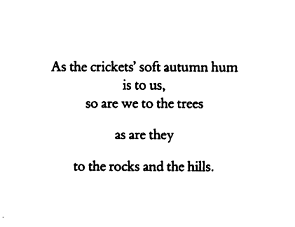
Such breadth of vision, such craft.

*

If this “material scope of things” too has a cadenza, it would be that all of this is shot through with some primary oppositions, dappled as the poet Gerard Manley Hopkins would have it, with swift, slow; sweet, sour; adazzle, dim — as indicated in the drone-sight and picnic double image at the head of this move.

This dappling, this constant flux of opposites, takes many forms — day and night lead to the more abstract light and dark, which can then be interpreted morally as good and evil, to which we respond with repulsion and attraction as the case may be, building our worldviews from love or fear…

At different scales the opposites that matter most to us may have different names and shadings, but here I’d just like to draw attention to the dappling of our world with:

competition and cooperation
Darwin‘s natural selection and Kropotkin‘s mutual aid
duel and duet (ah! — a favorite phrasing of mine)
war and peace

Provocatively, we find this dappling in scriptures, too, wherein the ripples of such verses as “The LORD is a man of war: the LORD is his name” (Exodus 15.3) dropped like a stone into the pond of the human mind, meet with the ripples of other verses such as “God is love; and he that dwelleth in love dwelleth in God, and God in him” (I John 4.16).

There are times when we take such oppositions literally, perhaps too literally, and times when we begin to see oppositions as abstract and theoretical end-points to what is in fact a yin-yang process continually unfolding…

Which brings me by a commodius vicus of recirculation to this image of the great opposition between war and peace, its dappling, its unfolding:

Links claimed:

To the Lamb, move 18: this move presents the material scope of the universe in counterpoint to its visionary scope as laid out in move 18 with its cadenza.

To Revelation, move 17 — the word revelation means unveiling, as we have seen, and our sciences and technologies, with their spectra of telescopes, microscopes, cameras and zooms, are unveiling and revealing to us much about the physicality of the world we live in — much that was accounted for in other times and places through intuition, vision and poetry.

This scientific and technical revelation of material existence, for many of us moderns, has largely eclipsed the mode of visionary revelation of move 17 — yet it cannot eradicate it. Implicit in this move, then, is the sense that we carry with us both subjective and objective, inner and outer, qualitative and quantitative understandings — though the data that “sight” and “insight” provide us with may be different in kind, and resolving them may be something of a koan to us, the deep problem in consciousness as philosophers of science have named it — and that we can discount neither one if we are to have and maintain a rich sense of our situation.

Comment:

If the two previous moves have shown us the scope of the universe we co-inhabit, perhaps we should now make our own zoom in, much as James Joyce did when he had the schoolboy Stephen inscribe his name and address in his geography book as Stephen Dedalus, Class of Elements, Clongowes Wood College, Sallins, County Kildare, Ireland, Europe, The World, Universe – an address that Stephen then read both forwards and backwards, finding himself in one direction, and finding in the other that he had no means of knowing what might lie beyond the universe…

Imagine then, skipping rapidly from (unimaginable) cosmos via such things as the intriguingly named End of Greatness to galaxy or nebula…

…solar system and planet — whence we can slow down and zero gently in on the Middle (or as my friend Ralph Birnbaum would call it, the Muddle) East, Israel / Palestine, Jerusalem / Al Quds / the Temple Mount / Noble Sanctuary – and to such matters of contemplative vision and tribal passion as the first, second and projected third Temples, the al-Aqsa mosque.

Our increasing focus will bring us, then, to that the rock which Jews believe marks the place where Abraham bound his son Isaac (the Akedah), and which Muslims believe to be the place of ascent of the Prophet to the celestial realms (the Mi’raj) on his Night Journey (Qur’an, Al-Isra).

Here again myth and history collide, and both visionary and material considerations merge in the heart of the what my friend the Israeli journalist Gershom Gorenberg has justly called “the most contested piece of real estate on earth”.
Quite the contrast

Tuesday, March 13th, 2012

[ by Charles Cameron — the Joseph Kony rumpus, and Robert Fowler on the religious zealotry of AQIM ]
.

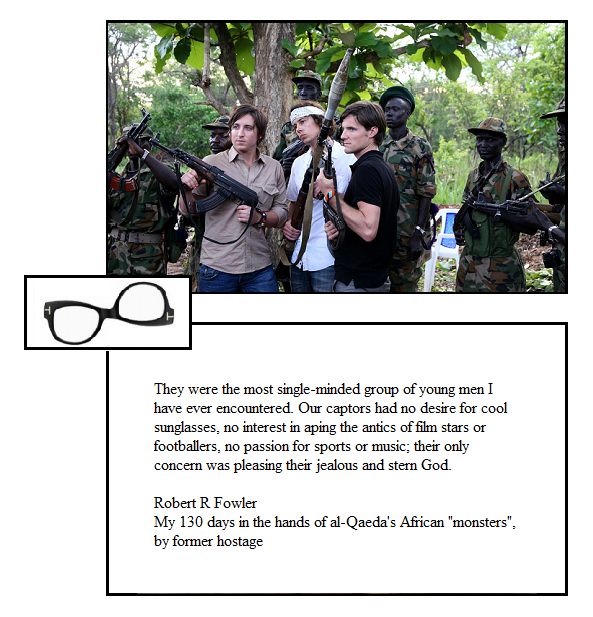
Above:

In the Glenna Gordon photo above the text is Jason Russell, the film-maker who put together the Joseph Kony 2012 campaign, who says of himself:

I am a rebel soul: dream evangelist. I am obsessed with people. I tell stories by making inspiring movies that move people’s emotions, and then I take those emotions and transform them into action. My middle name is Radical. I married my best friend.

— radical, yeah, and looking “tough” — or as one commentator on the Visible Children tumblr said, “posing”:

Here’s a photo of the founders of Invisible Children posing with weapons and personnel of the Sudan People’s Liberation Army. Both the Ugandan army and Sudan People’s Liberation Army are riddled with accusations of rape and looting, but Invisible Children defends them, arguing that the Ugandan army is “better equipped than that of any of the other affected countries”, although Kony is no longer active in Uganda and hasn’t been since 2006 by their own admission. These books each refer to the rape and sexual assault that are perennial issues with the UPDF, the military group Invisible Children is defending.

Below:

By way of contrast: the text below the photo is culled from Robert R Fowler‘s searing account of his al-Qaeda in the Islamic Maghreb (AQIM, but please don’t call it AA-kem) captors. As he also said:

Kidnappings of Westerners have fueled debate among securocrats as to whether our AQIM captors might simply bandits flying an Islamic flag of convenience. I know that to be the wrong answer. Our kidnappers were utterly focused religious zealots who believed absolutely in their cause. They sought to expel Western infidels from Muslim lands and to destroy what they saw as apostate Western-stooge governments who were usurping God’s purposes across the Muslim world. The concepts and ideals we hold most dear were anathema to them: liberty, freedom, justice, democracy, human rights, equality between the sexes — all matters which they considered to be the exclusive province of Allah.

Yes, that contains the popular idea that “they hate us for our freedoms” — but in the context of what I can only call ruthless religious idealism.

Fowler is very clear on that. And no posing.

Sounds like Fowler’s book, A Season in Hell, goes right onto the anti-library lists.

Of dust and breath

Tuesday, March 6th, 2012

[ by Charles Cameron — i have a major post, possibly two, on Ezekiel and Esther, Israel and Iran in prep, and zen just posted a major piece on the era of the creepy-state — so don’t mind me, this is just a brief aside on religious devotion, relics, the heart, the skull, the breath ]
.

There’s an eerie beauty to relics — and when I read a BBC news piece today titled Dublin patron saint’s heart stolen, about the theft of a relic of St Laurence from Dublin’s Christ Church cathedral (upper image), while the “contemporary” part of me found it perhaps worth a chuckle and certainly paradoxical —

The thief would have needed metal cutters to prise open the iron bars protecting the wooden heart-shaped box holding St Laurence O’Toole’s heart.

— another part of me was saddened, much as I was saddened some years back by the destruction of the Buddhas of Bamiyan.

I hope Dublin gets its spiritual heart back.

*

And so my mind went back to another relic, and another recent encounter with that eerie beauty — the relic of St Valentine, martyr, which I ran across in a photo by Fr. Lawrence Lew OP (lower image), posted on the saint’s day, February 14th, by Shawn Tribe in the New Liturgical Movement blog, a regular read of mine.

St Valentine, memorialized not by silly cupids (silli putti?) and plump, winged hearts, but by the fellow’s skull…

*

There’s something there about dust — that we are dust, animated by breath until the dust settles…

There’s an eerie beauty to that thought.

A note about nodes

Monday, March 5th, 2012

[ by Charles Cameron – places, people, neurons, ideas, with Kabul and Khost providing illustrations ]
.


[ illus: Starlight, from PNL ]

I was just reading Matthieu Aikins‘ GQ account of The Siege of September 13 in Kabul, when a couple of sentences caught my eye, not because of the attack itself, but because they reminded me of a point I want to make about the way we think these days about networks, nodes and linkages:

Salangi’s SUV was passing down the main road north of the embassy when the sound of gunshots and his police radio simultaneously erupted. He told his driver to turn around and head toward the sounds.

At Massoud Circle, the next roundabout down from Abdul Haq, they encountered a bottleneck of police vehicles, and so Salangi continued on foot, ducking as he heard the crack and whine of bullets passing close by…

What specifically caught and rerouted my attention was that phrase, “Massoud Circle, the next roundabout down from Abdul Haq” — Abdul Haq Circle, I’d read earlier in the article, “is a wide traffic roundabout named for a deceased mujahideen commander”, as presumably is the circle named for Massoud.

So we have two roundabouts connected by a road… and two deceased mujahideen commanders.

Or to put that another way, we have two nodes and a connection between them, twice over — in once case the nodes are places, and in the other the nodes are people.

*

Further into the article, I found a graphic showing the two places and the road connecting them — and an image of two people in Kabul that day, one extending an arm of care to the other. These two men weren’t Abdul Haq and Massoud, of course, but two people nonetheless. So in each graphic, we have two nodes and a connection:

A great deal of time and treasure goes into the analysis of networks of communication — cellphone to cellphone, person to person — or travel — place to place — (a) because the patterns can be revealing, and (b) because the data (what number called what number, e.g., how often Nidal Hassan emailed al-Awlaki, or what route bought Abu Dujanah from Amman to Khost) is unambiguous when obtained.

*

We’re also fond of neural nets, eh? — whether the “artificial” nets of AI or the “biological” nets of the brain — and again, these are unambiguous, scientists and technicians love them, and software developed with Congress-friendly budgeting implications is required to process them.

But what about ideas?

What about minds, what about the subjective side of persons and travels and communications and contacts and brains — what about thoughts, what about admiration?

That’s the node-link-node mapping that I find most interesting: it utilizes the most complex software (human intelligence), and demands the least complex support system (cappucino, napkin and pencil) — and some of its nodes and their linkages (beliefs, e.g., leading to actions) are among the richest features of the human behavioral landscape.

*

The idea that jihad is an individual obligation, for instance, is a staple of AQ-style theology. It is my contention, indeed, that acceptance of that idea is the religious foundation on which acts of jihadist suicide are based.

And by the same token, these suicide acts are then viewed in terms of martyrdom, since they were enacted in the cause of Allah, giving rise to such eulogies as this one, offered by AQ to Abu Dujanah after the Khost event:

May Allah have mercy on you, our dear Abu Dujanah, and may He raise your ranks in register of the inhabitants of Paradise. By the Lord of the Ka’bah, indeed you have succeeded, our dear Abu Lailah, Allah willing. You were truthful, and you became known. You set an example, and you were truthful in word and deed. You followed the speakers and writers before you. May Allah be pleased with you . Your patience, Jihad, and tolerance of hardships were in Allah’s Cause. Your prayers and insistency was for Allah, and was your solitude and secret conversation. Thus, your reward is with Allah. Allah is your Lord and Protector, and Allah willing, our next meeting will be in Al-Firdaws Al-A’la, our dear beloved brother.

Such logic, such rhetoric, and such devotion are of the essence of what we confront in the jihad…

*

And richest of all for us to come to terms with: the person to person transmission of such ideas…

On fire: issues in theology and politics – ii

Tuesday, February 28th, 2012

[ by Charles Cameron — burning and blasphemy ]
.

The question here is a simple one: which is the more blasphemous? burning holy scripture — or burning oneself, a human being?

Now I imagine you think the answer to that’s quite obvious, and I do too. But there are people with the opposite opinion to mine — and when we burn their scriptures, even by mistake, even making apologies afterwards, they get enraged, and kill people. There may be many other factors that contribute to their rage, but this is the trigger, the religious sanction, the thing that pushes them over the top.

Someone tweeted the other day:

Souls are being burned alive in Homs & others riot over ink & paper. Where’s the logic?!

It is not my purpose to attack or defend anyone’s beliefs or opinions here — what I would like to do instead is to see through the rage and glimpse that logic: I would like us to avoid needlessly triggering it.

I want to bring what may at first seem utterly incomprehensible to us, a little closer to our comprehension.

1.

In the Quran 5.32, we read:

We ordained for the Children of Israel that if any one slew a person – unless it be for murder or for spreading mischief in the land – it would be as if he slew the whole people: and if any one saved a life, it would be as if he saved the life of the whole people.

On the one hand, that sets an extremely high value on human life — the Jewish equivalent is found in the Talmud, Tractate Sanhedrin 37a — and on the other hand, it can be claimed that that high value is set not by humans but by their Creator in his revealed Word, the Qur’an.

2.

What metaphor or analogy would allow me to understand that logic in terms of my own culture? Not the rage itself, not the killings — but the logic that potentiates them?

3.

If you think, as the melancholy Jaques has it in As You Like It, that all the world’s a stage, and all the men and women merely players – and as Hamlet might think, pondering what more things might be in heaven and earth than are dreamt of in philosophy – why then —

How does one weigh the value of the life of a Jaques, or Hamlet, of one of us, one single human being – of whom Shakespeare, again through his Hamlet, said:

how noble in reason! how infinite in faculty! in form and moving how express and admirable! in action how like an angel! in apprehension how like a god! the beauty of the world! the paragon of animals! ..

against the value of a single copy of the Works of one William Shakespeare – who then continued on, through that same Hamlet’s voice, to ask:

And yet, to me, what is this quintessence of dust?

4.

Shakespeare, the First Folio, Hamlet?
God, the Scripture, you or me?

5.

It is said the imperishable Quran is writ in heaven before time was, and there is a hadith of Tirmidhi that describes Allah reciting Suras 20 and 36, Taha and Ya Sin, upon hearing which the angels responded “Happy are the people to whom this comes down, happy are the minds which carry this, and happy are the tongues which utter this”.

I am not a literalist, I am a poet — so that makes poetic sense to me, the way Shakespeare’s “all the world’s a stage” makes sense.

In reading these words, I see for a moment the beauty, the devotion that is possible towards this book, the fervent dedication.

I am not about to kill people in the name of Shakespeare or the Gospels — yet I can understand a reverence for that which is greater than I, for that which is more than we dream of, and for that which “comes down” from thence.

6.

Suppose the body is a perishable scaffolding, and the book an eternal transcript written in the immortal soul…

And now recall what that eternal transcript says:

We ordained for the Children of Israel that if any one slew a person – unless it be for murder or for spreading mischief in the land – it would be as if he slew the whole people: and if any one saved a life, it would be as if he saved the life of the whole people.

The paradox here, surely, is that we are each of us the quintessence of dust – each of us more than is dreamt of in philosophy.

7.

May the soul of Mohamed Bouazizi rest at last.


Switch to our mobile site

