zenpundit.com » Specs

Archive for the ‘Specs’ Category

Thinking outside the cocoon…

Thursday, May 16th, 2013

[ by Charles Cameron — on caterpillars, butterflies, psyche and the alephs of Georg Cantor, with a glance at the vertiginous idea it might be “boxes all the way up and down”… ]
.

Let’s get the science — which is quite fascinating — taken care of first. Here’s our best current visualization of how a caterpillar, after crafting its cocoon, prepares to become a butterfly:

**

Words can sometimes tell us some things that images can’t — or explain things to parts of us that simply cannot comprehend them visually — so here for parallel processing is an account of part of the same business from Scientific American:

How does a caterpillar rearrange itself into a butterfly? What happens inside a chrysalis or cocoon?

First, the caterpillar digests itself, releasing enzymes to dissolve all of its tissues. If you were to cut open a cocoon or chrysalis at just the right time, caterpillar soup would ooze out. But the contents of the pupa are not entirely an amorphous mess. Certain highly organized groups of cells known as imaginal discs survive the digestive process. Before hatching, when a caterpillar is still developing inside its egg, it grows an imaginal disc for each of the adult body parts it will need as a mature butterfly or moth—discs for its eyes, for its wings, its legs and so on. In some species, these imaginal discs remain dormant throughout the caterpillar’s life; in other species, the discs begin to take the shape of adult body parts even before the caterpillar forms a chrysalis or cocoon. Some caterpillars walk around with tiny rudimentary wings tucked inside their bodies, though you would never know it by looking at them.

Once a caterpillar has disintegrated all of its tissues except for the imaginal discs, those discs use the protein-rich soup all around them to fuel the rapid cell division required to form the wings, antennae, legs, eyes, genitals and all the other features of an adult butterfly or moth.

**

It’s just possible that the bear’s ability to “die” in the winter and “be reborn” in spring gave use the original cirumpolar bear cult — and more generally, a propensity to believe that resurrection from the dead might be a physical, existential human possibility.

Humans watch animals pretty diligently — my old friend and mentor Wallace Black Elk once told me:

We watch the deer, and when they’re sick they know which plant is their aspirin: they eat that green medicine, and drink water. So we have deer medicine. We don’t need the mass-produced kind.

I don’t have the exact quote, but he also observed somewhat wryly that scouts from pharmaceutical companies used to watch him and see what medicines he used, in much the same way…

And if there’s any natural process that humans have watched with equivalent metaphysical interest to that which they may have shown in observing the bear’s pattern of hibernation and return, it would have been the process of metamorphosis in butterflies — whose name in Greek, psyche, is also the word for soul.

**

WB Yeats had a sense of the butterfly transcending both day-to-day human logic and death itself, when he wrote in his poem Tom O’Roughley:

‘Though logic choppers rule the town,
And every man and maid and boy
Has marked a distant object down,
An aimless joy is a pure joy,’
Or so did Tom O’Roughley say
That saw the surges running by,
‘And wisdom is a butterfly
And not a gloomy bird of prey.

adding just a few lines later:

What’s dying but a second wind?

**

What I’d like to do here is to take us from the plodding science of linear thought to which Yeats was (among other forms of linearity) objecting, towards the science — and poetry — of complexity, of nuance.

And I’d like to do it by skipping a couple of thoughts like a stone across water, inviting you to watch the ripples…

These are the leaps that connect the dots.. the creative leaps. And some leaps, it seems to me, are bigger and more demanding than others.

**

Is the leap from cocoon to butterfly in Hutching‘s quote really quite a huge leap? It certainly keeps some of our best scientists busy uncovering its hidden secrets. And the leap from butterfly to tornado, that Lorenz made? That would appear to me to be a larger leap, requiring a different mode of perception. And skipping from Hutchings to Lorenz, can we skim our stone of thought even further?

Putting two and two together is one thing: imagining “aleph null” for the first time, as Cantor did, that would be something else altogether. From two to four, I’m tempted to say, is a quantitative leap, while the imaginative leap from four, ten, or ten thousand to the alephs is qualitative.

How should we recognize and connect widely separated — yet deeply entangled — dots? What would prove to be the richest and most profound of creative leaps? Is there a move that will take us not just out of this box into the box it came in — but out of a whole matrioshka nest of boxes?

Those are the questions in my sandbox about now.

**

When we next meet, I’ll try to tie them in with this diagram that Adam Elkus recently pointed us to —
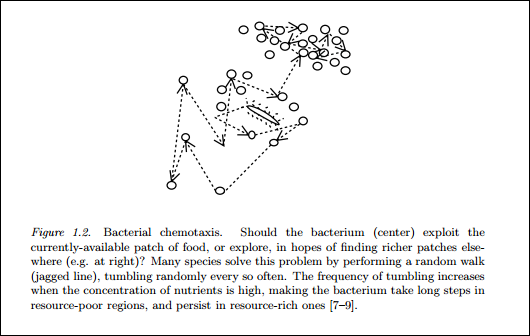
and with Hermann Hesse‘s Glass Bead Game for good measure.

Jottings 1: Wittypedia

Friday, May 3rd, 2013

[ by Charles Cameron — concerning the Dajjal, the Muslim antichrist — and introducing “jottings” ]
.

.

That’s witty — Wikipeetia, a version of Wikipedia that you may some day find yourself reading if you mis-spell a search term.

Like, if you write Entichrist.

Fascinating.

**

Jottings:

I am hoping to make Jottings a continuing series of brief posts, some serious and some light-hearted, that release the toxins of fascination and abhorrence from my system rapidly, ie without too much time spent in research. Jottings — hey, my degree was in Theology, Mother of the Sciences — derives from the English “jot” — and thence from the Greek iota and Hebrew yod, see Wikipedia on jots and tittles.

Of the Jerusalem and Mahdist syndromes

Friday, April 26th, 2013

[ by Charles Cameron — messianisms as madness ]
.

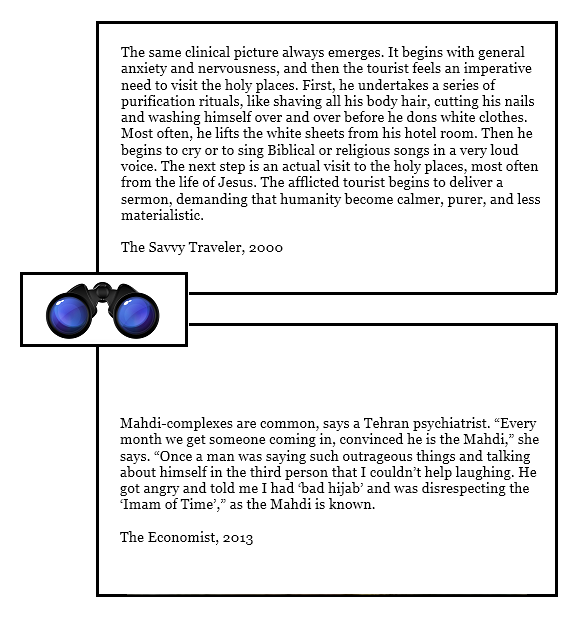
The Economist has a fascinating piece out about Iran’s multiplicity of messiahs (lower panel, below) which reminded me strongly of the Jerusalem syndrome (upper panel).

I suspect that was “bad adab” – bad manners, not bad clothing – but never mind.

**

The Economist piece is worth reading in full, if you also take the time to read Tim Furnish — who tones down the rhetoric a couple of notches:

I seriously doubt that Iranian jails are full of thousands of self-styled mahdis; I suspect many of them are guilty of nothing more eschatological than complaining too publicly about the price of gas or having too large a satellite TV antenna on their homes. But even if reduced by a factor of ten, the Islamic Republic does nonetheless appear to have a serious problem with apocalyptic antipathy toward the government. And a regime predicated, in no small part, on Mahdist ideology finds itself being hoist by its own philosophical petard.

**

Meanwhile, back in Jerusalem:

In Israel, Jerusalem Syndrome is taken very seriously. Everyone involved in security, tourism, or health is on the lookout for afflicted visitors. In an average year, three or four tourists develop real, palpable Jerusalem Syndrome. In l999, more than 50 visitors were diagnosed, the increase possibly attributed to millennial activities.

Why the security concern? Well, because occasionally those afflicted try some pretty dangerous stuff. Dr Yair Bar-El wrote in The British Journal of Psychiatry (2000) 176: 86-90:

A Protestant from South America conceived a plan to destroy Islamic holy places in order to replace them with Jewish holy places. The second stage of his plan was then to destroy them in order to start the war of Gog and Magog so that the Anti-Christ would reveal himself, after which Christ would reappear. The patient succeeded in gutting one of the most holy mosques in Jerusalem. Psychiatric examination was ordered by the court, and he was diagnosed as being unable to differentiate between right and wrong, not responsible for his deeds and therefore not fit to stand trial. He was admitted to a local psychiatric institution and later transferred to a mental health institution in his own country

I think “gutting” is overstating what happened — but you can sense the risk…

**

DoubleQuote Sources:

  • The Savvy Traveler, 2000
  • The Economist, 2013
  • Of Omar Hammami — and dying more than once?

    Friday, April 26th, 2013

    [ by Charles Cameron — dying more than once in hadith, in press reports, in Rumi and John of the Cross ]
    .

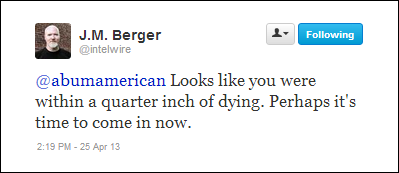
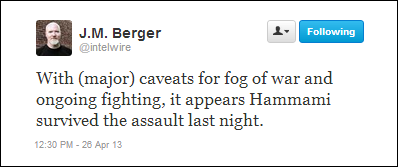
    The American mujahid in Somalia, Omar Hammami [see his Wikipedia bio], who has been tweeting back and forth with various “U.S. national security professionals” [see this Wired piece], reported yesterday that he had been shot in the neck “by Shabab assassin” [see this piece by Clint Watts at Selected Wisdom]. JM Berger, who has been in close correspondence with him, tweeted:

    Omar has indeed been in dispute with Shabab, the group he originally joined [see this LWJ post], and his own most recent tweets, sent eighteen hours ago as I write this, were these:

    Omar Hammami may or may not still be among us, although recent reports suggest with caveats that he survived the attack…

    That’s the background.

    **

    From my point of view, the most interesting discussion anyone had with Hammami in the last day or two was this exchange between Hammami and Jeremy Scahill, whose book Dirty Wars has just hit the stands:

    Characteristically, Omar has a light tone — yet speaks to the issue in the context of his theology…

    **

    There are, it seems to me, basically three ways that one might imagine dying more than once. The first — and it’s the one Hammami himself was referring to — is found in the hadith in Bukhari [Volume 4, Book 52, Number 54]:

    Narrated Abu Huraira:

    The Prophet said, “… By Him in Whose Hands my life is! I would love to be martyred in Allah’s Cause and then get resurrected and then get martyred, and then get resurrected again and then get martyred and then get resurrected again and then get martyred.

    Let the intensity of that hadith — and Hammami’s reference to it, a little earlier [?] on the same day he was shot — sink in.

    **

    The second, “secular” way to have “died” more than once is through faulty intelligence and / or journalism — and that’s what JM Berger is on about when he tweets:

    Indeed, such reports led to the 2011 release of a nasheed in his name, though he may not have sung it himself:

    Now Hammami has apparently resurfaced, with two new a cappella songs that appeared on the web earlier this week. In “Send Me A Cruise,” Hammami begs to be plastered by a tank shell, a drone attack or a cruise missile, so that he can martyred like some of the heroes he names, including Al Qaeda leaders Abu Musab al-Zarqawi and Abu Laith al-Libi. In his trademark tuneless drone, he claims “an amazing martyrdom” is what he “strive(s) for and adore(s).” “Send me a cruise like Maa’lam Adam al Ansari/ And send me a couple of tons like Zarqawi,” chants Hammami. “Send me four and send me more, that’s what I implore.”

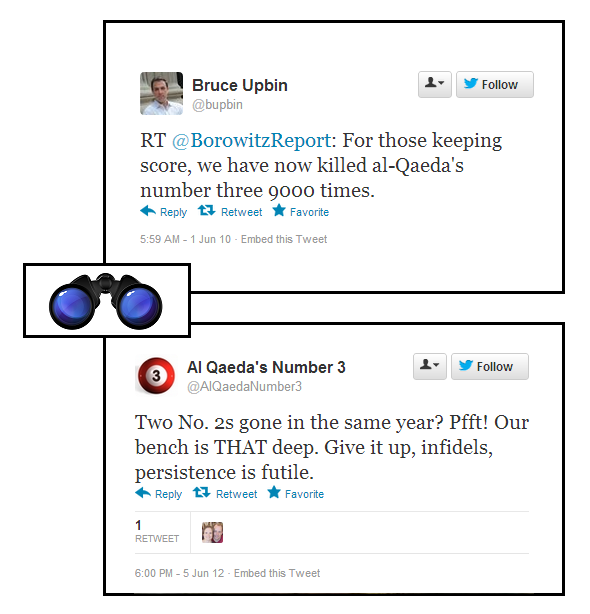
    More generally, false reports of AQ leaders dying hither and yon have become so common that I posted a DoubleQuote about it last year:

    **

    Here’s where it get’s most interesting…

    For a third view of dying more than once, we can turn to the mystical tradition. Thus the Prophet Muhammad is credited with the hadith “Die before death” by Jalaluddin Rumi, who in his Mathnawi, VI, 3837-38 writes:

    The mystery of “Die before death” is this, that the prizes come after dying (and not before).
    Except dying, no other skill avails with God, O artful schemer.

    The death before death here is the death of the nafs, the “self” — the true martyrdom of the greater jihad. As Peter Lamborn Wilson puts it in his Introduction to the Sufi Path:

    Man’s authentic existence is in the Divine; he has a higher Self, which is true; he can attain felicity, even before death (“Die before you die,” said the Prophet). The call comes: to flight, migration, a journey beyond the limitations of world and self.

    Of course, St John of the Cross wrote in much the same vein:

    This life I live in vital strength
    Is loss of life unless I win You:
    And thus to die I shall continue
    Until in You I live at length.
    Listen (my God!) my life is in You.
    This life I do not want, for I
    Am dying that I do not die.

    Jimmy Chen declares DQ on War

    Tuesday, April 23rd, 2013

    [ by Charles Cameron — juxtaposition offers us a potent way to connect “equal but opposite” dots ]
    .

    Jimmy Chen at HTMLGiant captures the griefs and joyful reliefs of war by juxtaposing two war photos that had separately become iconic — and their joint impact is precisely the kind I’m reaching for with my DoubleQuotes. I’ve re-framed them accordingly and slipped them into my DQ format, and here they are:

    **

    In Chen’s own words:

    Time may be a sedative, for it’s always harder to know who exactly the bad people were, yet so easy to tell — in the incessant now from which we cannot run — who the bad people are. Either moral clarity diminishes with time, or we simply stop caring, the euphemism being humility. Prisoner of war Lt. Col. Robert L. Stirm is greeted by his family at Travis Air Force Base in Fairfield, California on March 17, 1973, about a year after Phan Thi Kim Phuc, aged 9, was photographed running from a South Vietnamese napalm attack on their own land after it had been occupied by the North.

    The specifics of those two photographs may be slowly eroding in memory, as Chen suggests — but I don’t believe their power to evoke joy or grief will fade — and I am grateful to Jimmy Chen for reminding me, once again.

    Beautifully.


    Switch to our mobile site