zenpundit.com » symbolism

Archive for the ‘symbolism’ Category

Of swastikas, meanders and the mapping of complexity

Wednesday, May 16th, 2012

[ by Charles Cameron — a meander from the symbolism of the Greek neo-Nazi party to the complex flow of the great Mississippi River ]
.


.

As every red (or blue) blooded conspiracist knows, there’s a swastika-shaped building on the US Naval Amphibious Base Coronado near San Diego, CA.

That might of course mean the US Navy is under the spell of Hinduism or Buddhism, each of which makes use of the swastika for reasons that have nothing to do with the Nazis and more perhaps to do with simple geometric shapes and their near-universal use in rituals:

*

I mention this, because symbolism is important, because the Greek right-wing party that did well in the recent elections has a flag that has been compared with the Nazi swastika, and because conspiracy theories, though informative markers of shifts in the collective unconscious in their own right, are also useful tools in the shame and blame game.

The Greek party concerned (Chryssi Avghi or Golden Dawn) points out that the central symbol of its flag (left) is taken from an ancient Greek “meander” (note similarities in the various common designs, middle) and not from the Nazi flag (right) – even though it’s curious that they choose the same black on white on red colors, isn’t it?

In my view the flag is suggestive, not conclusive: it’s their holocaust denial that proves the point.

*

Anyway, it’s likely that none of that would have been interesting enough for me to post it, had my quirky researches not also pointed me to a far more interesting graphic.

Regular readers here will remember that I have an interest in graphical representations of complexity, and posted a piece titled Of railroad tracks and polyphonic thinking a while ago, in which I took the metaphor of trains of thought far too literally, and used railroad imagery to suggest a few ideas about complexity…

My researches into the Greek “meander” patterns were intriguing — but it was stumbling across this image from a post at the Ontario-based Onsite Review that decided me (and I think that’s the right usage, we are decided, we don’t decide) that I really did need to make this post.

Consider: it’s the mighty Mississippi, seen as it meanders across time:

The Onsite Review’s attribution is to Harold N. Fisk, Ancient Courses. Mississippi River Meander Belt, 1944. Their comment for this image reads:

The greek key pattern is sometimes called the meander, after the Maeander River, now called the Büyük Menderes River that flows from central Turkey to the Aegean. It winds through the Maeandrian plain in the manner of most prairie rivers, cutting into soft banks and creating oxbows.

We know a certain amount scientifically about river meanders, just as we know quite a bit about perturbations in the flow of liquids — but not enough, never quite enough to know where the river of time will take us next.

The map above illustrates the flows of a fairly simple complexity: take a good look at it. The thought-flows of a human are liable to be far more complex.

Change: a poem from The Poetry of the Taliban

Tuesday, May 8th, 2012

[ by Charles Cameron — poetry in time of war, symbolism / semiotics of blood and martyrdom, analogies with Jefferson and St Augustine, sacramental nature of reality ]
.
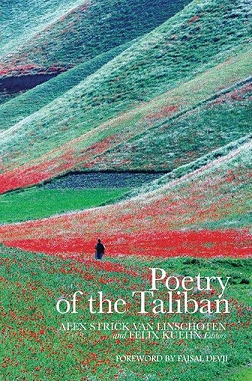
Felix Kuehn and Alex Strick van Linschoten’s book The Poetry of the Taliban (Hurst, Columbia UP) contains a remarkable poem composed in the 1990s by one Bismillah Sahar:
.

Change

The spring of change needs blood to rain down,
It requires the irrigation of the gardens with blood.
Valuing the blood of the people of the past
Requires the price of human blood.
Each drop of it has become a Nile of the dawn’s blood;
The Pharaohs want to fill the Nile with blood

Sitting here in California seven thousand miles and many cultures distant and more than a decade later, the phrase “spring of change” has an interesting ring to it – but it was likely not the not-yet-deposed Mubarak that Sahar was thinking of when he penned his lyric about the Pharaoh, but “the Oppressor” — whomever that might be. The imagery of the Pharaoh is a common enough trope, in fact, used for instance by the Taliban to describe President GW Bush in their magazine Al-Sumud [ link is to preview, relevant chapter of Master Narratives of islamist Extremism.

And while it is true that, as Asim Qureshi notes, “poetry links the ancient past with the modern day”, neither the trope itself nor the reference to the plight of the Jews in Egypt is exclusive to Afghanistan in specific or Islam in general. Indeed, Martin Luther King explicitly views himself as what theology would term a “type” of Moses when he says:

We’ve got some difficult days ahead. But it doesn’t matter with me now. Because I’ve been to the mountaintop. And I don’t mind. Like anybody, I would like to live a long life. Longevity has its place. But I’m not concerned about that now. I just want to do God’s will. And He’s allowed me to go up to the mountain. And I’ve looked over. And I’ve seen the promised land. I may not get there with you. But I want you to know tonight, that we, as a people will get to the promised land. And I’m happy, tonight. I’m not worried about anything. I’m not fearing any man. Mine eyes have seen the glory of the coming of the Lord.

These sacramental bleedings of the past into the present as in a palimpsest are native to the imagination and powerful in their poetic impact, as MLK’s life, final speech and death eloquently testify.

But there is a second layer of sacramental reality at work in the poem, and it lies in the repeated mention of blood. – the transition between past an present itself being presented in terms of blood spilled in the lines:

Valuing the blood of the people of the past
Requires the price of human blood.

The past requires a price from the present, then, and that price is paid in blood.

*

The poem is six lines long, and there is not a line of it that does not contain the word blood. Again:

The spring of change needs blood to rain down,
It requires the irrigation of the gardens with blood.
Valuing the blood of the people of the past
Requires the price of human blood.
Each drop of it has become a Nile of the dawn’s blood;
The Pharaohs want to fill the Nile with blood.

*

Zeus “poured bloody drops earthwards, honoring his own son, whom Patroklos was soon to destroy in fertile Troy far from his homeland”, Homer writes in the Iliad, 16.459, and the associations of rain with tears, and of spilled blood with spilled life, are ancient and pervasive.

Blood lust, blood sacrifice – the word blood is as powerful as any in the human vocabulary, so much less abstract that birth or death yet richly associated with both, while the sight or thought of blood stirs us at some archaic level of primal imagination. And what of the “irrigation of the gardens with blood”?

The gardens, first, are paradise. Next, they are paradise on earth, perhaps in one’s own village. I have written before of my memories of:

one small white-walled mosque way out on a dry stretch of road between Herat and Kandahar and its small, lush, green garden, all these years later: whatever it was to the inhabitants of that small village, to me it was “oasis” and “paradise” in perfect miniature, and it remains so in memory.

The rivers of Islam’s paradise flow with water, milk, honey and wines: so what place has blood there?

One answer would be found in the hadith, “Know that paradise is under the shade of swords”.

In his book The Shade of Swords: Jihad and the Conflict Between Islam and Christianity, named after the hadith in question, the noted journalist MJ Akbar writes:

The only reason why a person could ever want to leave paradise for this earth would be to get martyred again. Death was only a welcome release; there was no possible deed in this life that could equal jihad in reward after death. The Prophet urged Muslims to seek Firdaus, the best and brightest part of paradise, just below Allah’s throne. Allah had reserved one hundred grades of paradise only for the martyrs. The blood of the wounded would smell like musk on the day of resurrection; and nothing could interfere with Allah’s reward.

The blood of the wounded would smell like musk…

For more on musk, blood, martyrdom and the “odor of sanctity”, see my Of war and miracle: the poetics, spirituality and narratives of jihad.

And so blood is linked to paradise by martyrdom.

*

The spring of change “requires the irrigation of the gardens with blood” the poet tells us, much as Thomas Jefferson told William Stephens Smith in a letter of November 13, 1787:

The tree of liberty must be refreshed from time to time with the blood of patriots and tyrants. It is it’s natural manure.

But hold on, the same trope is found in St. Augustine‘s City of God, xx.7:

Through virtue of these testimonies, and notwithstanding the opposition and terror of so many cruel persecutions, the resurrection and immortality of the flesh, first in Christ, and subsequently in all in the new world, was believed, was intrepidly proclaimed, and was sown over the whole world, to be fertilized richly with the blood of the martyrs.

And the imagery continues, in the West, into our own day. When Pope Benedict XVI visited Mexico earlier this year, he was treading on “land that was wet with the blood of martyrs” according to Mgr. Fidel Hernández Lara, Episcopal Vicar of the Mexican Archdiocese of León.

*

The very earliest Christian accounts of martyrdom, indeed, have a distinctly sacramental flavor, as one sees by juxtaposing Ignatius of Antioch (quoted by Carolyn Forche in Susan Bergman, ed., Martyrs):

I am God’s wheat ground fine by the lion’s teeth to become purest bread for Christ

with Tertullian (Apologeticum in the translation by Lewis Carroll‘s father):

The blood of the Christians is their harvest seed

*

Joseba Zulaika subtitles his book Basque Violence — which Leah Farrall kindly pointed me to — with the words “Metaphor and Sacrament”.

Sacrament is a key word for me, obviously, and for the sake of those disinclined to religion, may I point to Gregory Bateson‘s comment in the first paragraph of the Introduction to his Mind and Nature:

Even grown-up persons with children of their own cannot give a reasonable account of concepts such as entropy, sacrament, syntax, number, quantity, pattern, linear relation, name, class, relevance, energy, redundancy, force, probability, parts, whole, information, tautology, homology, mass (either Newtonian or Christian), explanation, description, rule of dimensions, logical type, metaphor, topology, and so on. What are butterflies? What are starfish? What are beauty and ugliness?

The concept of “sacrament” occupies a place of honor second only to “entropy” in Bateson’s listing.

I am not arguing the pros and cons of publishing these poems, although I side firmly with the publisher on this. Nor am I attempting to assess the poetic value of the one poem I have quoted and examined. What I am trying to do is to give that poem the kind of reading I would want to give to any poem that interested me — one that seeks out its resonances in both local and world cultures as far as my wits can manage, showing, if possible, what power it gains from archetype, authority and form… If the poem were from the South English Legendary, for instance — which expresses similar sentiments — I’d have no hesitation calling its worldview “sacramental”.

But this is a poem from Afghanistan and Islam, not from medieval Christian England, so I should perhaps explain that in my view, any perspective which views the world as a series of legible “signs from God” — ayat, in the Arabic of the Qur’an — is a sacramental view, under the definition of sacrament that calls it “an outward and visible sign of an inward and spiritual grace”.

Blood is such a sign — of life, of its value, of its continuity by descent, and of its redemptive power even in death.

It is in sensing this semiotic / sacramental quality to Islam that we begin to grasp what translations such as these can point us to, but not directly reveal.

*****

Further reading:

From today’s NYT: Why Afghan Women Risk Death to Write Poetry
Poetry reading in Afghan culture: Reading Poetry In Kandahar
Afghan poetics: Poetry: Why it Matters to Afghans? Understanding Afghan Culture [.pdf], NPS, 2009
Talib poetry as propaganda: Johnson & Waheed, Analyzing Taliban taranas (chants): an effective Afghan propaganda artifact, Small Wars & Insurgencies, 2011
And finally, Afghans Build Peace, One Stanza at a Time

More “night watch” than “guardian angels” perhaps?

Thursday, March 29th, 2012

[ by Charles Cameronguardian angels, really? — or a surface use of in-depth terminology? ]
.

.
Just two days ago I posted Quantity and Quality: angelic hosts at Badr and / or Armageddon, and noted in a comment that “the Counterinsurgency Manual, FM 3-24 makes no mention of angels” — whereas “Brigadier Malik’s Qur’anic Concept of War does.

1.

Has someone in ISAF been reading ZP? Two days later, we have this AP report:

U.S. military commanders in Afghanistan have assigned “guardian angels” — troops that watch over their comrades even as they sleep — and have ordered a series of other increased security measures to protect troops against possible attacks by rogue Afghans.

A bit further down, we read:

According to the senior military official, the so-called guardian angels provide an extra layer of security, watching over the troops as they sleep, exercise or go about other daily activities.

Allen noted that the Afghans also have taken some similar steps to provide guards for their own forces.

2.

Just for the record, that’s not quite what I had in mind.

Specifically — and only half-joking — it’s an instance of what Sri Krishna Prem termed “the degradation of spiritual concepts” in his Yoga of the Bhagavat Gita (original Penguin edition, p. xxv. if my notes are to be believed):

There is a law, which may be termed the law of the degradation of spiritual concepts, by which terms originally used by Seers to express levels of supernormal spiritual experience become in the hands of later and purely scholastic exponents terms for elements in purely normal mental life.

Or as TS Eliot puts it in Burnt Norton: V (in Four Quartets):

Words strain,
Crack and sometimes break, under the burden,
Under the tension, slip, slide, perish,
Decay with imprecision, will not stay in place,
Will not stay still.

3.

Where does the idea of a guardian angel come from — and what did it mean before it meant some poor sod who’s on night watch?

4.

Anyway.

Best night watch ever? Rembrandt‘s, in the Rijksmuseum in Amsterdam:

The brilliant Peter Greenaway has made two quirky films [link to Amazon boxed set] about the painting. Wikipedia describes them well enough that I’ll simply use their phrasing:

The Night Watch is the subject of a 2007 film by director Peter Greenaway called Nightwatching, in which the film posits a conspiracy within the musketeer regiment of Frans Banning Cocq and Willem van Ruytenburch, and suggests that Rembrandt may have immortalized a conspiracy theory using subtle allegory in his group portrait of the regiment, subverting what was to have been a highly prestigious commission for both painter and subject. His 2008 film Rembrandt’s J’Accuse is a sequel or follow-on, and covers the same idea, using extremely detailed analysis of the compositional elements in the painting…

I was certainly richly educated and entertained by both films — and am a great admirer of his The Draughtsman’s Contract — but not quite convinced.

________________________________________________________________________________________

h/t @peterjmunson.

On the martyrdom of al-Hallaj & the modeling of pocket universes

Monday, March 26th, 2012

[ by Charles Cameron — commemoration of al-Hallaj, sufi and martyr, the nature of circumambulation, matrioshka, modeling and mandalas ]
.

According to a report by Fahad Faruqui in today’s Huff Post, Mansur al-Hallaj was martyred on this day, March 26, 922 CE.

His offence is often said to have been that he declared “An al-Haqq” — I am the Truth — although many sufis would say that his egoic nafs had been erased in fana, and that it was al-Haqq that spoke through him, not a claim that he made of himself.

So today would be the day to leave a marker here on Zenpundit, saying that I hope to return in the not too distant with a post that ties al-Hallaj as described in Faruqui’s post with the circumambulation of Banaras, the circumambulation of an avatar of Vishnu Shiva and Parvati by Ganesh, and the modeling of what I sometimes refer to as “pocket universes”…

*

The particular aspect of Faruqui’s post that caught my attention was this:

Hallaj was not sentenced to death for uttering “ana’l-haqq.” After his arrest, he was accused of various things, but, according to Professor Ernst, he was pinned down after his prosecutors discovered a document in the handwriting of Hallaj that recommended that those who were unable to afford Hajj pilgrimage could construct a model of Kaaba at home and perform circumambulation (tawaf) and give alms to poor and feed some orphans and they would have completed the Hajj.

“At that point one of the judges turned to Hallaj and said in Arabic ‘damuka halal,’ that is, your blood may legally be shed. In other words, now we have you,” said Professor Ernst, a specialist in Islamic Studies. “But then Hallaj said that I found this in the writings of Hasan al-Basri, so that was a kind of technicality, but he was given no opportunity to explain or repent.”

*

I gratefully offer a hat-tip @ Sarah Schlesinger.

Which world is more vivid? This, or the next?

Monday, March 19th, 2012

[ by Charles Cameron — bin Laden, Abu Bakr, Bernard of Clairvaux, Qur’an burning, Tora Bora, David Ignatius, Emptywheel, and impassioned belief ]
.


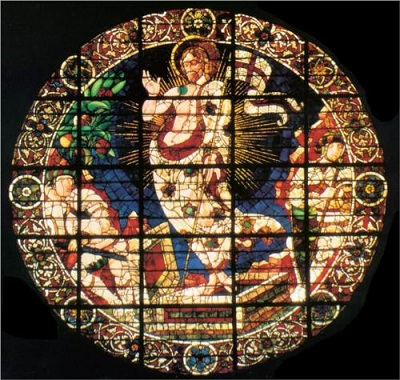
image: Paulo Uccello (1443) depicts the Resurrection
life after the grave, seen through a glass, darkly

We keep on stumbling over this one.

To the western mind, mostly, this world is axiomatically more vivid than the next. But there are those for whom the next life is axiomatically the more vivid – even if their day to day practices are geared to success and continuity in this life.

And this has consequences for our own lives, in the world around us — and for security.

1.

Some who are of this mind – bin Laden in this video among them — may quote or paraphrase Abu Bakr‘s message to Khosru:

I have come to you with an army of men that love death, as you love life.

That particular quote is from the rich tapestry of Islam – but Jewish history speaks also of Kiddush ha-Shem, martyrdom for the glory of God, which became in the time of the crusades “the exemplary answer of Jews threatened in their life and faith” when offered the options of conversion to Christianity or death.

And in Christendom, there is St Bernard of Clairvaux, who is quoted as writing in his letter to the Templars at the time of the Second Crusade:

The Christian who slays the unbeliever in the Holy War is sure of his reward, the more sure if he himself is slain.

and for good measure in his sermon promoting the Crusade:

Christian warriors, He who gave His life for you, to-day demands yours in return. These are combats worthy of you, combats in which it is glorious to conquer and advantageous to die.

2.

It is with this difference in axiomatic understanding in mind, that we should approach such issues as the relative importance – in our own minds, and in those of many Afghans – of the loss of human life in a night raid, as compared with the burning of copies of the Qur’an [In Reactions to Two Incidents, a U.S.-Afghan Disconnect]:

The mullah was astounded and a little angered to be asked why the accidental burning of Korans last month could provoke violence nationwide, while an intentional mass murder that included nine children last Sunday did not.

“How can you compare the dishonoring of the Holy Koran with the martyrdom of innocent civilians?” said an incredulous Mullah Khaliq Dad, a member of the council of religious leaders who investigated the Koran burnings. “The whole goal of our life is religion.”

And a quick note here — this is an issue I’ve raised before, eg in Burning scriptures and human lives, in Of Quantity and Quality I: weighing man against book, and more recently in On fire: issues in theology and politics – ii.

3.

The same understanding also explains bin Laden’s retreat to the Tora Bora caves. As I said in an early guest post here on ZP, with a hat-tip to Lawrence Wright and his book The Looming Tower:

When bin Laden, at the lowest point of his jihadist efforts, leaves the Yemen for Afghanistan and betakes himself to the Tora Bora caves, he will inevitably remind some Muslims of the Prophet himself, who at the lowest point of his prophetic vocation left Mecca for Medina and sought sanctuary in a cave — where by the grace of his God, a spider’s web covered the entrance in such a way that his enemies could not see him.

Our natural tendency in the west is to see Tora Bora in terms of military topography, as a highly defensible, almost impregnable warren of caves deep within some of the world’s most difficult mountain territory. What we miss may be precisely what Muslim piety will in some cases see — that bin Laden’s retreat there is symbolically aligned with the “sunna” or life of the Prophet, and thus with the life of Islam itself — in much the same way that Christians, in the words of Thomas a Kempis, may practice “the Imitation of Christ”.

4.

It was in fact Emptywheel‘s piece about bin Laden’s comment re killing President Obama (and thus promoting Joe Biden) that caught my attention today and prompted this post.

Emptywheel quoted the same passage from David Ignatius that had triggered my own post On the “head of infidelity” and the tale of Abdul-Rahman ibn Awf late yesterday —

“The reason for concentrating on them,” the al-Qaeda leader explained to his top lieutenant, “is that Obama is the head of infidelity and killing him automatically will make [Vice President] Biden take over the presidency… “

— and commented:

OBL was going to kill Obama not for the sake of killing the US President, but because Biden, who served in the Senate for 36 years, almost 12 of which he served as one or another powerful committee Chair, “is totally unprepared for that post, which will lead the U.S. into a crisis.”

I just don’t think that’s right. I think it’s wrong, in fact, but [and here’s the important part] subtly wrong.

I believe that OBL lived at the confluence of worlds — one that we might call mythic or spiritual, and one that’s the one we call the “real” world. I believe that it was his myth, archetype, spirit based reality that was the more vivid to him, the one to which he was entrained, and that he found means in the practical world of strategies and tactics to adhere to the demands of that other world.

A world that was both invisible to us, and to him axiomatically victorious – at least as much so in death as in life.


Switch to our mobile site