zenpundit.com » model

Archive for the ‘model’ Category

Unequal equations

Friday, January 18th, 2013

[ by Charles Cameron — math, modeling and mapping, in that strange zone where beauty meets understanding ]
.

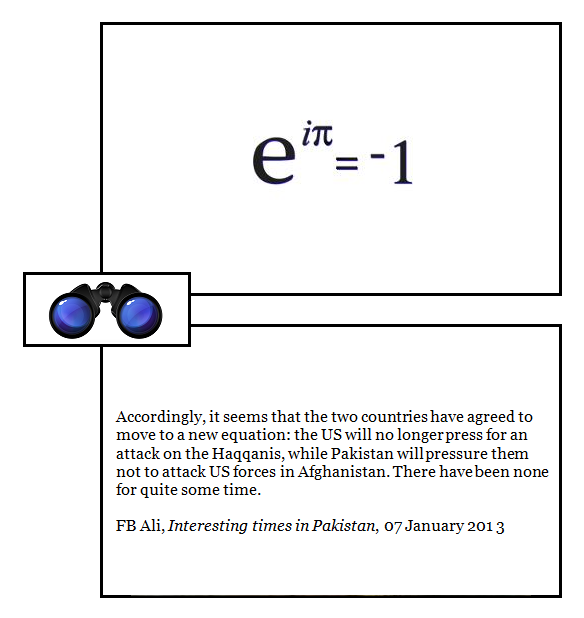
The upper equation — Euler‘s — gets as tight and definitional as one can get, yet is profound in the way the greatest haiku are… while the metaphorical “equation” mentioned in the lower panel is a very rough model indeed of the intricate and constantly shifting forces at work in and on Pakistan.

**

I’m interested in mapping these sorts of influences at a level of detail that the human mind can assimilate and comprehend — and the graphical news-map in the video below will give you an idea of what one approach to such a mapping would look like.

This particular example is drawn from a mapping of web-based news items related to President Obama over the course of 2009, but it should give you some idea of the constant flux of tensions and motion of “nodes” involved in tracking political issues, at home or abroad — the beginning is a bit slow, but from about the 23 second mark on is just amazing:

Now is that art, or technology — or a beginning of something fascinating that by its very nature melds both?

**

Sources:

  • FB Ali, Interesting times in Pakistan on Sic Semper Tyrannis
  • Recorded Future Index video
  • Look, I’m sorry to be so blunt — I: modeling ideas

    Thursday, July 19th, 2012

    [ by Charles Cameron — a stray thought, endlessly ricocheting — with a friendly wink to @khanserai ]
    .

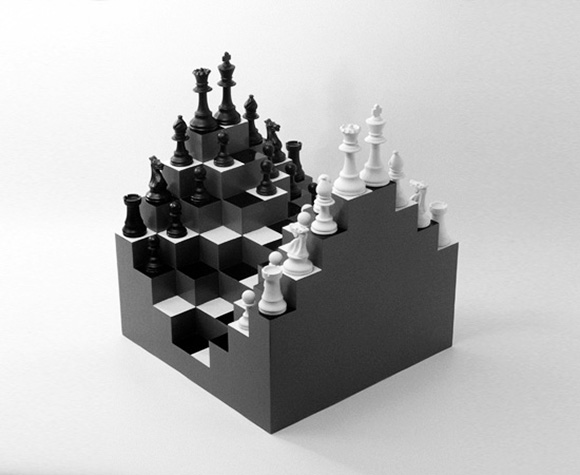
    chessboard by Ji Lee

    .
    Back in 2006 the US National Strategy for Combating Terrorism suggested:

    In the long run, winning the War on Terror means winning the battle of ideas. Ideas can transform the embittered and disillusioned either into murderers willing to kill innocents, or into free peoples living harmoniously in a diverse society.

    So. More than five years have passed.

    Look, I’m sorry to be so blunt… but how good are we now at modeling, simulating and / or gaming ideas?

    The best war game is a library of windows

    Tuesday, July 3rd, 2012

    [ by Charles Cameron — Escher, Borges, simulating the future, wargames, A Pattern Language, Sembl ]
    .

    MC Escher, Relativity

    .
    Ridiculous phrase, a library of windows. Unless you think, as I do, of books as windows onto different worlds, in which case it makes a whole lot of sense, and a decent library has more windows onto more profoundly different worlds than any physical room — and here we are getting into the territory of Jorge Luis Borges (links to Library of Babel) and Maurits Escher (image above).

    And let me just state for the record that Godel Escher Bach could just as well have been Escher Carroll Borges, and that a comparison between the logics of Escher and Borges is one of the desiderata of our times.

    That’s a Sembl move.

    **

    Let’s expand the concept of window to include the sort of inter-worldview glimpse that Haaretz describes today here:

    Last week, in a small beit midrash (study hall) named after Rabbi Meir Kahane in Jerusalem’s Shmuel Hanavi neighborhood, an emergency meeting was convened to discuss instigating freedom of religion and worship on the Temple Mount. It was a closed meeting attended by representatives of the Temple Institute, HaTenu’ah LeChinun HaMikdash (the Movement to Rebuild the Holy Temple) and the Temple Mount Faithful, as well as two representatives of Women for the Mikdash, and others. The activists met to try to understand how they could overcome the authorities, who they believe are plotting against them, and return to the Temple Mount. At this meeting, Haaretz was offered a rare behind-the-scenes glimpse of the most ardent activists in the battle to Judaize the Temple Mount.

    **

    Here’s the meat of the post, as yet uncooked. Back in 2005, but brought to my attention today by Rex Brynen at Paxsims, is this piece from Strategy Page:

    After eight years of effort, and spending over $300 million, the U.S. Army has officially received its new wargame (WARSIM) for training battalion, brigade, division, and as big as you want to get, commanders, and their staffs. Now even the most elaborate commercial wargame would not get $300 million for development, and eight years to create the system. But wargames for professional soldiers have different requirements, and a troublesome Department of Defense bureaucracy to deal with. First, the requirements. Commercial wargames shield the player from all the boring stuff (support functions, especially logistics.) But professional wargames must deal with these support activities, because in a real war, these are the things commanders spend most of their time tending too. …

    WARSIM covers a lot of complex activities that a commander must deal with to achieve battlefield success. Besides logistics, there’s intelligence. Trying to figure out what the enemy is up to is, next to logistics, the commanders most time consuming chore.

    — which in turn was referenced by Michael Peck writing in a Kotaku piece today titled Why It’s So Hard to Make a Game Out of the 21st Century:

    Let’s build a game. Let’s make it a strategy game. We will realistically simulate global politics in the 2030s. Perhaps a sort of Civ or Supreme Ruler 2020-type system.

    Where shall we start? How about something easy, like choosing the nations in the game? It’s simple enough to consult an atlas. We’ll start with Britain…but wait! Scotland is on the brink of declaring independence from the United Kingdom. Should Britain be a single power, or should England and Scotland be depicted as a separate nation? What about Belgium splitting into Flemish and Walloon states? And these are old, established European nations. How will states like Syria and Nigeria look in two decades? It was only a bit over 20 years ago that the Soviet Union appeared to be a unshakeable superpower that controlled Eastern Europe and Central Asia.

    **

    Let’s cook that meat, let’s make a meal of it.

    Peck’s piece goes into many other ways in which predictive gaming isn’t terribly productive.

    But it left me asking the question, what would I do with a game-sized budget, if my aim was to push military and intelligence towards greater insight.

    And my answer would be to embed information in walls. In corridors…

    To build windows at sparse and irregular intervals into the internal corridors that connect any given office in the Pentagon or three-letter agency — or my local preference (hush, I know it’s the Glorious Fourth tomorrow) MI-5 and -6 — through which analysts and decision makers can glimpse snippets of information.

    Which can then fall into the deep well of memory.

    It is deep within that well of half-forgotten knowledge, ST Coleridge tells us, that the “hooks-and-eyes of memory” link one thought with another to build a creative third.

    **

    A wall, then. I would build a wall embedded with facts and fancies, maps and illustrations, graphs and stats, film clips and news clips, anecdotes and quotes — even, perhaps, tiny alcoves here and there with books free for the taking, music CDs, DVDs of movies, old, new, celebrated, strange…

    And I would be constantly shifting and rearranging the “views” from my windows, so that what was seen yesterday would not be what would be seen tomorrow — yet with a powerful index of words, topics, themes, memes, image contents, names of actors, newscasters, authors and so forth, so that what was once seem and dimly recalled could be recaptured.

    **

    The concept here is pretty much the exact opposite of having a huge black poster proclaiming Creativity Matters!

    Don’t get me wrong, creativity does matter (get that poster and others here), but it “works in mysterious ways its wonders to perform” — and the way to entice it is to see things out of the corner of the eye…

    The windows I’m looking for, therefore, offer glimpses you wouldn’t necessarily notice if you were deep in thought or conversation, and conversely, wouldn’t see twice and grow so familiarized to that they’d become irrelevant by repetition. They’d be glimpsed in passing, their esthetic would be that of Christopher Alexander’s Zen View, pattern 134 in his brilliant work — the closest we have to a Western I ChingPattern Language:

    The idea, then, is to seed the memory with half-conscious concepts, patterns, facts and images, carefully selected and randomly presented — so that those hooks and eyes have the maximum chance of connecting some scrap of curious information with a pressing problem.

    Which is how creativity tends to work.

    **

    That way each corridor becomes a game-board — but it is in the analyst’s focused mind that the game is played and won.

    What you’d get, in effect, would be community-wide, ongoing free-form gameplay in complete alignment with the web-based game we’re currently developing at Sembl. Games of this genre will also have powerful application in conflict resolution.

    And peace.
    Mali: a tale of two tweets

    Tuesday, July 3rd, 2012

    [ by Charles Cameron — Timbuctu, Bamiyan, iconoclasm, dissolution of the monasteries, conceptual mapping, ethics, aesthetics, Venice ]
    .

    credit: Alidade, see below


    .

    Zen called the Ansar al-Din “The Taliban of the Mahgreb” today, pointing to an article on the destruction of the Bamiyan Buddhas, and that’s an equation of a sort: destruction of the Sufi shrines in Mali compares with and in some ways equates to destruction of the Buddhas of Bamiyan.

    The similarity lies in the destruction by Islamic zealots of images considered idolatrous — and as Curtis reminded us, a Chritian expression of the same concept also motivated the Iconoclastic movement in Orthodoxy.

    To some extent, the dissolution of the monasteries in Henry‘s England under Thomas Cromwell carries a similar resonance.

    Which brings me to two tweets I received in my Twitterfeed today.

    **

    Here’s Tweet Number One, as Dr Seuss might have said:

    And Tweet Number Two:

    **

    Between the two of them, and with an eye to Zen’s remark, I get the idea that there’s a style of mental mapping that I can just about see out of the corner of my eye — a mapping that would interest me if I could figure out more about how to take it from being implicit and verbal and make it graphical and visible.

    In this mapping, we would lay out the manner in which things presumed equal are treated differently.

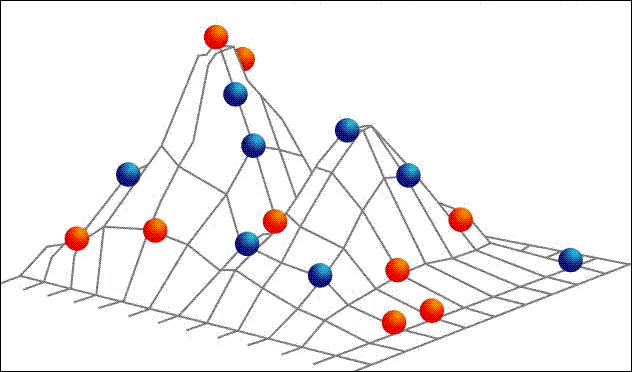
    I suspect the mapping might initially look something like the graphic at the head of this post — which I’ve borrowed from the materials on an interesting “Co-Revolutionary War Game” devised by Alidade in 2003 or thereabouts.

    **

    Arguably the publication of blasphemous cartoons of the Prophet upsets many Muslims more than does the destruction of Sufi shrines. Likewise, the publication of Salman Rushdie‘s Satanic Verses upsets many Muslims more than does the fatwa calling for Rushdie’s death. The burning of Qur’ans seems to upset many Afghans more than the deaths of nine Afghan children… And likewise, the loss of human lives in Mali seemingly pales in comparison to the loss of the Timbuctu shrines of saints in the eyes of the western press.

    Throw in the Bamiyan Buddhas, and you have a first cluster of data-points that might be mapped in terms of public outrage — Christian, Buddhist, Muslim, cultural, political. the peaks and valleys will differ according to the perspectives chosen, and mapping the differences too would be of considerable interest.

    **

    The question has become something of a classic among ethicists, I believe: whether to rescue an unknown human child — who may if saved, as they say, grow into a Mao or a Michelangelo — or a great masterpiece of painting, if both are swirling past you in the same Venetian flood…

    My instinct is with the child, but oh! — my temptation goes towards the painting…

    On the martyrdom of al-Hallaj & the modeling of pocket universes

    Monday, March 26th, 2012

    [ by Charles Cameron — commemoration of al-Hallaj, sufi and martyr, the nature of circumambulation, matrioshka, modeling and mandalas ]
    .

    According to a report by Fahad Faruqui in today’s Huff Post, Mansur al-Hallaj was martyred on this day, March 26, 922 CE.

    His offence is often said to have been that he declared “An al-Haqq” — I am the Truth — although many sufis would say that his egoic nafs had been erased in fana, and that it was al-Haqq that spoke through him, not a claim that he made of himself.

    So today would be the day to leave a marker here on Zenpundit, saying that I hope to return in the not too distant with a post that ties al-Hallaj as described in Faruqui’s post with the circumambulation of Banaras, the circumambulation of an avatar of Vishnu Shiva and Parvati by Ganesh, and the modeling of what I sometimes refer to as “pocket universes”…

    *

    The particular aspect of Faruqui’s post that caught my attention was this:

    Hallaj was not sentenced to death for uttering “ana’l-haqq.” After his arrest, he was accused of various things, but, according to Professor Ernst, he was pinned down after his prosecutors discovered a document in the handwriting of Hallaj that recommended that those who were unable to afford Hajj pilgrimage could construct a model of Kaaba at home and perform circumambulation (tawaf) and give alms to poor and feed some orphans and they would have completed the Hajj.

    “At that point one of the judges turned to Hallaj and said in Arabic ‘damuka halal,’ that is, your blood may legally be shed. In other words, now we have you,” said Professor Ernst, a specialist in Islamic Studies. “But then Hallaj said that I found this in the writings of Hasan al-Basri, so that was a kind of technicality, but he was given no opportunity to explain or repent.”

    *

    I gratefully offer a hat-tip @ Sarah Schlesinger.


    Switch to our mobile site