The Said Symphony: move 19
Sunday, March 18th, 2012[ by Charles Cameron – extended analytic game on Israeli-Palestinian conflict — for those who wish to catch up, our game thus far consists of an intro to the game and game board, followed by moves 1-5, 6-9, then moves 10-11 which together constitute a meditation, moves 12, 13-15, 16-17, and most recently before this, move 18 with cadenza ]
Move 19: The view from above

Move content:
Discussing strategy, the very canny LTG (USMC, Ret’d.) Paul Van Riper had this to say:
What we tend to do is look toward the enemy. We’re only looking one way: from us to them. But the good commanders take two other views. They mentally move forward and look back to themselves. They look from the enemy back to the friendly, and they try to imagine how the enemy might attack them. The third is to get a bird’s-eye view, a top-down view, where you take the whole scene in. The amateur looks one way; the professional looks at least three different ways.
A bird’s-eye view, a hawk’s eye view, a top-down view, an overview, a view from 30,000 feet, a God’s eye view, a view from above, a zoom…

If move 18 and its cadenza gave us a view of the depth of vision or insight that is necessary for a full and rich understanding of the world we live in — its qualitative or spiritual scope, if you like — this next move, with its picnic and drone-sight, addresses its breadth in space and time — materially and quantitatively speaking.
The classic expression of the sheer material scope of the universe was put together by Charles and Ray Eames in their justly celebrated film, Powers of Ten, from which the lower of these two images is drawn:
Here are some other relevant scans of the scope of things, in terms of time and space:
The Scale of the Universe 2
A Brief History of The Universe
The Known Universe
A Time-Lapse Map of Every Nuclear Explosion Since 1945
These are impressive videos to be sure, but as an aside I’ll invite you to ask yourselves how well they compare with this zoom in words, a poem by the zennist, ecologist, essayist and poet Gary Snyder, from his book, Axe Handles: Poems:
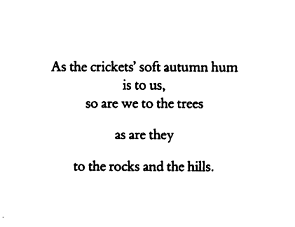
Such breadth of vision, such craft.
*
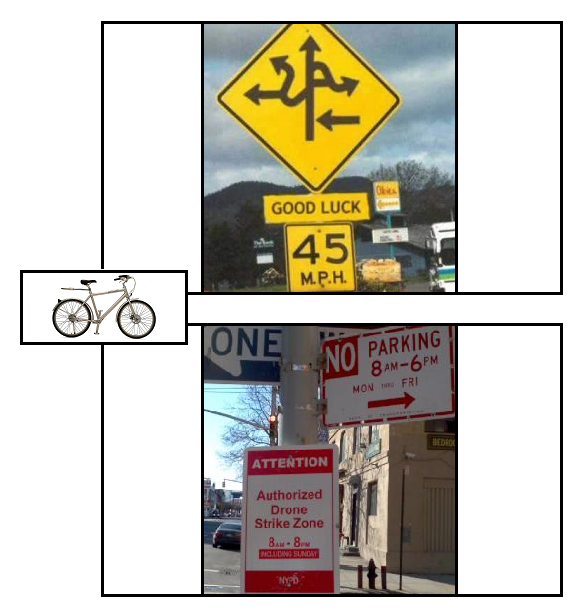
If this “material scope of things” too has a cadenza, it would be that all of this is shot through with some primary oppositions, dappled as the poet Gerard Manley Hopkins would have it, with swift, slow; sweet, sour; adazzle, dim — as indicated in the drone-sight and picnic double image at the head of this move.
This dappling, this constant flux of opposites, takes many forms — day and night lead to the more abstract light and dark, which can then be interpreted morally as good and evil, to which we respond with repulsion and attraction as the case may be, building our worldviews from love or fear…
At different scales the opposites that matter most to us may have different names and shadings, but here I’d just like to draw attention to the dappling of our world with:
competition and cooperation
Darwin‘s natural selection and Kropotkin‘s mutual aid
duel and duet (ah! — a favorite phrasing of mine)
war and peace
Provocatively, we find this dappling in scriptures, too, wherein the ripples of such verses as “The LORD is a man of war: the LORD is his name” (Exodus 15.3) dropped like a stone into the pond of the human mind, meet with the ripples of other verses such as “God is love; and he that dwelleth in love dwelleth in God, and God in him” (I John 4.16).
There are times when we take such oppositions literally, perhaps too literally, and times when we begin to see oppositions as abstract and theoretical end-points to what is in fact a yin-yang process continually unfolding…
Which brings me by a commodius vicus of recirculation to this image of the great opposition between war and peace, its dappling, its unfolding:

Links claimed:
To the Lamb, move 18: this move presents the material scope of the universe in counterpoint to its visionary scope as laid out in move 18 with its cadenza.
To Revelation, move 17 — the word revelation means unveiling, as we have seen, and our sciences and technologies, with their spectra of telescopes, microscopes, cameras and zooms, are unveiling and revealing to us much about the physicality of the world we live in — much that was accounted for in other times and places through intuition, vision and poetry.
This scientific and technical revelation of material existence, for many of us moderns, has largely eclipsed the mode of visionary revelation of move 17 — yet it cannot eradicate it. Implicit in this move, then, is the sense that we carry with us both subjective and objective, inner and outer, qualitative and quantitative understandings — though the data that “sight” and “insight” provide us with may be different in kind, and resolving them may be something of a koan to us, the deep problem in consciousness as philosophers of science have named it — and that we can discount neither one if we are to have and maintain a rich sense of our situation.
Comment:
If the two previous moves have shown us the scope of the universe we co-inhabit, perhaps we should now make our own zoom in, much as James Joyce did when he had the schoolboy Stephen inscribe his name and address in his geography book as Stephen Dedalus, Class of Elements, Clongowes Wood College, Sallins, County Kildare, Ireland, Europe, The World, Universe – an address that Stephen then read both forwards and backwards, finding himself in one direction, and finding in the other that he had no means of knowing what might lie beyond the universe…
Imagine then, skipping rapidly from (unimaginable) cosmos via such things as the intriguingly named End of Greatness to galaxy or nebula…

…solar system and planet — whence we can slow down and zero gently in on the Middle (or as my friend Ralph Birnbaum would call it, the Muddle) East, Israel / Palestine, Jerusalem / Al Quds / the Temple Mount / Noble Sanctuary – and to such matters of contemplative vision and tribal passion as the first, second and projected third Temples, the al-Aqsa mosque.
Our increasing focus will bring us, then, to that the rock which Jews believe marks the place where Abraham bound his son Isaac (the Akedah), and which Muslims believe to be the place of ascent of the Prophet to the celestial realms (the Mi’raj) on his Night Journey (Qur’an, Al-Isra).
Here again myth and history collide, and both visionary and material considerations merge in the heart of the what my friend the Israeli journalist Gershom Gorenberg has justly called “the most contested piece of real estate on earth”.