zenpundit.com » judaism

Archive for the ‘judaism’ Category

Going five rounds and then some with those Egyptian Crucifixions…

Sunday, September 2nd, 2012

[ by Charles Cameron — news, debate, credibility, Muslim brotherhood, Egypt, Ansar al-Shariah, Yemen, capital punishment, scriptures, USA, progress? ]
.

There’s plenty of food for thought here — quite a Smörgåsbord in fact — with rumor outstripping fact, images and facts too grisly for the squeamish, biases and bias-confirmation, subtlety in the details, scriptural sanctions and shifts in emphasis, capital punishment… and human progress, to paraphrase William Gibson, more or less evenly distributed.

Round One:

.
On the 17th of August, Michael Carl wrote a piece, Arab Spring run amok: ‘Brotherhood’ starts Crucifixions in WorldNetDaily:

The Arab Spring takeover of Egypt by the Muslim Brotherhood has run amok, with reports from several different media agencies that the radical Muslims have begun crucifying opponents of newly installed President Mohammed Morsi.

Middle East media confirm that during a recent rampage, Muslim Brotherhood operatives “crucified those opposing Egyptian President Muhammad Morsi naked on trees in front of the presidential palace while abusing others.”

The run amok is stated as fact, the crucifixions are described in terms of reports.

Also worth noting:

Carl quoted in his support Raymond Ibrahim — a Fellow with the Middle East Forum and the Investigative Project on Terrorism — in support. It is worth noting that Ibrahim, who authored The Al Qaeda Reader — a book I admire for its pointed insistance of the religious current in AQ documents — is himself an American of Egyptian Coptic Christian parentage, whose views of the Brotherhood can be gleaned from a recent post of his titled Egypt: Islamists vs. Copts — An Animosity That Seeks Any Excuse to Attack

Round Two:

.
On the 22nd, Jonathan Kay responded to Carl’s piece in the [Candadian] National Post, Egypt’s “crucifixion” hoax becomes an instant Internet myth:

Have you heard the one about how Christians are being nailed up on crucifixes and left to die in front of the Egyptian presidential place?

It’s a story worth dissecting — not because it’s true (it isn’t), but because it is a textbook example of how the Internet, once thought to be the perfect medium of truth-seeking, has been co-opted by culture warriors as a weapon to fire up the naïve masses with lies and urban legends.

Kay then offered his somewhat nuanced critique:

It is, of course, theoretically possible that Muslim radicals truly have “crucified” someone, somewhere, sometime, in Egypt. Islamist mobs have staged countless murderous attacks on Copt “infidels” in recent years — and a crucifixion would hardly be a more barbarous tactic than truck bombs and beheadings.

But the story doesn’t just allege that a crucifixion has taken place somewhere in Egypt: It alleges that multiple crucifixions have taken place in front of the presidential palace. That would be the equivalent of, say, mass lynchings taking place in front of the White House, or a giant gang rape taking place in front of Ottawa’s Centennial Flame fountain.

Kay then goes into some detail about his attempts to find a single photograph — or an eyewitness account — of a crucifixion outside Egypt’s Presidential Palace, and his inability to find either one, coupled with his research into the murky origins of the story…

His overall sense of things?

Why do so many people believe this made up story? For the same reason that people believe all urban legends — because they play to some deeply held narrative that resides in our deepest fears. In this case, the narrative is that the Arab Spring is part of an orchestrated Islamist plot to destroy Western civilization (beginning with Israel).

Round Three:

.
Carl quickly responded with Video Report confirms Egyptian Crucificions.

The problem here: Kay had written “That’s because there is no Sky report on the subject” — he had, he write that, and Carl quoted him, pointing out that Sky had in fact carried a report, as if that dismissed Kay’s point. What Carl didn’t quote was the following paragraphs, in which Kay said:

Yesterday I contacted the management of Sky News Arabic, and asked them about the crucifixions. According to Fares Ghneim, a Sky communications official, the crucifixion claim “began on social media. It started getting pick-up from there and eventually reached us.”

“Our reporters came across reports of the alleged crucifixions and a story very briefly appeared on the Sky News Arabia website,” he added. “The story — which was taken down within minutes — was based on third-party reports and I am not aware that any of our reporters said or confirmed anything along the lines of what is quoted…

So: Kay somewhat foolishly overstated his case with his summary “there is no Sky report” but made it immediately clear that there was in fact a report, “taken down within minutes”. Carl then quotes the inaccurate summary and shows it to be inaccurate, while ignoring the more detailed (and accurate) version.

Round Four:

.
Jonathan Kay came back on the 24th with More on the debunked Egyptian ‘crucifixion’ hoax (and its 2009 precedent). He made the point I’ve just made above, and then mentioned a Carnegie Endowment report describing “an internet rumor circulated in late 2008 to the effect that Hamas was ‘celebrating’ Christmas by crucifying Gaza’s non-Muslims”:

And amazingly, it wasn’t just the conspiracy theorists at WND who got sucked into this one. According to Brown, it was featured in blogs connected to such respectable publications as The New Republic, National Review and Commentary. Even the Simon Wiesenthal Center was pushing the story.

Voices that agree with you are easier to hear (and believe) than voices that don’t.

Round Five:

.
Carl came back again with Shocking video evidence of Islamic Crucifixion on the 29th:

WND recently confirmed a Sky News Arabia report of the crucifixion of dissidents in Egypt.

According to a report by Lebanon Today translated into English, the Yemeni jihadist group Ansar al-Shariah took control of the Azzan area of Yemen and imposed Islamic law, or Shariah.

In the process, the group crucified three men, accusing them of being agents for the U.S. The executions reportedly took place several months ago.

See that?

We’ve been discussing crucifixions allegedly taking place right outside the Presidential Palace in Egypt, and although the headline here doesn’t specify Egypt, the Egypt story is again mentioned — at which point we switch from Egypt to Yemen, and from the Muslim Brotherhood to the AQAO-related Ansar al Shariah!

Funny thing, that.

And then some:

.
The Carnegie report:

Here’s another quick quote from the Carnegie Endowment’s piece to which Kay referred, Pointers for the Obama Administration in the Middle East: Avoiding Myths and Vain Hopes from January 2009:

Myth 4: Hamas decided to celebrate Christmas by crucifying people.

Didn’t hear this one?

It is an odd story and one that is not central to diplomatic efforts. But it can illustrate the treacheries of finding one’s way in the conflict.

Different versions of this story has spread around the world—propounded most recently by a member of the Australian Senate.

If you have not read about it, that is because of what you choose to read. If you rely on the New York Times, the story would be news to you. If you choose the Washington Post, you may remember it popping up in Charles Krauthammer’s column. It turned up at least twice in the Washington Times. In the UK, it was asserted by a columnist for the Times but by none in the Guardian. Aficionados of English-language Israeli press would have read it a couple times in the Jerusalem Post but never in Ha‘aretz. It was featured in blogs connected to the New Republic, the National Review, and Commentary, but not the Nation or Mother Jones. It was pushed by the Simon Wiesenthal Center but not pursued by other mainstream Jewish organizations.

Oh, and by the way — it’s not true.

So the credibility of various media is at issue here, eh?
.

WND:

As Kay observed in his first piece, WorldNetDaily does have a history of making dubious conspiracist claims, such as:

most of the medical (not socio-spiritual) blame for today’s rise in homosexuality must fall upon the rise in soy formula and other soy products

Medical authorities with a wide range of approaches have refuted this claim, from Dr Andrew Weil (“the premier resource for timely, trustworthy information on natural health and wellness“):

When you consider that millions of men in China, Japan and other Asian countries have had soy foods in their daily diets from earliest childhood, you can appreciate that the plant estrogens they contain have no discernible effect on male sexual development, and no feminizing effects at all.

to the National Center for Biotechnology Information at the National Institutes for Health, which hosts the Fertility and Sterility (2010 May 1; 93(7): 2095-104) article Soybean isoflavone exposure does not have feminizing effects on men: a critical examination of the clinical evidence.
.

Meanwhile in Yemen…

I usually like to have an intriguing graphic at the head of my posts, but the appropriate graphic for this one is striking enough that I thought it better to present it here, well into the body of the post. It comes from MEMRI TV:

It depicts that crucifixion in Yemen. And I’d say it represents a man who has been hung on a cross to die in the excruciating heat, rather than someone crucified in the Roman manner. Either way, the death would be a horrible one — and such things happen.

It appears there was indeed a crucifixion — indeed, there may have been three — in Yemen.
.

Nota Bene:

But note well: this is not the Muslim Brotherhood, this is not Egypt, this is not anything happening directly in front of Morsi’s Presidential Palace. This is Yemen, and this is allegedly the work of Ansar al-Shariah.

Gregory Johnsen described the relationship between Al Qaeda in the Arabian Peninsula (AQAP) and Ansar al-Shariah a few months ago in this Frontline piece:

We know that Nasir al-Wuhayshi heads both AQAP and Ansar al-Sharia. We know that the different emirs for Ansar al-Sharia accept the bay‘a or oath of allegiance on behalf of Wuhayshi. And we know that members claimed by Ansar al-Sharia are also claimed by AQAP. … What we don’t know is whether everyone who self-identifies as Ansar al-Sharia would also identify as a member of AQAP.

Okay, the exact, appropriate use of the term Al-Qaeda and the relations of AQAP and Ansar are topic of discussion among scholars. But whether you think, Brotherhood, Al-Qaeda, they’re all the same, or Brotherhood, Al-Qaeda, so very different, likely depends on how much you know about the respective organizations and their history.

Here’s a fairly nuanced assessment from CFR:

Since 9/11, prominent members of the Brotherhood have renounced violence publicly and tried to distance themselves from al-Qaeda’s violent practices. The Brotherhood’s foray into electoral politics has also widened the schism between them and groups like al-Qaeda. Zawahiri had been openly critical of the Brotherhood’s participation in the 2005 parliamentary elections.

But like other mass social movements, Egypt’s Muslim Brotherhood is hardly a monolith; it comprises hardliners, reformers, and centrists, notes terrorism expert Lydia Khalil. And some hardline leaders have voiced support for al-Qaeda or use of violent jihad…

By way of religious context:

The Qur’an endorses crucifixion as a penalty at 5.33-4:T

Those who wage war against God and His Messenger and strive to spread corruption in the land should be punished by death, crucifixion, the amputation of an alternate hand and foot or banishment from the land: a disgrace for them in this world, and then a terrible punishment in the Hereafter, unless they repent before you overpower them: in that case bear in mind that God is forgiving and merciful.

Similarly, the Torah in Deuteronomy 21.18-21 endorses death by stoning for disobedient sons:

If a man have a stubborn and rebellious son, which will not obey the voice of his father, or the voice of his mother, and that, when they have chastened him, will not hearken unto them: Then shall his father and his mother lay hold on him, and bring him out unto the elders of his city, and unto the gate of his place; And they shall say unto the elders of his city, This our son is stubborn and rebellious, he will not obey our voice; he is a glutton, and a drunkard. And all the men of his city shall stone him with stones, that he die: so shalt thou put evil away from among you; and all Israel shall hear, and fear.

Jesus in the Gospel of John 8.7 comments on the punishment by stoning of an adulteress with a clever rabbinic shift of emphasis — not denying earlier scripture (Deuteronomy 17.7) which called for the first stone to be cast by a witness, but rendering the punishment itself effectively impossible to carry out:

He that is without sin among you, let him first cast a stone at her.

Finally:

From stoning, crucifixion and beheading, we the human race have by and large progressed in our use of capital punishment to such more recent devices as the guillotine, gas chamber, electric chair, and lethal injection.

Someone named Starling Carlton was executed in South Carolina in 1859 for aiding a runaway slave.

According to the Innocence Project:

Seventeen people have been proven innocent and exonerated by DNA testing in the United States after serving time on death row.

And so the wheel turns.
Of the destruction of places of prayer

Monday, August 27th, 2012

[ by Charles Cameron — the destruction of sacred spaces considered — réfléchissons ]
.

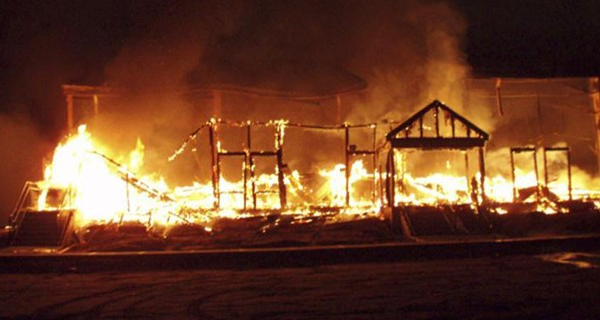
A church in Missouri is destroyed:

because someone hated a black man becoming President.

A mosque is destroyed in Massachusetts:

because someone hated Islam.

**

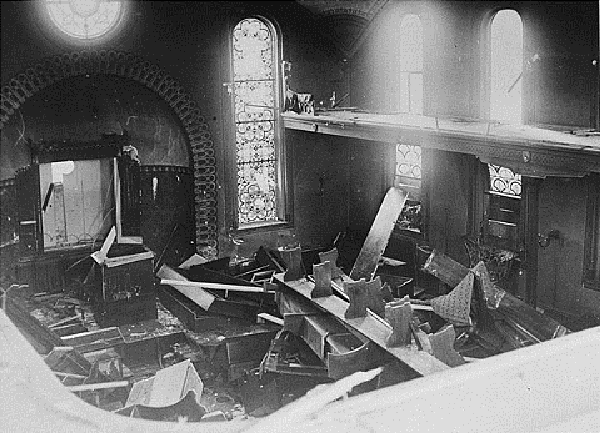
A synagogue is destroyed:

during Kristallnacht.

A mosque is destroyed:

in Gaza.

**

A mosque is destroyed:

in Gaza.

A synagogue is destroyed:

in Gaza, by Palestinians.

**

A mosque is destroyed:

by Hindus.

A church is destroyed:

in Kosovo.

**

A world hertiage site mosque in Timbuktu is destroyed:

by fellow Muslims.

The cathedral in Haiti is destroyed:

by act of God…

Rhetoric, intent — logistics — and who went first?

Monday, August 27th, 2012

[ by Charles Cameron — when religious leaders talk of wiping nations off the map ]
.

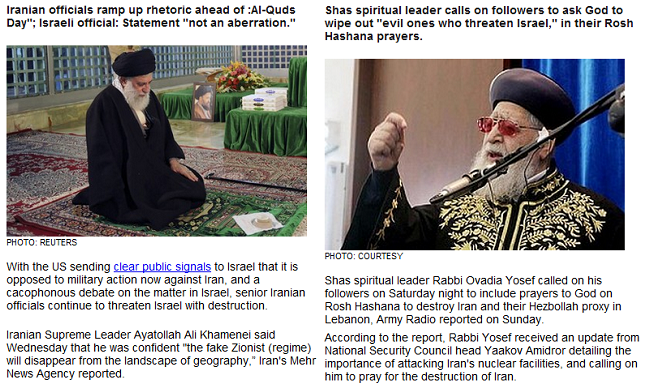
-Two bearded religious figures face of with what seems like parallel but opposite rhetoric:

______________________________________________________________________________________________

______________________________________________________________________________________________

The Ayatollah Khamenei, left, is the Supreme Jurisprudent of Iran — not merely a senior cleric but Iran’s final authority. Rabbi Ovaida Yosef, right, is the leader of the Shas movement in Israel and a cleric who swings enough power that Prime Ninister Netanyahu consults him and Foreign Minister Avigdor Lieberman, briefs him — an influence, then, something akin to an eminence grise perhaps, but by no means the final authority.

You may, loathe one of them you may loathe both of them: I doubt there are many people who admire both. But I’m not here to stir your animosities, I’m here to see what we can learn from comparing and contrasting them by catching them in similar circumstances. Perhaps it will make their differences stand out in high relief — perhaps it will reinforce their similarities.

The two men are both religious clerics, both political players, both getting on in years, both grey-bearded — and both seem to be comfortable using the same rhetoric at this point.

My aim here is to learn from this juxtaposition.

*

So I have two sorts of questions that I’d like to explore here, calmly and with appropriate documentation if you please…

One sort of question probes the differences in position and pouvoir of the two men:

Who has the higher position? Whose side has the most potent weapons? Whose side started this — or is that a moot question?

The second sort is subtler, since it has to do with motives hidden in the hearts and minds of men — and with the differences that sometimes exist between between rhetoric and intent.

Is is an entire people, or simply a regime that they would like to see an end to?

Is either one of them bluffing?

And of course my own favorite: is either one of them, the rabbi or the ayatollah, saying what he’s saying because of an “end times” (Messianic or Mahdist) expectation?

**

Hitler‘s rhetoric in Mein Kampf was pretty clear, and the actions of his Dritte Reich did not belie his rhetoric. Considerable planning was involved, there was documentation.

What, beyond rhetoric, do we know about Israeli planning to take down the Iranian nuclear program? What, beyond rhetoric, do we know about Iranian planing to respond to an Israeli strike — or to defeat and destroy Israel more generally?

Do the logistics back the rhetoric up?

What happens when the word “fire” is itself a match? What happens in an echo chamber, in a hall of mirrors?

Yiddish humor, US Presidential Election

Friday, August 24th, 2012

[ by Charles Cameron — Jewish Democrats suggest humorous barbs for Jewish Republicans to digest ]
.

As those who follow my strand of posts her on Zenpundit know by now, I’m not a great one for taking sides: I imagine very few bridge builders are, and my real interest is in building bridges.

I am also, in general, interested in the ephemeral signals that go on between and within opposing camps — because they’ll often portray a different side of things from what’s in the official pronouncements.

What I’m offering here, then, is a fleeting glimpse into some Jewish humor from the Democratic side of things:


.
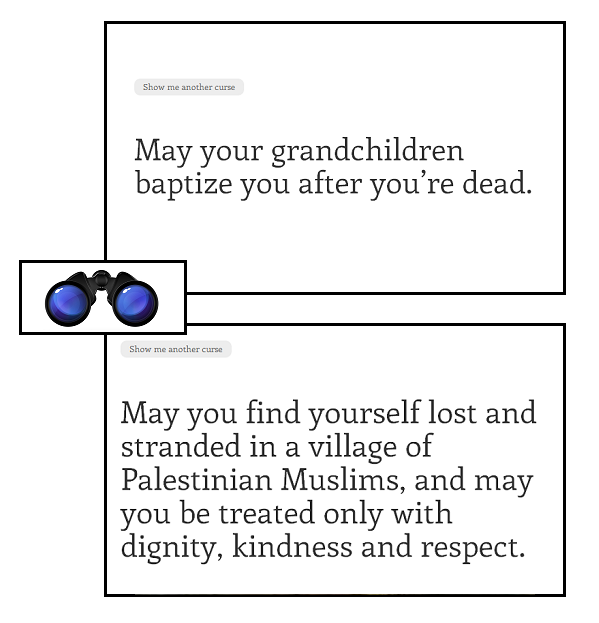
— two “curses” from the from the Yiddish Curses for Republican Jews website.

As wry humor, I’m okay with these. As embittered humor, not so much.

And I don’t know the people who posted these “curses” — though I’m reasonably sure they didn’t intend them as actual, may G*d do this to you and I mean it, curses.

Frankly, I’m interested in the religious content.

**

I’m interested in the jokes.

I’m interested in the leaflets, the comments in the comment sections of websites — and in the winks, the nudges and the nods.

I’m interested in the differences between “in-house” and “external” explanations of things, what the differences may actually mean, and what they may get interpreted to mean. I’m interested in the asides, the sneers and smears, the jokes, the ambiguous threats, the real hatreds, the moments of reflection, the metanoias, changes of heart, repentances.

At times, the materials I run across are threatening, at times witty or droll, at times insightful, and at times completely unhinged from reality, but they usually have something to teach us about undercurrents — about the variousness of human thoughts and feelings.

We humans are a strange lot, each one of us so singular that we have a hard time getting our heads around the differences between us — differences that can make all the difference between peace and war, life and death.

**

I’m not going to explain the jokes, but I am going to take just a quick look at their religious content.

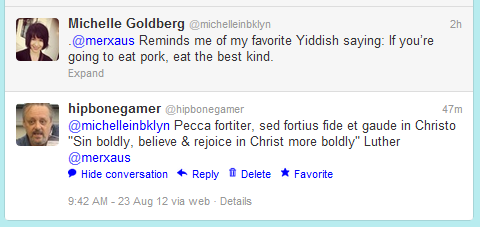
One of the qualities that is, IMO, most likeable about Jewish culture is that it delights in self-mockery. The New York Times journalist Michelle Goldberg tweeted a Jewish joke yesterday, to which I responded with a quote from Martin Luther:

Now I don’t know about Michelle, but I didn’t intend my quote from Luther — “sin boldly” — as representing either my personal advice to the world at large, or Luther’s, except perhaps in a very limited sense such as the one Dietrich Bonhoeffer offered as his explanation of Luther’s meaning.

Bonhoeffer’s question is the obvious one:

Is this the proclamation of cheap grace, naked and unashamed, the carte blanche for sin, the end of all discipleship? Is this a blasphemous encouragement to sin boldly and rely on grace? Is there a more diabolical abuse of grace than to sin and rely on the grace which God has given?

And his response?

Take courage and confess your sin, says Luther, do no try to run away from it, but believe more boldly still. You are a sinner, so be a sinner, and don’t try to become what you are not. Yes, and become a sinner again and again every day, and be bold about it. But to whom can such words be addressed, except to those who from the bottom of their hearts make a daily renunciation of sin and of every barrier which hinders them from following Christ, but who nevertheless are troubled by their daily faithlessness of sin? Who can hear these words without endangering his faith but he who hears their consolation as a renewed summons to follow Christ? Interpreted in this way, these words of Luther become a testimony to the costliness of grace, the only genuine kind of grace there is.

**

So no, I don’t think all religiously-themed tweeting and web-based cursing is to be taken literally.

But I do find it interesting that Michelle jokes about kosher, and I joke about sinning boldly — and that the Yiddish humor displayed on the “curses” website includes references to the LDS practice of proxy baptism for the dead and an indication that it might be uncomfortable for those with strong anti-Muslim feelings to meet the generous hospitality that so often characterizes Muslim cultures.

So let’s dig into those two themes in a little more depth.

**

Official Latter-day Saints doctrine teaches:

Jesus Christ taught that baptism is essential to the salvation of all who have lived on earth (see John 3:5). Many people, however, have died without being baptized. Others were baptized without proper authority. Because God is merciful, He has prepared a way for all people to receive the blessings of baptism. By performing proxy baptisms in behalf of those who have died, Church members offer these blessings to deceased ancestors. Individuals can then choose to accept or reject what has been done in their behalf.

And while the practice of baptizing the dead by proxy may seem strange to most Christians, the Latter-day Saints can point to I Corinthians 15.29:

Else what shall they do which are baptized for the dead, if the dead rise not at all? why are they then baptized for the dead?

and I Peter 4.6 for precedent:

For for this cause was the gospel preached also to them that are dead, that they might be judged according to men in the flesh, but live according to God in the spirit.

Maybe so — but Saints Peter and Paul, though Jewish by birth, are now generally reckoned Christians, having accepted the belief that Jesus was the awaited Jewish Messiah, the Christ — so their epistles are not canonical texts for mainstream Judaism.

**

Feelings in the Jewish community can run pretty strongly on the issue of Mormon believers’ baptisms of Jewish believing dead:

The wrongful baptism of Jewish dead, which disparages the memory of a deceased person is a brazen act which will obscure the historical record for future generations. It has been bitterly opposed by many Jews for a number of years. Others say they will never stop being Jews, simply because there is a paper saying they had been baptized, that the act of posthumous baptism is unimportant and should be ignored. We think this to be a narrow, parochial, and shallow view. We will continue opposing this wrongful act which assimilates our dead to the point where it will not be possible to know who was Jewish in their lifetimes.

[ … ]

A protest drive initiated by Jewish genealogists escalated it to a nationally publicized issue that was followed by public outcry. American Jewish leaders considered it an insult and a major setback for interfaith relations. They initiated discussions with the Mormon Church that culminated in a voluntary 1995 agreement by the Church to remove the inappropriate names. Activists continue to monitor Mormon baptismal lists, seeking removal of inappropriate entries.

Indeed, in February of this year it was discovered that the Holocaust victim Anne Frank had been baptized by proxy — for what one researcher said was the ninth time.

The Nobel laureate Elie Wiesel responded with passionate anger, and the Mormon Church with an apolpogy and a firm statement that the practice was prohibited.

LDS spokesman Michael Purdy made it clear that the Church “is absolutely firm in its commitment to not accept the names of Holocaust victims for proxy baptism.”

There are serious issues here: as humans, we can listen to one another with respect, and work them out.

**

Palestinian Muslim hospitality towards Jews?

Miftah is an Ethiopian who visited some Palestinian shepherds in company with people sympathetic to the Palestinian cause:T

he group I went with was a mostly Israeli – international activists’ group that accompanies shepherds in the village as they graze their herds. Since these shepherds face attacks from settlers and soldiers frequently, the purpose of the trip was to document and confront the settlers or soldiers if they try to harass the shepherds.

These were people the Palestinians had reason to respect, Israelis and foreign activists sympathetic to their cause — but the degree of hospitality they were shown nicely illustrates the innate courtesy of so many pastoral peoples…

As we were heading back from the hills to where our mini-van was, these shepherds we had met offered to take us home for some tea and coffee. Mind you, it’s the Ramadan fasting season and all of them were fasting. They would offer us water, coffee and bread even though the last meal they had was at dawn that morning and would not have any food or water until dusk that evening. In Ramadan, even people who don’t fast don’t eat in public or in front of people who fast. But out of true hospitality, they extended their “‘Mitzvah’ – their act of kindness” to us, as one of the Israeli activists put it

**

The story is an old one: the person of few possessions who will kill one of their handful of sheep to feed the passing stranger…

In this second “curse” we glimpse the long tradition of hospitality to strangers without which the great trade routes of the ancient would would not have permitted China to supply Europe with silks, nor Roman jewelry to have found its way into Japanese tombs

Pussy Riot VI: counterpoint and counterfactuals

Wednesday, August 22nd, 2012

[ by Charles Cameron — compare and contrast as a means of contextualizing, suggesting a tool that might be of use to the IC in any number of circumstances ]
.

In this particular case, Pussy Riot is the topic, comparison with is the method, and some form of graphic the appropriate medium around which to build a presentation.


.

Both these statements have been made recently by Catholic priests, and they portray opposite positions on the matter. Again, it is my sense that the graphical representation of these remarks calls forth in the reader both similarities and differences, as Cath Styles nicely put it:

A general principle can be distilled from this. Perhaps: In the very moment we identify a similarity between two objects, we recognise their difference. In other words, the process of drawing two things together creates an equal opposite force that draws attention to their natural distance. So the act of seeking resemblance – consistency, or patterns – simultaneously renders visible the inconsistencies, the structures and textures of our social world. And the greater the conceptual distance between the two likened objects, the more interesting the likening – and the greater the understanding to be found.

From my point of view, the direct juxtaposition in a DoubleQuote or equivalent format does the job nicely when two fairly simple quotes are considered together.

Things can get more complex than that when a variety of discourses come together, but the same general principles can still be applied, and a graphical representation sought.

Bearing Cath’s point in mind, then, I’d like to examine some of the ways in which people have contextualized the Pussy Riot event in the Cathedral with counterfactual instances (ie by contrasting it with instances that in some ways parallel the factual instance, but in “what if” style alternate universes.

**

Here, then, are the documents I’ll be drawing on. First, from Khanya, a blog I’ve praised in an earlier post:

An Amnesty International petition site (Take Action Now – Amnesty International USA) urges people to send an email with the following text to the Russian prosecuting authorities:

I respectfully urge you to drop the charges of hooliganism and immediately and unconditionally release Maria Alekhina, Ekaterina Samutsevich and Nadezhda Tolokonnikova. Furthermore, I call on you to immediately and impartially investigate threats received by the family members and lawyers of the three women and, if necessary, ensure their protection. Whether or not the women were involved in the performance in the cathedral, freedom of expression is a human right under Article 19 of the Universal Declaration of Human Rights, and no one should be jailed for the peaceful exercise of this right. Thank you for your attention to this serious matter.

Now imagine, for a moment, that the boot was on the other foot.

Imagine that it was a Western European country, and that the act of “hooliganism” concerned was daubing swastikas on a synagogue. If that were the case, would Amnesty International be urging its members and the general public to send messages saying:

Whether or not the women were involved in writing the graffiti on the synagogue, freedom of expression is a human right under Article 19 of the Universal Declaration of Human Rights, and no one should be jailed for the peaceful exercise of this right. Thank you for your attention to this serious matter.

I think that in Western Europe such a petition would be widely regarded as “hate speech”, and “anti-Semitic”, as would the graffiti. So why does Amnesty International think that it is OK to encourage people to send such things to Russia?

And then, of course, one can put the boot back on the first foot again. If these same three young women had daubed graffiti on a synagogue in Moscow, would they have been prosecuted for the same offence and in the same way as they have been in this case?

So there are differences between Russian culture and Western culture, and differences within Russian and Western culture.

That’s a pretty impressive example of the counterfactual genre — and doubly so, it seems to me, because of the final reversal, the twist in its tail.

**

Next, here’s another quote from the same Fr. Hogan we quoted above. In this case, the mosque is used as the primary contrast to the cathedral, but the synagogue also makes an appearance — and Fr. Hogan throws at least one other interesting contrast into the mix — comparing Putin and western leaders:

Protest is fine, the day will come, I’m sure, and not too far away either I think, when we Christians may be protesting against our governments and engaging in civil disobedience, but protest must always respect others and the faith of others. As some have asked, would these ladies do the same in a mosque? They would not for two reasons – it would not be politically incorrect and they might end up being stoned to death before they had a chance to get out of the building. Is it legitimate to mock faith and descecrate places held sacred by people in order to protest against a political regime?

Some will say these ladies did so because the Orthodox Church is too close to the Russian government. Okay, well Judaism is considered by many to be too close to Zionism and the State of Israel – well, where are the lewd feminists dancing in the synagogues mocking Abraham and Moses? They are not there because they know it is inappropriate and wrong – just as it is inappropriate and wrong to desecrate a place of Christian worship.

What interests me here is that he uses multiple counterfactual contrasts, which perhaps makes his paragraphs a little less elegant than Khanya’s — but interesting in the complexity it adds to his analysis.

I’ll return to that remark about “we Christians may be protesting against our government” later.

**

My last text — and I’ve quoted it here on ZP before — is Josh Shahryar‘s tweet:

I wonder if #PussyRiot would get so much attention if they were a band of men called #DickMob.

That comes at the Pussy Riot issue from a completely different angle, and is very elegantly done.

**

Our next task is to see what oppositions we can find in these three statements.

  • Kanya uses Amnesty’s concerns regarding freedom of expression vs appropriateness of expression by comparing the cathedral incident with women “in a Western European country” daubing swastikas on a synagogue, thus also proposing a comparison between eastern and western European mores.
  • Then, in a reversal, Kanya uses the same cathedral incident vs daubing graffiti on a synagogue specifically in Moscow this time, to explore the degree to which Moscow might be more tolerant of anti-Semitism than of anti-Orthodoxy, both in terms of public opinion and via political and legal systems.
  • Fr Hogan’s question poses a contrast between the cathedral (and Orthodoxy and Putin) and a hypothetical mosque (and Islam and, say, a militant faction in Pakistan).
  • His second comparison is between two church-and-state collaborations, Orthodoxy with the Russian state and Judaism with the Zionist, and again the question he raises is whether similar behavior in a parallel situation would be tolerable.
  • Then there’s his intriguing third comparison, which I said I’d return to, in which he suggests that the “not too far” future may hold the need for civil disobedience and anti-government protests by Christians – in the west presumably. Fr Hogan hails from Ireland, which has had its own share of Church troubles and no longer wields the power it once did over Irish people and politics. Present day Russia, then, contrasted with a hypothetical future Ireland.
  • But the malaise is more widespread, and to add a comparison of my own into the pot, Fr Hogan’s remark reminds me of something Cardinal George of Chicago said not so long ago, looking at the looming battle between an increasingly secular state and his own moral stances on such issues as abortion and same sex marriage:

    I expect to die in bed, my successor will die in prison and his successor will die a martyr in the public square.

  • But that’s oblique to our narrative here…

  • Finally, there’s Josh Shahryar’s contrast between a factual girl band named Pussy Riot and a counterfactual boy band called DickMob.

**

What sort of a graphic would allow us to rotate all these polarities in our minds?

One answer is a Sembl-type game board — see design below — but with concepts rather thyan objects in the “positions” on the board:

But I’m also after other possibilities here. What would our fine artists, engineers, architects, dancers, cartographers, logicians, musicians, data visualizers and computer scientists suggest?

**

It would of course be nice if we could wrap this whole business of counterfactuals with a nice British cuppa tea, eh? Perhaps we can…

From a comment in the Guardian:

With the best will in the world I can’t see that if a bunch of noisy youngsters stood up in Westminster Abbey and screamed obscenities about the Queen to the accompaniment of electric guitars turned up to eleven, that the rest of the world would throw up its hands in horror if they were first stopped and then charged with an offence.

What’s that? We endured the Blitz, for goodness sake!


Switch to our mobile site