zenpundit.com » nature

Archive for the ‘nature’ Category

E.O. Wilson on the Evolutionary Origin of Creativity and Art

Thursday, April 4th, 2013
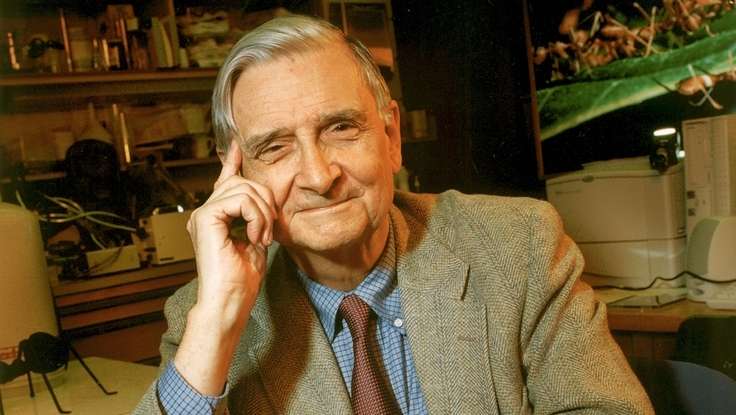
E.O. Wilson 

Last summer, eminent sociobiologist E.O. Wilson published an article in Harvard Magazine:

On the Origins of the Arts 

….By using this power in addition to examine human history, we can gain insights into the origin and nature of aesthetic judgment. For example, neurobiological monitoring, in particular measurements of the damping of alpha waves during perceptions of abstract designs, have shown that the brain is most aroused by patterns in which there is about a 20 percent redundancy of elements or, put roughly, the amount of complexity found in a simple maze, or two turns of a logarithmic spiral, or an asymmetric cross. It may be coincidence (although I think not) that about the same degree of complexity is shared by a great deal of the art in friezes, grillwork, colophons, logographs, and flag designs. It crops up again in the glyphs of the ancient Middle East and Mesoamerica, as well in the pictographs and letters of modern Asian languages. The same level of complexity characterizes part of what is considered attractive in primitive art and modern abstract art and design. The source of the principle may be that this amount of complexity is the most that the brain can process in a single glance, in the same way that seven is the highest number of objects that can be counted at a single glance. When a picture is more complex, the eye grasps its content by the eye’s saccade or consciously reflective travel from one sector to the next. A quality of great art is its ability to guide attention from one of its parts to another in a manner that pleases, informs, and provokes

This is fascinating.  My first question would be how we could determine if the pattern of degree of complexity is the result of cognitive structural limits (a cap on our thinking) or if it represents a sufficient visual sensory catalyst in terms of numbers of elements to cause an excitory response (neurons firing, release of dopamine, acetylcholine etc. ) and a subsequent feedback loop. Great art, or just sometimes interesting designs exhibiting novelty can hold us with a mysterious, absorbing fascination

Later, Wilson writes:

….If ever there was a reason for bringing the humanities and science closer together, it is the need to understand the true nature of the human sensory world, as contrasted with that seen by the rest of life. But there is another, even more important reason to move toward consilience among the great branches of learning. Substantial evidence now exists that human social behavior arose genetically by multilevel evolution. If this interpretation is correct, and a growing number of evolutionary biologists and anthropologists believe it is, we can expect a continuing conflict between components of behavior favored by individual selection and those favored by group selection. Selection at the individual level tends to create competitiveness and selfish behavior among group members—in status, mating, and the securing of resources. In opposition, selection between groups tends to create selfless behavior, expressed in
greater generosity and altruism, which in turn promote stronger cohesion and strength of the group as a whole 

Very interesting.

First, while I am in no way qualified to argue evolution with E.O. Wilson, I am dimly aware that some biological scientists might be apt to take issue with Wilson’s primacy of multilevel evolution. As a matter of common sense, it seems likely to me that biological systems might have a point where they experience emergent evolutionary effects – the system itself has to be able to adapt to the larger environmental context – how do we know what level of “multilevel” will be the significant driver of natural selection and under what conditions? Or does one level have a rough sort of “hegemony” over the evolutionary process with the rest as “tweaking” influences? Or is there more randomness here than process?

That part is way beyond my ken and readers are welcome to weigh in here.

The second part, given Wilson’s assumptions are more graspable. Creativity often is a matter of individual insights becoming elaborated and exploited, but also has strong collaborative and social aspects. That kind of cooperation may not even be purposeful or ends-driven by both parties, it may simply be behaviors that incidentally  help create an environment or social space where creative innovation becomes more likely to flourish – such as the advent of writing and the spread of literacy giving birth to a literary cultural explosion of ideas and invention – and battles over credit and more tangible rewards.

Need to ponder this some more.

Cross-grain thinking, 3: ASP’s Report on Climate Security

Wednesday, November 21st, 2012

[ by Charles Cameron — as Dylan sang, a change in the weather is known to be extreme ]
.

People sit at a flooded table in Piazza San Marco, Venice -- photo: Luigi Costantini / AP

.
Right at the top of Part I of the recent three-part Report on Climate Security from the American Security Project, we read this paragraph:

Climate change is real: we see its impacts every day, around the world. A melting Arctic, unprecedented droughts across the world, extreme examples of flooding, and uncontrollable wildfires are all examples of the changing climate.

That’s right, that’s right and important, that’s right, important and timely.

But you know, at heart I’m a poet. And although I’m concerned about the issues the report addresses, I can’t help thinking of climate and weather, atmosphere and wind, in a manner that crisscrosses the “interior” vs “exterior” divide.

If you lean to the scientific more than the poetic, you might want to consider what I’m talking about as an instatiation of the insight Gregory Bateson expressed in the title of his seminal book, Mind and Nature: A Necessary Unity.

**

Let me lean to the poetry-side for a paragraph or so, then we’ll come back to security issues the report raises.

I probably caught this particular “weather and weather” disease from Dylan Thomas’ great and celebrated poem, A Process in the Weather of the Heart:

A process in the weather of the heart
Turns damp to dry; the golden shot
Storms in the freezing tomb.
A weather in the quarter of the veins
Turns night to day; blood in their suns
Lights up the living worm.

Writing about this poem in his Reader’s Guide to Dylan Thomas, William York Tindall notes “Thomas’ obsessive concern with the natural process that, linking man and world, inner and outer, turns upon the axis of life and death” and specifies that “applying ‘weather,’ a word for outer climate, to inner climate joins two worlds.”

Thomas is concerned in that extraordinary poem to join, likewise, life with death, night with day, womb with tomb, seeing eye with blind bone and more – or not so much to join them as to see them as inseparable, as parts of the single unfolding that is the world.

There is much more to the poem than the central obsessive theme of the “process in the weather of the heart” with which the poem opens and the “process in the weather of the world” with which it closes. It is their conjunction, their inseparability which interests me here – the poet’s perception that there is no inner without the outer, no outer without the inner – that in each there is weather, which Tyndall also calls climate, that weather is in both…

**

Back to meteorology and national security..

Look, I’m not exactly an enemy of thinking about climate change and national — or global — security. I admire ASP for today’s piece by Catherine Foley, Climate Change: The Missing Link in Tackling the Mali Crisis. We need more considerations of that kind, they’re rare and extremely valuable.

Mecca is one of the hottest cities in the world, and the Kaaba the central pivot around which all Islam revolves — potentially a double hot-spot. What are the implications of climate change for the Saudis, for Mecca, for Islam?

**

When I think about weather, I think about storms in the world, storms in the heart and mind, almost in the same breath. Specifically, when I think of global warming, I can’t help but see the problem as being one of double-awareness – rising temperatures and rising tempers, rising sea-levels and rising levels of anxiety and / or denial, the climate of meteorology and the climate of opinion…

Seen from my bifocal perspective, the report is notably focused on externals. Take another sentence from the brief bullet points on the first page;

The climate influences people’s everyday lives, from what they eat to where they live.

We eat food, food that can be weighed and measured, and analyzed for its nutrient elements and health properties. We live in cities, towns and villages, in houses, or developments, which can located on maps…

With my bifocals on, it would be more accurate, more encompassing to say:

The climate influences people’s everyday lives, from what they eat to how they feel, and from where they live to what they think and how they behave.

Because in my view, the situation is as much about “mind change” as it is “climate change” — in my view, the “fulcrum that can move the world” is to be found in the geography of mind and heart.

**

Okay, let’s back up a bit.

The “first page” I quoted is the first page of the First Part of the Report, but there’s also an Introduction, and I want to pick up the thread there now, because the Introduction is written with human thought — specifically “honest dialogue” — in mind, and opens with what seems at first glance like one of those obvious truths that serve as the jumping off points for more detailed considerations:

The American Security Project is organized around the belief that honest, public discussion of national security requires open, non-biased, non-partisan discourse about the dangers and opportunities of the 21st Century.

There’s just one problem here, though — a single paragraph later, we read:

Climate change poses a clear and present danger to the United States

I’d give my assent happily enough to either of these two propositions, if they weren’t both talking about the same situation. Because when someone sees a “clear and present” hungry tiger coming at them and doesn’t take rapid action to avoid being eaten, it’s not “open” and “unbiased” — it’s “in denial”.

Which in turn means there’s a swathe of the population that may not be willing to hear “open, non-biased, non-partisan discourse” nor able to contribute to it. “I don’t believe my eyes, they’re deceiving me with all this hogwash about tigers”…

And those people have loved ones, bring foods to community pot-lucks, and teach class, and vote…

**

Some time ago, I was working on a transposition of the Gospel narratives of Luke and John into the Troubles in Northern Ireland, with Britain playing the part of Rome and so forth, and adding some commentary along the way. Here’s a slightly revised version of my comment on John 3.8:

There is one particular word that John uses which has what we today might call a triple (rather than a double) meaning. When Christ in this verse says, “The wind bloweth where it listeth, and thou hearest the sound thereof, but canst not tell whence it cometh, and whither it goeth: so is every one that is born of Spirit,” it is the Greek word pneuma that can be translated both as wind and spirit. It also means breath.

Christ is saying here that those who are born of spirit are like the wind, like breath, and like inspiration: each of which can be noticed but not predicted, because each moves of its own accord — yet in the Greek these are not three separate concepts as they are for us today. As CS Lewis says in another context, we must always remember “that the various senses we take out of an ancient word by analysis existed in it as a unity.”

In telling us this, St John is saying at one and the same time that nobody knows where the first breath comes from or when the last breath will leave us, nobody knows how to forecast exactly which path a hurricane will take, and nobody knows how to make an assembly line for inspiration – if we did, Beethoven could have written another three symphonies as great as his Ninth to order, stat!

One of the reasons we don’t know how the heart and mind work is that we’ve separated “meteorological” weather from “the weather of the heart” — and there’s a storm brewing, inextricably, on both fronts.

If the ASP report is anything to judge by, we’re only looking at one of them.

**

Oh, and here by way of confirmation is an old friend from my Oxford days, the late Chogyam Trungpa Rinpoche, quoted in a piece for the November issue of Shambhala Sun:

No matter where we are in the world, there is a need for enlightened society, wherever natural disasters hit. In this case, “natural disaster” refers to aggression, passion, and ignorance. These kinds of natural disasters occur in the minds of people.

Trungpa’s sense of “natural disaster”, I humbly submit to the folks at the American Security Project, either needs to run like a woof through the warp of their report on climate change — which it doesn’t — or it deserves a fourth section of its own.

On Psychopaths and Society

Wednesday, August 22nd, 2012

Earlier this year, milblogs had much discussion regardingtoxic leaders” – so-called “leaders” who in command epitomized a bullying, negative, destructive, egocentric, “boss from hell” that compromised missions, institutional values, morality and sometimes the law with their behaviors. This a phenomena plaguing more than just in the US military; a best-selling business book, The No Asshole Rule by Stanford professor Robert I. Sutton , even attempted to quantify the negative economic impact of psychopathic or antisocial personalities on their organizations and concluded the best strategy was to systematically not hire these people in the first place (Steve Jobs, incidentally, was identified by Sutton as the extremely rare asshole who created significantly more value for an organization than he destroyed in the damage he did to the people around him).

I came across an intriguing discussion of pyschopathology on TED that takes a number of surprising twists that puts “toxic” personalities in a different perspective than fixed categories.

Percussions and repercussions

Monday, August 6th, 2012

[ by Charles Cameron — ecology, fire, forests, an elevator in Denver, and how one thing leads to another ]
.

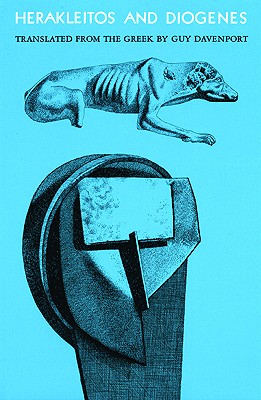
Guy Davenport, a stylist worthy of his Masters

.

HeraclitusHerakleitos — sees this world as one seamless “all” in constant motion and taking many forms — with what we call “fire” as the recurring form within that flux that he can point to by name, using it as his best metaphor for that “all”…

In the beautiful translation of Guy Davenport (drawn here from fragments 28 and 29 in his book, 7 Greeks, p 161:

Everything becomes fire, and from fire everything is born, as in the eternal exchange of money and merchandise.

This world, which is always the same for all, neither god nor man made: it has always been, it is, and always shall be: an everlasting fire rhythmically dying and flaring up again.

**

This is just a quick post, a little creativity flaring up and dying down again while I am preparing longer pieces on Nidal Hassan (as discussed by Daveed Gartenstein-Ross, JM Berger and emptywheel), a zennish biography of John Cage, and Rain (with a capital roar) in African religion and urban settlements.

I was glancing at Chris Bright‘s entry Anticipating Environmental “Surprise” in State Of The World 2000, and my eye was caught by the phrase, “Surface fires do not climb trees and become crown fires.”

I’d never heard of “surface fires” and “crown fires” before, and “crown fires” in particular had me thinking there’s poetry here…

So I took a deep breath, slowed down, and read more carefully. And as I was reading the whole short section that began with those words, one part of my mind was soaking in the vivid images the text conjured up for me, but another part was calculating percentages in what seemed to be a rapidly accelerating descent.

I have tried to picture that double effect — of lush rainforest and the numbers that illustrate its fiery fall — in what follows:

**

100%

Surface fires do not climb trees and become crown fires. They just crackle along the forest floor, here and there, as little patches of flame, going out at night, when the temperature drops, and rekindling the next day. They will not kill the really big trees, and they do not cover every bit of ground in a burned patch. But they are fatal to most of the smaller trees they touch. Overall, an initial surface fire may kill perhaps 10 percent of the living forest biomass.

90%

The damage may not look all that dramatic, but another tract of forest may already be doomed by an incipient positive feedback loop of fire and drying. After a surface fire, the amount of shade is reduced from about 90 percent to around 60 percent, and the dead and injured trees rain debris down on the floor. So a year or two later, the next fire in that spot finds more tinder, and a warmer, drier floor. Some 40 percent of forest biomass may die in the second fire. At this point, the forest’s integrity is seriously damaged; grasses and vines invade and contribute to the accumulation of combustible material.

50%

The next dry season may eliminate the forest entirely.

0%

.
**

Those falling numbers remind me of the floors whizzing by in an elevator I once frequented in Denver — where the framed elevator license said, ominously enough, Type: Plunger.

And so here we are at “Ground floor: Perfumery, Stationery and leather goods”.

One very simple part of how complex the world we live in really is has to do with repercussions…

On the Limits of Human Intelligence

Monday, July 16th, 2012

IQ as a concept (and specifically “g“) and the psychometric instruments used to quantify them has provoked fierce political and scientific debate for decades. The political debate tends to be heatedly emotional and revolve around the inescapably inegalitarian societal implications of crafting policy (education, public health etc.) in light of a wide spectrum of IQ scores being unevenly distributed through the population. Scientific debate tends to be more focused on defining or identifying the parameters of intelligence, the relationship between physical brain structure, cognition and human consciousness,  heritability, neuroplasticity, the accuracy of psychometric instruments and more specialized topics beyond my ken.

What’s usually seldom disputed by scientists is that large differences in IQ are significant and that a very, very small number of individuals – the top 1% to .0001% of the Bell Curve, have unusually gifted and varied cognitive capacities.  It is technically more difficult to measure people who are such extreme outliers with accuracy as their intelligence might very well exceed the parameters of the test. Stephen Hawking’s IQ is frequently estimated in the media to be in the 160’s and Albert Einstein’s in the 150’s but those are speculative guesses. Most of the people touted as being “smarter than Einstein” with astronomical IQ scores, like Marylin vos Savant or Christopher Langan do not (for whatever reason) produce any tangible intellectual work comparable to that of Stephen Hawking, much less Albert Einstein. Maybe we really ought to use that cultural comparison with greater humility until there’s a better empirical basis for it 🙂

[If you are curious what the extremely smart do think about, browse the Noesis journals of The Mega Society]

It is being asserted that any evolutionary improvements to human intelligence are apt to come with (presumably undesired) tradeoffs or deficits. That we are “bumping up against” our “evolutionary limits”. I’m not qualified to evaluate that hypothesis, but it’s assumptions are not stable as advanced societies are already radically changing their cognitive environments as well as approaching the ability to directly manipulate our genetic legacy. Whether it is Kurzweil’ssingularity” or not matters less than these things change the “natural” probability of our evolutionary trajectory. A one in a billion random genetic mutation is no longer so if you can design it in a lab.

How much higher could we push cognition? Or could we expand the existing range by adding a new dimension of senses?

Why would a dictatorship not bound by ethical scruples not do this, even at considerable cost to the individual subjects of such experiments, in order to systematically harness the results of “a genetic arms race” for the benefit of the state? Though a growing body of supersmart people would eventually become difficult to control if your secret police were not intelligent enough to comprehend what they were doing .

The potential economic rewards of increasing human intelligence would inevitably outweigh any risk assessment or ethical constraints.


Switch to our mobile site