zenpundit.com » poetry

Archive for the ‘poetry’ Category

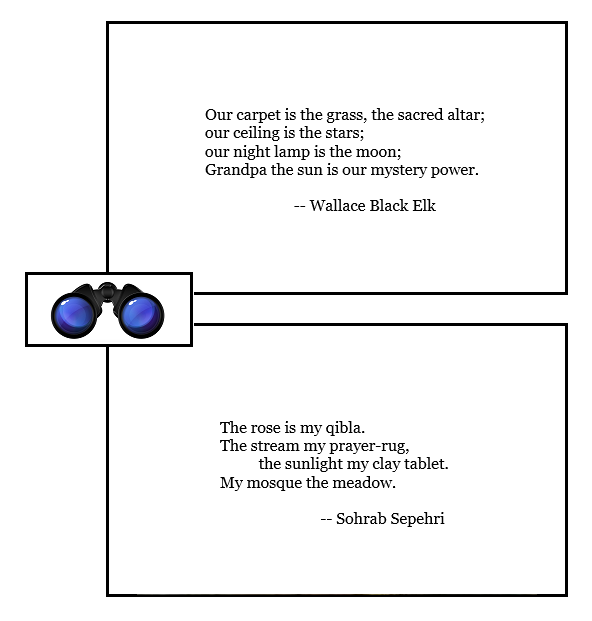
The rose is my qibla

Thursday, September 3rd, 2015

[ by Charles Cameron — some light refreshment after dark sides and devilish walks ]
.

SPEC WBE Sepehri

**

Sources:

  • Sohrab Sepehri, Poetic Voices of the Muslim World
  • Wallace Black Elk, The Greenfield Review, vol 9, double issue 3 & 4
  • with thanks to Joseph Bruchac & Rabia Chaudry

    The Washington Post – can’t read, or can’t count?

    Thursday, August 20th, 2015

    [ by Charles Cameron — a grumpy grammatical plaint, plus Proclus for poet’s delight ]
    .

    You know me, maybe — I’m not a quant, if anything I’m a qualit, but even so..

    CEOs at the top 50 U.S. charities, including Samaritan’s Purse, earn in the $350,000 to $450,000 range, which makes Graham’s $622,000 salary from his aid organization alone about 40 percent to 50 percent higher than average, according to a Forbes story. He receives the rest of his $258,000 compensation as CEO of the Billy Graham Evangelistic Association.

    That’s straight out of the Washington Post, who got it whole cloth from Religion News Service.

    **

    OK, we know what the writer means to say, but.

    If top US charity CEOs including Franklin Graham earn between $350,000 to $450,000, and Graham earns $622,000 as his CEO’s salary, then — bzztzz — top US chatioty CEOs earn in the $350,000 to $622,000 range, , not “in the $350,000 to $450,000 range” period.

    Further, if Graham earns $622,000 from Samaritan’s Purse — which purse it seems I shall not be filling any time soon, and which might want to change its name to Sadducee’s Purse — the “rest of his $258,000 compensation” doesn’t make any sense at all — bzztzz. How can $622,000 plus an additional fee possibly sum to $258,000?

    There is a language, English, and a numerical method, Arithmetic, and this paragraph is lacking in one, the other, or both.

    **

    Or is Franklin Graham paid in irrational numbers?

    Proclus, as quoted by Danziger:

    It is told that those who first brought out the irrationals from concealment into the open perished in shipwreck, to a man. For the unutterable and the formless must needs be concealed. And those who uncovered and touched this image of life were instantly destroyed and shall remain forever exposed to the play of the eternal waves.

    Play of the eternal waves?

    Perhaps Graham’s expefrience is not unlike that of George Boole, who wrote a sonnet on the Trinity, and of whom Margaret Masterman wrote:

    Towards mathematical truth he had indeed a consciously religious attitude, which he sometimes expressed to himself by the phrase, ‘For ever, O Lord, Thy word is settled in heaven.’ Boole’s behaviour during his last illness was characteristic of the man… When his mind had been wandering in fever, he told his wife that the whole universe seemed to be spread before him like a great black ocean, where there was nothing to see and nothing to hear, except that at intervals a silver trumpet seemed to sound across the waters, ‘For ever, O Lord, Thy word is settled in heaven.’ And as he lay in bed on the borders of delirium, all the little sounds of the house, such as the creaking of doors, resolved themselves into a chant of these words, which expressed for him the excellence of mathematical truth.

    **

    Ah, but I drift.
    The quantity of mercy is not strain’d?

    Wednesday, August 12th, 2015

    [by Charles Cameron — some remedial philosophy at age 71 ]
    .

    I seem to be doing remedial political philosophy this week. As it happens, I read a Chinese comedian in my youth and was admonished against “sitting down while running round in circles” and have been aerating my brain with too much conscious breathing ever since — neither leaving me much time or interest for what in Oxford in my day was known, somewhat dismissively, PPE — Philosophy, Politics and Economics.

    Which brings me today, and to grabbing lectures in just that sort of thing from Harvard’s Michael Sandel, courtesy of YouTube:

    The video shows Sandel’s lectures, “Justice: Putting a Price Tag on Life”, and “How to Measure Pleasure” — salted with some dark humor:

    Back in ancient Rome, they threw Christians to the lions in the Coliseum for sport. If you think how the utilitarian calculus would go, yes, the Christian thrown to the lion suffers enormous, excruciating pain, but look at the collective ecstasy of the Romans. .. you have to admit that if there were enough Romans delirious with happiness, it would outweigh even the most excruciating pain of a handful of Christians thrown to the lion.

    I enjoyed the two lectures immensely — maybe I should rewind fifty years, and try PPE at Harcard?.

    **

    All of which caused me to wonder:

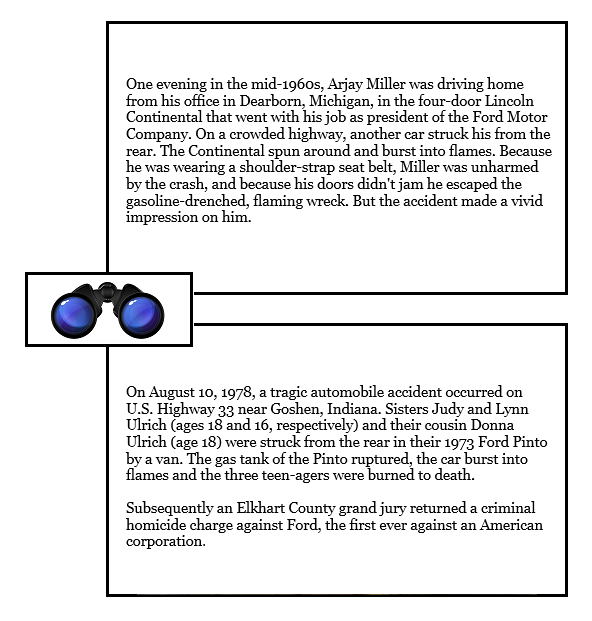
    SPEC pinto and lincoln continental

    Sources:

  • Mark Dowie, Pinto Madness
  • W Michael Hoffman, Case Study: The Ford Pinto
  • See also:

  • ES Grush and CS Saunby, Fatalities Associated with Crash-Induced Fuel Leakage and Fires
  • **

    I mean, all of which made me wonder about Jeremy Bentham, I suppose.

    We had Locke at Christ Church, staring disdainfully from his portrait during dinners in the Great Hall — but Bentham? I don’t think I saw any utility in utilitarianism.

    **

    But then I also wondered:

    SPEC trolley problem torture

    I wondered: how close is the analogy between the trolly problem and the ticking bomb torture questionn? Do we start from numbers of likely victims in each case and decide from there, or should we instead start by contemplating torture — and recognize the abyss staring back at us?

    Sources:

  • Wikipedia, Trolly problem
  • Michael Sandel, Justice: Putting a Price Tag on Life & How to Measure Pleasure
  • See also:

  • Kyle York, Lesser-Known Trolley Problem Variations
  • **

    What Shakespeare said, though — getting back to my title — was “The quality of mercy is not strain’d” — not the quantity, the quality — unquantifiable.

    Get up early to kill him first

    Thursday, August 6th, 2015

    [ by Charles Cameron — from Tractate Sanhedrin and Grotius to Gershon Scholem and the power of names ]
    .

    I ran across Yonatan Mendel‘s post, Kill Him First, in the Jewish Quarterly today while searching for the Habrew of the phrase get up early to kill him first, which I wanted to pair with the quote from Hugo Grotius which is pretty obviously derived from it:

    SPEC DQ rise up early

    **

    I arrived at that page, in other words, looking for the phrase Ha-Ba le-Horgekha Hashkem le-Horgo, and was glad to find it there, along with a fascinating narrative of some of the times it has been quoted in recent Israeli political circles:

    Following the Second Lebanon War, Ehud Yatom, a Likud MK, explained the asymmetrical death toll of 44 Israeli civilians and 1,191 Lebanese civilians with the same trump card: ‘and if someone comes to kill you, get up early to kill him first.’ It has been used by Minister of Strategic Affairs Moshe Ya’alon when addressing university students about their military reserve service and by Minister of Public Security Avi Dichter when lecturing about IDF strategy. It was also the explanation provided by Minister of Minorities Avishai Braverman for the assassination of a Hamas leader in Dubai. Even Ayoub Kara, a Druze MK from Likud, has used it. When asked about the Iranian nuclear plan Kara showed little originality: ‘I think an attack on Iran will be justifi ed’, he said, ‘since if someone comes to kill you, get up early to kill him first.’

    **

    But, but.

    That’s not the real treasure. For me, the real treasure is in the quote that heads Mendel’s article, from the great schoilar of Kabbalah Gershom Scholem in his 1926 letter to Franz Rosenzweig, On Our Language: A Confession. Here’s Mendel’s quote:

    The people here are not aware of the significance of their acts. They only think they have turned Hebrew into a secular language. That they have released the apocalyptic sting out of it… but God will not remain silent in the language in which he was invoked again and again, thousands of times, to return into our lives.

    Scholem’s whole letter is a powerful poetic testament:

    Language is name. The power of language is enclosed in the name; the abyss of language is sealed within it..

    Intriguing DoubleTweet variants & more

    Monday, August 3rd, 2015

    [ by Charles Cameron — also genetics, genetic algorithms and John Holland on the glass bead game ]
    .

    An abstract DoubleQuote:

    Thi9s is like one of my DoubleQuotes boards, empty — the reader is incited to fill in the blanks. And —

    A Skew DoubleQuote:

    **

    Parallelism is a pretty obvious form of linkage, opposition is almnost the same, yet also sharply distinct — and there’s the style of linage where two ideas could be be described as in oblique relation, intersecting, but not in direcxt opposition or parallelism. And then, then there’s the situation where wo ideas, two lines of thought, may pass quite close by one another, without intersecting- – ideas that pass in the night — in a manner that would be oblique if they were in the same plane, but they’re not – skew ideas?

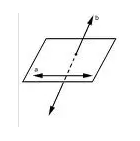
    I’m using the definition of skew that says “Skew lines lie on separate planes, they are not parallel, they do not intersect” — as illustrated here:

    skew lines

    Poets love skew links between thoughts, for the leaps they embody:

    Li Po drowning, drunk, into the moon reflected in the Yellow River. Crazy? Crazed. Amusing? Mused.

    **

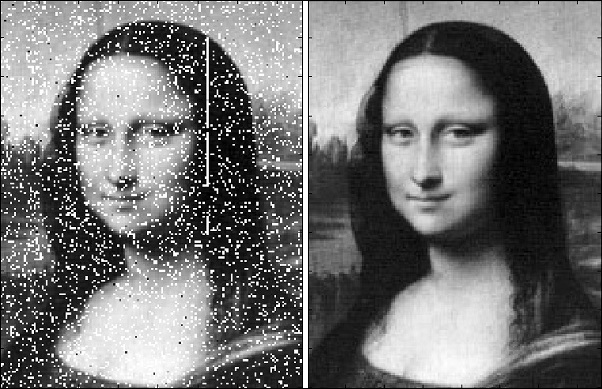
    Bryan Alexander alerted me to the bead game matter. You may need to read the whole article, The Codes of Modern Life by Alex Riley to understand how Reed-Solomon codes allow for the nifty correction of errors in complex messages:

    rs-mona-lisa

    but what led Bryan to cc me in on the discussion was the passing mention that DNA-stored data could best be protected bu encasing the DNA encapsulated in “microscopic beads of glass” — cue the Glass Bead Game by Hermann Hesse:

    DNA in glass beads

    **

    While on the subject of genetics, it’s worth recalling once again that John Holland, the “father” of genetic algorithms, once told interviewer Janet Stites:

    I’ve been working toward it all my life, this Das Glasperlenspiel. It was a very scholarly game, starting with an abacus, where people set up musical themes, then do variations on it, like a fugue. Then they’d expand it to where it could include other artistic forms, and eventually cultural symbols. It became a very sophisticated game for setting up themes, almost as a poet would, and building variations as a composer. It was a way of symbolizing music and of building broad insights into the world.

    If I could get at all close to producing something like the glass bead game I can’t think of anything that would delight me more.


    Switch to our mobile site