zenpundit.com » poetry

Archive for the ‘poetry’ Category

On the prophetic & predictive via David Degner’s Egypt

Thursday, August 22nd, 2013

[ by Charles Cameron — the first O of OODA, as one photographer applied it to Mubarak’s destiny ]
.

Angel's Trumpet, Brugmansia arborea, image credit BH&G

.

As you all know, I am fascinated by the intersection of the poetic (sacramental, irrational, magical, pre-scientific) and the prosaic (secular, rational, mundane, scientific) worldviews, so ably captured by John Donne with the four words “round earth’s imagin’d corners” in one of his Holy Sonnets:

At the round earth’s imagin’d corners, blow
Your trumpets, angels, and arise, arise
From death, you numberless infinities
Of souls, and to your scatter’d bodies go…

One such intersection comes where prophecy meets prediction.

**

I was accordingly interested when Erin Cunningham pointed us to these two remarkable tweets, the first from earlier today:

and the second, to which the first refers, from two weeks ago:

I believe that second tweet permits photographer David Degner the (secular) rank of Prophet — but it would take, in my view, an entity with the secular rank of Angel, Recording Angel to be precise, to give us an accurate and complete timeline of mental, communications and physical events here, from the first stirring of an idea in the mind of some Egyptian judge, general or staffer through multiple discussions, decisions and levels of implementation, to today’s outcome.

One might even say that the IC with its all source intel aspires to, but will never quite obtain, such an angelic function… while for those of us wholly reliant on open source intelligence, observation and intelligent extrapolation (in the case of Degner) and keeping one’s eye on appropriate parts of the twitterstream (for the rest of us) seems to be the way to go.

**

How foolish of me, therefore, to be unaware of the tweets and works of Degner, whose photographs of Churches looted and burnt in Upper Egypt and current project on Liminal states in Egyptian Maharagan music are both of keen interest to me.

Egypt, from the prosaic to the poetic — our world is rich in both.

Concerning two Lifebuoys

Friday, July 26th, 2013

[ by Charles Cameron — nothing strategic or serious, just dropping a little beauty your way ]
.

Here’s a DoubleQuote that doesn’t fit my usual graphic format, but that gives me enough delight that I thought I’d post it anyway.

It all begins with a friend pointing me to this video — it’s quite beautiful, it’s a commercial, and it’s promoting a Lifebuoy campaign, in their words, “to help reduce the deaths of two million children before their fifth birthday” by means of their “handwashing behaviour change programmes”:

Okay: so I like the video very much, but I know nothing about Lifebuoy, their politics, their labor practices, the things that might make me hesitate to be quite as delighted by the video as I might be if there wasn’t a massive “international” tied in with the short and moving narrative. So I googled “Lifebuoy”…

**

And found this poem, which has nothing to do with soap but a great deal to do with telling a short and beautiful story — albeit with the simplicity of words, of poetry:

Tarantulas on the Lifebuoy
–Thomas Lux
.

For some semitropical reason
when the rains fall
relentlessly they fall

into swimming pools, these otherwise
bright and scary
arachnids. They can swim
a little, but not for long

and they can’t climb the ladder out.
They usually drown—but
if you want their favor,
if you believe there is justice,
a reward for not loving

the death of ugly
and even dangerous (the eel, hog snake,
rats) creatures, if

you believe these things, then
you would leave a lifebuoy
or two in your swimming pool at night.

And in the morning
you would haul ashore
the huddled, hairy survivors

and escort them
back to the bush, and know,
be assured that at least these saved,
as individuals, would not turn up

again someday
in your hat, drawer,
or the tangled underworld

of your socks, and that even—
when your belief in justice
merges with your belief in dreams—
they may tell the others

in a sign language
four times as subtle
and complicated as man’s

that you are good,
that you love them,
that you would save them again.

**

The video and the poem are very different — yet closely connected, coming to me as they did, hot on one another’s heels the other day. I celebrate them here as an informal DoubleQuote, with gratitude to Google.

May I recommend, to myself when my ship comes in and to others: Thomas Lux, New and Selected Poems: 1975-1995.

The dervish and the gas mask

Monday, June 10th, 2013

[ by Charles Cameron — wall art, sufism and poetry in Istanbul ]
.


.

I wasn’t altogether sure, when Zeynep Tufekci tweeted a stenciled image of a whirling dervish (above, right) the other day, that the dervish was in fact wearing a gas mask. Just the fact that the dervish was showing up on a wall during the events in Turkey was interesting to me — and all the more so since Zeynep pointed out that the accompanying slogan Sen de GelCome, Come Whoever you are is from Jalaluddin Rumi, the great Sufi poet and founder of the Mevlevi order of whirling dervishes.

As the photo of a dervish whirling in the park (above, left) shows, however — and I only saw it today — the stencil is indeed the iconization — in protest art — of a dervish in gas mask in real-time Istanbul.

There’s insight to be had there.

**

The version of Rumi’s poetry that I first ran across lo these many years ago, and to which I return:

AJ Arberry, tr, Mystical Poems of Rumi 1
AJ Arberry, tr, Mystical Poems of Rumi 2

Rumi’s prose:

AJ Arberry, tr, Discourses of Rumi

Rumi’s poetry in the versions that have made this thirteenth century Afghan-born, Persian-speaking resident of Turkey “the best-selling poet in America”:

Coleman Barks, Rumi: The Big Red Book

Rumi’s life, as told within Sufi tradition:

Idries Shah, The Hundred Tales of Wisdom

Rumi’s life, teachings and poetry, in contemporary context:

Franklin D. Lewis, Rumi: Past and Present, East and West

Rumi explored with scholarship and depth:

Anne-Marie Schimmel, The Triumphant Sun
Anne-Marie Schimmel, Rumi’s World
William C Chittick, The Sufi Path of Love
Fatemeh Keshavarz, Reading Mystical Lyric

**

Come, Come Whoever you are

A feast of form in my twitter-stream today

Sunday, June 2nd, 2013

[ by Charles Cameron — forms & patterns, pattern recognition & creative leaps, creative leaps & connecting dots, connecting dots & node-and-edge mapping — node-and-edge mapping, link charts and Sembl-HipBone games ]
.

.

There’s no “actionable intelligence” in that tweet, but it recognizes a pattern, it makes a fine creative leap. And given the chance, that’s something bright minds do naturally, and enjoy doing, and is away more important than we think.

Yestedrday I was watching Manhunt pretty closely for an upcoming Zenpundit review, and noticed that some of the most significant quotes in the film were absent from CNN’s transcript. One gap I noticed had to do with the descriptions of the analytic process, and in particular some of the things Cindy Storer said. I’ll quote this one, which goes to the heart of the matter, but there’s plenty more left for me to chew over with you later. Here she goes:

Even in the analytical community there’s a relatively smaller percentage of people who are really good at making sense of information that doesn’t appear to be connected. So that’s what we call pattern analysis, trying to figure out what things look like. And those people, you really need those people to work on an issue like terrorism, counternarcotic, international arms trafficking, because you’ve got bits and pieces of scattered information from all over the place, and you have to try to make some sense of it. … That takes this talent, which is also a skill, and people would refer to it as magic — not the analysts doing it, but other people who didn’t have that talent referred to it as magic.

That’s a pretty exact description of what the Sembl game will eventually teach people, once it comes out of the museum prototype and onto the web — but let’s back it up with a quick quote from Wittgenstein:

A surveyable representation produces precisely that kind of understanding which consists in ‘seeing connections’ [Zusammenhänge sehen]. Hence the importance of finding and inventing connecting links. Hence the importance of finding and inventing intermediate links.

That’s from Philosophical Investigations, 122, and it’s a higher altitude / more abstract view — but it’s also the very heart of network thinking, seeing processes not just in terms of isolated nodes but of the connections between them.

**

Seeing connections — connecting the dots — happens in lines and leaps. That is to say, it can happen according to the usual linear way of thinking, the dogged 99% of perspiration that people talk about — or according to the far less common lateral move or creative leap, which moves by analogy, which is to say by pattern recognition, by the perception of similarities of form.

That’s the 1% we call inspiration. That’s the magic.

**

So a whole lot of patterning was going on in my twitter-stream today, and I thought I’d show you.

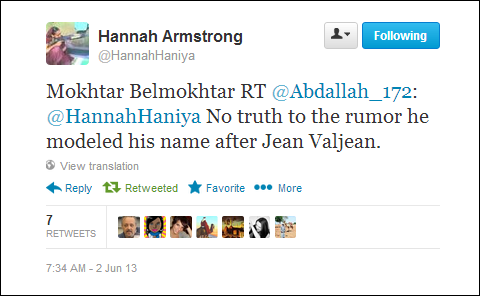
First, there was the parallel between the names Mokhtar Belmokhtar and Jean Valjean (above). If you’re hunting either fellow, the parallelism isn’t going to yield a useful clue — but the mode of recognition is what matters, and the reason its such a rare mode is precisely because it’s playful. It plays with forms — in this case, the forms of the two names — without regard for practicality.

And yet this playful spirit is what brought us Weil‘s conjecture and Pierre Deligne‘s Abel Prize, and the Taniyama-Shimura conjecture and Wiles‘ proof of Fermat’s Last Theorem.

Serious playfulness is key… to serious, magical breakthroughs. In any and all domains.

*

With that in mind, here are the rest of the patterns I recognized in todays feed.

Let’s start with self-reference, which can hardly get more succinct than the hackers hacked:

There’s also a self-referential paradox at work in the question of a defendant appearing in his own defense — something that gives judges pause, because they see how tightly the serpent is chasing its own tail. Defendant defends self, From Raff Pantucci:

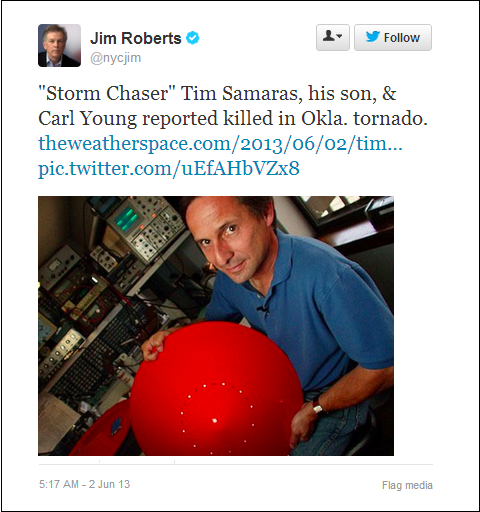
The saddest self-reference of the morning’s tweets was this one, which could be encapsulated as storm-chaser chased by storm:

Even tragedy can take self-referential form.

**

But lets move on to Turkey, which provided a rich dividend:

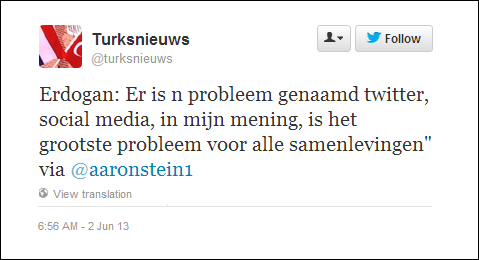
There was this problem:

Turkish I couldn’t read, Dutch I can more or less make out — but for an English tweet making the same point let’s go to Zeynep Tufekci, who has expertise in both matters Turkish and matters Internet, and tweets about Erdogan disapproving of tweeting:

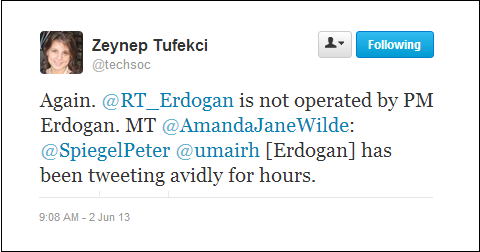
Tufekci again, this time catching an even neater self-reference which doesn’t quite pan out — because, as she says, PM Erdogan is not the same as @RT_Erdogan:

**

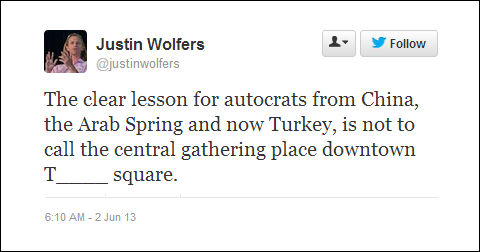
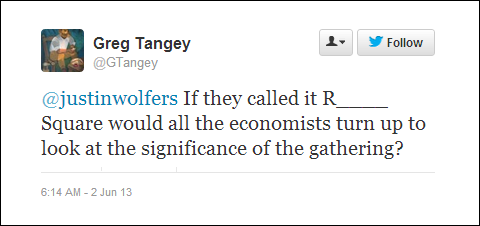
While we’re on Turkey, this tweet about Tienanmen, Tahrir and Taksim Squares gave us another example of a bright mind catching a hint of pattern…

And what a neat rejoinder!

All of the above is quite useless, entirely playful — and of deep interest if creativity and insight matter

**

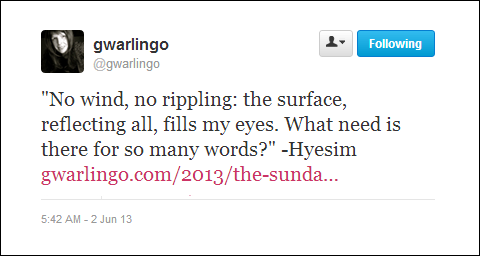
Finally, I’d like to go someplace quiet and bathe in peace. This tweet, featuring a poem by a Korean zen master, does the trick nicely:

AN appreciative bow to Gwarlingo for that one…

Glass Beads and Complexity

Monday, May 27th, 2013

[ by Charles Cameron — achieving something like closure on a post I started for Adam Elkus here, with a side dish along the way here ]
.

.

It’s astonishing to me how closely complexity science is related to Hermann Hesse‘s Glass Bead Game.

Adam Elkus recently pointed those who follow him to Cosma Rohilla Shalizi, Methods and Techniques of Complex Systems Science: an Overview, and just a quick dip there gave me the graphic I’ve put at the head of this post, together with this quote about “patterns” as Shalizi understands that term:

I mean more or less what people in software engineering do: a pattern is a recurring theme in the analysis of many different systems, a cross-systemic regularity. For instance: bacterial chemotaxis can be thought of as a way of resolving the tension between the exploitation of known resources, and costly exploration for new, potentially more valuable, resources (Figure 1.2). This same tension is present in a vast range of adaptive systems. Whether the exploration-exploitation trade-off arises among artifcial agents, human decision-makers or colonial organisms, many of the issues are the same as in chemotaxis, and solutions and methods of investigation that apply in one case can profitably be tried in another. The pattern “trade-off between exploitation and exploration” thus serves to orient us to broad features of novel situations. There are many other such patterns in complex systems science: “stability through hierarchically structured interactions”, “positive feedback leading to highly skewed outcomes”, “local inhibition and long-rate activation create spatial patterns”, and so forth.

**

Let’s start with patterns. The “people in software engineering” Shalizi mentions gleaned their use of the term “pattern” from the architect Christopher Alexander, author of the extraordinary, seminal book A Pattern Language, which in turn has hugely influenced computer science. Alexander distilled the essence of his thinking in his “Bead Game Conjecture”:

That it is possible to invent a unifying concept of structure within which all the various concepts of structure now current in different fields of art and science, can be seen from a single point of view. This conjecture is not new. In one form or another people have been wondering about it, as long as they have been wondering about structure itself; but in our world, confused and fragmented by specialisation, the conjecture takes on special significance. If our grasp of the world is to remain coherent, we need a bead game; and it is therefore vital for us to ask ourselves whether or not a bead game can be invented.

Manfred Eigen, Nobel laureate in Chemistry, called his book with Ruth Winkler-Oswatitsch Laws of the Game — and it deals with molecular biology, cellular automata, game theory, and games. But not just that — it is specifically written with Hesse’s concept in mind:

We hope to translate Hermann Hesse’s symbol of the glass bead game back into reality.

While we’re on about cellular automata, what about Stephen Wolfram? I don’t know that he talks about the Glass Bead Game himself, but at least three people talk about Wolfram’s book, A New Kind of Science, and/or his search engine, Wolfram Alpha as being strongly analogous to Hesse’s game — Jason Dyer, Graeme Philipson, and most recently, Mohammed AlQuraishi. Here’s a key para from Quraishi’s piece:

I think the Game is an intriguing concept, and I think it may one day be realized. In fact I think we are already on our way toward realizing it. In the simplest and most general sense, mathematics and programming languages allow us to formalize all knowledge. Contenders for the language of the Game already exist, at least in principle. But we are further along than that. Search engines like Wolfram Alpha have already begun the process of formalizing diverse pieces of knowledge, unifying them in a single medium, and providing the means to connect and reason about them. A repeated example in the book, the mapping of musical compositions to mathematical formulas or even historical events, is eminently doable within Wolfram Alpha. Much remains to be done of course, and there is no “game” yet that can be played across the vast sea of all human knowledge, but some enterprising individuals have already gotten started on creating it.

And then there’s John Holland, the “father of genetic algorithms”. Holland told an interviewer:

I’ve been working toward it all my life, this Das Glasperlenspiel. It was a very scholarly game, starting with an abacus, where people set up musical themes, then do variations on it, like a fugue. Then they’d expand it to where it could include other artistic forms, and eventually cultural symbols. It became a very sophisticated game for setting up themes, almost as a poet would, and building variations as a composer. It was a way of symbolizing music and of building broad insights into the world.

If I could get at all close to producing something like the glass bead game I can’t think of anything that would delight me more.

**

I’ve been working on a playable variant on the Glass Bead Game too, for twenty years quite consciously, and more if you count subterranean stirrings. And I don’t think glass beads, or stones, or chess or go pieces, or beads on an abacus, or strings of ones and zeros, or cells in an agent-based model for that matter, are the way to go. Which is not to say those approaches shouldn’t be tried, or don’t have remarkable things to teach us. I just don’t believe they give us quite what Hesse envisioned:

a direct route into the interior of the cosmic mystery, where in the alternation between inhaling and exhaling, between heaven and earth, between Yin and Yang, holiness is forever being created.

I think what’s important in Hesse’s game is that concepts that humans can grasp should reveal their stunning interrelations to heart and mind. And for that reason, the “moves” in my games [Hipbone, and more recently Sembl] consist of concepts — musical, verbal, visual, mathematical — and the links, the analogies, the “semblances” between them.

**

And thus the game is a search for analogies.

The human mind must inevitably perform what Shalizi calls the “trade-off between exploitation and exploration”. Some thoughts are proximate to others, they can be developed without any special insight by regular “linear” thinking. We do this every day, every minute — but it is not particularly revelatory. It doesn’t solve thorny problems, much less create beauty. There is another mode of thinking, however, that leaps between thoughts that are not so “close” but are nevertheless deeply related. To leap the apparent distance between such deeply related thoughts, we deploy analogy and creative thinking, and that is where the aha! of revelation occurs.

So I would suggest there is a close analogy here with the point Shalizi is making with the diagram atop this post. The human mind, to slightly paraphrase Shalizi’s caption, will “exploit the currently-available patch of food” for thought by linear, inside-the-patch thinking, but at full stretch it will also “explore, in hopes of ?nding richer patches elsewhere” — the “elsewhere” being attained precisely by “creative leaps” — by seeing semblances, patterns, analogies.

And to return to my earlier post, Thinking outside the cocoon, of which this post is a continuation, and perhaps the completion….

Shalizi’s “random walk” is thus also the archangel’s “zig-zag wantonness” in that great poem, Tom O’Roughley — when William Butler Yeats asks, “how but in zig-zag wantonness / could trumpeter Michael be so brave?” and writes, “wisdom is a butterfly / and not a gloomy bird of prey”…


Switch to our mobile site