zenpundit.com » poetry

Archive for the ‘poetry’ Category

A hop and a skip, YouTube-style

Saturday, May 25th, 2013

[ by Charles Cameron — on a brief random walk through YouTube, an ambulation for a sedentary soul — nothing serious, I promise ]
.

Back when I was a wee lad at Oxford there was another wee lad, also of a poetic disposition, named Heathcote Williams. For some reason, the other evening I stumbled on a clip of Heathcote performing the role of a psychiatrist in a movie I haven’t seen, but will probably keep an eye out for.

Here’s that (somewhat ob)scene:

Well, I’m the nomadic type, and my eye somehow strayed from there to this:

Okay? I get the sense I’m on a roll here, Salma Hayek is compellingly beautiful, and so I compulsively gamble away a few more minutes of my precious time, and find… You’ll forgive me, I hope, and see this clip through to the end, because in its own light-hearted way it’s about miracles.

And as you know, I have theological interests:

**

So that was my evening’s delectation a couple of days ago, delivered here today for yours.

If, however, you are willing to take a grander leap into anti-monarchical, pro-poetic, anti-theological polemic, you might take a look at Heathcote’s fiery account of Shelley, his volatile predecessor at Oxford, in seven parts beginning on YouTube here: Shelley at Oxford.

Heathcote takes the liberty of speaking his mind, and consequently several of my own sacred cows get scorched to steak along the way — you have been warned.

Thinking outside the cocoon…

Thursday, May 16th, 2013

[ by Charles Cameron — on caterpillars, butterflies, psyche and the alephs of Georg Cantor, with a glance at the vertiginous idea it might be “boxes all the way up and down”… ]
.

Let’s get the science — which is quite fascinating — taken care of first. Here’s our best current visualization of how a caterpillar, after crafting its cocoon, prepares to become a butterfly:

**

Words can sometimes tell us some things that images can’t — or explain things to parts of us that simply cannot comprehend them visually — so here for parallel processing is an account of part of the same business from Scientific American:

How does a caterpillar rearrange itself into a butterfly? What happens inside a chrysalis or cocoon?

First, the caterpillar digests itself, releasing enzymes to dissolve all of its tissues. If you were to cut open a cocoon or chrysalis at just the right time, caterpillar soup would ooze out. But the contents of the pupa are not entirely an amorphous mess. Certain highly organized groups of cells known as imaginal discs survive the digestive process. Before hatching, when a caterpillar is still developing inside its egg, it grows an imaginal disc for each of the adult body parts it will need as a mature butterfly or moth—discs for its eyes, for its wings, its legs and so on. In some species, these imaginal discs remain dormant throughout the caterpillar’s life; in other species, the discs begin to take the shape of adult body parts even before the caterpillar forms a chrysalis or cocoon. Some caterpillars walk around with tiny rudimentary wings tucked inside their bodies, though you would never know it by looking at them.

Once a caterpillar has disintegrated all of its tissues except for the imaginal discs, those discs use the protein-rich soup all around them to fuel the rapid cell division required to form the wings, antennae, legs, eyes, genitals and all the other features of an adult butterfly or moth.

**

It’s just possible that the bear’s ability to “die” in the winter and “be reborn” in spring gave use the original cirumpolar bear cult — and more generally, a propensity to believe that resurrection from the dead might be a physical, existential human possibility.

Humans watch animals pretty diligently — my old friend and mentor Wallace Black Elk once told me:

We watch the deer, and when they’re sick they know which plant is their aspirin: they eat that green medicine, and drink water. So we have deer medicine. We don’t need the mass-produced kind.

I don’t have the exact quote, but he also observed somewhat wryly that scouts from pharmaceutical companies used to watch him and see what medicines he used, in much the same way…

And if there’s any natural process that humans have watched with equivalent metaphysical interest to that which they may have shown in observing the bear’s pattern of hibernation and return, it would have been the process of metamorphosis in butterflies — whose name in Greek, psyche, is also the word for soul.

**

WB Yeats had a sense of the butterfly transcending both day-to-day human logic and death itself, when he wrote in his poem Tom O’Roughley:

‘Though logic choppers rule the town,
And every man and maid and boy
Has marked a distant object down,
An aimless joy is a pure joy,’
Or so did Tom O’Roughley say
That saw the surges running by,
‘And wisdom is a butterfly
And not a gloomy bird of prey.

adding just a few lines later:

What’s dying but a second wind?

**

What I’d like to do here is to take us from the plodding science of linear thought to which Yeats was (among other forms of linearity) objecting, towards the science — and poetry — of complexity, of nuance.

And I’d like to do it by skipping a couple of thoughts like a stone across water, inviting you to watch the ripples…

These are the leaps that connect the dots.. the creative leaps. And some leaps, it seems to me, are bigger and more demanding than others.

**

Is the leap from cocoon to butterfly in Hutching‘s quote really quite a huge leap? It certainly keeps some of our best scientists busy uncovering its hidden secrets. And the leap from butterfly to tornado, that Lorenz made? That would appear to me to be a larger leap, requiring a different mode of perception. And skipping from Hutchings to Lorenz, can we skim our stone of thought even further?

Putting two and two together is one thing: imagining “aleph null” for the first time, as Cantor did, that would be something else altogether. From two to four, I’m tempted to say, is a quantitative leap, while the imaginative leap from four, ten, or ten thousand to the alephs is qualitative.

How should we recognize and connect widely separated — yet deeply entangled — dots? What would prove to be the richest and most profound of creative leaps? Is there a move that will take us not just out of this box into the box it came in — but out of a whole matrioshka nest of boxes?

Those are the questions in my sandbox about now.

**

When we next meet, I’ll try to tie them in with this diagram that Adam Elkus recently pointed us to —

and with Hermann Hesse‘s Glass Bead Game for good measure.

Of Alice, Angels and Apsaras

Wednesday, May 15th, 2013

[ by Charles Cameron — squeezed between the space of astronomers and the paradise of the believers, is there yet room for the dancing play of poetry, music and imagination? ]
.

My first question for you today would be — do you believe in Alice?

And further to that, do you believe in the Red Queen?

**

Two things collided to cause me to write this post today. First, Emptywheel opened her blog post on Putin’s outing of an American spy today with a quote from Lewis Carroll:

‘I declare it’s marked out just like a large chessboard!’ Alice said at last. ‘There ought to be some men moving about somewhere–and so there are!’ she added in a tone of delight, and her heart began to beat quick with excitement as she went on. ‘It’s a great huge game of chess that’s being played–all over the world -– if this is the world at all, you know. Oh, what fun it is!’

I can’t really ignore Lewis Carroll when he crops up in my morning feed like that: he’s a Christ Church man and a poet, as I am, and it would be rude of me to ignore him. And besides, what he’s on about here is the world-as-game concept, which is never far from my mind — hence my inclusion of that question about the Red Queen.

**

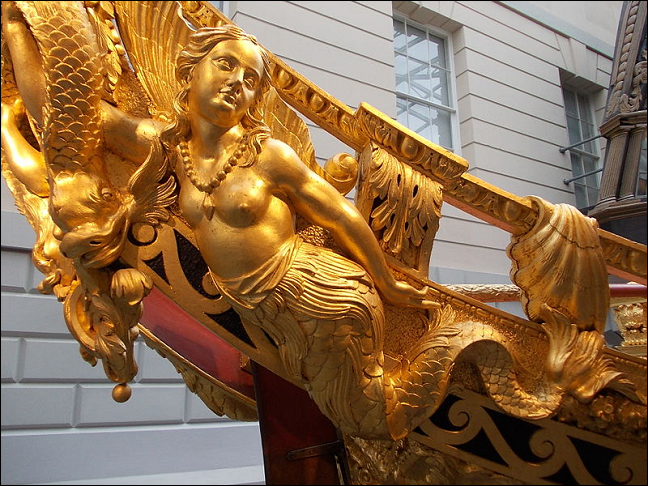
And second, mermaids.

.

It gets more interesting, you see. Because what collided with that first question was a conversation @khanserai aka Humera Khan was having with @mujaahid4life aka Abdallah via Twitter, in which the Harry Potter books were discussed and the topic of unimaginative clerical fatwas on games and works of fiction came up. At which point, Abdallah pointed us all to this now-archived fatwa regarding the permissibility of eating mermaid flesh:

Ruling on eating mermaids

A mermaid is a creature that lives in water and looks like a human. As to whether it really exists or it is a mythical being, that is subject to further discussion.

It says in a footnote in al-Mawsoo’ah al-Fiqhiyyah (5/129): From the modern academic resources that are available to us, it may be understood that the mermaid, which is called Sirène in French, is a mythical creature that is described in fairy tales as having an upper body like a woman and a lower half like a fish.

See the French Larousse encyclopédique on the word Sirène.

The encyclopaedia goes on to say: The widespread notion in ancient times was that the wonders and animals of the sea were more and greater than the wonders of dry land, and that there was no kind of animal in the sea that did not have a counterpart on land. This was confirmed by Prof. Muhammad Fareed Wajdi in his encyclopaedia, quoting from modern academic sources. See: Daa’irah Ma’aarif al-Qarn al-‘Ishreen: Bahr – Hayawiyan. End quote.

Al-Dumayri said in Hayaat al-Haywaan al-Kubra: Mermaid: it resembles a human but it has a tail. Al-Qazweeni said: Someone brought one of them in our time. End quote.

Many of the fuqaha’ mentioned mermaids and differed on the ruling concerning them. Some of them said that they are permissible (to eat) because of the general meaning of the evidence which says that whatever is in the sea is permissible. This is the view of the Shaafa’is and Hanbalis, and is the view of most of the Maalikis and of Ibn Hazm and others. And some of them regarded it as haraam because it is not a kind of fish. This is the view of the Hanafis and of al-Layth ibn Sa’d.

Ibn Hazm (may Allaah have mercy on him) said in al-Muhalla (6/50): As for that which lives in the water and cannot live anywhere else, it is all halaal no matter what state it is in, whether it is caught alive and then dies, or it dies in the water and then floats or does not float, whether it was killed by a sea creature or a land animal. It is all halaal to eat, whether it is the pig of the sea (i.e., a dolphin), a mermaid, or a dog of the sea (i.e., shark) and so on. It is halaal to eat, whether it was killed by an idol-worshipper, a Muslim, a kitaabi (Jew or Christian) or it was not killed by anyone.
What’s outside the box?

And it goes on… ending, mercifully:

And Allaah knows best.

Sometimes I think those might be my favorite words evvah!

**

Are mermaids real enough for religious scholarship to address them?

Is Alice?

John Daido Loori Roshi, late zen master and abbot of the Mountains and Rivers Order’s Mt Tremper abbey, once gave a teisho using a passage from Alice as his koan:

Many Zen koans contain references to myths and folktales of ancient India, China, and Japan. Since Westerners generally are not familiar with these stories, koan study without extensive background information is often a frustrating and exasperating process.

In this dharma discourse, Abbot John Daido Loori fashions a koan, complete with pointer and capping verse, from a classic of children’s literature, Lewis Carroll’s Alice in Wonderland. The koan revolves around Alice’s encounter with a caterpillar who explains the magical properties of a special two-sided mushroom that to Alice’s eyes appears perfectly round. Alice’s struggles with this dilemma make for a stimulating story that mirrors the conflicts and dualities we face in our everyday life.

You can read it here.

**

All of which brings me to the question of the place of deep imagination in a sometimes shallow world.

Alice, do you believe in her? Mermaids and Macbeth mean something to sailors and theater-folk, respetively. Angels? If angels, then the djinn, too? Christian scripture speaks for the existence of one, the Qur’an of both — is one more probable, more real, perhaps, than the other?
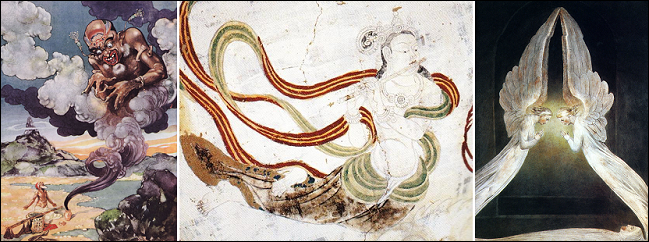
And what of the gandharvas and apsaras — middle panel — the celestial musicians and airy dancers who move to their music? Is there any poet who can claim never to have sensed them?

**

And thus we come to Robert Graves and the muse as he depicts her, in his book The White Goddess, and in many poems such as this:

In Dedication
.

Your broad, high brow is whiter than a leper’s,
Your eyes are flax-flower blue, blood-red your lips,
Your hair curls honey-colored to white hips.

All saints revile you, and all sober men
Ruled by the God Apollo’s golden mean;
Yet for me rises even in November
(Rawest of months) so cruelly new a vision,
Cerridwen, of your beatific love
I forget violence and long betrayal,
Careless of where the next bright bolt might fall.

**

But here the waters are getting deeper…

History doesn’t rhyme — it swears

Friday, May 10th, 2013

[ by Charles Cameron — finding both rhyme and obscenity here, to be honest — San Salvador then, Mexico today ]
.

**

I once had the privilege of hearing Carolyn Forché read her poems.

You can read and hear her reading the prose poem from which that excerpt is taken here — for richer background on her experiences in El Salvador, see her extraordinary essay El Salvador: An Aide-Mémoire in Granta, or find a copy of The American Poetry Review for July/August 1981, pp. 3-7.

Sources:

  • Carolyn Forché, The Country Between Us
  • Sunil S, El Narco and the Jihad in Pragati, illus credit: El cartel de San Luis
  • **

    I know, in the title of this post I’m conflating a quote attributed to Mark Twain, “History doesn’t repeat itself, but it rhymes”, with Bob Dylan‘s “Money doesn’t talk, it swears”. So be it.

    As Dylan also once said: “I said that.”

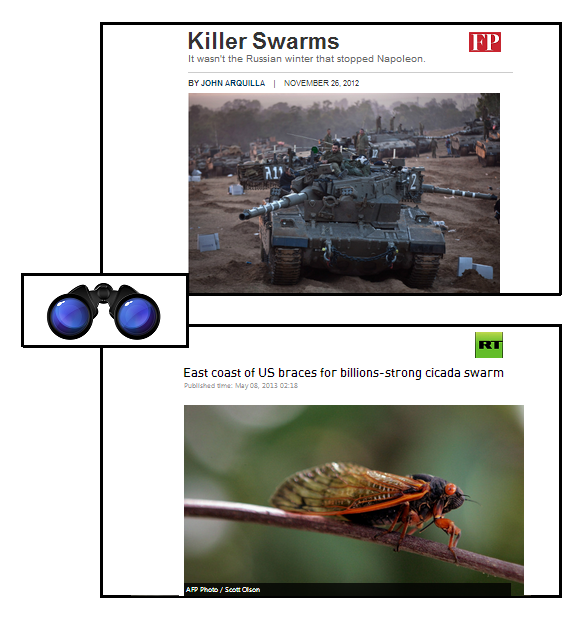
    Paging John Arquilla & David Ronfeldt

    Thursday, May 9th, 2013

    [ by Charles Cameron — on the West Coast ]
    .

    Sources:

  • John Arquilla, Killer Swarms
  • RT, East coast of US braces for billions-strong cicada swarm
  • **

    Exodus 10. 3-6:

    And Moses and Aaron came in unto Pharaoh, and said unto him, Thus saith the Lord God of the Hebrews, How long wilt thou refuse to humble thyself before me? let my people go, that they may serve me. Else, if thou refuse to let my people go, behold, to morrow will I bring the locusts into thy coast: And they shall cover the face of the earth, that one cannot be able to see the earth: and they shall eat the residue of that which is escaped, which remaineth unto you from the hail, and shall eat every tree which groweth for you out of the field: And they shall fill thy houses, and the houses of all thy servants, and the houses of all the Egyptians; which neither thy fathers, nor thy fathers’ fathers have seen, since the day that they were upon the earth unto this day.

    Qur’an, 7. 133:

    So We let loose upon them the flood and the locusts, the lice and the frogs, the blood, distinct signs; but they waxed proud and were a sinful people.

    And the Eastern seaboard of the US is way more sinful than the ill-reputed West?

    **

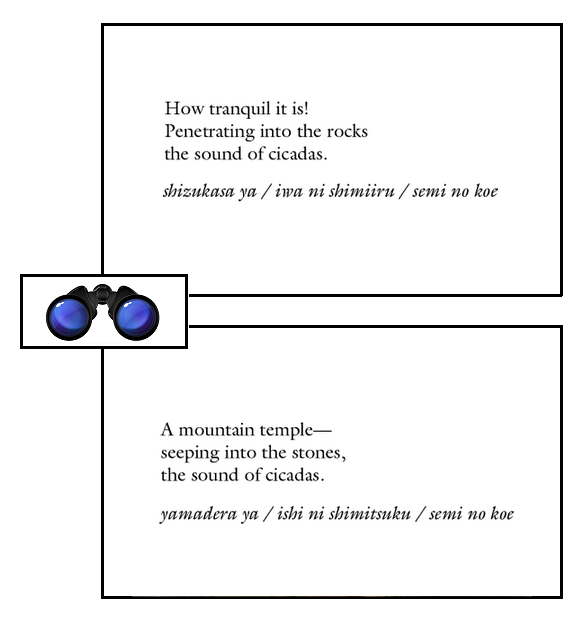
    For a different view, we turn to Basho. Here are the earlier and later forms of one of his poems:

    Source:

  • Eleanor Kerkham, ed., Matsuo Bashô’s Poetic Spaces: Exploring Haikai Intersections

  • Switch to our mobile site