zenpundit.com » poetry

Archive for the ‘poetry’ Category

Ancestral voices prophesying war

Thursday, May 2nd, 2013

[ by Charles Cameron — “And ‘midst this tumult Kubla heard from afar, Ancestral voices prophesying war!” ]
.

At 36 minutes and 12 seconds, this video of Bob Dylan‘s Masters of War slowed down “800%” — i.e. to eight times its normal length — may or may not be something you find time for.

It’s eeeeerie, I can tell you that much. And I’m not the only one to post it either — Wired featured it in their birthday greeting to Dylan last year.

If you have the meditative patience for Tibetan chanting, you might want to give Dylan at 1/8th speed a try.

**

Sources:

  • Coleridge, Kubla Khan
  • Dylan, Masters of War, eight versions…
  • Of Omar Hammami — and dying more than once?

    Friday, April 26th, 2013

    [ by Charles Cameron — dying more than once in hadith, in press reports, in Rumi and John of the Cross ]
    .

    The American mujahid in Somalia, Omar Hammami [see his Wikipedia bio], who has been tweeting back and forth with various “U.S. national security professionals” [see this Wired piece], reported yesterday that he had been shot in the neck “by Shabab assassin” [see this piece by Clint Watts at Selected Wisdom]. JM Berger, who has been in close correspondence with him, tweeted:
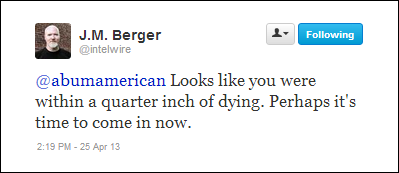
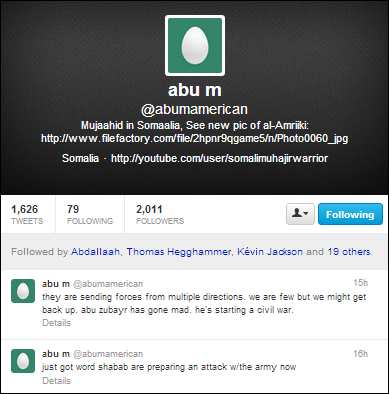
    Omar has indeed been in dispute with Shabab, the group he originally joined [see this LWJ post], and his own most recent tweets, sent eighteen hours ago as I write this, were these:
    Omar Hammami may or may not still be among us, although recent reports suggest with caveats that he survived the attack…
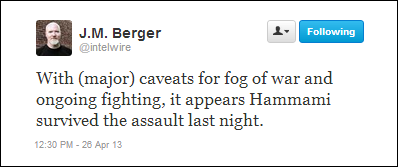
    That’s the background.

    **

    From my point of view, the most interesting discussion anyone had with Hammami in the last day or two was this exchange between Hammami and Jeremy Scahill, whose book Dirty Wars has just hit the stands:
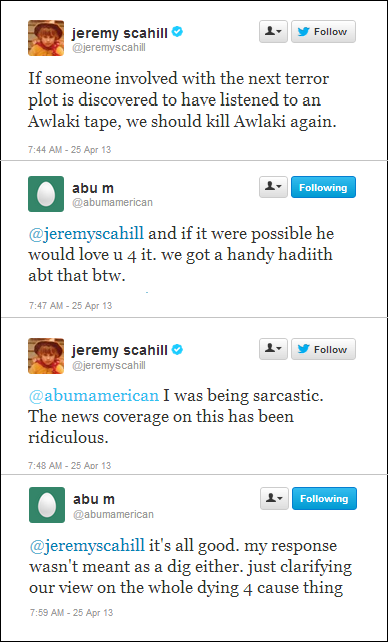
    Characteristically, Omar has a light tone — yet speaks to the issue in the context of his theology…

    **

    There are, it seems to me, basically three ways that one might imagine dying more than once. The first — and it’s the one Hammami himself was referring to — is found in the hadith in Bukhari [Volume 4, Book 52, Number 54]:

    Narrated Abu Huraira:

    The Prophet said, “… By Him in Whose Hands my life is! I would love to be martyred in Allah’s Cause and then get resurrected and then get martyred, and then get resurrected again and then get martyred and then get resurrected again and then get martyred.

    Let the intensity of that hadith — and Hammami’s reference to it, a little earlier [?] on the same day he was shot — sink in.

    **

    The second, “secular” way to have “died” more than once is through faulty intelligence and / or journalism — and that’s what JM Berger is on about when he tweets:

    Indeed, such reports led to the 2011 release of a nasheed in his name, though he may not have sung it himself:

    Now Hammami has apparently resurfaced, with two new a cappella songs that appeared on the web earlier this week. In “Send Me A Cruise,” Hammami begs to be plastered by a tank shell, a drone attack or a cruise missile, so that he can martyred like some of the heroes he names, including Al Qaeda leaders Abu Musab al-Zarqawi and Abu Laith al-Libi. In his trademark tuneless drone, he claims “an amazing martyrdom” is what he “strive(s) for and adore(s).” “Send me a cruise like Maa’lam Adam al Ansari/ And send me a couple of tons like Zarqawi,” chants Hammami. “Send me four and send me more, that’s what I implore.”

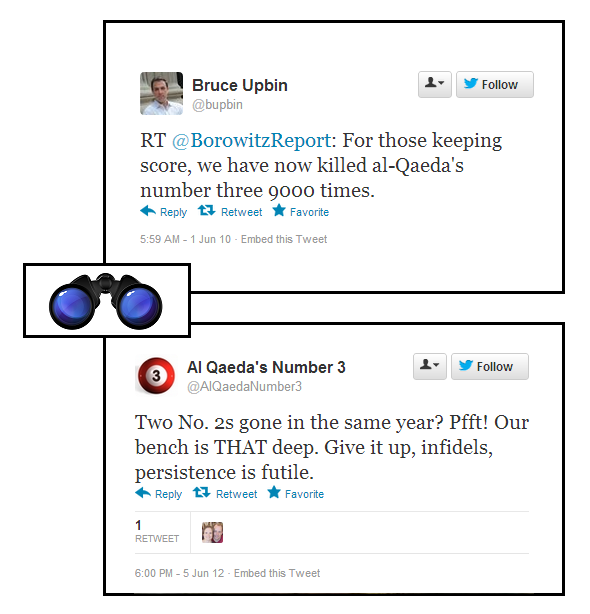
    More generally, false reports of AQ leaders dying hither and yon have become so common that I posted a DoubleQuote about it last year:
    **

    Here’s where it get’s most interesting…

    For a third view of dying more than once, we can turn to the mystical tradition. Thus the Prophet Muhammad is credited with the hadith “Die before death” by Jalaluddin Rumi, who in his Mathnawi, VI, 3837-38 writes:

    The mystery of “Die before death” is this, that the prizes come after dying (and not before).
    Except dying, no other skill avails with God, O artful schemer.

    The death before death here is the death of the nafs, the “self” — the true martyrdom of the greater jihad. As Peter Lamborn Wilson puts it in his Introduction to the Sufi Path:

    Man’s authentic existence is in the Divine; he has a higher Self, which is true; he can attain felicity, even before death (“Die before you die,” said the Prophet). The call comes: to flight, migration, a journey beyond the limitations of world and self.

    Of course, St John of the Cross wrote in much the same vein:

    This life I live in vital strength
    Is loss of life unless I win You:
    And thus to die I shall continue
    Until in You I live at length.
    Listen (my God!) my life is in You.
    This life I do not want, for I
    Am dying that I do not die.
    A Boston DoubleQuote, via Jim Friedrich

    Saturday, April 20th, 2013

    [ by Charles Cameron — the subject of interest is in the details ]
    .

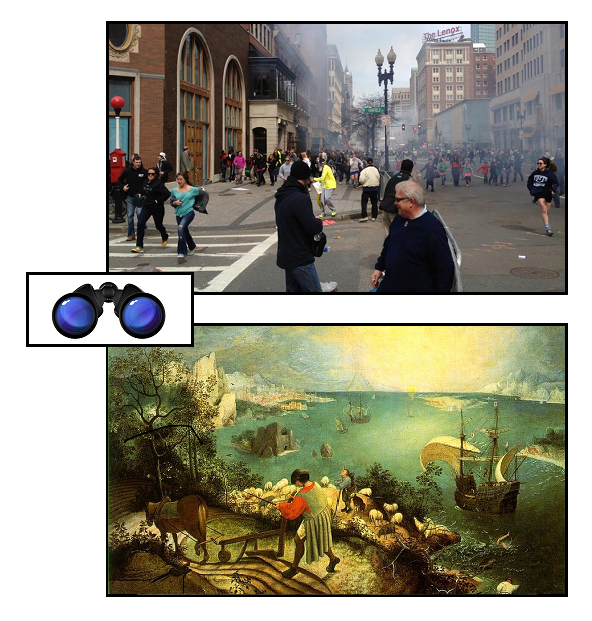
    My friend Jim Friedrich, an Episcopalian priest and artist, posted a thought-provoking juxtaposition of images on FaceBook yesterday, which I have resized and cropped to fit my own DoubleQuotes format:

    Fr Friedrich’s comment:

    This photo snapped Monday in Boston is like Brueghel’s “Fall of Icarus.” The critical subject in each is, from the viewer’s position, just a small detail practically lost in the totality of the scene. Very strange to look at, and to think about – ethically, existentially, theologically…

    **

    Also worth recalling in this context is WH Auden’s poem, Musee des Beaux Arts:

    About suffering they were never wrong,
    The old Masters: how well they understood
    Its human position: how it takes place
    While someone else is eating or opening a window or just walking dully along;
    How, when the aged are reverently, passionately waiting
    For the miraculous birth, there always must be
    Children who did not specially want it to happen, skating
    On a pond at the edge of the wood:
    They never forgot
    That even the dreadful martyrdom must run its course
    Anyhow in a corner, some untidy spot
    Where the dogs go on with their doggy life and the torturer’s horse
    Scratches its innocent behind on a tree.

    In Breughel’s Icarus, for instance: how everything turns away
    Quite leisurely from the disaster; the ploughman may
    Have heard the splash, the forsaken cry,
    But for him it was not an important failure; the sun shone
    As it had to on the white legs disappearing into the green
    Water, and the expensive delicate ship that must have seen
    Something amazing, a boy falling out of the sky,
    Had somewhere to get to and sailed calmly on.

    **

    I hope to post something tomorrow on the Mahdist video that Tamerlan Tsarnaev “liked” on FaceBook and added to his “Islam” folder. In its own way, that’s a minor — yet significant — detail, too.

    Bérubé, Plotinus, and William Shakespeare

    Sunday, February 17th, 2013

    [ by Charles Camerontotus mundus agit histrionem ]
    .

    Or as Shakespeare‘s Melancholy Jacques famously observed in As You Like It: All the world’s a stage…

    **

    On the off-chance that you’ll take a few minutes to read it once again, profound beauty being a river into which we cannot dip too often, I’ll give you the whole speech:

    All the world’s a stage,
    And all the men and women merely players:
    They have their exits and their entrances;
    And one man in his time plays many parts,
    His acts being seven ages. At first, the infant,
    Mewling and puking in the nurse’s arms.
    And then the whining school-boy, with his satchel
    And shining morning face, creeping like snail
    Unwillingly to school. And then the lover,
    Sighing like furnace, with a woeful ballad
    Made to his mistress’ eyebrow. Then a soldier,
    Full of strange oaths and bearded like the pard,
    Jealous in honour, sudden and quick in quarrel,
    Seeking the bubble reputation
    Even in the cannon’s mouth. And then the justice,
    In fair round belly with good capon lined,
    With eyes severe and beard of formal cut,
    Full of wise saws and modern instances;
    And so he plays his part. The sixth age shifts
    Into the lean and slipper’d pantaloon,
    With spectacles on nose and pouch on side,
    His youthful hose, well saved, a world too wide
    For his shrunk shank; and his big manly voice,
    Turning again toward childish treble, pipes
    And whistles in his sound. Last scene of all,
    That ends this strange eventful history,
    Is second childishness and mere oblivion,
    Sans teeth, sans eyes, sans taste, sans everything.

    **

    Sources:

    Bérubé, A Theory of Theory of Mind
    Plotinus, Third Ennead, ii, 15
    Shakespeare, As You Like It, Act II Scene vii.

    Recruitment, poetry and tears

    Thursday, January 31st, 2013

    [ by Charles Cameron — Hegghammer on testing and trusting as precursors to AQ recuitment ]
    .

    I’ve been having trouble finding any of the anasheed Ibn Siqilli was posting on his site, many of which have been taken down — but this one, found in a comment of his on Leah Farrall‘s site, has somehow survived:

    Craftsmanship in search of emotion, in service to the jihad.

    Thomas Hegghammer has a fascinating article out titled The recruiter’s dilemma: Signalling and rebel recruitment tactics from which I’ll only tease you with the bits of special interest to me, viz those that speak to religion (roughly, scripture and ritual), and culture (narrative, music and poetry).

    **

    First, matters clearly involving religious piety and its expressions:

    At the same time, personal piety at the time of recruitment was certainly a necessary condition for joining. Failure to observe any of the basic rituals or engaging in sinful behaviour – by skipping prayers, smoking, or watching Hollywood films – would have constituted a very negative sign. Moreover, even at the far end of the piety spectrum there were small signs that distinguished the extremely pious from the very pious. These signs were not in material objects such as clothes, but rather in body language and habits. QAP martyrdom biographies would highlight the piety of some but not of others, which suggests some variation. Judging from texts and videos, the behaviours that were appreciated included reading the Qur’an at every available spare moment, weeping while reciting the Qur’an, frequent minor pilgrimages (umra) to Mecca, efforts to acquire religious knowledge, etc. However, to observe these signs, recruiters needed to already be in direct contact with the recruit.

    Piety, however, was not enough. Recruiters would also need to see signs of ideological commitment of a more political nature, in particular approval of violent activism.

    Particularly interesting to me here is the sentence, These signs were not in material objects such as clothes, but rather in body language and habits.

    **

    And then, culture…

    To find out whether a person had really been abroad for jihad, recruiters would solicit signs of jihad experience, either by engaging the recruit in conversation, or if in a larger group, steer the conversation toward the topic of foreign jihad fronts. They would presumably look for displays of three types of knowledge, the combination of which would be very hard to acquire for a person who had not been to any of the major battlefronts.

    The first was knowledge of people, places and events specific to the conflict in which the recruit claimed to have taken part. [ more … ]

    The second type of distinctive knowledge was weapons expertise. [ more … ]

    The third type was familiarity with ‘jihad culture’, a set of peculiar practices and artistic expressions that emerged in the Arab Afghan community in the 1980s and developed in subsequent jihad fronts. One important component was anashid, battle hymns sung a capella during training and socializing. A similar component was poetry. Arab fighters in Afghanistan, Bosnia and Chechnya would continuously compose new poems and recite them in the camps. Veterans would be familiar with at least part of this material and would share it during social gatherings in the kingdom. Yet another aspect of jihad culture was the telling of war stories from the time of the Prophet Muhammad and his immediate successors. While some of these stories were part of the basic religious education of most Saudis, it required extra effort to learn many or all of them, and to be able to cite them verbatim, as custom required. In the training camps and the trenches, such stories were told all the time (Nasiri, 2006), so jihad veterans typically knew many more such stories than the average Saudi.

    Of course, non-veterans could acquire some of this knowledge if they wanted to, but to mimic jihad experience, impostors would need to emit large and consistent clusters of correct signs – a considerable challenge.

    I’m reminded of Abdullah Azzam‘s book The signs of Ar-Rahmaan in the Jihad of Afghanistan, which I quoted in an earlier post Of war and miracle: the poetics, spirituality and narratives of jihad.

    **

    Here’s how bad we are at learning the local mores of the various war zones we keep dropping in on, in the words of FPRI’s Adam Garfinkle, in Mali: Understanding the Chessboard, posted recently:

    As the article says, when the Tuareg rebellion in Mali gained steam after the denouement of the Libya caper, greatly stimulated by the return of heavily armed Tuareg brethren from that fight, these three Tuareg commanders defected to the rebels, bringing soldiers, vehicles, ammunition and more to the anti-government side. Anyone who was surprised by this is at the very least a terminal ignoramus. And anyone in the U.S. military who failed to understand the ethnic composition of the country’s politico-military cleavages, such that he let U.S. Special Forces training be lavished on Tuareg commanders, was clearly insufficiently trained to do his job. And believe me, that’s about as nice a way to put that as I can summon.

    How do things like this (still) happen, after what we should have learned from years of dealing with Iraqis and Afghans and others on their home turf? I happen to know someone who teaches in the U.S. military education system, and this person happens to be a field-experienced Harvard Ph.D. in anthropology. This person tries very hard to clear away the thick fog created by the innocent Enlightenment universalism that pervades the American mind—the toxic fog that tries to convince us that all people, everywhere, are basically the same, have the same value hierarchies, the same habits of moral and tactical judgment, and mean the same things by roughly comparable translated words.

    Now imagine how good we’d be at infiltration, getting the anasheed, poetry and stories right…


    Switch to our mobile site

