zenpundit.com » poetry

Archive for the ‘poetry’ Category

When I was a very young poet

Tuesday, January 1st, 2013

[ by Charles Cameron — a suggested solution to what ails the US Congress, Bertold Brecht style — and trace evidence of some early unpublished poems ]
.

from a private communication, dom sylvester houedard, 1964

**

I was reading Shivam Vij‘s piece, The epiphanic moment of the lathi charge, on Kafila today, and he included a quote from Bertolt Brecht that was intriguing enough — and appropriate enough to the fiscal-cliff-jumping mood in Congress these last few days — that I looked for the source, and found it in this poem:

The Solution
Bertolt Brecht, tr John Willett
.

After the uprising of the 17th June
The Secretary of the Writer’s Union
Had leaflets distributed in the Stalinallee
Stating that the people
Had forfeited the confidence of the government
And could win it back only
By redoubled efforts. Would it not be easier
In that case for the government
To dissolve the people
And elect another?

**

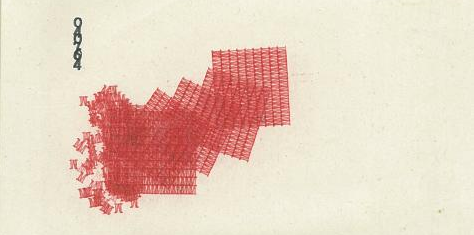
When I was a very young poet, my friend Dom Sylvester Houédard sent some very young poems of mine to John Willett, who was then the Editor of the Times Literary Supplement. They didn’t publish them, but I did get a mention in the TLS a little later, in one of Sylvester’s own writings on the British poetry avant-garde. In any case, here’s the note Sylvester sent me, letting me know he’d been submitting my stuff to Willett:

As you can see, Dom Sylvester could do some pretty nifty graphics with his old Olivetti Lettera 22 typewriter. He’d gotten into the habit while working in British Army Intelligence somewhere in the Far East during World War II as I recall — before he came home and became a monk. Why? Because Army Intelligence demanded he send them 16-page reports, and he could only ever find fifteen pages worth of intel to send them. They disapproved of blank pages, he complied with orders by filling the final pages of his reports with graphical poetry. And thus a tiny whirlpool in the arts was born…

Okay, enough: Sylvester was a phenomenon of mind and heart, and is sorely missed.

As I said, I was very young when he sent those poems of mine to the TLS — it was 1964, and I was a student at Christ Church, Oxford, “chch” in Sylvester’s abbreviation — but the name of John Willett stayed with me, like a runic talisman. So I just can’t help but notice when my daily reading, almost fifty years later, brings up his name again — this time as a noted Brecht translator.

Sow wind, reap whirlwind

Sunday, December 30th, 2012

[ by Charles Cameron — on blowback, in praise of a Gregory Johnsen post, and literacy ]
.

William Blake, The Lord Answering Job Out of the Whirlwind

.

ED Hirsch and Joseph F Kett‘s New Dictionary of Cultural Literacy doesn’t appear to have an entry for the phrase “For they have sown the wind, and they shall reap the whirlwind” which is straight out of the prophet Hosea and is now something of a proverb in the form “sow the wind, reap the whirlwind”. Hunh.

It’s an elegant phrase. The translators of the King James Bible were masterful in their singular ear for English, and no doubt Hosea‘s original Hebrew (Hosea 8.7) is no less pithy. Seed preceding harvest is about as basic a notion of cause resulting in effect as one can find in the lived world of agriculture, with the actual mechanism through which it comes to pass hidden in the “black box” between them where, as another biblical passage (John 12.24) puts it:

unless a kernel of wheat falls to the ground and dies, it remains only a single seed. But if it dies, it produces many seeds.

**

Sow the wind…

It doesn’t sound like much, does it? Put an airy nothing in the ground…

reap the whirlwind.

If you were within media reach of the devastation that Sandy caused to New York and New Jersey — or Haiti (yet again) for that matter — you know what reaping the whirlwind is about. And the proverb, with the prophet behind it, tells us we get it by sowing the wind.

Blowback.

**

Gregory Johnsen, in a recent Waq-al-Waq post, Sowing the Wind: Three years of strikes in Yemen, pulls together three recent news pieces on Yemen to give us a view from 30,000 feet — in which blowback is clearly visible as the “whirlwind” his title implies we are already beginning to reap.

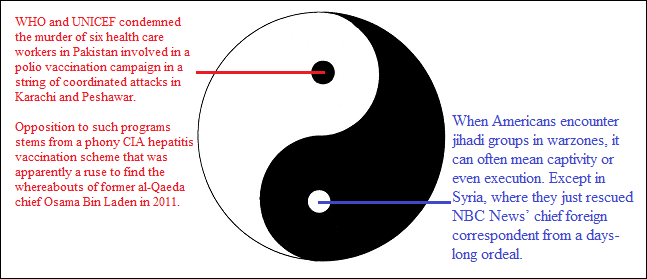
This sort of “here’s how the weather system looks from above” picture comes from the juxtaposition of key quotes, and since that’s one of my specialties, I’ll present two quotes that Johnsen selected in my own format devised with just that sort of exercise in mind:

That first quote is from Letta Tayler in Foreign Policy, and the second from Sudarsan Raghavan in the Washington Post.

As Johnsen puts it:

This is clear: the US bombs, kills civilians and AQAP sends compensation – ie, helps out the families that have been killed – and takes advantage of the carnage the US has sown to reap more recruits.

This is at once all too sad, and at the same time all too predictable.

**

There’s plenty more in Johnsen’s post, obviously, and being a trawler for religious details, I myself was particularly amused, or maybe alarmed, by this sentence:

That opening strike in the US’ war against AQAP in Yemen was a disaster, a strike so bad that the Pentagon lawyer who authorized it famously said later: “if I were Catholic, I’d have to go to confession.”

Indeed, as I hope to show shortly in a review of his book, The Last Refuge: Yemen, al-Qaeda, and America’s War in Arabia, Johnsen has a great deal to tell us, and he tells it with the added grace of a real appreciation for the language he uses.

Which brings me to the reason why I singled this particular post for commendation, given that I read a number of insightful people on a number of interesting topics each day.

Gregory Johnsen is literate, lettered.

**

I can’t estimate for myself just how many people would know and recognize the Hosea quote, nor how many more would at least know the proverb “sow the wind, reap the whirlwind” well enough to recognize its first half and provide the second half from memory… That’s why I looked it up in Hirsch’s New Dictionary of Cultural Literacy. And when I didn’t find it there, I have to say I wasn’t surprised.

Way back in 19232, was it, TS Eliot was dropping snippets of already obscure (obsolete?) texts in English, Italian, Latin, and French — from Thomas Kyd‘s Spanish Tragedy, Dante‘s Purgatorio, the Pervigilium Veneris, and Gérard de Nerval‘s El Desdichado — into his poem The Waste Land, with the comment “these fragments I have shored against my ruins.”

As Eliot would note later in Burnt Norton, “Words strain, / Crack and sometimes break, under the burden, / Under the tension, slip, slide, perish, / Decay with imprecision, will not stay in place…”… And how much more so the myths, fables and proverbs made of them — myths, fables and proverbs which pass down the embodied wisdom of generations, as this proverb from Hosea passes down embodied wisdom about blowback — or negative positive feedback loops, as a latter-day Hosea might call them.

Johnsen is, precisely in this sense, literate, and in addition to the benefit his analysis brings, it’s a delight to read him for that very reason.

But there’s an even bigger issue here — the one Eliot was on about — the question of what happens when we lose the cultural underpinnings which, I’ll repeat, pass down the embodied wisdom of generations?

Johnsen speaks to the present, to Yemen, to the Yemeni people and to American politics. But in quoting that fragment of a proverb in his title, and expecting us to recognize it, he also speaks to memory, to culture, and to wisdom — wisdom, the capacity to act wisely — to which memory and culture are portals.

**

William Blake painted The Lord Answering Job Out of the Whirlwind, which I’ve placed at the top of this post, and it is said in Job 38.1, “the Lord answered Job out of the whirlwind”.

In a forthcoming post — how often have I posted those words, and how seldom do I manage to fullfil them? — I hope to address the other possibility, the one in which as I Kings 19 has it (verses 11-12):

And, behold, the Lord passed by, and a great and strong wind rent the mountains, and brake in pieces the rocks before the Lord; but the Lord was not in the wind: and after the wind an earthquake; but the Lord was not in the earthquake: And after the earthquake a fire; but the Lord was not in the fire: and after the fire a still small voice.

But the Lord was not in the wind — it might be nice if the evangelists of righteous doom would remember that verse, before they inform us that a hurricane like Sandy is simply God reproving Cuba, Haiti and the eastern seaboard of the United States!
Happy Birthday, Sir Isaac Newton and …

Tuesday, December 25th, 2012

[ by Charles Cameron — season’s greetings in a couple of different contexts ]
.

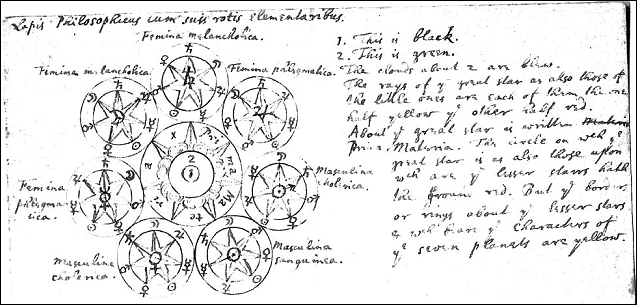
Lapis Philosphicus / The Philosopher's Stone, from Sir Isaac Newton, MS 416

.

It is Sir Isaac Newton‘s birthday today, December 25th, and that’s surely cause for some celebration.

Shakespeare‘s birthday is unknown, but was probably around April 23rd, Bach‘s is celebrated on March 31st, Galileo‘s on February 15th, Buddha‘s is mostly celebrated on April 28th, and HM the Queen‘s on April 21st, making April — TS Eliot‘s “cruelest month” — a powerful time for moving from womb into world.

If you’re a cricketer, you might celebrate WG Grace‘s birthday, 18th July, it takes all kinds to make a world. But December 25th? If you don’t also make a big deal about Leibniz on July 1st, what’s so special about Newton on December 25th?

**

There are some great aggregator blogs out there, and frankly I favor 3 Quarks Daily for their blend of culture, science and an accent from the subcontinent.

Today, as in other years, 3QD is celebrating Isaac Newton’s birthday, and I’ll raise a toast to him too. There are a great many things in our world that I am grateful for, that wouldn’t have been possible without his great and inquiring mind — though it’s his alchemical and apocalyptic interests that capture my own imagination.

What hath Newton wrought? You could do worse than to consult 3QD on this day across the years, 2004, 2005, 2006, 2007, 2008, 2009 — but you know, part of celebrating Newton’s Day (rather than that of Shakespeare, Leibniz, WG Grace, Dante, Marilyn Monroe or whomever) is that you can celebrate it on Christmas Day, on the day assigned conventionally to the birth of Christ — without getting all religious.

So it’s a sort of escape hatch for seculars, in a sacred season. As if all the gifts we give to commerce and each other weren’t enough.

**

In honor, therefore, of the child whose nominal birthday makes Sir Isaac Newton’s so much more easily memorable — this poem:

The birth of phoenix bliss
.

Gallows humor was implicit from the start
in the tiny child, in the newborn universe, in the
very heart of all that breathes and hopes,
evident then, at that first beginning, more so
in the tool shed behind the motel, most
now if we clear the rubble of malls and ads
from our eyes, blink a bit in the light, so
steady, so other than flash and glitter, so very

divinely human unfolding in each folded heart:
for oh, we are pilgrims, zeros traveling in
from earth to infinity, infinity itself
two zeros, two virgins intersecting, breeding,
filling the abyss: believe me, no phoenix
bliss is born, save from the ashes of crucifixion.

**

I know, I know, some of you will wonder WTF Charles is on about.

A lot of people have folded their Sunday suits away and mothballed them, I know — I just happen to think that the finest story in the world tells of an infant conquering men at arms, mighty empires, with love alone in his eyes.

I am not of the opinion that this obliges me to expect greybeards in space, to follow the culinary restrictions of some desert tribe, or to condemn those whose attitudes are different from mine: on the contrary, I find liberty in the childlike gaze, liberty and clarity, depth and profundity, and at bottom a deep mystery.

I wish you all whatever blessings may befall you, now and always.

The circle in the swirl

Sunday, December 23rd, 2012

[ by Charles Cameron — the one prediction that never fails to amaze is “surprise”! ]
.


.

There are two great paeans to diversity that my mind constantly recurs to: the Svalbard global seed vault, with its more than 750,000 distinct varieties of seed deposited in “black boxes” by various national genebanks — and the Jesuit Gerard Manley Hopkins‘ great poem, Pied Beauty:

GLORY be to God for dappled things—
For skies of couple-colour as a brinded cow;
For rose-moles all in stipple upon trout that swim;
Fresh-firecoal chestnut-falls; finches’ wings;
Landscape plotted and pieced—fold, fallow, and plough;
And áll trádes, their gear and tackle and trim.

All things counter, original, spare, strange;
Whatever is fickle, freckled (who knows how?)
With swift, slow; sweet, sour; adazzle, dim;
He fathers-forth whose beauty is past change:
Praise him.

The world is fundamentally dappled: look where you will, you will find general rules — and unexpected exceptions. The whole Syrian opposition business is dappled, it’s a mixed bag, it’s subtle.

I dunno, maybe this can be my motto: keep it subtle, stupid.

**

Seen from another angle… variety is, as they say, the spice of life.

Or as the Qur’an puts it (49:13):

O mankind, We have created you male and female, and appointed you races and tribes, that you may know one another. Surely the noblest among you in the sight of God is the most godfearing of you. God is All-knowing, All-aware.

Doors within doors: Ibn Arabi, Henry Corbin and Tom Cheetham

Sunday, December 2nd, 2012

[ by Charles Cameron — a response to, and endorsement of, Tom Cheetham ]
.

Interior of the Touba mosque

**

If I only had one book to take with me, I’d pick Henry Corbin‘s Creative Imagination in the Sufism of Ibn Arabi, also available under the title Alone with the Alone. And I’d pick it, because — well, this poem of mine says it best:

No Place Special
.

I am baffled:
                 your muezzin calls me
with a call more resonant than any command
of sensible business, any
instrument, nay, of corporeal music,
to prayer in no place visible,
as if defining by example what
eyes in the back of the head might mean,
might see, ears on the inside
of the skull
mean, what
their music, not being
ears or eyes in the habitual sense at all.

Cliff.
        Not the sheer cliffs of fall
Of Hopkins’ poem, but cliffs sheer without any
word-hold by which to climb
celestialwards — as if
adamant, as if obsidian,
oblique to terrestrial gravity, this cliff
of hearing the call without seeing the mosque
,
without turning
around, inwards, some new way within.

I have ignored the lures, chased breath,
pressed my life into service, and —
as if a pressed life, even in service, were
death on display, a pinned butterfly —
withdrawn from pressing,
taken ease in the swell and ride
of life, loved much, seen
many to my great joy and felt richly
to my grief…
                  and the
muezzin yet calls, the baffle, the cliff
still between me and the attainment of garden,
tree and spring.

Corbin’s book is too high for me, but I feel the call. And Ibn Arabi — beyond my knowing.

**

Ibn Arabi is known as the Shaykh al-Akbar, the greatest shaykh, because his work towers higher and digs deeper into the soul than that of any other Islamic writer, saving only (perhaps) his contemporary the poet mystic Jalaluddin Rumi.

Stepping down from his heights, up from his profundities, we have in Henry Corbin an interpreter of great power — and since I find even Corbin requiring of me a depth of insight I can not yet grasp yet must read again and again across the decades, I am happy to have found his interpreter, Tom Cheetham.

And thus Tom Cheetham is a doorway for me into the doorway that Henry Corbin is to Ibn Arabi, himself a doorway into the profoundest mystery.

**

You can find Tom Cheetham’s four books here — I’d start with The World Turned Inside Out: Henry Corbin and Islamic Mysticism, and read them in the order of publication.

I have written this post to draw the attention of any who may be interested to Tom’s offer of an online seminar in Corbin’s work: The World of Henry Corbin – Online Learning.

I am considering the possibility of offering some kind of online learning program.
I would like to know:

(1) if there is interest,
(2) what topics people would be most interested in,
(3) what format or formats might be most useful, and
(4) whether people might be willing to pay a modest fee.

Any other comments or suggestions are welcome.

Contact me by commenting on this post or emailing me at
tcheetham@gmail.com
subject heading “Corbin Online Learning”

Very highly recommended.


Switch to our mobile site