zenpundit.com » poetry

Archive for the ‘poetry’ Category

The war and peace paradox, take 2: of wolves and music

Tuesday, October 30th, 2012

[ by Charles Cameron — second take on the paradox, this time featuring wolves, poetry, lions, honey, and Bach ]
.

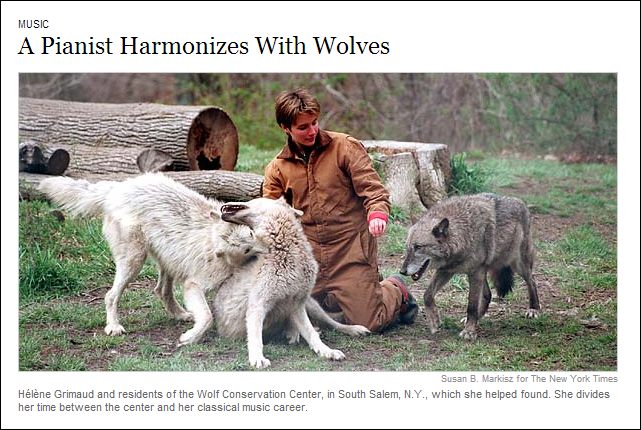
eye-catching headline & image from the New York Times, 2008

.

I’m always trying to see war and peace — violence and gentleness, if you like — in counterpoint rather than in opposition. The distinction is a subtle one, I know, but that’s the task. I tackled it from one angle a few days ago in this earlier post, and imagine I’ll return to it again from time to time.

**

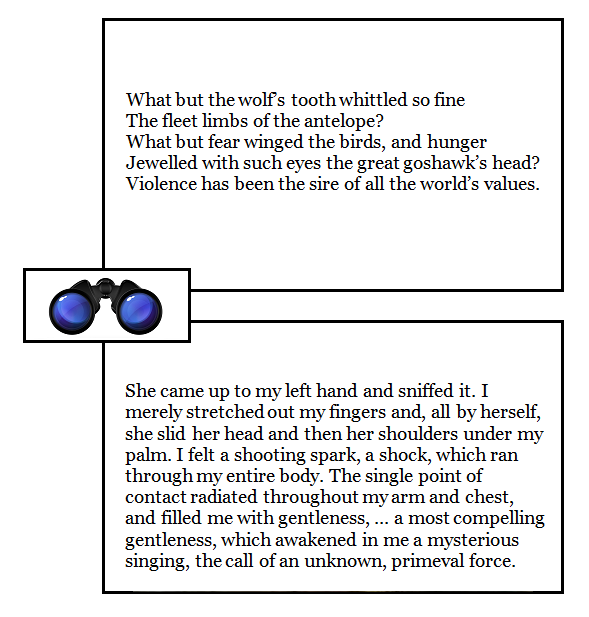
I was fascinated to run across two very different artists talking about wolves these last few days. Robinson Jeffers, in his great poem The Bloody Sire, sees the wolf’s violence (upper panel) as bringing speed and grace to the antelope:

while the extraordinary pianist Hélène Grimaud describes her first encounter with a wolf (lower panel) in terms of gentleness.

After that striking first encounter with a wolf, Grimaud went on to found the Wolf Conservation Center in upstate New York (see NYT article by clinking on image at top of this post).

**

There’s a longish and fairly erotically, religiously and violently charged story in chapter 14 of the book of Judges. Samson, so the story goes, took a liking to a woman of the Philistines, and despite his parent’s urgings went down to see her because, as he delicately put it, “she pleaseth me well.” Along the way he meet a young lion, and “rent him” — tore him apart with his bare hands — “as he would have rent a kid” — here meaning a young goat. Samson continued to like the look of the women of the Philistines, we are told, and on his next visit down to see her, “he turned aside to see the carcase of the lion: and, behold, there was a swarm of bees and honey in the carcase of the lion. And he took thereof in his hands, and went on eating, and came to his father and mother, and he gave them, and they did eat…”

Samson, it seems, was a gambling man, and he soon proposed a bet and a riddle to his bride’s companions — for somewhere around that time they had married, a fact that the story teller omits to tell us in so many words — giving them seven days to solve it:

Out of the eater came forth meat, and out of the strong came forth sweetness.

The companions, of course, could not solve the riddle, since they had not seen the lion, nor its carcase with its swarm of bees and honey… but they pleaded with his new wife so piteously that she pleaded with her new husband so piteously that he revealed the secret to her, and on the seventh day her Philistine companions won the bet and answered Samson’s riddle:

What is sweeter than honey? And what is stronger than a lion?

To which poor Samson replied:

If ye had not plowed with my heifer, ye had not found out my riddle.

The marriage didn’t last — and, we are told, “his anger was kindled…”

**

I certainly heard this story intoned in chapel at one school or another, but recognized neither the eroticism nor the violence nor the significance of the religious enmity between monotheistic Jew and pagan Philistine…

But my mother did make us pancakes on rare and wonderful occasions, and on them I lavished farm butter and Tate and Lyle‘s glorious Golden Syrup, with its image of Samson’s lion and the honey bees:

and the Tate and Lyle motto: Out of the strong came forth sweetness.

It’s that sweetness — that image of the lion and those bees more than the Biblical story itself — that I remember…

**

I am grateful to Steve Engel for bringing Robinson Jeffers’ poem to my attention this last week, and to J Scott Shipman of this blog for introducing me to Hélène Grimaud’s playing of the Bach Chaconne on YouTube:

Out of the strong came forth sweetness indeed.

Søren Kierkegaard on espionage & Kenneth Burke on strategy

Thursday, October 25th, 2012

[ by Charles Cameron — a meditation on theological espionage, literary strategy, a Sufi tale from Jalaluddin Rumi, and why the arts and humanities offer excellent preparation for analytic work ]
.

Kit Marlowe's portrait, Corpus Christi College, Cambridge, Kierkegaard sketch, Niels Christian Kierkegaard

.

It may seem somewhat strange, at least on the surface, for a poet to be interested in strategy and a theologian in the world of intelligence analysis.

We poets. however, have been termed “the unacknowledged legislators of the world” by Mr. Shelley, one of our own number, and we theologians long considered our study the Queen of the Sciences – so here we have the roots of attitudes that may flower into this strange hybrid being that is myself.

**

It’s not easy to list significant writers who were also in the intelligence business, in part because both “writing” and “intelligence” are subject to varied definitions — so my own list here will lean heavily British, and have the patina of old age rather than the glamor of the freshly minted. Let’s just say that Christopher Marlowe, who wrote the great play Doctor Faustus, was apparently sent on extended errands while up at Cambridge on “matters touching the benefit of his country”.

More recently Rudyard Kipling, John Buchan, Somerset Maugham, Graham Greene, even JRR Tolkien apparently, Ian Fleming, John le Carré, and Anthony Burgess have been among British writers who were also spies, and Peter Matthiessen can serve as a distinguished recent American example.

Which brings me to the OSS, and this quote from a 2003 piece on Boston.com:

Yale’s literature specialists played a key role in shaping the agency’s thinking. Mole-hunter James Jesus Angleton, the most controversial figure in CIA history, began his career as an apprentice of the New Critics on Yale’s English faculty, and his literary training in “close reading” may have shaped his hyper-skeptical (some would say paranoid) approach to counterintelligence.

**

Why do fine writers make decent intelligence analysts?

John le Carré, who has been both, has this to say:

Artists, in my experience, have very little centre. They fake. They are not the real thing. They are spies. I am no exception.

I’d like to take that a little further. I’d like to say that to be a keen observer of human behavior, you must be a keen observer of your own – only one who has taken the beam out of his own eye can see clearly the mote that is in another’s. That brings you, I believe that chameleon-like condition of receptivity and observation that Keats termed “negative capability” in his letter to Richard Woodhouse of October 27, 1818.

More on that in the Sufi story below. Now, onward to the two quotes that anchor this piece.

**

Here’s Kenneth Burke on “strategy” in the arts, in his Literature as Equipment for Living [link is to .pdf]:

For surely, the most highly alembicated and sophisticated work of art, arising in complex civilizations, could be considered as designed to organize and command the army of one’s thoughts and images, and to so organize them that one “imposes upon the enemy the time and place and conditions for fighting preferred by oneself.” One seeks to “direct the larger movements and operations” in one’s campaign of living. One “maneuvers,” and the maneuvering is an “art.”

Are not the final results one’s “strategy”?

And Kierkegaard on “spying” as a theologian, in the chapter, Governance’s Part in My Authorship from his The Point of View:

l am like a spy in a higher service, the service of the idea. l have nothing new to proclaim, I am without authority; myself hidden in a deception. l do not proceed directly but indirectly — cunningly; I am no saint — in short, l am like a spy who in spying, in being informed about malpractices and illusions and suspicious matters, in exercising surveillance, is himself under the strictest surveillance. See, the police also use such people. For that purpose they do not choose only people whose lives have always been most upright; what is wanted is only experienced, scheming, sagacious people who can sniff out everything, above all pick up the trail and expose. Thus the police have nothing against having such a person under their thumb by means of his vita ante acta [earlier life] in order precisely thereby to be able to force him unconditionally to put up with everything, to obey, and to make no fuss on his own behalf. It is the same with Governance, but there is this infinite difference between Governance and the municipal police — that Governance, who is compassionate love, precisely out of love uses such a person, rescues and brings him up, while he uses all his sagacity, which in this way is sanctified and consecrated. But in need of upbringing himself, he realizes that he is duty-bound in the most unconditional obedience.

**

To return, then, to the issue of those who spy upon themselves…

Jalaluddin Rumi has a story in his Masnavi, one of the many facets of which, I suspect, can illuminate this point, albeit a bit obliquely.

He describes a contest that a sultan once held between the Chinese and Greek schools of artists, to determine which had the greater ability in art. Each school was given one half of a room, and a great curtain fixed between them. The Chinese, with a vivid appreciation of nature’s moods and humanity’s place between skies and mountains, painted their half of the room with exquisite care and subtlety. The Greeks took quite an other approach, covering the walls on their side with silver plate, then buffing and burnishing it to a brilliant reflective sheen.

When the work was done and the curtain drawn back, the beauty of the Chinese room was stunning – but the loveliness of the Greek room, in which the Chinese room was reflected to dazzling effect, was even more so:

The image of those pictures and those works
was mirrored on those walls with clarity.
And all he’d seen in there was finer here –
his eyes were stolen from their very sockets.

Rumi explains that the Chinese in his fable are like those who see the outer world only, while the Greeks are those who “stripped their hearts and purified them” – and that “the mirror’s purity is like the heart’s”…

Those who examine their own hearts — Ursula le Guin nicely calls them “withinners” since their voyages, adventures, discoveries and treasures are found primary within themselves — may make reluctant spies, for they do not easily see one side of a dispute as entirely right and the other side utterly wrong: but their nuance places them among the finest of analysts.

**

Oh, but let’s be sensible and worldly: most of us like to balance our mundane lives with the more exciting possibilities that are their opposites, and espionage – the derring-do more than the analysis, to be sure – is a wonderful foil for scholars’ fantasies, just as being swept off one’s feet by a prince and loved tempestuously between the pages of a book is a sweet shift from the menial paper trails of office life, and space opera a fine venture for those beset by gravity and white lab coats.

And whether Jason Bourne, Jack Bauer, James Bond or just a little J&B‘s your tipple, you may find espionage, dealing as it does with secrets, is a natural launching pad for fantasy…

**

More sseriously, for the analysts and educators among our ZP readership — let me just suggest that the literary and humane arts will deepen analytic understanding as surely as big data will extend its technical reach.

And when you come right down to it — your human mind is still the best and subtlest software engine in the room…
Pulse: a poem on setting out

Monday, October 22nd, 2012

[ by Charles Cameron — thunder, lightning, wind, water, moon, thanks and praise ]

.

Pulse

.

Like a thunderbolt out of juicy nothingness
a chord
            strikes, as if
from the face before time itself, lightning:
                                                                nor
is there any measuring the impact a breeze
might ripple out across waters, each drop
containing,
                  constraining
its reflected ocean.

                              Live, then, your
lively life, be struck, dumb, gifted, wildly
giving – what else? – thanks
and praise. Not as flattering tongues praise,
                                but as one moon
surrenders herself, gone, crescent, whole
and shattered, across each and all
                              turbulent and calm waters.

Haaretz on the Temple Mount, pt II: axis mundi

Sunday, October 7th, 2012

[ by Charles Cameron — Jerusalem, and the Temple Mount in particular, as the still point in the turning world — Midrash, Haaretz, a map from 1581, M Eliade, TS Eliot, Navaho Night Way ]
.

There is tremendous poetic force to the notion of the axis mundi, the mythic center around which all else revolves.


.

In an earlier post, I quoted this saying, which exemplifies the power of the “center of the world” motif as applied to Israel and the Temple Mount:

As the navel is set in the centre of the human body,
so is the land of Israel the navel of the world…
situated in the centre of the world,
and Jerusalem in the centre of the land of Israel,
and the sanctuary in the centre of Jerusalem,
and the holy place in the centre of the sanctuary,
and the ark in the centre of the holy place,
and the foundation stone before the holy place,
because from it the world was founded.

– Midrash Tanchuma, Qedoshim.

**

Let’s give that room to breathe.

**

There are those who will dismiss all such images and words as irrelevant, impractical, foolish, irrational — Jerusalem is not the center of the earth any more than the earth is the center of the solar system — but to a poet they are words in a familiar language, not of fact but of imagination and love. They are poetry.

Sadly, in my view, the members of the various movements to rebuild the Jerusalem Temple on or near the sites of the Al-Aqsa Mosque and Dome of the Rock on the Noble Sanctuary / Temple Mount take the poetry of the Mount as axis mundi literally and all too politically — as happens not infrequently with authentic poetry.

Phrased as political prose, the idea just isn’t the same, as these words from Shany Littman‘s Haaretz article addressed in the prequel to this post will demonstrate:

Rivka reminded us that over and above the sheer experience and the historical tales, the visit had a purpose: to understand the essence of the Jewish home through the Temple, as the visit revolved around a bride on her wedding day. Holding up a page containing what looks like a satellite image of planet Earth, she showed how, from a certain angle, the Land of Israel and Jerusalem appear to be at the center of the world, in its innermost circle. “I give lessons to women about modesty,” she said. “I show them this image and replace the word ‘modesty’ with the word ‘inwardness.’ The innermost circle, the most hidden, is the Land of Israel, Jerusalem, the Temple, the Holy of Holies. What is modesty, what is a modest, inward place? It is hidden, the place least visible to the eye.”

But the bride was contentious: “You could take that photograph from a different angle and then Jerusalem will not be in the center.” “True,” Rivka replied, “but here we see that the State of Israel is at the heart of the world. If the world knew how much it would gain from us building the Temple, they would heap good stones on us, because they will profit from it. The most prosperous countries in the world are the Western ones; China, Africa and Asia are poor.”

A questioning eyebrow was raised. “Don’t look at the industry,” Rivka said. “Look at the miserable people, who are not allowed to have more than one child and don’t have proper housing and suffer from tsunamis and earthquakes. Look at the suffering they are undergoing. And why? Because the Jewish people resides close to the Temple, the world on this side gains; where we do not reside [i.e., the East] the world loses. This is the place that coordinates and pinpoints all the prayers and the connection with the Master of the Universe. If we are not here, they lose. And we lose, too.”

and, in the words of Prof. Weiss from the same article:

I want to take the movements to a place that is more sensible: a Temple-based state, where the state’s entire content revolves around the Temple.”

**

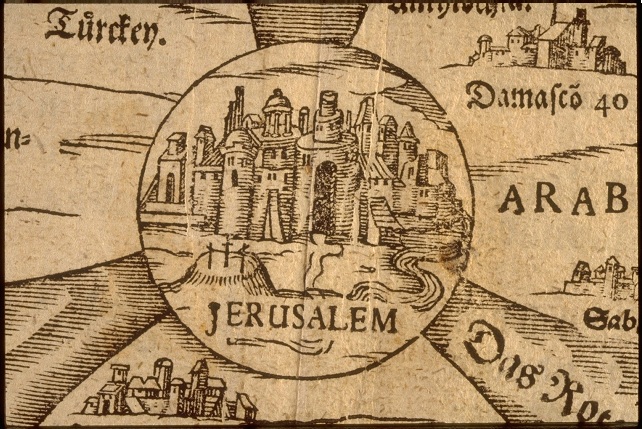
Map (above) by Heinrich Bunting from a copy of Itinerarium Sacrae Scripturae (1581) in the Jerusalem as the center of the world exhibition at the University of Southern Maine’s Osher Map Library, detail below:

**

For more on the symbolism of the axis mundi, see Mircea Eliade‘s essay Symbolism of the Centre in his book Images and Symbols — or consider these lines from TS Eliot‘s poem-series, Four Quartets:

At the still point of the turning world. Neither flesh nor fleshless;
Neither from nor towards; at the still point, there the dance is,
But neither arrest nor movement. And do not call it fixity,
Where past and future are gathered. Neither movement from nor towards,
Neither ascent nor decline. Except for the point, the still point,
There would be no dance, and there is only the dance.
I can only say, there we have been: but I cannot say where.
And I cannot say, how long, for that is to place it in time.
The inner freedom from the practical desire,
The release from action and suffering, release from the inner
And the outer compulsion, yet surrounded
By a grace of sense, a white light still and moving…

**

In many ways, both Eliot’s words and those of the Midrash remind me of the beauty found in the prayers of the Navaho Night Chant:

In beauty may I walk.
All day long may I walk.
Through the returning seasons may I walk.
On the trail marked with pollen may I walk.
With grasshoppers about my feet may I walk.
With dew about my feet may I walk.
With beauty may I walk.
With beauty before me, may I walk.
With beauty behind me, may I walk.
With beauty above me, may I walk.
With beauty below me, may I walk.
With beauty all around me, may I walk.
In old age wandering on a trail of beauty, lively, may I walk.
In old age wandering on a trail of beauty, living again, may I walk.
It is finished in beauty.

To my reading eye as a poet, these are all expressions of the same kind — invocations of the human spirit by rhythm and imagery — true poems, visions. They offer us a form of nourishment and insight not easily found today — nourishment and insight which shrivel and die when reduced to politics or prose.

**

For more on the Navaho chantways, and the balance called “sa’a naghai bik’e hózhó” which this prayer embodies, see John Farella, The Main Stalk: A Synthesis of Navajo Philosophy.

An Afghan Buddha koan

Friday, October 5th, 2012

[ by Charles Cameron — for Madhu ]
.

Our friend Madhu has requested that I post poems here on occasion, and this particular poem made me think of her and her request, so here it is:

A copper and gold koan
.

The world happened, the world is drifting away,
the farther away the world floats the deeper into the mists.

In Mes Aynak, Afghanistan, the remains
of a buddhist monastery already eroded by time are adrift,
a sitting buddha is floating into the mist,
headless, gold paint still on his knees and robe,
the devotion has drifted, lifted its focus
to the one without a second, the buddha left
whatever he left in memory, lingering, to gather aromas
of other ideas, realms, dust, archaeology, oblivion,
there is change, ceaseless change,

and adults must decide: is the wealth implied by the copper
beneath the buddha worth more than a trace of halo,
as the moon moves once again across a brilliant night sky.

.
Koans are those brilliant paradoxes zen buddhism uses to pry the mind open, I think they’re important aids to handling complexity, and I have a post about them coming up shortly. Here, it’s enough to say that the issue of copper mining vs archaeology in Mes Aynak seems to me to be a living, breathing koan.

**

It’s awkward, when you write an “ekphrastic” poem, a poem about a painting or photo, to have the image right there when the poem is read, because it trammels the reader’s mind in much the same way that a film can trammel the mind of a reader into “seeing” only the film-maker’s Gandalf, no longer her or his own.

And I’m going on at some length about this, because next up is the image from which that particular poem was built, but I’d like the image to be, as they’d say in the newsprint world, “below the fold” as you read the poem.

So here it is, #4 in a fine series of photos in a Foreign Policy photo essay which I recommend, although I’ve taken this particular (smaller) version from a CNN page, since the subtitle in the lower right corner explains the basic situation handily:

You can hear the archaeologist Brent Huffman, who took the photo, talk about the situation here — local reactions pro and con, who the Taliban are shooting at, the likelihood that the Chinese operation will in fact benefit the locals and more:

The koan of balancing material with immaterial values remains, but in this circumstance the likelihood of local Afghans receiving litter or nothing from the mining project likely tips the scales.

You can petition Afghan President Hamid Karzai for preservation…

But then he’s another wild-card in the continuing Great Game, isn’t it?


Switch to our mobile site