zenpundit.com » poetry

Archive for the ‘poetry’ Category

Of the importance of form in intelligence: I

Wednesday, October 3rd, 2012

[ by Charles Cameron — form as pattern recognition, the form of suicide / martyrdom ops, a format for analysts, first in a series on form in intelligence, and maybe the beginnings of an eccentric thinking manual for analysts ]
.

Bear with me for a paragraph or two, while I try to sort something out.

Form is to content as algebra is to arithmetic: does that work for you? Form is one degree more abstract than content: how about that? I don’t think either of these expressions quite captures what I want to say about form and content, but they may help us think about form. Here’s a form:

It’s pretty clearly a diagram of connections of some sort, but exactly what those connections are is unclear as long as the various boxes in the diagram remain empty.

I could fill it with the names of members of a hippie commune that practiced a flexxible approach to free love over a decade or two, from when the founder bought the farm (in the literal sense of real estate) to the point where the last surviving member bought the farm (metaphorically speaking — the farm in the sky).

Or with the names of elements in the human digestive and energetic system…

I mention the latter, because I came across this particular (empty) diagram on a blog post by a certain Jacques Chester about how people get fat, where it was preceded by the words:

A better diagram for bodyweight control will resemble a great big mess

I won’t tell you where I got the other idea from, if you want to know you’ll just have to fantasize, as I did.

**

At least in this case, form means pattern. The diagram above is a pattern, fill it with appropriate verbal or other content and you’ll give it meaning — which can then be disputed or accepted. But the form, the patterning, is somehow antecedent to any particular content.

Take the last words of each line of Shakespeare‘s Sonnet XCVII and you’ll get:

been, year, seen, everywhere, time, increase, prime, decease, me, fruit, thee, mute, cheer, near.

The rhyme scheme is pretty clear: ABAB CDCD EFEF GG.

That’s a form, and all of Shakespeare’s sonnets follow it. Petrarch‘s sonnets by contrast follow the rhyme scheme ABBA ABBA CDECDE.

**

In my practice of thinking, as a poet and as a practitioner of the open source analysis of scriptural sanctions for religious violence, I find the recognition of forms — pattern recognition — to be my central process.

I think what first really brought this home to me was the similarity of form between two reports of terrorist training activities — each in its own way illustrating the idea that the activity to be performed will begin quite naturally on earth, where training is required, but end quite supernaturally in paradise, where it isn’t:

That one’s pretty obvious, right? I mean, if you’ve seen the first instance you would be pretty likely to remember it if you ran across the second…

And what the form means is pretty clear too — martyrdom ops, suicide ops.

But what if you had a note-pad on your desk — or better, a game format on your computer — that gave you those two boxes, free of specific data, and any time you found a weird or anomalous data-point or image you could scribble it or drag-n-drop it into that form, give it a name for easy retrieval, and keep your eyes peeled for parallels, opposites, similars?

I call that format SPECS, by the way, because it allows you to see two similar ideas stereoscopically, so to speak, and thus gain an extra dimension — neat trick, eh?

What if collecting SPECS was part of your training as an analyst, and you practiced the form a few hundred times and kept 150 mind-blowing examples — as Shakespeare did with his ABAB CDCD EFEF GG sonnets?

**

Why, you’d be training yourself in pattern recognition — formal thinking — horizontal thinking — lateral thinking — analogy — thinking by leaps and bounds.

Inteligence happens in the Intelligence Community, and in the human population as well. I can’t speak to the ways in which animal and plant mimicry, or the artistry of birdsong, correspond to pattern recognition, although that would be a fascinating topic for another post.

What I can say is that analogical, horizontal, cross-disciplinary thinking is in its own away more powerful than logical, rational, vertical, silo-bound thinking.

**

In terms of Intelligence and intelligence, the strategies of linear / vertical thinking are like your fingers: it’s your skill at lateral / horizontal thinking that gives your mind an opposable thumb.

Book review: Kay Larson on the zen of Cage

Friday, August 10th, 2012

[ by Charles Cameron ]
.

Kay Larson, Where the Heart Beats: John Cage, Zen Buddhism, and the Inner Life of Artists, Penguin, $29.95

.

Dropping silence into a concert turns things upside down: it brings the solo performer or group of performers into the position of audience, makes listeners of them – and makes keener listeners of the audience — perhaps with a touch of unease or self-consciousness, but with an unusual attentiveness, too.

Dropping John Cage‘s piece of silent music into a book right around the beginning… well, it has a similar impact. And that’s what Kay Larson‘s book Where the Heart Beats does, on the page numbered xiii so you’ll know the book hasn’t even started properly yet. Larsen points you, without giving you the URL, to YouTube, where you can find Cage’s most shocking, and thus his most famous piece, 4’33”, performed by the London Symphony at the Barbican, in three movements, all silent as demanded by the composer’s score – with breaks in between the movements for the usual coughing and fidgeting.

And how to say this? During the silence, you could have heard a pin drop? Or you could hear, as Tom Service said on the BBC, the “very distinct high hum” of the Barbican’s electrical system, and the occasional cough too – “you could cut the atmosphere with a knife, and every cough, every tiny noise was absolutely amplified, made into a massive musical event”.

Listen:

You can tell the audience was delighted – self-satisfied perhaps, too? – from the hearty applause, and they had listened, had presumably taken onboard the idea that pauses – silences – are as much a part of music as sounds.

But what if I said that wine was just as much a part of drinking as glasses, and poured wine for my guests with no glasses to contain it?

The thing about John Cage’s 4’33” is that it straddles the line between the emperor having and not having clothes, between group assent and dissent, between “either” and “or” -– if it turns us from self-obsessed self-expressives into attentive listeners, it has reached into us musicically and carried us beyond the limits of music. And if it’s a bunch of boring minutes while an orchestra gets paid to SFU, it’s plain idiotic.

Which means that John Cage composed it right at the tipping point between the stupid and the profound.

I want to express it that way, and not tell you that Cage composes where the mind is fresh and inspiration flows, because it is stupid as well as fresh and profound.

As Hitler might have said, if he’d been asked…

And we haven’t really begun the book yet.

**

There are three stories here:

There’s the rigorous thread of western classical music, from its origins in the mist via Jewish cantillation and Gregorian chant into Polyphony and the Baroque, Classicism proper, Romanticism and the Modern. The music of Cage is the culmination, here, of this theme.

There’s the circling yet nonexistent circle, drawn as it were on glass with an ink brush dipped in water, of Zen, a “rebirth with neither beginning nor end”…

And there’s the world of the contemporary arts, centering in New York, with Cage a leading light.

They comes together when various characters have what Larson calls “life altering moments” — Larson herself, John Cage, Gary Snyder, Allen Ginsberg, Jack Kerouac in the first few pages alone, with the two Suzukis, DT Suzuki and Shunryu Suzuki Roshi and their experiences hovering in the background.

Zen is the pond, the emptiness, the silence, the stillness waiting into which like so many varied pebbles, the themes are character off the book will drop, in which their ripples will intersect…

Or to put that another way: silence, the stillness, is the pond into which Cage’s life and influence is dipped, and music and the arts the shingle on the beach from which the pebbles are dropped.

**

And Cage played in that shingle, sent notes from “prepared piano” and other instruments… formal and informal… skipping across the silence.

Cage not only invited silence into the concert hall, he also theorized it at length. I’d like to quote here a celebrated passage from his book, aptly named Silence: Lectures and Writings:

What happens to a piece of music when it is purposelessly made? What happens, for instance to silence? That is, how does the mind’s perception of it change?… Silence becomes something else — not silence at all, but sounds, the ambient sounds… Where ears are in connection with a mind that has nothing to do, that mind is free to enter into the act of listening, hearing each sound as it is, not as a phenomenon more or less approximating a preconception.

**

Zen is the simplest thing, it’s human nature. It is also the most difficult — it’s what we instinctively shy away from. And it can take all our resources, as those who “sit while going round in circles” well know — to break from the “boredom” of silence into listening, to dip into the sound stream, to hear the stillness.

Somehow, I’m hoping to nudge you into that kind of awareness, so that you can understand from within the taste of silence, the importance of Cage’s life, and of Kay Larson’s book.

Here’s another nudge, from a different angle — the Scottish poet Edwin Morgan‘s poem in homage to one of John Cage’s sayings:

Opening the Cage: 14 Variations on 14 Words
“I have nothing to say and I am saying it and that is poetry.” — John Cage

I have to say poetry and is that nothing and am I saying it
I am and I have poetry to say and is that nothing saying it
I am nothing and I have poetry to say and that is saying it
I that am saying poetry have nothing and it is I and to say
And I say that I am to have poetry and saying it is nothing
I am poetry and nothing and saying it is to say that I have
To have nothing is poetry and I am saying that and I say it
Poetry is saying I have nothing and I am to say that and it
Saying nothing I am poetry and I have to say that and it is
It is and I am and I have poetry saying say that to nothing
It is saying poetry to nothing and I say I have and am that
Poetry is saying I have it and I am nothing and to say that
And that nothing is poetry I am saying and I have to say it
Saying poetry is nothing and to that I say I am and have it

Edwin Morgan, The Second Life
Edinburgh University Press, 1968

**

In a follow up post on Monday or Tuesday, I shall describe Larson’s book in more conventional terms, and offer you some details from Cage’s intricate life and extraordinary network of friends..

For now, I just want to give you again that taste of silence from which this whole endeavor springs. Here is the pianist David Tudor, for whom the piece was written, playing 4’33”:

A Bigger Bang for the Book?

Friday, August 10th, 2012

[ by Charles Cameron — apocalypse out-movied, science fiction overwhelmed, what in the world is the world coming to? and whither SF? ]
.

I could hardly be expected not to share with you my delight in this, from the Onion [turn down your volume control before you click, it’s preset to wake the dead]:

**

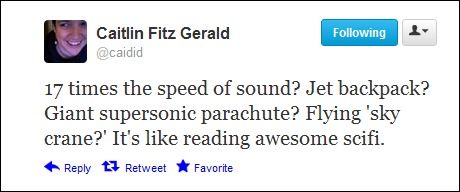
But I don’t think the Book (of the Revelation of St John on Patmos) is the only thing that’s getting out-gunned these days. Consider this tweet from Caitlin Fitz Gerald aka @caidid:

The thing is — aside from terraforming Mars [Frederick Turner, Kim Stanley Robinson] or visiting spaces deeper out, we’ve accomplished or are accomplishing much of what “hard” (ie science-based) science fiction imagined for us. And to my mind, that suggests the possibility that writing hard SF will be getting a whole lot more difficult, and that character and culture will increasingly be what divides the best from the bland.

Still plenty of room for the likes of Jack Vance and his brilliant and beautiful Moon Moth, though.

**

So, will the End Bang be bigger than the Big Bang? Or is there a principle of symmetry that makes them exquisitely equal and opposite?

Landmines in Paradise Garden

Wednesday, August 8th, 2012

[ by Charles Cameron — pros and cons of an important piece by Scott Atran — who among us can comprehend religion? ]
.
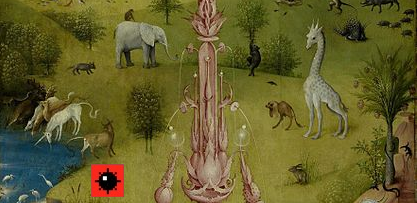
At play (Minesweeper) in the Fields of the Lord (Bosch, Garden of Eden)

.
Scott Atran, the anthropologist who gave us the book Talking to the Enemy, has got it right (as to importance) but wrong (as to procedure) in his latest, significant piece on Foreign Policy, God and the Ivory Tower: What we don’t understand about religion just might kill us.

First, the importance of the issue he’s discussing – understanding religions (emphatically plural, IMO):

Religion molds a nation in which it thrives, sometimes producing solidarity and sacred causes so powerful that citizens are willing to kill or die for a common good (as when Judea’s Jews around the time of Christ persisted in rebellion unto political annihilation in the face of the Roman Empire’s overwhelmingly military might). But religion can also hinder a society’s ability to work out differences with others, especially if those others don’t understand what religion is all about. That’s the mess we find ourselves in today, not only among different groups of Americans in the so-called culture wars, but between secular and Judeo-Christian America and many Muslim countries.

Time and again, countries go to war without understanding the transcendent drives and dreams of adversaries who see a very different world. Yet we needn’t fly blindly into the storm.

Atran is exactly right: we needn’t fly blindly into the storm — but to avoid flying blindly we need to understand those “drives and dreams of adversaries who see a very different world” — and to avoid flying into the storm at all we may (all of us, friends and foes alike) need to understand our own “transcendent drives and dreams” better than we do at present.

The question is, who can help us do that?

That’s what I mean by the procedure — the path that should be taken to achieve that kind of understanding. And note: there are different kinds of understanding — theoretical, imaginative, visceral… dispassionate, empathetic, impassioned…

**

Atran’s answer is science:

Science can help us understand religion and the sacred just as it can help us understand the genome or the structure of the universe. This, in turn, can make policy better informed.

There’s only one problem there. I can believe that scientists of extraordinary breadth and insight – Einstein, Bohr, Oppenheimer, Gell-Mann, Feynman probably – and social scientists — Bateson certainly, Victor Turner, Atran perhaps – my lists are not exhaustive – could make useful suggestions for scientific approaches to the field of religion.

But scientists in general? As Atran notes:

If you look at the prestigious U.S. National Academy of Sciences or Britain’s Royal Society, well over 90 percent of members are non-religious. That may help explain why some of the bestselling books by scientists about religion aren’t about the science of religion as much as the reasons that it’s no longer necessary to believe.

Non-believers may “get” what’s dangerous about religions, but they almost certainly won’t “get” what’s marvelous and inspiring about them.

And believers are no better – they may get what’s great about their own tradition, but still see nothing but perdition in the traditions of others…

So to get a decent set of insights worth experimenting with — or modeling, for that matter — requires a blend of subtle thinkers to include some social anthropologists, some scholars of comparative religion, some sociologists with fine-tuned statistical skills, some depth psychologists… believers, skeptics, atheists and agnostics… with a whole wild variety of plumages, specialties and interests.

Yes, and some poets, historians, some hard scientists. Yes.

**

How easy is it to get things wrong?

In his paper Reframing Sacred Values [link is to .pdf] written with Robert Axelrod — the political scientist whose contest for winning strategies for the iterated Prisoner’s Dilemma game put “tit for tat” and agent based modeling on the map in his books The Evolution of Cooperation and The Complexity of Cooperation — Atran speaks of “Rational versus Devoted Actors“.

The distinction is a significant one. And the paper itself is important because, as Atran and Axelrod suggest:

Counterintuitively, understanding an opponent’s sacred values, we believe, offers surprising opportunities for breakthroughs to peace. Because of the emotional unwillingness of those in conflict situations to negotiate sacred values, conventional wisdom suggests that negotiators should either leave sacred values for last in political negotiations or should try to bypass them with sufficient material incentives. Our empirical findings and historical analysis suggest that conventional wisdom is wrong. In fact, offering to provide material benefits in exchange for giving up a sacred value actually makes settlement more difficult because people see the offering as an insult rather than a compromise. But we also found that making symbolic concessions of no apparent material benefit might open the way to resolving seemingly irresolvable conflicts.

But who is to say which actors are “devoted”?

The most devoted may be the one who stands in most need of redemption, the one who has sinned the most, not the one who has been the most pious. Let me put that another way: the most devoted may be the drunken reveler rather than the regular church- or mosque-goer.

**

Consider:

Inigo was a courtier, a conquistador, a musketeer. The commandments were of course unquestionable in theory, but practice was entirely another matter. Church was for times of danger or for celebration of victory, and he never prayed so hard to our Lady as before a duel. In his last years when he had no need to be boastful, he was quoted by his secretary- biographer: “Though he was attached to the faith, he lived no way in conformity with it and did not avoid sin. Rather, he was much addicted to gambling and dissolute in his dealings with women, contentious and keen about using his sword.”

Inigo found plenty of trouble…

A scientist might not think such a person a reliable example of religious fervor. An antagonist of religion might think it illustrates the flaws of religion perfectly.

The passage in question comes from a life of St. Ignatius of Loyola, founder of the Jesuits.

Religion is a subtle matter. We may think it a matter of belief, but it may be a matter of behavior – orthopraxy vs orthodoxy is the distinction the folks in religious studies make — or of visionary experience.

It may “take one to know one” – as Thomas Merton, the Catholic contemplative understood the Buddhist contemplatives he met. But then he was open to the possibility that others might have intuitions not dissimilar to those he himself had had. “I’m deeply impregnated with Sufism,” he once wrote — Sufism being the mystical strand in Islam. Indeed, I received a letter from him myself while still a student at Oxford, in which he wrote of his life in the Abbey of Gethsemani, “here you get beaten for being a dervish. I am bruised for this all day long.”

**

But again, one can be blinded by one’s own faith to the merits of the faiths of others. And this is also a subtle business.

Retired US Gen. Jerry Boykin, for instance, said in April last year (link is to YouTube video):

Sharia law is a very serious threat in America. We are being invaded by a group of people who see it as their absolute imperative to establish a legal system in America which will in fact destroy our Constitution to be replaced by this thing called Sharia law.

One wonders what Boykin might make of the late California Presbyterian teacher, RJ Rushdoony — a figure, I’m guessing, far to the General’s right?

As is widely known, the New Testament contains a “Great Commission” which Christ gave to his apostles after his Resurrection:

Then Jesus came to them and said, “All authority in heaven and on earth has been given to me. Therefore go and make disciples of all nations, baptizing them in the name of the Father and of the Son and of the Holy Spirit, and teaching them to obey everything I have commanded you. And surely I am with you always, to the very end of the age.” — Matthew 28:18-20.

Rushdoony, in his master work The Institutes of Biblical Law, makes it clear that in his views, this constitutes a divine mandate to bring Biblical law into effect in all nations: “The fulfillment of that covenant is their great commission: to subdue all things and all nations to Christ and His law-word” (Institutes, p. 14) and this is to be achieved in terms of a single world order, “The goal is the developed Kingdom of God, the New Jerusalem, a world order under God’s law” (Institutes, p. 357).

Sadly, the church no longer recognizes the full implications of the Great Commission, and has fallen into a heresy that is political in nature: “The church today has fallen prey to the heresy of democracy” (Institutes, p. 747). In truth, the laws of a democratic society will need to be replaced by the laws of God as set forth in the Old Testament: “While all Scripture is God’s law word, the heart of that law is the law of Moses” (Institutes, p. 675).

Here’s where it gets trickier, though:

Slavery, too, will need to be reinstituted: “The (Biblical) Law here is humane and also unsentimental. It recognizes that some people are by nature slaves and will always be so. It both requires that they be dealt with in a godly manner and also that the slave recognizes his position and accepts it with grace” (Institutes, p. 251).

**

This thing called “religion” is difficult to pin down. It has extremes that appear unconscionable even to many who claim devotion to the same scriptures as do the extremists. It features violence, peace, apocalypse as destruction and apocalypse as fresh creation.

Atran is an anthropologist – he surely knows this.

The study of religion involves walking through a minefield — in the gardens of Paradise…

Aurora, Samarra, Vermont…

Tuesday, July 24th, 2012

[ By Charles Cameron — the gun issue, complexity, human beings being humans and the world we live in ]
.

As always, I’m a fence-sitter bridge-builder, not wanting to take sides, preferring to talk with them.

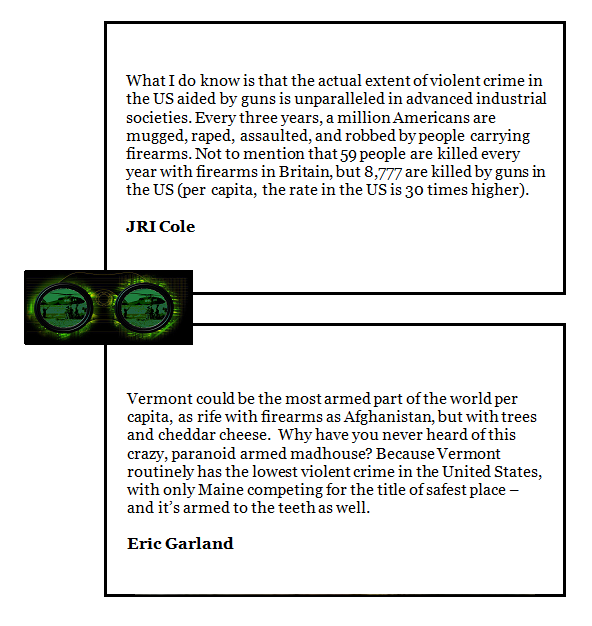
The irritating beauty of these two quotes is that either one taking separately might seem like a “case closed” argument in favor of guns or gun control — but taken together, they show the world to be a dappled place.

Here’s the lead-in to that Vermont quote:

One facet of Vermont life is neither famous nor quaint: Vermonters are armed to the teeth. Guns are absolutely everywhere. Rifles. Pistols. Shotguns. Muzzle-loaders. Semi-automatics. 50 caliber tripod-mount “semi” automatics that could take out aircraft. Every firearm you can possibly imagine. Vermont could be the most armed part of the world per capita, as rife with firearms as Afghanistan, but with trees and cheddar cheese…

Things are weird that way: just when you think you’ve got them figured out, there’s an exception to the rule… a black dot in the white part of the yin-yang symbol… an anomaly that challenges the easy paradigm.

Dappled, as Hopkins puts it.

**

Pied Beauty
by Gerard Manley Hopkins, SJ
.

GLORY be to God for dappled things—
For skies of couple-colour as a brinded cow;
For rose-moles all in stipple upon trout that swim;
Fresh-firecoal chestnut-falls; finches’ wings;
Landscape plotted and pieced—fold, fallow, and plough;
And áll trádes, their gear and tackle and trim.

All things counter, original, spare, strange;
Whatever is fickle, freckled (who knows how?)
With swift, slow; sweet, sour; adazzle, dim;
He fathers-forth whose beauty is past change:
Praise him.

**

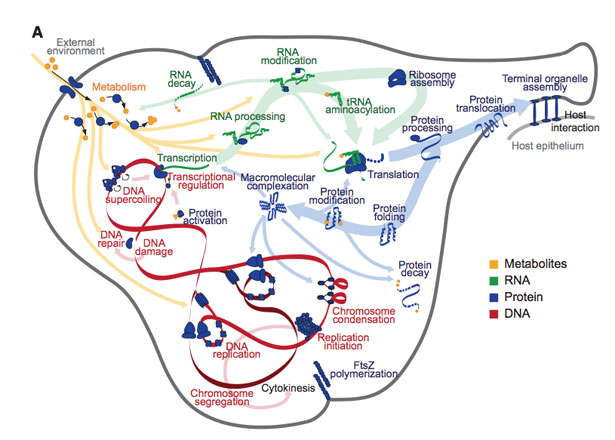
The world is complex: scientists using microscopes and a suite of 128 computers recently (and triumphantly) managed to simulate the genome of one of the smallest micro-organisms in the world, Mycoplasma genitalium (neat name, that):

Alexis Madrigal (another neat name, btw) writes:

“Right now, running a simulation for a single cell to divide only one time takes around 10 hours and generates half a gigabyte of data,” lead scientist Covert told the New York Times. “I find this fact completely fascinating, because I don’t know that anyone has ever asked how much data a living thing truly holds.”

One cell. One division. Half a gig of data. Now figure that millions of bacteria could fit on the head of a pin and that many of them are an order of magnitude more complex than M. genitalium.

Yup. So think how complex the world is. No wonder we name things, divide stuff up into categories — use quite a large chunk of our brains for making distinctions.

But then think how complex the humans studying M. genitalium (still like that name, but this’ll be the last time I mention it) themselves must be… As Madrigal (really a nice name, you can almost sing it) goes on to point out:

Or ponder the idea that the human body is made up of 10 trillion (big, complex) human cells, plus about 90 or 100 trillion bacterial cells. That’s about 100,000,000,000,000 cells in total. That’d take a lot of computers to model, eh? If it were possible, that is.

**

Complexity looks at complexity with a view to modeling it. Simple, you think? Complex, you’d say?

The world’s a subtle place, and I might just go live in Vermont.

But people get shot in Vermont too, from time to time — there’s always a black and bleeding bullet-hole in the white half of the yin yang symbol — this world is hopelessly dappled.

And you know that story Somerset Maugham tells about Samarra?

There was a merchant in Bagdad who sent his servant to market to buy provisions and in a little while the servant came back, white and trembling, and said, Master, just now when I was in the marketplace I was jostled by a woman in the crowd and when I turned I saw it was Death that jostled me. She looked at me and made a threatening gesture, now, lend me your horse, and I will ride away from this city and avoid my fate. I will go to Samarra and there Death will not find me. The merchant lent him his horse, and the servant mounted it, and he dug his spurs in its flanks and as fast as the horse could gallop he went. Then the merchant went down to the marketplace and he saw me standing in the crowd and he came to me and said, Why did you make a threating getsture to my servant when you saw him this morning? That was not a threatening gesture, I said, it was only a start of surprise. I was astonished to see him in Bagdad, for I had an appointment with him tonight in Samarra.

Idries Shah tells a version of the same story as “When Death Came to Baghdad” in his Tales of the Dervishes, but with Samarkand rather than Samarra as the fatal destination.

It just might be the same with Vermont.


Switch to our mobile site