zenpundit.com » greece

Archive for the ‘greece’ Category

A couple more beads for Hesse’s Game

Sunday, April 24th, 2016

[ by Charles Cameron — Art & Philospphy, Latin, Greek & Arabic, Porphyry & Proclus ]
.

I discovered Elaine Van Dalen‘s twitterstream today, and was enchanted. Trawling backwards a little from her tweet about the Sultan al-Kamil, I ran across this one:

which fairly begged to be DoubleTweeted with this hastily assembled tweet of my own, quoting from Hermann Melville‘s Mardi:

**

Both are instances of the game Hermann Hesse described himself playing while raking and burning leaves, in his poem Hours in the Garden:

Within me, my thoughts begin to play
A game, an exercise I have practiced for many years.
It is called the Glass Bead Game, a charming invention
Whose framework is music, whose basis is meditation.

[ … ]

I hear music and see men of the past and the future.
Wise men and poets and scholars and artists, all of one mind,
Building the hundred-gated cathedral of the spirit…

That’s Hesse’s private manner of playing the Glass Bead Game: the game as played in the novel is more abstract, shorn of persons, a virtual music of ideas indeed.

I’ve quoted this over and over, I know, but for those who are new to the Game, here’s Hesse’s definitive description from the novel:

The Glass Bead Game is thus a mode of playing with the total contents and values of our culture; it plays with them as, say, in the great age of the arts a painter might have played with the colors on his palette. All the insights, noble thoughts, and works of art that the human race has produced in its creative eras, all that subsequent periods of scholarly study have reduced to concepts and converted into intellectual values the Glass Bead Game player plays like the organist on an organ. And this organ has attained an almost unimaginable perfection; its manuals and pedals range over the entire intellectual cosmos; its stops are almost beyond number. Theoretically this instrument is capable of reproducing in the Game the entire intellectual content of the universe.

Déjà Vu as DoubleQuote

Thursday, July 9th, 2015

[ by Charles Cameron — Greek or Turk, austerity or quake — as Buddha might say, it’s dukkha, suffering, no? ]
.

This is not the first time we’ve seen the same image serve dual purposes, but it’s still a neat reminder of the hazards of trusting modern media:

Deja Vu DQ

Is the poor man experiencing some sort of variant on Groundhog Day?

Hat tip: Eliot Higgins of Bellingcat.

**

Sparagmos (see title in larger print, left) is an interesting word, btw. Literary critic Northrop Frye:

The imagery of cannibalism usually includes, not only images of torture and mutilation, but what is technically known as sparagmos or the tearing apart of the sacrificial body, an image found in the myths of Osiris, Orpheus, and Pentheus.

The black flags of Athens and Athos

Wednesday, August 7th, 2013

[ by Charles Cameron — mostly about monks vs riot police on the Holy Mountain ]
.

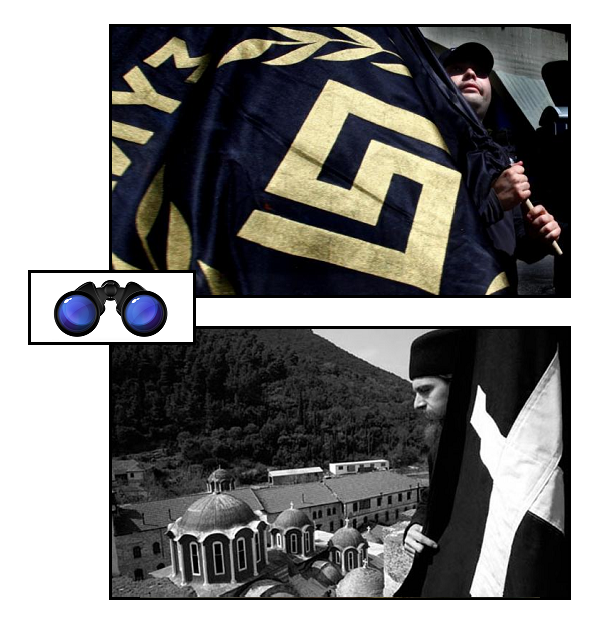
I’ve written often enough about the black banners in Islamic iconography — here are two examples of black flags from Greece, one of them specifically Christian:

The flag in the upper image you probably know: it’s one version of the Greek nationalist Golden Dawn party flag, with its swastika echo that the party describes as a “meander”. The lower image is described thus by photojourno Nikos Pilos:

Father Paulos is holding the black flag with the white cross, Esfigmenon’s Monastery and zealots’ symbol. The meaning of this flag is “orthodoxy or death “. The monks of Esfigmenon Monastery have stopped since 1972 (time of the patriarch Athinagora, Dimitrio and Vartholomeo) to mention in their preys the name of Constantinople’s Patriarch, blaming him as a heretic because he had and he has conversations with the Pope. The last dramatic episode in the history of one of the earliest Orthodox monasteries, 1500 years after it was first built in Mt Athos, the Holy Mountain in northern Greece.

Let me offer you some angles on what’s given rise to that monk with a black banner

**

July 29th’s Vatican Insider carried an article titled Patriarchate of Constantinople wages war against rebel monks on Mount Athos, describing the most recent event with a little background:

The Greek government sent riot police to Mount Athos in Northern Greece this morning, to forcibly remove a group of monks from Esphigmenou monastery, one of the twenty monasteries that form part of this famous Eastern orthodox complex. Esphigmenou monastery is renowned for the war it has waged against the Ecumenical Patriarchate of Constantinople which it accuses of betraying the Orthodox Church by opening ecumenical dialogue with the Vatican. A war which has been going on since the 70s. According to an Associated Press report, the traditionalist monks threw stones and Molotov cocktails at police and judicial officials as they attempted to storm the building .Patriarch Bartholomew declared the monks of Esphigmenou an illegal brotherhood in 2002 and ordered their eviction. But the monks ignored this, claiming the Patriarch of Constantinople does not have the power to evict them.

**

In response to news media, the monks posted a friend’s report, Correcting the Record:

I just spoke with one of the Esphigmenou monks, Father Sava, and want to correct the record about the ongoing attacks against the monastery today.

This morning, a group of around 20 large armed men armed attacked the Esphigmenou monastery building in Karyes, Mt. Athos where the monks were engaged in quiet prayer. This is the 12th day that the monastery has been under siege. The monks twice asked for the men to leave in peace after a city clerk attempted to serve them with eviction papers. Then the 20 large men attempted to smash their way into the monastery building with a construction bulldozer. As you can see in the video, uniformed Greek police stood around while a bulldozer attacked the property and attempted to smash down the front door:

This bulldozer came within 15 centimeters of killing a defenseless monk (who was behind the door and did sustain injuries) with its steel blade.

Contrary to media reports, they did NOT throw any bombs. I specifically asked Fr. Sava about these alleged “bombs” and he said that they do not have bombs and did not throw any bombs. It appears Greek government officials are trying to cover up their complicity in these lawless and criminal activities by spreading false reports to media outlet now that their nefarious activity has been exposed. The video of the attack shows that there is no evidence of bombs or aggressive action by the monks.

**

Finally, here’s the Theology of the dispute, also from the monks’ site:

The fathers of Esphigmenou struggle against the heresy of ecumenism which states that there is no one church which possesses the Truth. The Orthodox Church believes, as the monks of Esphigmenou Monastery believe, that the Church has never lost the Truth or its unity. The Nicene Creed states the Orthodox Church’s dogmatic basis, “I believe in one Holy Catholic and Apostolic Church. I believe in one baptism.” Ecumenism rejects these fundamental truths of the church by teaching that there are many churches and many baptisms.

The beliefs of ecumenism and the beliefs of Orthodoxy are mutually exclusive. You can either believe in the Creed or you can believe in ecumenism, not both. By embracing ecumenism Patriarch Bartholomew has embraced a belief in conflict with the teachings of the Orthodox Church. This is what the monks object to and what they wish to discuss with the Patriarch. There is not a single saint of the Church, ever, who believes in what Patriarch Bartholomew teaches and practices with regards to ecumenism, and this has caused great concern on the part of the monks. The Patriarch refuses to allay those concerns and refuses to engage in constructive dialogue with the monks. He has, however, demanded an apology in writing for questioning him.

**

DoubleQuote Sources:

  • Golden Dawn black banner: IB Times
  • Monks’ black banner: Nikos Pilos
  • Book Review: Lords of the Sea by John R. Hale

    Tuesday, November 6th, 2012

    Lords of the Sea: The Epic Story of the Athenian Navy and the Birth of Democracy by John R. Hale 

    “I cannot tune a harp or play a lyre, but I know how to make a small city great.” – Themistocles

    Nautical archaeologist Dr. John R. Hale, an expert on bronze age shipbuilding and seafaring, has written a delightful and robust popular history of the navy of ancient Athens, but more importantly, a poignant political history of the Athenian navy’s  intrinsic relationship to radical Democracy and Empire.  A page turner with enough detail about triremes and warfare in the Aegean to leave you crying “The Sea! The Sea!”,  Lords of the Sea will be enjoyed by naval buffs and philo-Hellenes alike.

    As you would expect, there is much in Lords of the Sea about the design, construction and care of triremes, Piraeus and the Long Walls, the shipsheds at Zea Harbor, the financing of the Athenian navy, trierarchy, naval tactics, rowers and rowing, superstitions of Athenian sailors on campaign, the deforestation of Athens for ship timber, comparisons with Spartan, Persian and Macedonian naval prowess and the great sea battles of the ancient world. Plenty, in fact, to keep naval aficionados happy while reading Lords of the Sea and all of which I am spectacularly unqualified to comment upon. I can say that in regard to ancient navies, I learned much that was new to me.

    What was of greater relevance to me was Hale’s major theme of the political nature of the Athenian navy. That the imperial glory and thalassocracy was irrevocably bound up with democracy itself and bitterly opposed by the wealthy, would-be, oligarchs who consistently preferred a much diminished Athens they controlled as Sparta’s vassals to a democratic Athenian empire where they shared power with the people:

    ….The resumption of work on the Long Walls jolted Athens’ oligarchs into action. A small group of upper-class citizens still hoped to destroy the radical democracy. These men feared that once Athens was permanently and inseparably linked to its navy by the Long Walls, the common people would never be unseated from their rule. Before the walls had been completed, the oligarchs sent secret messages to a Spartan army that was at that moment encamped not far from the frontiers of Attica. The oligarchs invited the Spartans to attack Athens, promising to assist in the overthrow of the current regime. In their own minds, these men were patriots, pledged to restore the ancestral consitution.

    Traitors are always heroic in their own minds.

    Hale was a student of Donald Kagan, whom he credits with inspiring him toward an investigation of the naval prowess of Athens, however in covering the history of Athens, including the Persian and Peloponnesian wars, Hale is more evenhanded in his assessments than Kagan. The  faction of oligarchs come off quite badly, except for the rising to the occasion of the Areopagus, patriotism and sacrifice is to be found  by Hale primarily in the demos, especially the thetes and newly freed and enfranchised slaves who rose to the call to defend the city in the hours of Athens’ maximum  danger. However, the demos in the Assembly were not without fault; rule by the people also proved to be impetuous, arrogant, capricious toward Athenian generals and cruel toward allies and enemies alike. The Athenian empire was, in short,  afflicted with hubris and this caused their downfall.

    Hale ties both democracy and Athens’ unparalleled cultural creativity to thalassocracy. When the political will to maintain Athenian naval dominance and independence as a power faded among the Athenian upper-classes, the spirit of oligarchy ignominiously surrendered Athens to a foreign king, despite a mighty navy and eagerly betrayed their own countrymen:

    ….The Assembly sent Phocion and Demades and Xenocrates, the head of the Academy, to ask Antipater [ Alexander the Great”s regent and successor ]  about terms: a war hero, an orator, and a philosopher to negotiate the fate of a once-great city. Antipater demanded a payment of indemnity equal to the full cost of the war, the handing over of Demosthenes and other enemies of Macedon, and the evacuation of Samos. The thetes of the demos, defined as all citizens with a net worth of less than two thousand drachmas, were to be expelled from Athens. The wealthier citizens who remained must surrender the fort on Munychia Hill in the Piraeus to a Macedonian garrison.

    …..So the Athenian envoys returned to Athens with the terms of surrender that gave up Athenian independence and, for all practical purposes, Athenian identity. The incredible had happened. Almost three-fifths of the citizens – 12,000 out of 21,000 – failed to pass Antiper’s test of wealth. They were the rabble, the mob, the radical democrats who were everywhere blamed for all the crimes of restless, ambitious, and expansionist Athens. They were now to be banished for the good of all, not merely from Athens but for the most part from Greece itself

    The Athenian Assembly would have been far better off keeping Demosthenes, executing the trierachs who had cravenly surrendered to Cleitus the White and his Macedonian fleet, ostracizing Phocion, Demades and Xenocrates and resuming the war. From this defeat, there was no recovery for Athens, nor did the new oligarchy, secure in their power now, seek any. Without the thetes there were no crews to man the ships or skilled laborers to build them at Zea. Athens was broken as a power and a polis forever.

    Strongly recommended.

    Søren Kierkegaard on espionage & Kenneth Burke on strategy

    Thursday, October 25th, 2012

    [ by Charles Cameron — a meditation on theological espionage, literary strategy, a Sufi tale from Jalaluddin Rumi, and why the arts and humanities offer excellent preparation for analytic work ]
    .

    Kit Marlowe's portrait, Corpus Christi College, Cambridge, Kierkegaard sketch, Niels Christian Kierkegaard

    .

    It may seem somewhat strange, at least on the surface, for a poet to be interested in strategy and a theologian in the world of intelligence analysis.

    We poets. however, have been termed “the unacknowledged legislators of the world” by Mr. Shelley, one of our own number, and we theologians long considered our study the Queen of the Sciences – so here we have the roots of attitudes that may flower into this strange hybrid being that is myself.

    **

    It’s not easy to list significant writers who were also in the intelligence business, in part because both “writing” and “intelligence” are subject to varied definitions — so my own list here will lean heavily British, and have the patina of old age rather than the glamor of the freshly minted. Let’s just say that Christopher Marlowe, who wrote the great play Doctor Faustus, was apparently sent on extended errands while up at Cambridge on “matters touching the benefit of his country”.

    More recently Rudyard Kipling, John Buchan, Somerset Maugham, Graham Greene, even JRR Tolkien apparently, Ian Fleming, John le Carré, and Anthony Burgess have been among British writers who were also spies, and Peter Matthiessen can serve as a distinguished recent American example.

    Which brings me to the OSS, and this quote from a 2003 piece on Boston.com:

    Yale’s literature specialists played a key role in shaping the agency’s thinking. Mole-hunter James Jesus Angleton, the most controversial figure in CIA history, began his career as an apprentice of the New Critics on Yale’s English faculty, and his literary training in “close reading” may have shaped his hyper-skeptical (some would say paranoid) approach to counterintelligence.

    **

    Why do fine writers make decent intelligence analysts?

    John le Carré, who has been both, has this to say:

    Artists, in my experience, have very little centre. They fake. They are not the real thing. They are spies. I am no exception.

    I’d like to take that a little further. I’d like to say that to be a keen observer of human behavior, you must be a keen observer of your own – only one who has taken the beam out of his own eye can see clearly the mote that is in another’s. That brings you, I believe that chameleon-like condition of receptivity and observation that Keats termed “negative capability” in his letter to Richard Woodhouse of October 27, 1818.

    More on that in the Sufi story below. Now, onward to the two quotes that anchor this piece.

    **

    Here’s Kenneth Burke on “strategy” in the arts, in his Literature as Equipment for Living [link is to .pdf]:

    For surely, the most highly alembicated and sophisticated work of art, arising in complex civilizations, could be considered as designed to organize and command the army of one’s thoughts and images, and to so organize them that one “imposes upon the enemy the time and place and conditions for fighting preferred by oneself.” One seeks to “direct the larger movements and operations” in one’s campaign of living. One “maneuvers,” and the maneuvering is an “art.”

    Are not the final results one’s “strategy”?

    And Kierkegaard on “spying” as a theologian, in the chapter, Governance’s Part in My Authorship from his The Point of View:

    l am like a spy in a higher service, the service of the idea. l have nothing new to proclaim, I am without authority; myself hidden in a deception. l do not proceed directly but indirectly — cunningly; I am no saint — in short, l am like a spy who in spying, in being informed about malpractices and illusions and suspicious matters, in exercising surveillance, is himself under the strictest surveillance. See, the police also use such people. For that purpose they do not choose only people whose lives have always been most upright; what is wanted is only experienced, scheming, sagacious people who can sniff out everything, above all pick up the trail and expose. Thus the police have nothing against having such a person under their thumb by means of his vita ante acta [earlier life] in order precisely thereby to be able to force him unconditionally to put up with everything, to obey, and to make no fuss on his own behalf. It is the same with Governance, but there is this infinite difference between Governance and the municipal police — that Governance, who is compassionate love, precisely out of love uses such a person, rescues and brings him up, while he uses all his sagacity, which in this way is sanctified and consecrated. But in need of upbringing himself, he realizes that he is duty-bound in the most unconditional obedience.

    **

    To return, then, to the issue of those who spy upon themselves…

    Jalaluddin Rumi has a story in his Masnavi, one of the many facets of which, I suspect, can illuminate this point, albeit a bit obliquely.

    He describes a contest that a sultan once held between the Chinese and Greek schools of artists, to determine which had the greater ability in art. Each school was given one half of a room, and a great curtain fixed between them. The Chinese, with a vivid appreciation of nature’s moods and humanity’s place between skies and mountains, painted their half of the room with exquisite care and subtlety. The Greeks took quite an other approach, covering the walls on their side with silver plate, then buffing and burnishing it to a brilliant reflective sheen.

    When the work was done and the curtain drawn back, the beauty of the Chinese room was stunning – but the loveliness of the Greek room, in which the Chinese room was reflected to dazzling effect, was even more so:

    The image of those pictures and those works
    was mirrored on those walls with clarity.
    And all he’d seen in there was finer here –
    his eyes were stolen from their very sockets.

    Rumi explains that the Chinese in his fable are like those who see the outer world only, while the Greeks are those who “stripped their hearts and purified them” – and that “the mirror’s purity is like the heart’s”…

    Those who examine their own hearts — Ursula le Guin nicely calls them “withinners” since their voyages, adventures, discoveries and treasures are found primary within themselves — may make reluctant spies, for they do not easily see one side of a dispute as entirely right and the other side utterly wrong: but their nuance places them among the finest of analysts.

    **

    Oh, but let’s be sensible and worldly: most of us like to balance our mundane lives with the more exciting possibilities that are their opposites, and espionage – the derring-do more than the analysis, to be sure – is a wonderful foil for scholars’ fantasies, just as being swept off one’s feet by a prince and loved tempestuously between the pages of a book is a sweet shift from the menial paper trails of office life, and space opera a fine venture for those beset by gravity and white lab coats.

    And whether Jason Bourne, Jack Bauer, James Bond or just a little J&B‘s your tipple, you may find espionage, dealing as it does with secrets, is a natural launching pad for fantasy…

    **

    More sseriously, for the analysts and educators among our ZP readership — let me just suggest that the literary and humane arts will deepen analytic understanding as surely as big data will extend its technical reach.

    And when you come right down to it — your human mind is still the best and subtlest software engine in the room…

    Switch to our mobile site

