zenpundit.com » ideas

Archive for the ‘ideas’ Category

The Sounds of Silence and Your Own Mind

Tuesday, November 27th, 2012

Scott Shipman had an excellent book review post An Unknown Future and a Doubtful Present: Writing the Victory Plan of 1941 — a review-lite and a few questions in which he discussed the intellectual seriousness and evolution of war planner   Major Albert C. Wedemeyer as a military officer and strategist:

….Wedemeyer was an honor graduate of the Command and General Staff College, and his performance earned him the opportunity to attended the Kriegsakademie, the German staff college. However, coupled with impressive academic preparations, Kirkpatrick writes that Wedemeyer’s curiosity exposed him to a “kaleidoscope” of ideas and methods. Kirkpatrick summed-up Wedemeyer: “Competence as a planner thus emerged as much from conscientious professional study as from formal military education…” Going on to say:

In common with many of his peers, much of Wedemeyer’s professional and intellectual education was less the product of military schooling than of personal initiative and experience in the interwar Army.

Wedemeyer’s intellectual development was purposeful and paid off. In Wedemeyer’s deep study of his profession he used the prescribed paths, but also explored on his own. How common is that today? 

As often happens, the discussion can take an unexpected turn in the comments section. Lexington Green weighed in with this:

Think about George Marshall in China, traveling around on horseback.  No cell phone, no email.  The man could actually think.  Or Eisenhower meeting with Fox Connor to talk about the books Connor had him read. Telephone calls were not even common.  The military might do well to have two days once a quarter of silent retreats, only emergency communication permitted, with literally no unnecessary conversation, for groups of officers and non-coms, with some assigned reading and some self-selected on the same theme, then an open discussion after dinner. It would cost virtually nothing and would be an intellectual and mental oasis, and some good ideas might come out of it.  Religious silent retreats which last a couple of days and are truly life-restoring. This would probably be useful as well.

That in turn provoked this response from Marshall:

My sense is that many of us live, work, and fraternize in a culture of crisis. Everything is urgent. One response is to just shut off the moment we get some downtime. TV, drinking, schlock fiction, immersion in pop culture, video games, blog reading are some of the ways I’ve coped. I grew out of those as timewasters as I realized that I no longer had time to shut off if I wanted to do something.

But I still live in a culture of crisis. Almost everybody around me “has no time”. It doesn’t really matter what is being proposed, the sense of urgency kills all ambition toward progress. Defending myself and my space form this is a daily challenge – and some days I lose.

I’m visiting family this week on a long-scheduled “vacation” that has been interrupted by my office several times already, but always with the promise, “just this thing, Marshall, we don’t want to take you away from your family”. And these are the people I choose as my allies!

The culture of crisis doesn’t believe in people’s choices. It says that time will only be wasted, so we have to keep our people busy. After all, see how they spend their “free” time? Dissolute wastrels the lot of them. And then the culture of crisis tells us that we need to recharge by shutting off our minds. You need to vege out, man, you’re stressed; turn on the TV and have a beer, mate. Or else fire up your e-mail and write six more. And, hey, sorry about your insomnia, but it lets you get a jump on the day, amirite? [….]

The discussion moved on, but I have been mulling upon this exchange ever since.

The first thing that came to mind is that what we mean by “silence” really isn’t silent, what is really meant is that there is an absence of human voice pulling at our limited capacity for attention. Cognitive load is probably a real, if variable, limit on human cognition and the nature of hyperconnected information society is that all too frequently we are -and feel – “overloaded”.

When human voices are absent the “background” environmental noise comes “forward” , natural (wind through trees, animals etc) or mechanical (various humms and clicks) that we unconsciously tune out as a matter of routine focusing on conversation or distracting hearsay, broadcasts and so on. The processing in the brain is significantly different depending on what kinds of sounds you are listening to, for example:

1. Listening to Music

2. Listening to Language

3. Listening to unpleasant sounds (nails on chalkboard etc.)
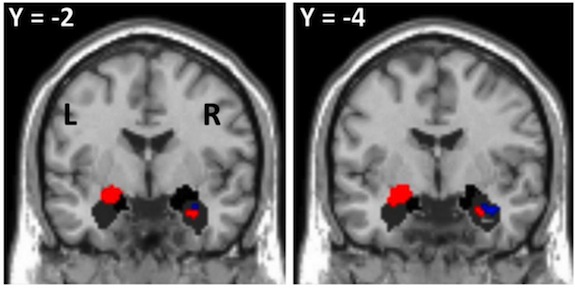
So eliminating human speech from your environment but not hearing (earplugs) itself allows other regions of your brain to become more active than usual, depending on whatever else you may be doing at the time (walking, chopping wood, smelling a flower, scanning the horizon and so on).  Your brain’s performance and how it varies when thinking under conditions of different combinations and levels of sensory stimuli – “crossmodal processing” – is not yet well understood as research is in early stages of investigation.

I will speculate here that what is important for enriching your thinking is that taking your brain out a linguistic-saturated environment (let’s include the “soundless noise” of intruding textual symbols as well from smartphones, iPads, laptops)  gives it an opportunity to operate differently for a time and establish new neuronal network patterns of activity. Various forms of meditation – which involves both silence and an intentional modulation of attention – also  alters normal  brain activity.

I will now go further out on a data-free analytical limb and hypothesize that making a practice of “silence” and/or meditation might improve your thinking by making moments of creative insight more likely. Studies on insight tend to show that as a cognitive event, insight  comes about as a kind of a “pulse” of activity and relaxation in the brain:

….Mark Jung-Beeman, a cognitive neuroscientist at Northwestern University, has spent the past fifteen years trying to figure out what happens inside the brain when people have an insight. Jung-Beeman became interested in the nature of insight in the early nineteen-nineties, while researching the right hemisphere of the brain. Mentions Jonathan Schooler. Jung-Beeman decided to compare word puzzles—or Compound Remote Associate Problems (C.R.A. Problems)—solved. He teamed up with John Kounios, a psychologist at Drexler University, and they combined fMRI and EEG (electroencephalography) testing to scan people’s brains while they solved the puzzles. The resulting studies, published in 2004 and 2006, found that people who solved puzzles with insight activated a specific subset of cortical areas. Although the answer seemed to appear out of nowhere, the mind was carefully preparing itself for the breakthrough. The suddenness of the insight is preceded by a burst of brain activity. A small fold of tissue on the surface of the right hemisphere, the anterior superior temporal gyrus (aSTG), becomes unusually active in the second before the insight. Once the brain is sufficiently focused on the problem, the cortex needs to relax, to seek out the more remote association in the right hemisphere that will provide the insight. As Kounios sees it, the insight process is an act of cognitive deliberation transformed by accidental, serendipitous connections. Mentions Joy Bhattacharya and Henri Poincaré. The brain area responsible for recognizing insight is the prefrontal cortex. Earl Miller, a neuroscientist at M.I.T., spent years studying the prefrontal cortex. He was eventually able to show that it wasn’t simply an aggregator of information, but rather it was more like a conductor, waving its baton and directing the players. In 2001, Miller and Princeton neuroscientist Jonathan Cohen published an influential paper laying out their theory of how the prefrontal cortex controls the rest of the brain. It remains unclear how simple cells recognize what the conscious mind cannot. An insight is just a fleeting glimpse of the brain’s huge store of unknown knowledge.

Another interesting data point to consider re: “silence” and insight is that the mental illness of schizophrenia, where delusions and other mental “noise” exists is significantly negatively correlated with insight.  Researchers are currently investigating if meditation can ease the symptoms of schizophrenia and other mental illnesses.

For myself, I find my best ideas come via insight when I am doing something primarily physical requiring steady but not all of my concentration and I am alone – working out, walking the dog, a household chore and so on. Relatively useful ideas can happen when I am reading or writing or debating (i.e. interacting with a text or a person), but they tend to be analytic and derivative, sort of an intellectual “tweaking” or “tinkering” but not ones that are fundamentally creative or synthesizing.

Lexington Green may be right – Silence is golden.


The Deep Shadow of Abraham Lincoln

Monday, November 26th, 2012

Just saw the Steven Spielberg epic Lincoln.  

The performance of Daniel Day-Lewis as Abraham Lincoln was titanic; all the anger and villainous darkness he channeled into his earlier memorable characters Bill “the Butcher” and Daniel Plainview are eclipsed in his Lincoln by wisdom and a transcendent, melancholic grace. The supporting cast was equally strong, with Sally Fields alluding in word and deed to the shrewish madness that troubled First Lady Mary Todd Lincoln; Tommy Lee Jones humanized – probably more than is historical – the implacable political ferocity of Radical Republican leader Representative Thaddeus Stevens; and James Spader added lighthearted realism as Secretary of State Seward’s cagey political fixer and bagman, William N. Bilboe.

Spielberg has done a magnificent storytelling of the passage of the 13th Amendment to abolish slavery in the United States and he has done even better at capturing Lincoln’s towering stature as a statesman. Day-Lewis’ Lincoln is Periclean – in possession of heroic, historical vision and mastery of grand strategy along with an intimate grasp of the granular, grubby mechanics of political deal making and a humane tolerance of other’s frailties needed to make things happen.  The scene where Day-Lewis explains to his squabbling Cabinet Lincoln’s coup d’oeil –  the real Constitutional, moral, military and political exigencies of emancipation governing the imperative questions of the 13th Amendment –  is one of the most brilliant expositions of strategy in the fusion of policy, politics and war that I have ever seen on screen.

In a sense, that was the genius of Abraham Lincoln – surpassing his own humble origins to solve herculean problems without ever losing sight that lasting resolution of Civil War and slavery were going to have to occur on Earth with fallible human beings, operating in a political reality that would never be ideal. The limits of vision of Lincoln’s contemporaries, copperhead and abolitionist, is marked but the comparison between Abraham Lincoln and politicians of our own day is yet for the worse.  Our problems are so much smaller, our resources and capabilities infinitely vaster than the severe test the Republic faced in Lincoln’s time, yet our leaders are grossly inadequate even to these.

Martyrdom naturally magnified the legacy of Abraham Lincoln, but even without the assassination he would have still been reckoned our greatest president, one of the rare individuals whose leadership made an irreplaceable mark upon history. If one of Lincoln’s rivals for the Republican nomination had become president in 1860 instead, or had Lincoln not been re-elected in 1864, the Union cause would have failed.  We would not be who we are nor the world what it is without a United States in the 20th century to stem the tide of  first German domination, then Fascism and then Soviet Communism. The world would be a poorer, darker place and we would be lesser peoples of lesser nations of the former United States.

Lincoln’s shadow is not merely long, it is deep.

Strategy, Power and Diffusion

Monday, November 19th, 2012

“….and therefore, two kinds of reactions are possible on the defending side, depending whether the attacker is to perish by the sword or by his own exertions.

                                                               – Carl von Clausewitz,  On War

 “Again, if the campaign is protracted, the resources of the State will not be equal to the strain.”

                                                                 – Sun Tzu,  The Art of War 

A recent estimate for the cost of the war in Afghanistan by the Congressional Research Office is $443 billion dollars to occupy and fight a Pakistani-supported insurgency in a primitive country whose annual GDP is a mere $ 27 billion. A  figure that itself inflated by $ 3-4 billion is remittances, $ 4 billion in NGO aid and $14 billion in direct US aid (2010 figure); when you then subtract opium smuggling ($ 4 billion), Afghanistan’s legitimate economic activity may only be a miniscule GDP of  $ 2 – 3 billion.

This does not, of course, include the cost of ten years of lavish bribes for Pakistan, a portion of which was used by the ISI to support the Taliban  killing American and ISAF  soldiers  and Afghan civilians.

This is not a cost-effective or strategic way to run a war. In fact, even for a nation as wealthy as the United States there is nothing in Afghanistan worth such an expenditure of blood and treasure, especially when the bulk of our enemies appear to be based in Pakistan, not Afghanistan. You can approach a strategic problem directly or indirectly but to do so indirectly in the most expensive way logistically possible makes little sense. For example:

….Since the ‘war to end all wars’, however, war has not exactly stood still.  Although the US Defense Logistics Agency rather quaintly describes its mission in terms of a supply chain extending ‘from factory to foxhole’, it is, above all, the mobility of military violence that is central to the conduct of late modern war.  But Creveld is adamant that since 1945 the operational freedom of modern ground forces has not markedly increased, not least because their prized mobility is absolutely dependent on supplies of petrol and gasoline.  Since the end of the Second World War the use of petroleum-based fuels by the US military has soared, and as its stripped-down forces have been expected to do more with less (through technological change and outsourcing) so the fuel expended per soldier has increased by 175 per cent to an average of 22 gallons (83 litres) per day. [viii]  As Obama had US forces ‘surge’ into Afghanistan in 2009 so ISAF’s daily fuel consumption rocketed from two million to over four million litres a day. Given these volumes, it is scarcely surprising that the death-dealing capacities of the US military and its allies should have been tied in knots by ‘umbilical cords’ far more convoluted than Creveld could ever have imagined.

There are three main supply networks to be disentangled in turn.  All of them are ground lines of communication.  Air transportation is extremely, usually prohibitively expensive, and only four airports in Afghanistan are accessible to non-military aircraft, so that until 2011 only 20 per cent of cargo was flown in.  Similarly, onward delivery to combat outposts and forward operating bases has usually only involved airdrops if other options are too dangerous. Still, by the start of 2010 around 30-40 per cent of bases were being supplied by air because the Taliban controlled much of Highway 1, the ring road that loops between Afghanistan’s major cities, and its IED attacks on NATO and Afghan forces were increasingly effective.  The high cost of airdropping pallets of fuel, ammunition, water and supplies has imposed all sorts of fuel economies on the military as it attempts to reduce its carbon footprint – ‘troops have learned to sip, not guzzle’ – but it is still the case that, as one US pilot put it, ‘we’re going to burn a lot of gas to drop a lot of gas’.  According to some estimates it can cost up to $400 a gallon to deliver fuel by air. [ix] 

Neither war nor strategy are a hard science like physics. That said, there are fields of study and investigation that while not being a science are, like physics, inherently about systems or systemic relationships. Economics  and engineering are two such examples, strategy is another.  Because of this similarity, it is often profitable to employ metaphors or analogies from physics to illustrate strategic problems, as Clausewitz famously did in On War with “friction” and “center of gravity“.

Diffusion” might be another analogy for statesmen and soldiers to keep in mind.

Military force, or more broadly, national power marshaled and employed toward a vital objective represents a potent concentration of energy like a red hot iron bar. Thrust deeply into a trough of ice water, the surface of the water yields to the mass and heat of the iron bar in a furious burst of steam and boiling turbulence. Keep the bar submerged and every erg of heat will be sapped out of it by the water and the iron will emerge cold, tempered by the experience and inert. Keep the bar submerged long enough and the water will begin to rust the iron away until nothing is left.

Vast spaces, hostile populaces and deeply impoverished environments are like ice water to the molten heat of an invading power, as we have discovered in Afghanistan.

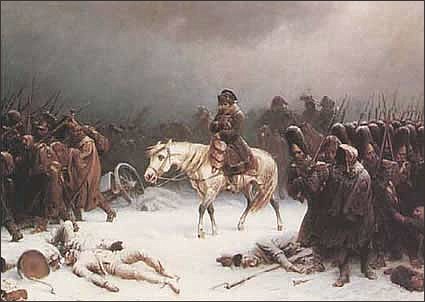
There are already old military maxims that express a warning about the risks of diffusion, notably “Don’t get into a land war in Asia” or “Don’t invade Russia in winter”.  Napoleon Bonaparte marched his vast and fabled Grand Armee of 600,000 men into the endless steppes of Tsar Alexander’s Russia. Everything gave way before Napoleon’s legions, but the Russians were not the Austrians or Prussians, they retreated, savagely burning and destroying as they went:

….Alexander’s proclamation to his people, issued at the time of the French invasion, appealed to these deep seated feelings: Napoleon had come to destroy Russia; the entire nation must rise against ‘this Moloch’ and his ‘legions of slaves’. ‘Let us drive this plague of locusts out! Let us carry the Cross in our hearts and steel in our hands!’ The proclamation was read in all the churches, and the priests supplemented it with embellishments of their own. The Comte de Segur, at this time an aide-de-camp to Napoleon, wrote: ‘They convinced these peasants we were a legion of devils commanded by the Antichrist, infernal spirits, horrible to look upon, and whose very touch defiled”

In Moscow, the city in flames, even Napoleon the Conqueror, the master of Europe, did not have enough men, or material or speed of movement to either digest and rule the immense spaces of Russia or compel Alexander to come to terms:

….Throughout the fall of 1812, Napoleon waited in vain for Alexander’s peace proposals to arrive in the Kremlin. When none came, he made overtures of his own, but Alexander sent no reply. As the days stretched into weeks, Napoleon came to see that he, not Alexander, faced a truly desperate situation, for Russia’s armies grew stronger by the day while his own dwindled from desertions and the ravages of disease. He faced the hopeless prospect of wintering in Russia without adequate food, shelter, or supplies, surrounded by a people so hostile that they burned their grain rather than sell it for French gold. As winter approached, and as the Russian partisans stepped up their attacks on his rear, Napoleon saw that his line of communications, which relied upon a perilously vulnerable corps of couriers who raced from Paris to Moscow in fourteen days, must soon collapse.

Of the Grand Armee, only five thousand returned home from the snowy wastes of Russia alive.

The Wehrmacht did little better. Hitler’s imagined drive to the Urals without a surrender and territorial concession by Stalin was a fantastical ambition. The far-flung distance, roadless mud and icy snow alone were too much for panzer armies and Luftwaffe air wings that proceeded to break down with statistical certainty. Supply lines were too long; gasoline and replacement parts were too few, as were replacements for the men for whom the Eastern Front was a grave. To the dogged resistance of the Red Army, the Germans needlessly added the people’s rage of the Russian partisans by demonstrating to the peasantry that the NKVD held no monopoly on atrocity.  Imperial Japan’s coterminous war in China tells exactly the same unhappy tale.

William Lind and the 4GW school used to like to make the point, regarding your moral and political legitimacy, that ” If you fight the weak, you become weak”. The corollary to that is economic: “If you fight the poor, you become poor”.

Grinding poverty itself  is a tax upon the invading force. There are no resources for your army to comandeer or buy, no skilled manpower to requisition or hire, no infrastructure for them to use. All of that must be imported and built at great expense by the invader whose troops are accustomed to far less spartan environs. The local population is usually malnourished, illiterate, ignorant, suspicious of outsiders and  rife with disease; their living habits and water sources unsanitary and endanger the troops. Caring for the locals, even minimal administration of humanitarian aid, becomes a bureaucratic and logistical burden consuming time and diverting resources away from urgent military needs.

The United States under George Bush the Elder, entered into Somalia, a land beset by violent anarchy and it’s people in the grip of a terrible famine and was driven out shortly thereafter under Bill Clinton. The last scenes there being the emaciated Somali followers of  a two-bit warlord,Mohammed Farah Aidid, gleefully swarming over and looting our military’s former…. garbage dump.

When the enemy has a land so poor that he treasures and makes use of the crap you throw away, the economic spillover of your logistical supply lines will fund his war against you. Used to surviving on bare subsistence, the invader’s presence becomes an economic bonanza for resistance and collaborator alike. Sort of a highly kinetic form of military Keynesianism. The war itself and the occupation become an irreplaceable cornerstone of their economy. They hate you being there, but can’t afford to defeat you and drive you out either – making a “quagmire” irregular conflict their ideal economic equilibrium to maintain.

What lessons can we draw here?

  • Keep your national power concentrated – don’t diffuse it with unmanageable, ill-defined, tasks of unlimited scope
  • Military power is to be used for a clear and articulated policy end with a defined political settlement in mind
  • If a political settlement is impossible because the problem is intractable, avoid involvement.
  • If you cannot avoid getting involved (i.e. -you were attacked) your best option is to engage in a punitive expedition to destroy the war-making capacity of the enemy and impose  ruinous costs and then immediately leave.
  • Keep campaigns short. In operation, military power is a terrible, swift sword and you should sheathe it just as quickly. 
  • Ruling over enemy population is a wasteful, thankless, burden not to be undertaken except in extremis (Reconstruction and occupation of Germany and Japan were in extremis cases).
  • Maximum gains accrue from the most effective use of the smallest possible force in the shortest period of time.
  • Make an army large enough and the enemy will become a secondary or tertiary concern of its leaders.


Does Culture Trump Strategy?

Thursday, November 1st, 2012

The always interesting John Hagel tweeted a link recently to an old post at  Mill’s-Scofield Innovanomics, a blog run by a business strategist and consultant with a science background, Deb Mills-Scofield.

Summer’s Trump Cards 

….Culture Trumps Strategy: The best made plans are worthless if they’re not aligned with the culture. Sometimes the strategy can help transform the culture (for good or bad), but if the culture doesn’t support it, it won’t happen.  Perhaps that’s why I think CEOs need to be CCS’s – Chief Culture Stewards.

Challenge:  Start to check the health of your culture – really, be brutally honest -before the end of August.

This was interesting to me.

Obviously, Mills-Scofield was concerned here with “business strategy” and organizational theory and not strategy in the classical sense of war and statecraft. As Dr. Chet Richards has pointed out, unlike a military leader in war, businessmen are not trying to destroy their customers, their employees or even their competition, but while not the same kind of “strategy”, the underlying cognitive action, the “strategic thinking”,  is similar. Perhaps the same.

So, shifting the question back to the original context of war and statecraft, does culture trump strategy?

On twitter, I had a brief twitter discussion on this with Marc Danziger who was sympathetic to the proposition of cultural supremacy. I am not so sure, though I think the relationship between culture and strategy is an iterative one, the degree to which culture matters in strategy is highly contextual and is determined by how broadly you define cultural values as being directly operative in driving the scenario. Some disjointed comments:

  • Your own cultural-societal worldview shapes politics, policy and politik. So indirectly, culture will be a determining factor in conceiving “Ends” worth spilling blood and dying for – particularly in wars of choice. When war, especially existential conflict is forced upon a state by an enemy attack, some of the initiative and room for constructing artful or limited “Ends” has been lost and becomes secondary to survival. Even Stalin’s normally overweening and murderous ideological preferences mattered somewhat less in Soviet policy and strategy the day after Operation Barbarossa began than the day before.
  • If the Ends in view imply forcing a political settlement upon the enemy – “compelling him to do our will” – than the enemy’s culture matters a great deal. All the moreso, if the war entails COIN, military governance of an enemy population and reconstructing an enemy state to our liking. The enemy culture is part of the operational environment because our use of military force (destruction) is going hand in glove with substantial political activity (construction) – mere physical control of the population is not enough, though it is a precondition for success. MacArthur’s role as SCAP in post-war Japan demonstrated an exceptionally shrewd blend of coercion and concession to traditional Japanese cultural touchstones.
  • If our Ends are much more limited – degrading enemy operational capacity and/or simple, spasmodic, punitive expeditions to impose costs on an enemy state or entity in retaliation for aggression; or, if we intend to stand off-shore and strike with air and naval superiority – than the enemy culture matters far less. Force is being used to “bargain” at a very primitive level that does not require much cultural nuance to understand and the message of “we will hit back” . Likewise, if the war is an unlimited one of extermination and Carthaginian peace, enemy culture matters far less than your military capacity to execute your strategy.
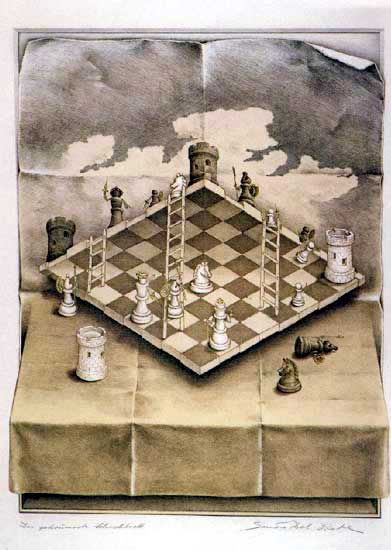
  • Your cultural worldview shapes your grand strategy or statecraft because great and lesser powers are not coldly playing chess for material interests alone when they engage in geopolitical conflict and warfare but are establishing, evolving and protecting a national identity on the world stage. What Thucydides called “Honor”, the British “Paramountcy”, Richard Nixon “Credibility” and Joseph Nye “Soft Power” may all have been intangible expressions, difficult to quantify, but are very much part of the strategic calculus of war and peace.
  • Finally, it is important to note that strategic employment of brute force has a large role in setting the parameters of where and when cultural nuance and interpretation matter and exercise political leverage during war. Extreme violence disrupts and warps the cultural norms of belligerents, usually for the worse. It was the wars of the French Revolution and Napoleon that awoke the romantic pan-German nationalism of the 19th century that eventually united Germany and transformed it into the terror of the world in the 20th. The First World War ushered in a century of ideological monstrosities and revolutionary state terrorism on an epochal scale of murder unequaled even by the butchery of the Romans or Mongols. War is often the Abyss that looks into you.

Thoughts?

Strategy and Creativity: Part I.

Tuesday, October 9th, 2012

“War is more than a true chameleon that slightly adapts its characteristics to the given case. As a total phenomenon its dominant tendencies always make war a remarkable trinity–composed of primordial violence, hatred, and enmity, which are to be regarded as a blind natural force; of the play of chance and probability within which the creative spirit is free to roam; and of its element of subordination, as an instrument of policy, which makes it subject to reason alone.”
                                                                                                -Carl von Clausewitz, On War

“Thus the highest form of generalship is to balk the enemy’s plans; the next best is to prevent the junction of the enemy’s forces; the next in order is to attack the enemy’s army in the field; and the worst policy of all is to besiege walled cities….Therefore the skillful leader subdues the enemy’s troops without any fighting; he captures their cities without laying siege to them; he overthrows their kingdom without lengthy operations in the field. With his forces intact he will dispute the mastery of the Empire, and thus, without losing a man, his triumph will be complete. This is the method of attacking by stratagem.”
                                                                                             – Sun Tzu, The Art of War 

This blog is read by many people with a deep interest in strategy coming from different philosophical and professional perspectives. While I have my own speculations  based on years of study, I would like to begin by first posing a few questions to the readership:

  • What is the relationship between strategy and creativity?
  • Or between strategic thinking and creative thinking?
  • Is “doing strategy” primarily an act of planning, calculation and rational problem-solving or is it also a profoundly creative and intuitive enterprise?
  • If we get better at thinking creatively, do we become better, more effective strategists? The reverse?
  • Is creativity more useful in “grand strategy” (or “statecraft”, if you prefer) and policy than in straightforward “military strategy”?

The floor is yours, strong argument is welcomed.


Switch to our mobile site