zenpundit.com » ideas

Archive for the ‘ideas’ Category

On Psychopaths and Society

Wednesday, August 22nd, 2012

Earlier this year, milblogs had much discussion regardingtoxic leaders” – so-called “leaders” who in command epitomized a bullying, negative, destructive, egocentric, “boss from hell” that compromised missions, institutional values, morality and sometimes the law with their behaviors. This a phenomena plaguing more than just in the US military; a best-selling business book, The No Asshole Rule by Stanford professor Robert I. Sutton , even attempted to quantify the negative economic impact of psychopathic or antisocial personalities on their organizations and concluded the best strategy was to systematically not hire these people in the first place (Steve Jobs, incidentally, was identified by Sutton as the extremely rare asshole who created significantly more value for an organization than he destroyed in the damage he did to the people around him).

I came across an intriguing discussion of pyschopathology on TED that takes a number of surprising twists that puts “toxic” personalities in a different perspective than fixed categories.

An Unquiet Riot

Monday, August 20th, 2012

The Master and the Minion

The Russian girl-punk rock band Pussy Riot has done something with their protest at  Christ the Savior Cathedral that prior cases of oppression, election-fraud, corruption and murder of Putin’s critics by agents of the siloviki regime failed to do – put a defiant human face on political persecution in Russia. Something we have not seen since the days of Sakharov and Solzhenitsyn.
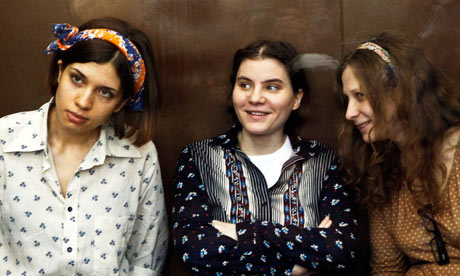

Photo credit: The Guardian 

A reminder that when men are not free, mocking insolence is a form of bravery.

In a thoughtful post, Charles Cameron suggests that their performance was not a “political protest”. I disagree, though I think Charles’ examination of the tradition of “Holy Fools” in Russia is useful and culturally relevant as to how this event was intended to register with a Russian audience. Pussy Riot was being audaciously offensive in their selection of performance sites, as TM Lutas explains:

Orthodoxy is not a religion that is widely understood in the West. So it’s actually the rare pundit that catches how offensive what this punk riot group was doing actually was. There’s a subtitled version of the video that helps. The video misses the positional problems. The picture screen, called an iconostasis is something like the old altar rails of Catholicism but with fairly elaborate rituals surrounding the structure. There are three doors, the center one is called the holy doors. As a lay person you’re not even supposed to walk in front of that door. It’s viewed as disrespectful, even sacrilegious. So the people in charge of order and discipline were a bit stuck because these girls were dancing in the sanctuary, in front of the iconostasis and extracting them actually meant that they had to break the rules too. Several times a Pussy Riot girl bowed and did a full prostration. One does these things towards the altar in Orthodoxy. Reversing this as the protesters did is viewed as idolatry. Who, exactly, are they bowing to? That’s the genesis of the “devil dancing” talk in their trial.

Putin may have been a target but he certainly wasn’t the target. Their attack had a much wider range of victims. This was an attack on Orthodoxy, an attack on symphonia, the concept of church and state in complementary roles and mutual respect, and also an attack on Putin. 

In 4GW thinking, the strong lose when they are forced to fight the weak on terms that favor the weak. Pussy Riot – a group of young women – engineered a protest at a location whose significance meant that the authorities could not easily ignore or suppress it quietly with brutal thuggery in the shadows. By making Vladimir Putin the lyrical center of gravity, local officials were  made to look sycophantic and toadying, national officials petty and foolish. The Russian authorities, burly and oafish like their Soviet counterparts, have been reduced to fighting young girls while the rigged legal system that passes for justice in Russia is showcased in the unsparing glare of the global media.

By daring the authorities to make them political prisoners, Maria Vladimirovna Alyokhina, Yekaterina Stanislavovna Samutsevich and Nadezhda Andreyevna Tolokonnikova have made the regime look weak.

Moreover, their actions are a not so subtle reminder to Russians that the Orthodox Church is a corrupt vessel, a propaganda arm of the regime with a long tradition of KGB agents as Patriarchs and squalid informers as clergymen. The Church in Russia has not been free of the tentacles of state security since the day Lenin ordered the arrest of St. Tikhon. President Putin and Patriarch Kyrill are not peers temporal and spiritual, but fellow alumni of the same organs as the Big Lubyanka’s gaolers and policemen.

I would like to close this post by letting Yekaterina Samutsevich speak for herself:

In the closing statement, the defendant is expected to repent, express regret for her deeds, or enumerate attenuating circumstances. In my case, as in the case of my colleagues in the group, this is completely unnecessary. Instead, I want to voice some thoughts about what has happened to us.
That Christ the Savior Cathedral had become a significant symbol in the political strategy of the authorities was clear to many thinking people when Vladimir Putin’s former [KGB] colleague Kirill Gundyayev took over as leader of the Russian Orthodox Church. After this happened, Christ the Savior Cathedral began to be openly used as a flashy backdrop for the politics of the security forces, which are the main source of political power in Russia.
Why did Putin feel the need to exploit the Orthodox religion and its aesthetic? After all, he could have employed his own, far more secular tools of power—for example, the state-controlled corporations, or his menacing police system, or his obedient judicial system. It may be that the harsh, failed policies of Putin’s government, the incident with the submarine Kursk, the bombings of civilians in broad daylight, and other unpleasant moments in his political career forced him to ponder the fact that it was high time to resign; that otherwise, the citizens of Russia would help him do this. Apparently, it was then that he felt the need for more persuasive, transcendent guarantees of his long tenure at the pinnacle of power. It was then that it became necessary to make use of the aesthetic of the Orthodox religion, which is historically associated with the heyday of Imperial Russia, where power came not from earthly manifestations such as democratic elections and civil society, but from God Himself.
How did Putin succeed in this? After all, we still have a secular state, and any intersection of the religious and political spheres should be dealt with severely by our vigilant and critically minded society. Right? Here, apparently, the authorities took advantage of a certain deficit of the Orthodox aesthetic in Soviet times, when the Orthodox religion had an aura of lost history, of something that had been crushed and damaged by the Soviet totalitarian regime, and was thus an opposition culture. The authorities decided to appropriate this historical effect of loss and present a new political project to restore Russia’s lost spiritual values, a project that has little to do with a genuine concern for the preservation of Russian Orthodoxy’s history and culture.
It was also fairly logical that the Russian Orthodox Church, given its long mystical ties to power, emerged as the project’s principal exponent in the media. It was decided that, unlike in the Soviet era, when the church opposed, above all, the brutality of the authorities toward history itself, the Russian Orthodox Church should now confront all pernicious manifestations of contemporary mass culture with its concept of diversity and tolerance.
Implementing this thoroughly interesting political project has required considerable quantities of professional lighting and video equipment, air time on national television for hours-long live broadcasts, and numerous background shoots for morally and ethically edifying news stories, where the Patriarch’s well-constructed speeches would in fact be presented, thus helping the faithful make the correct political choice during a difficult time for Putin preceding the election. Moreover, the filming must be continuous; the necessary images must be burned into the memory and constantly updated; they must create the impression of something natural, constant, and compulsory.
Our sudden musical appearance in the Cathedral of Christ the Savior with the song “Mother of God, Drive Putin Out” violated the integrity of the media image that the authorities had spent such a long time generating and maintaining, and revealed its falsity. In our performance we dared, without the Patriarch’s blessing, to unite the visual imagery of Orthodox culture with that of protest culture, thus suggesting that Orthodox culture belongs not only to the Russian Orthodox Church, the Patriarch, and Putin, but that it could also ally itself with civic rebellion and the spirit of protest in Russia.
Perhaps the unpleasant, far-reaching effect of our media intrusion into the cathedral was a surprise to the authorities themselves. At first, they tried to present our performance as a prank pulled by heartless, militant atheists. This was a serious blunder on their part, because by then we were already known as an anti-Putin feminist punk band that carried out its media assaults on the country’s major political symbols.
In the end, considering all the irreversible political and symbolic losses caused by our innocent creativity, the authorities decided to protect the public from us and our nonconformist thinking. Thus ended our complicated punk adventure in the Cathedral of Christ the Savior.
I now have mixed feelings about this trial. On the one hand, we expect a guilty verdict. Compared to the judicial machine, we are nobodies, and we have lost. On the other hand, we have won. The whole world now sees that the criminal case against us has been fabricated. The system cannot conceal the repressive nature of this trial. Once again, the world sees Russia differently than the way Putin tries to present it at his daily international meetings. Clearly, none of the steps Putin promised to take toward instituting the rule of law has been taken. And his statement that this court will be objective and hand down a fair verdict is yet another deception of the entire country and the international community. That is all. Thank you.
Pakistan’s Strategic Mummery

Saturday, August 18th, 2012

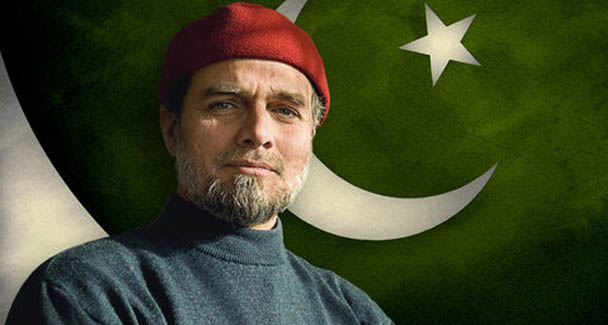
A while back, Charles Cameron had a post on the Ghazwa E Hind that served as my introduction to an oddball Pakistani agitator named  Zaid Hamid The colorful Mr. Hamid seems to be Pakistan’s fully militarized version of Glenn Beck fused with an Islamist George Friedman, with perhaps an astrologer and Rip Taylor thrown in for good measure. In discussing this figure, ZP commenter Omar offered:

….But this clown has serious backers. The deep state systematically uses these clowns to prepare the “information space” for their plans. ..and they are not kidding around. 

Zaid Hamid made a recent appearance in another post by Charles, so I felt inspired to look at him more closely and discovered that Hamid, who has a fondness for 4GW verbiage, has his own think tank, Brasstacks which publishes “geostrategic analysis”, largely about alleged “Hindu Zionist” (?) conspiracies to destroy Pakistan. These papers are fascinating, in a car-crash sort of way, much like a political intelligence letter from the LaRouchies. There is also a blog by Hamid, where his latest post remarkably declares Pakistan’s late dictator, the ruthless General Zia ul-Haq, a “shaheed”.

My question, since Hamid appears to stir controversy and criticism within Pakistan, is what is his real level of influence in Paskistani society? Comments welcome.

Rethinking Fortification

Monday, August 13th, 2012

John Robb now has a Facebook page for Global Guerrillas, where he posts quick snippets of big ideas. It seems to be a replacement for his old, informal, personal blog which served a similar purpose some years back. In any event, John had a spectacular picture of Mexico City and an intriguingly dystopian caption:

Mexico City. 

Future of warfare. Megacities + millions of drones.

I wandered into a Mexican shantytown once, back in the 1990’s . Not sure I would care to repeat the experience at the present time.

Robb’s facebook post started me thinking. If drones of all sizes and functions become ubiquitous someday, it creates a great incentive for the powerful, at least to safeguard their privacy, to apply human ingenuity toward concealment, countermeasures and postmodern “citadels”.

All the moreso, if “megacities’ are all girdled in vast seas of slums. Imagine the LA or London riots with 20 times the underclass population. The bloody experience of the New York City Draft Riots during the Civil War taught the Robber Barons of the Gilded Age to support the building of public and private armories to defend the gentle classes from the great uprising that never came.

Fortification is something of a lost art, but it was up until recent history, a critical military capability. After castles went into a temporary decline with the advent of cannons blasting apart their high walls, post-renaissance architects redesigned European fortifications to endure the new bronze siege guns and defense again triumphed over offense. Military engineers like Vauban were more valuable than field marshals and kings staked their strategies on the strength of chains of fortifications and arsenals.  Obsolete by the time of the Napoleonic wars, massive fortresses nonetheless enjoyed a long twilight march to military irrelevance, ending in WWII with the ignominious capture of Belgium’s mighty Eben-Emael fortress by 75 lightly armed Germans and the utter uselessness of the extremely expensive Maginot Line during the Battle of France.

Fortification began to receive renewed interest as governments sought defensive measures to allow their leadership to survive a nuclear attack, such as the Cold War era secret bunkers for USG officials at Greenbrier or Raven Rock or efforts by rogue dictatorships to build facilities carved deep into a mountain to protect their leadership or nuclear weapons programs from American attack. The ancient arms race of defense and offense continues with the designers of “bunker-busters” as a peripheral military activity.

Governments and occasionally corporations and superwealthy individuals will continue to build and tweak these doomsday bunkers but as strategic investments they do not offer very good ROI. For one thing, if your national leadership is cornered fifty stories underground, it will be little comfort to you and your fellow citizens as the nuclear bombs are exploding; the game is pretty much over at that point. Secondly, the ultimate risk they are hedging against is far more remote and the benefits infinitesimal compared to what rethinking fortification as a concept would do to minimize more mundane and probable risks faced by the rest of us.

A great fortress conjures the idea of impregnability and, ironically, usually achieves eternal fame for falling or being breached – the walls of Constantinople,  the Great Wall of China, Masada, Alamut, Murud-Janjira and the aforementioned Maginot Line. “Impregnability” is a misnomer, what a good fortification really does is raise operational costs for adversaries, hopefully high enough to discourage them from making the effort to attack in the first place. Raising costs for those who bear us ill-will by adaptation and a priori design should be our paradigm.

What are the primary risks we will face in coming years as individuals and societies? Erosion of privacy and the security of our persons, property and data at the hands of criminals, avaricious elites, government and private surveillance and bouts of civil disorder, all in a number of forms. For example

  • Drones: As John Robb suggested in his FB post and at Global Guerrillas, drone usage could potentially become ubiquitous by governments, corporations and individuals with an axe to grind or an interest in stalking, terrorism or committing mayhem.  Imagine the Unabomber or Osama bin Laden with a drone swarm controlled from a laptop – superempowerment will go robotic.Drones will/are becoming semiautonomous. They are easily modified to carry cameras, recording/SIGINT devices, imaging systems, weapons, toxic substances or explosives.
  • Civil Unrest: The UK Riots were an excellent reminder that, as with the LA Riots, in the case of dangerous criminal-class rioting, elites will be unable to reestablish order or rescue law-abiding citizens until their reticence becomes a political debacle (and they may, as in Britain, initially restrain law enforcement personnel from suppressing the rioters). This contrasts with elite willingness to mobilize vast police and paramilitary forces against mere embarrassing political protests.
  • Cybersecurity: This adds a new dimension to fortification that is not limited to a physical space and place, even securing your home networks, but to your identity.

How might we adapt individually and collectively to these risks?

First, we are managing risk within reasonable costs and means while living a normal life. If you imagine something to hold off  an angry mob indefinitely or that will allow you to defy the US government then you need to come out of fantasyland or have a Bill Gates budget to play with. Here are some more practical possibilities:

Privacy architecture: Building design embedded with the idea of  promoting privacy, adjusted to the surrounding environment, which today includes thwarting advocates of a panopticon society. You want a structure that breaks clear fields of vision from the outside to the interior. Overhangs, angled exterior surfaces, material surface to reflect heat and light, ornaments/catwalks/netting and  landscaping to break up spatial fields. Perhaps layered walls of different materials to diffuse or mislead spectral/thermal imaging. This could be incorporated in public spaces in neighborhoods or campuses improving both aesthetics as well as privacy.

Underground: Increasing useful space by building down to sub-basement level gives you more possible points of egress, protection from surveillance technologies, storage and living quarters while concealing the true extent of your property from street level view. Best of all, it usually does not count toward your property tax assessment. Substreet complexes, like the system at Disneyworld, could easily planned into the development stage of residential and commercial construction.

Unobtrusive but Unconventional:  Attracting large amounts of attention is helpful in commerce or branding but generally disadvantageous to security. A home should be designed to frustrate opportunistic predators and delay determined ones with the most interesting elements reserved for the interior and (if possible) the rear with the street view presenting a target that is visually more bland than adjacent structures and also unattractive for forced entry. Windows should be treated to make it more difficult to see in or observe when residents are home vice away.

Defensive Security: This is something to consider individually and cooperatively. I once lived in a house in a town with a modestly high crime rate but never had a problem because the house was in a cul-de-sac with a wide oblong court and a long bottleneck entry. The neighbors knew one another and it was impossible (unlike on a conventional street) to not notice a strange car or pedestrian as every home faced the court.  Aside from alarm systems, simple things like better quality doors and locks buys you time to react. If multilevel, you should have at least two ways to escape from an upper floor (when I designed my second home, there were three) which also increases the interior complexity for an unfamiliar intruder. First floor windows should be out of easy reach from ground level.

Manage your Connectivity: Aside from normal cybersecurity precautions, you might consider managing, blocking or at least being aware of your geolocational activity by being selective about tracking devices (like smart phones) and your exposure to “the internet of things”. Do you really need to hook your fridge up to the internet or pay for everything with a debit card?

Fortification is largely about thinking ahead to put objects and systems between yourself and the world.

State Failure is the Child of Oligarchy

Sunday, August 12th, 2012

An interesting piece in Democracy Journal by James Kwak:

Failure Is an Option

….Countries differ in their economic success because of their different institutions, the rules influencing how the economy works, and the incentives that motivate people,” write Acemoglu and Robinson. Extractive institutions, whether feudalism in medieval Europe or the use of schoolchildren to harvest cotton in contemporary Uzbekistan, transfer wealth from the masses to elites. In contrast, inclusive institutions—based on property rights, the rule of law, equal provision of public services, and free economic choices—create incentives for citizens to gain skills, make capital investments, and pursue technological innovation, all of which increase productivity and generate wealth. Economic institutions are themselves the products of political processes, which depend on political institutions. These can also be extractive, if they enable an elite to maintain its dominance over society, or inclusive, if many groups have access to the political process. Poverty is not an accident: “[P]oor countries are poor because those who have power make choices that create poverty.” Therefore, Acemoglu and Robinson argue, it is ultimately politics that matters.

The logic of extractive and inclusive institutions explains why growth is not foreordained. Where a cohesive elite can use its political dominance to get rich at the expense of ordinary people, it has no need for markets and free enterprise, which can create political competitors. In addition, because control of the state can be highly lucrative, infighting among contenders for power produces instability and violence. This vicious circle keeps societies poor. In more fortunate countries, pluralistic political institutions prevent any one group from monopolizing resources for itself, while free markets empower a large class of people with an interest in defending the current system against absolutism. This virtuous circle, which first took form in seventeenth-century England, is the secret to economic growth….

Read the rest here. 


Switch to our mobile site

