zenpundit.com » ideas

Archive for the ‘ideas’ Category

The Journal of Military Operations

Tuesday, August 7th, 2012
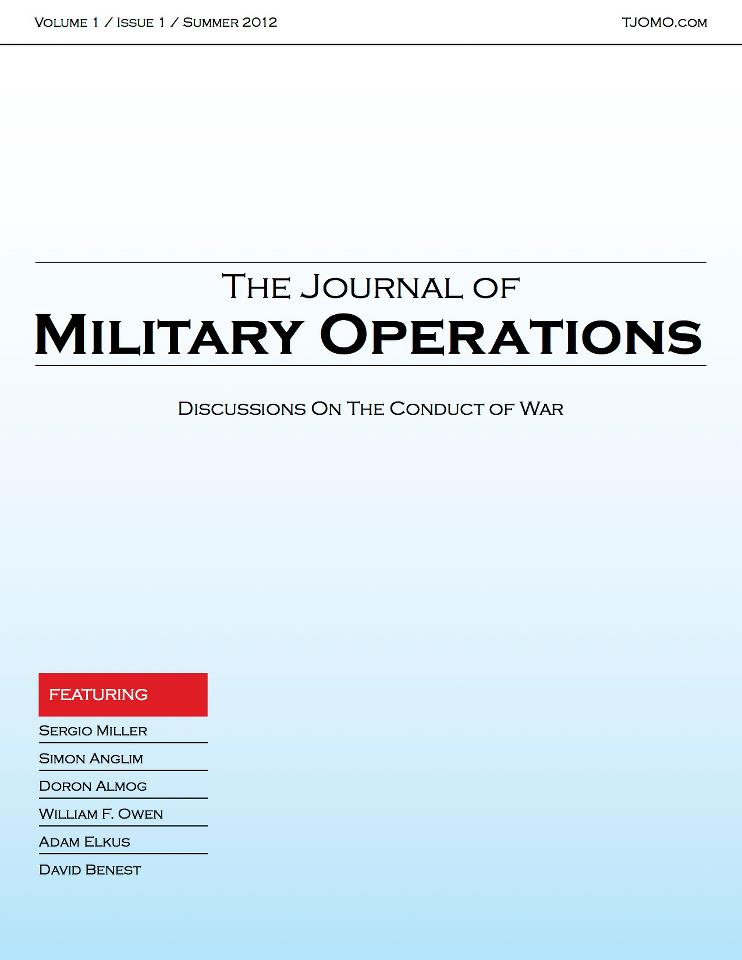
The Journal of Military Operations  

A new peer-review “journalzine” from the IJ  Group, which publishes Infinity Journal.  The difference between the two is that Infinity focuses on strategy while the former, as the masthead implies, is dedicated to military operations as well as tactics. If you do not know what the difference between strategy and tactics are….well….reading these should help. The Editor is Dr. Jim Storr, a.k.a  Colonel Storr, author of the well regarded The Human Face of War.  Registration is free.

The maiden issue of JoMO has articles from two friends of ZP, Deputy Editor Wilf Owen and Adam Elkus.

Ironically, Wilf is  arguing against the existence of an operational level of war or the utility of separating operational art from sound understanding of tactics and strategy and criticizes Soviet strategist A.A. Svechin:

“The Operational Level of War Does Not Exist”

….Thus the definitions of strategy and tactics were and are simple, coherent and highly workable. While armies conducted ‘operations’, such activity did not impinge on the delineation of strategy and tactics. Conducting operations did not an operational level of war make!

The operational level of war is strongly associated with Soviet military thought. A.A. Svechin is often seen as the originator of the idea, when he discussed ‘Operational Art’ (operativnoe iskustvo) as conceptual connection between tactics and strategy.[iii] He defined an operation as ‘the effort of troops directed towards the achievement of a certain intermediate goal in a certain theatre of military operations without interruptions.’[iv] In the very next sentence he went on to explain that operations were designed to destroy or encircle a portion of the enemy forces to force a withdrawal of other forces, to capture or hold a ‘certain line or geographical area.’ Destroying a portion of the enemy’s armies is what battles traditionally sought to do. Svechin’s description equates strongly with battle and thus tactics, at least in terms of the outcome described.

Much Soviet and Russian writing (and Western analysis of it) on the Operational Level of War is, once subject to rigour, paper-thin and mostly a sophistry that arbitrarily creates a false and unneeded link between strategy and tactics. The extremely high losses suffered by Soviet Forces in WW2 are not symptomatic of anything other than bad tactics poorly executed. If the acme of operational art is encirclement operations, then at what level of command does this operational level of war take place? A platoon can encircle an enemy section, just as much as an army group can encircle an enemy army.

Svechin’s fundamental intellectual problem was not that he did not understand strategy or tactics, but how to function as a strategist in a society where politics as normally understood no longer existed and adherence to yesterday’s policy could be regarded as today’s evidence of treason. Indeed, this is what ultimately resulted in Svechin’s demise during the Great Terror despite his best effort to the contrary. Whatever the other merits of defining an “operational level of war” or “operational art” Sevechin was looking for an ideological safe harbor, a purely “technical” realm where military officers could do the campaign planning war required without the act of planning or doing strategy itself being ideologically suspect in Stalin’s eyes.  In 1937, this was a hopeless task, but Svechin’s legacy carved out a degree of professional autonomy for Red Army general staff officers in milder times that was unthinkable under Stalin’s rule.

Adam Elkus explains “D&D”:

“The Continuing Relevance of Military Denial and Deception”

….From the end of the Cold War onwards, Western militaries have rightly assumed that military competitors would attempt to disguise their power and deceive to draw attention away from their real capabilities and intentions. Moreover, the West’s enemies also are frequently authoritarian states for whom cheating and deception is basic political behavior. The attractiveness of deception operations and capabilities to opponents ranging from Mao’s China to Saddam Hussein’s Iraq provides empirical support for this prejudice.

But democracies are also capable of information manipulation and deception. The United States was able to exercise remarkable control over information in the 1991 Gulf War, not only shaping the media coverage’s tenor, but also protecting secrets. It is true that America cannot do so today in regards to its remotely piloted vehicle (‘drone’) program and its cyber operations in Iran. But while this demonstrates the difficulty of conducting D&D in democracies, it is not proof that D&D is impossible.

Now that the West has become fiscally weaker and weary of war, denial and deception will be crucial to engaging and destroying both conventional and irregular forces. Currently, the United States is employing special operations forces, paramilitary intelligence capabilities, and regular air and sea military platforms to acquire and target al-Qaeda affiliated groups in Africa, the Middle East, and South Asia. Information denial is key to this campaign, lest press leaks alert al-Qaeda to ongoing operations. The US reliance on human intelligence also presents opportunities for adversary deception operations, like the Jordanian double agent who executed a hit against an American spy base in Khost in 2009.

Future conventional campaigns are likely to also hinge on the employment of denial and deception. Information denial has always been a hallmark of successful Western operations, but deception has been neglected due to the brute fact of Western qualitative and material superiority. If one marches with big battalions and has better troops, platforms, and weapons, why do any extra effort to engage in deception? At times, such as during Operation Moshtarak in Afghanistan and Israeli operations in Lebanon and Gaza, operational objectives have been served by telegraphing the attack in advance in order to allow civilians to leave the target zone and intimidate the enemy.

I think Adam is on the right track here with his analysis. In an age of austerity, as the advanced states field shrinking, increasingly expensive, militaries, this will force a return to the employment of force-multiplying stratagems that are supplementary to and supportive of the employment of military force and coercion.

Scarcity is the mother of strategic invention.

Writer’s Block

Friday, August 3rd, 2012

Lately, I have been struggling with a moderate case of writer’s block.

Some of the problem stems from a growing weariness of returning time and again to limited number of subjects.  I admire those who can drill a very narrow topical field day in a day out , but to me that feels like a rut and a rut soon leads to boredom.  Consequently, I now find myself staring at a computer screen rather more often than typing away at the keyboard and not enjoying it.

A second problem, I suspect, is too often trying to persevere in writing in an unsuitable, chaotic, environment full of distractions. As anyone who writes with seriousness knows, loved ones will ignore you for hours on end, but should you sit down to write anything you will suddenly become a magnet for children, the dog, your spouse, phone calls from old friends and neighbors at the door . Stringing words coherently becomes difficult because writing is an art, not a component of multitasking.

So today, I did something different.

Instead of sitting at my desk, I went outside and sat at the patio table in the sun and fresh air. The electronic devices were left inside, but I brought a long, yellow legal pad and a medium thickness blue sharpie ( I’d have preferred black). I lit a Cohiba and had an ice cold beer with me and a couple of books, in case I felt like reading ( The Makers of Strategy and Everitt’s bio of  Hadrian). It was unusually quiet.

And then I began to write. Bullet points, notes, phrases, diagrams interspersed with some sketching. Some notes were connected to others with arrows. Ideas were flowing (some were crossed out later) and the rough approximation of an argument took shape. It was’t a moment of epiphany – just a solid, uninterrupted, focused, productive hour of writing and deep reflection that filled a couple of pages on my legal pad. How uncommon that has become.

And after that, I felt much better.

Barlow on COIN and Failure

Sunday, July 29th, 2012

Some astute observations on COIN practice from the founder of Executive Outcomes, Eeben Barlow:

….Governments, despite often being the prime reason why an insurgency starts, are often only too keen to make the armed forces responsible for establishing workable governance in areas that have become positively disposed towards the insurgency.
As it is an internal problem, countering the insurgency is essentially a law enforcement responsibility. The problem is that often the law enforcement agencies do not realise that an insurgency is developing and through ignorance and denial, mislead government – and the nation – on the seriousness of the situation. This provides the insurgents with numerous advantages, most crucial being time to organise, train and escalate the insurgency.
The end goal of the insurgency is political in nature and therefore, the main effort aimed at countering it ought to be political and not militarily. This “passing the buck” approach places the armed forces in a position they can seldom if ever win as the military’s role is not to govern but to ensure an environment in which governance can take place.  
An insurgency is neither a strategy nor a war. It is a condition based on the perception(s) of a part of the populace that poor governance exists, that government only governs for its own benefit and that they – the populace – are being marginalised or politically suppressed. In reality, an insurgency is an internal emergency that, left unchecked, can develop into a civil war. The insurgency itself is a means to an end and it is an approach aimed at either weakening or collapsing a government’s control and forcing a negotiation in the favour of the insurgents.   
Read the rest here.
As a rule, countries whose citizens  are happy, prosperous and free seldom suffer an insurgency unless they are foreign proxies. Oligarchies however, are frequently the cradle of insurgency and revolution.

SWJ: Manea interviews Fernando Lujan

Tuesday, July 24th, 2012

The latest in the series of COIN interviews by Octavian Manea:

COIN and Other Four-Letter Words: Interview with AfPak Hand Major Fernando Lujan 

OM:  In early 2009, I made a tour of a few DC think tanks.  At the time everybody was talking about COIN. Why did COIN become a dirty word, today? Why do you still believe in COIN doctrine?

FL:  Well, frankly I get a bit nervous whenever I hear the words “believe” and “doctrine” in the same sentence… the same way I get nervous when I hear people refer to the current counterinsurgency manual, FM 3-24, as “the good book.”  The counterinsurgency manual should never be dogma, never be seen as some sort of universal solution.  The manual was an attempt to change the culture of the Army at a time when we desperately needed it.  It was written by a group of very smart people who tried to include some lessons from Cold War-era insurgencies, but let’s not fool ourselves–it was written in extremis, for forces struggling through their rotations in Iraq from 2006-2010.  It did a pretty good job helping those units.. and it serves as a decent framework for one type of counterinsurgency effort–the resource intensive, ‘boots heavy’ sort that we saw in Iraq and Afghanistan.

 But we should not lose sight of the fact that this type of massive COIN effort is only one extreme of a long continuum of policy options, undertaken when the situation in both countries had already deteriorated so much that major reinforcement became the ‘least bad’ choice in the minds of our civilian leaders.  If we want to keep COIN from becoming a ‘dirty word,’ as you say, we need to make this distinction clear, and leave room for alternate, smaller footprint models.  The next version of the doctrine should not just pull lessons from Iraq and Afghanistan–but also from Colombia, the Philippines, El Salvador, the Sahel, and the myriad of other places we’ve been involved in over the past decades.  To the credit of the Army and Marines, Ft. Leavenworth is in the midst of rewriting the manual as we speak–but it remains to be seen what kind of message the final product will send.  Will we have a cookie cutter model with the five standard lines of effort, built around heavy resources and a 5,000-man brigade combat team or will we have a manual that offers a broad toolkit of different approaches–some civilian-led or embassy ‘country team’ based, some more heavily reliant on targeting and offshore training or 3rd party actors, et cetera.  Knowing what we know about land wars in Asia, I’d personally much rather see the latter…..

Read the rest here.

Two annexes to my post: It’s an abomination!

Saturday, July 21st, 2012

[ by Charles Cameron — finding feedback loops in blindspots, truths in symbols, strength in ideas ]
.

photo credit: Mobile News UK

.

It is in the nature of analogical thinking that it moves sideways, or more precisely, in honeycomb fashion, rather than forwards — and so it is that my just completed post It’s an abomination! leads me to two other considerations:

**

My first is to compare the situation of the Pakistani gentleman preparing and selling flags for burning

The man who dominates much of the supply chain of American flags to religious groups, 30-year-old Mamoon-ur-Rasheed – who’s been publishing anti-American placards and hand-made stars and stripes since his school days, when he was angered by the Clinton administration’s sanctions on Pakistan following its nuclear weapons testing in 1998 – is now remarkably dispassionate about his services, as well as about the short shelf-life of his flammable goods.

“We work hard for our product, and we get paid for our product,” says Rasheed, clad in a camouflage baseball cap and seated behind a desk that takes up most of the space in his eight-by-six-foot office in Gulashan-e-Iqbal, one of the city’s oldest working class neighborhood.

“So what if it burns? The purpose of the flag is to last for an hour. It’s unfortunate, but if the demand is for an hour, then the supplier must meet such demand too,” he says.

— with the no less entrepreneurial fellows in Cambodia who capture birds for the express purpose of selling them to those who wish to set them free:

Merit release — procuring animals that are about to be slaughtered and releasing them back into the wild — is a tradition practiced, to different degrees, by various Buddhist groups each year. It sounds like a good — and yes, meritorious — idea, but you might want to think twice before trying it. Why?

Well, as Conservation Magazine reports, hundreds of thousands of birds are caught in Asia each year just so they can be bought for merit release, putting them through the unnecessary stress of catching them just to be set free again. But there’s more. Many of these birds are infected with avian flu virus and other pathogens, and they can infect other birds, animals and people when they’re released. According to the study, published in Biological Conservation, 10 percent of the Cambodian birds the researchers tested were infected with avian influenza. “The presence of pathogenic viruses and bacteria among birds available for merit release is a concern both to wild bird populations and to humans involved in the trade,” the authors write.

The lesson here being that there are always more things going on than catch the eye, and that feedback loops in your blindspots are liable to getcha

**

My second is to compare Coleridge‘s observation about symbols:

On the other hand, a Symbol is characterized by a translucence of the Special in the Individual or of the General in the Especial or of the Universal in the General. Above all by the translucence of the Eternal through and in the Temporal. It always partakes of the Reality it renders intelligible; and while it enunciates the whole, abides itself as a living part in that Unity, of which it is the representative.

with the quote from Anais Nin that I referenced recently in relationship with Marisa Urgo‘s comment on Zawahiri:

The personal, if it is deep enough, becomes universal, mythical, symbolic…

And here the moral is that words can at times cut deeper than sticks and stones — in the words of that 2006 National Strategy for CT I just quoted, that winning the War on Terror means winning the battle of ideas — or as another poet, Muriel Rukeyser famously put it, that:

The universe is made of stories, not of atoms.


Switch to our mobile site