zenpundit.com » ideas

Archive for the ‘ideas’ Category

Venkat on Positioning vs. Melee Moves

Thursday, July 19th, 2012

Blogfriend, Dr. Venkat Rao had an intriguing post at Tempo (his other blog) on which I want to make a few, relatively disjointed, observations:

Positioning Moves versus Melee Moves 

My general philosophy of decision-making de-emphasizes the planning/execution distinction. But I am not an agility purist. Nobody is. You can think of the Agility Purist archetype as a useful abstraction. This mythical kind of decision-maker believes that a mind and personality that is sufficiently prepared for a particular domain (say programming or war or biochemistry) needs no preparation for specific situations or contingencies. This magical being can jump into any active situation in that particular domain and immediately start acting effectively.

At the other extreme you have an equally mythical Planning Purist archetype who has thought through every possible contingency all the way through the end and can basically hit “Start” and reach a successful outcome without further thinking. In fiction, this is best represented by jewelry heist capers based on long, involved and improbably robust sequences of moves, as in Ocean’s Eleven or The Italian Job. A few token things go wrong, but overall, these narratives play out like Rube Goldberg machines. 

What is interesting to me is that if we look at historical figures who epitomize a “purist archetype” they can represent disaster as easily as they can triumph. Take the planner archetype,  for example. Two figures in the annals of warfare who are “purists” in this regard would be Moltke the Elder and Robert Strange McNamara.

Because the Vietnam War was such a terrible debacle and because McNamara’s role in the war was so significant the resulting opprobrium heaped upon McNamara (deservedly, IMHO) makes it too easy to forget that he had a brilliant mind, that he was not just a reckless bumbler or a hack as Secretary of Defense. A famous anecdote of McNamara’s intelligence and his ability to quickly grasp enormous reams of data is in The Best and the Brightestby David Halberstam.  As Halberstam related, Secretary McNamara was once over a thousand slides into  being briefed about the war when he abruptly ordered the briefer to stop because the current slide conflicted with the information on something like “slide 23”. They stopped and checked. McNamara was indeed right.

It was McNamara who introduced systems analysis and PPBS to the Department of Defense, created the DIA and the Defense Logistics Agency. Yet despite his methodical and mathematical analytical gifts, his understanding of the human element was a curious lacuna that led to his carefully calculated attrition strategy and escalation. There was no way way, in Robert Strange McNamara’s metrics, to quantify Hanoi’s will to fight, and without such comprehension, attrition would be (to use a popular phrase anachronistically) a “stratergy of tactics”.

Field Marshal Graf von Moltke’s careeer as a war planner and chief of the Prussian general staff was a happier one as the victor in three of Prussia’s wars and a co-founder, with Bismarck, of the German Empire. A devoted student of Clausewitz, von Moltke was at home in the contradiction of exquisite planning and the improvisation that was part and parcel of coup d’oeil in the midst of battle. Unlike McNamara, von Moltke’s planning encompassed the human factors and serendipity. As Antulio J. Echevarria put it:

….Like Clausewitz, Moltke emphasized flexibility in military planning and execution. He eschewed dogmatic thinking, whether tactical or strategic, accepted chance and uncertainty as inseparable from the nature of war, and recognized the often decisive (but incalculable) role that moral factors played in victory. He originally viewed the destruction of the enemy’s main fighting force as the proper aim of war, but gradually became less convinced of its genuine decisiveness after the French resorted to partisan warfare in 1870-71.[10] “We want to believe,” he later told the Reichstag, “that neither the Thirty Years’ nor the Seven Years’ War will recur, but when millions of individuals are engaged in a bitter struggle for national existence, we cannot expect that the matter will be decided with a few victorious battles.”

….By the early 1880s, this free-form approach to war had further established itself as part of the German military tradition, accruing still more Moltkean ideas: simplicity is the essential ingredient of an order; war plans do not endure beyond the first engagement; friction, chance, and uncertainty are inescapable elements of war; and strategy serves policy best when it strives for the highest aim, complete tactical victory.[32] The fact that military writers often accused each other of Schematismus–rigid, prescriptive thinking–in Germany’s turn-of-the-century military debates indicates that Moltke’s ideas had become paradigmatic within the officer corps. Ironically, an inherent contradiction developed in the German view of war at this time–namely, that while war possessed no absolute rules, the destruction of the enemy’s forces had to remain its ultimate aim.

Second, Moltke’s open, inductive approach to war also helped legitimize a decentralized style of warfighting called (perhaps wrongly) Auftragstaktik. Much confusion reigns concerning this concept and its “dubious” historical validity.[34] Military writers on either side of the Atlantic have somewhat abused the term Auftragstaktik in an effort to legitimize their own preferred style of command. In fact, Auftragstaktik and the meaning behind it surfaced decisively, albeit sparingly, in the debate over tactics that raged for years between the Imperial Army’s traditionalists and reformists. In its origins, the concept probably owes more to that leading figure of the Prussian Restoration, Gerhard von Scharnhorst, than to Moltke. But Moltke clearly advocated the decentralization of military effort. He reasoned that war, a product of opposing wills subject to a host of frictions, gives rise to rapidly changing situations that quickly render a commander’s decisions obsolete. Hence, subordinates had to think and act according to the situation, even without or in defiance of orders. While Moltke did indeed promote such a style of command, he did not condone willful disobedience. In fact, the Prussian, and later the German, army maintained strict codes of discipline. 

Back to Venkat:

….In sail warfare, there is a clear distinciton between moves designed to put you in an advantageous position with respect to relatively predictable environmental conditions (primarily the wind direction of course) and moves that are used once an engagement starts.  The latter culminate in a melee: ships next to each other, boarding actions and hand-to-hand combat. It is messy, chaotic and the very definition of the “Fog of War” phenomenon (in the case of sail warfare, cannon fire and the action of fire ships could create a literal blinding smokescreen over everything).

You can think of positioning moves as rich moves based on fertile variablesthat are likely to put you in command of many situations (“own the high ground” is the most famous one). They are high-potential-energy commitments in the space of probable paths. You can also think of them as leverage moves. A crucial feature is that positioning moves involve much less time pressure than melee moves and can be set up well before they are needed. So positioning moves are early, rich moves.

Melee moves on the other hand are, well, the other kind.

I am no naval expert, but the sea like the sky, being free of human clutter and topographic variation, brutally clarifies for commanders and strategists like Mahan or Wohlstetter the relative spatial relationship between adversaries and the limitations of their comparative resources and capabilities in light of distance and time.

If Russia had been a sea, Hitler would have thought twice about Operation Barbarossa.

On the Limits of Human Intelligence

Monday, July 16th, 2012

IQ as a concept (and specifically “g“) and the psychometric instruments used to quantify them has provoked fierce political and scientific debate for decades. The political debate tends to be heatedly emotional and revolve around the inescapably inegalitarian societal implications of crafting policy (education, public health etc.) in light of a wide spectrum of IQ scores being unevenly distributed through the population. Scientific debate tends to be more focused on defining or identifying the parameters of intelligence, the relationship between physical brain structure, cognition and human consciousness,  heritability, neuroplasticity, the accuracy of psychometric instruments and more specialized topics beyond my ken.

What’s usually seldom disputed by scientists is that large differences in IQ are significant and that a very, very small number of individuals – the top 1% to .0001% of the Bell Curve, have unusually gifted and varied cognitive capacities.  It is technically more difficult to measure people who are such extreme outliers with accuracy as their intelligence might very well exceed the parameters of the test. Stephen Hawking’s IQ is frequently estimated in the media to be in the 160’s and Albert Einstein’s in the 150’s but those are speculative guesses. Most of the people touted as being “smarter than Einstein” with astronomical IQ scores, like Marylin vos Savant or Christopher Langan do not (for whatever reason) produce any tangible intellectual work comparable to that of Stephen Hawking, much less Albert Einstein. Maybe we really ought to use that cultural comparison with greater humility until there’s a better empirical basis for it 🙂

[If you are curious what the extremely smart do think about, browse the Noesis journals of The Mega Society]

It is being asserted that any evolutionary improvements to human intelligence are apt to come with (presumably undesired) tradeoffs or deficits. That we are “bumping up against” our “evolutionary limits”. I’m not qualified to evaluate that hypothesis, but it’s assumptions are not stable as advanced societies are already radically changing their cognitive environments as well as approaching the ability to directly manipulate our genetic legacy. Whether it is Kurzweil’ssingularity” or not matters less than these things change the “natural” probability of our evolutionary trajectory. A one in a billion random genetic mutation is no longer so if you can design it in a lab.

How much higher could we push cognition? Or could we expand the existing range by adding a new dimension of senses?

Why would a dictatorship not bound by ethical scruples not do this, even at considerable cost to the individual subjects of such experiments, in order to systematically harness the results of “a genetic arms race” for the benefit of the state? Though a growing body of supersmart people would eventually become difficult to control if your secret police were not intelligent enough to comprehend what they were doing .

The potential economic rewards of increasing human intelligence would inevitably outweigh any risk assessment or ethical constraints.

SWJ: Casebooks on Insurgency

Tuesday, July 10th, 2012

This looks to be an invaluable resource. From SWJ:

Casebooks on Insurgency and Revolutionary Warfare 

US Army Special Operations Command and Johns Hopkins University/Applied Physics Laboratory National Security Analysis Department have put together a useful reference for small wars students and practitioners entitled “Casebook on Insurgency and Revolutionary Warfare Volume II:  1962-2009.”  The resource is available for download in PDF format here.  If you are wondering where Volume I is, that government document covers post-World War I insurgencies and revolutions up to 1962 and can be downloaded in PDF here.  The original was published by the Special Operations Research Office at The American University in 1962.

Volume II is broken down by conceptual categories as can be seen by the table of contents….

Read the rest here.


Book Review: Thucydides:The Reinvention of History by Donald Kagan

Thursday, July 5th, 2012

Thucydides: The Reinvention of History by Donald Kagan 

Donald Kagan, who has been a professor of history and classics at Yale University almost as long as I have been alive has written a provocative book about Thucydides that challenges both conventional scholarly wisdom regarding the man who shares the title of “The Father of History” and the purpose of the book Thucydides meant to be “a possession forever”, The Peloponnesian War. In Kagan’s interpretation, Thucydides is the father of historical revisionism whose careful methodology furthered a political agenda: to defend the record of the Periclean state in Athens, where democracy was moderated by the wise statesmanship of the old aristocratic elite; and lay the blame for the downfall of Athens at Spartan hands on the vulgar hubris of radical democracy of mob and demagogue.

Thucydides is tightly focused argument about Thucydidean omissions, juxtapositions and treatment of sources and bias in his analytical rendering of military events and debates in the Assembly, not a comprehensive examination of  The Peloponnesian War. Specifically, the treatment of Pericles and Nicias (whom Kagan argues Thucydides favors and whom Kagan blames for failures of strategy and execution, especially the latter) vs. that he meted out to Cleon, Alcibiades and Demosthenes. Kagan criticizes Thucydides for the deliberate omission of speeches of Periclean opponents in debates where he  had been present and purporting to know the thoughts of actors where definitely had been absent, in exile; of faulty military analysis of the situation of the Spartan garrison besieged on Sphacteria due to personal enmity with Cleon and of the original expedition to Syracuse, because of favortism toward Nicias.

On Nicias in particular, a fellow aristocrat in favor of strategic restraint whom Kagan ascribes blame for the disaster in Sicily, did Thucydides seek a radical revision of the contemporary Athenian opinion. It was Thucydides belief that the post-Periclean democracy was a reckless, superstitious and greedy mob that led him, Kagan argues, to craft his narrative as an apologia for the inept statesmanship and incompetent generalship of Nicias that brought Athens to utter ruin in Sicily. Kagan’s accusations of bias on Thucydides part are more persuasive than his contention that the original expedition to Syracuse of sixty ships was a justifiable and sensible endeavor.

Kagan’s charges against Thucydides indirectly raise the larger question of politics in postwar Athens. A democracy shorn of it’s empire, long walls and fleet, defeated in external war but triumphant in brutal civil strife over it’s internal oligarchic enemies, was in all likelihood a dangerous place. Xenophon felt as a follower of Socrates, who had been associated with the reviled Alcibiades and Critias, that it was politic to leave Athens for his march upcountry under the banner of Cyrus. Socrates was unjustly put to death by the democratic faction. Writing from retirement in the luxury of a distant estate was a wiser option for a man of Thucydides’ opinions in that era than a return to the political fray in Athens and in part, would explain his supposed “revisionism”.

Strongly recommended.

“We Hold these Truths to be Self-Evident….”

Wednesday, July 4th, 2012

In CONGRESS, July 4, 1776.
 

The unanimous Declaration of the thirteen united States of America,
When in the Course of human events, it becomes necessary for one people to dissolve the political bands which have connected them with another, and to assume among the powers of the earth, the separate and equal station to which the Laws of Nature and of Nature’s God entitle them, a decent respect to the opinions of mankind requires that they should declare the causes which impel them to the separation.

We hold these truths to be self-evident, that all men are created equal, that they are endowed by their Creator with certain unalienable Rights, that among these are Life, Liberty and the pursuit of Happiness.–That to secure these rights, Governments are instituted among Men, deriving their just powers from the consent of the governed, –That whenever any Form of Government becomes destructive of these ends, it is the Right of the People to alter or to abolish it, and to institute new Government, laying its foundation on such principles and organizing its powers in such form, as to them shall seem most likely to effect their Safety and Happiness. Prudence, indeed, will dictate that Governments long established should not be changed for light and transient causes; and accordingly all experience hath shewn, that mankind are more disposed to suffer, while evils are sufferable, than to right themselves by abolishing the forms to which they are accustomed. But when a long train of abuses and usurpations, pursuing invariably the same Object evinces a design to reduce them under absolute Despotism, it is their right, it is their duty, to throw off such Government, and to provide new Guards for their future security.


-Such has been the patient sufferance of these Colonies; and such is now the necessity which constrains them to alter their former Systems of Government. The history of the present King of Great Britain is a history of repeated injuries and usurpations, all having in direct object the establishment of an absolute Tyranny over these States. To prove this, let Facts be submitted to a candid world.

  • He has refused his Assent to Laws, the most wholesome and necessary for the public good.
  • He has forbidden his Governors to pass Laws of immediate and pressing importance, unless suspended in their operation till his Assent should be obtained; and when so suspended, he has utterly neglected to attend to them.
  • He has refused to pass other Laws for the accommodation of large districts of people, unless those people would relinquish the right of Representation in the Legislature, a right inestimable to them and formidable to tyrants only. 
  • He has called together legislative bodies at places unusual, uncomfortable, and distant from the depository of their public Records, for the sole purpose of fatiguing them into compliance with his measures. 
  • He has dissolved Representative Houses repeatedly, for opposing with manly firmness his invasions on the rights of the people.
  • He has refused for a long time, after such dissolutions, to cause others to be elected; whereby the Legislative powers, incapable of Annihilation, have returned to the People at large for their exercise; the State remaining in the mean time exposed to all the dangers of invasion from without, and convulsions within.
  • He has endeavoured to prevent the population of these States; for that purpose obstructing the Laws for Naturalization of Foreigners; refusing to pass others to encourage their migrations hither, and raising the conditions of new Appropriations of Lands.
  • He has obstructed the Administration of Justice, by refusing his Assent to Laws for establishing Judiciary powers.
  • He has made Judges dependent on his Will alone, for the tenure of their offices, and the amount and payment of their salaries.
  • He has erected a multitude of New Offices, and sent hither swarms of Officers to harrass our people, and eat out their substance.
  • He has kept among us, in times of peace, Standing Armies without the Consent of our legislatures.
  • He has affected to render the Military independent of and superior to the Civil power.
  • He has combined with others to subject us to a jurisdiction foreign to our constitution, and unacknowledged by our laws; giving his Assent to their Acts of pretended Legislation:
  • For Quartering large bodies of armed troops among us:
  • For protecting them, by a mock Trial, from punishment for any Murders which they should commit on the Inhabitants of these States:
  • For cutting off our Trade with all parts of the world:
  • For imposing Taxes on us without our Consent: 
  • For depriving us in many cases, of the benefits of Trial by Jury:
  • For transporting us beyond Seas to be tried for pretended offences
  • For abolishing the free System of English Laws in a neighbouring Province, establishing therein an Arbitrary government, and enlarging its Boundaries so as to render it at once an example and fit instrument for introducing the same absolute rule into these Colonies:
  • For taking away our Charters, abolishing our most valuable Laws, and altering fundamentally the Forms of our Governments:
  • For suspending our own Legislatures, and declaring themselves invested with power to legislate for us in all cases whatsoever.
  • He has abdicated Government here, by declaring us out of his Protection and waging War against us.
  • He has plundered our seas, ravaged our Coasts, burnt our towns, and destroyed the lives of our people. 
  • He is at this time transporting large Armies of foreign Mercenaries to compleat the works of death, desolation and tyranny, already begun with circumstances of Cruelty & perfidy scarcely paralleled in the most barbarous ages, and totally unworthy the Head of a civilized nation.
  • He has constrained our fellow Citizens taken Captive on the high Seas to bear Arms against their Country, to become the executioners of their friends and Brethren, or to fall themselves by their Hands. 
  • He has excited domestic insurrections amongst us, and has endeavoured to bring on the inhabitants of our frontiers, the merciless Indian Savages, whose known rule of warfare, is an undistinguished destruction of all ages, sexes and conditions. 

In every stage of these Oppressions We have Petitioned for Redress in the most humble terms: Our repeated Petitions have been answered only by repeated injury. A Prince whose character is thus marked by every act which may define a Tyrant, is unfit to be the ruler of a free people.

Nor have We been wanting in attentions to our Brittish brethren. We have warned them from time to time of attempts by their legislature to extend an unwarrantable jurisdiction over us. We have reminded them of the circumstances of our emigration and settlement here. We have appealed to their native justice and magnanimity, and we have conjured them by the ties of our common kindred to disavow these usurpations, which, would inevitably interrupt our connections and correspondence. They too have been deaf to the voice of justice and of consanguinity. We must, therefore, acquiesce in the necessity, which denounces our Separation, and hold them, as we hold the rest of mankind, Enemies in War, in Peace Friends. 

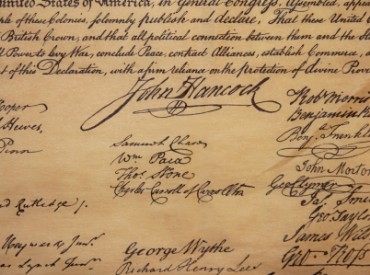
We, therefore, the Representatives of the united States of America, in General Congress, Assembled, appealing to the Supreme Judge of the world for the rectitude of our intentions, do, in the Name, and by Authority of the good People of these Colonies, solemnly publish and declare, That these United Colonies are, and of Right ought to be Free and Independent States; that they are Absolved from all Allegiance to the British Crown, and that all political connection between them and the State of Great Britain, is and ought to be totally dissolved; and that as Free and Independent States, they have full Power to levy War, conclude Peace, contract Alliances, establish Commerce, and to do all other Acts and Things which Independent States may of right do. And for the support of this Declaration, with a firm reliance on the protection of divine Providence, we mutually pledge to each other our Lives, our Fortunes and our sacred Honor.


Switch to our mobile site