zenpundit.com » ideas

Archive for the ‘ideas’ Category

A Library vs. a Collection

Thursday, June 30th, 2011

Recall the “antilibrary ” discussion some years back, prompted by Nassim Nicholas Taleb?

The other day, I was having a conversation in the comments section regarding ancient Chinese philosophers with my learned friend Lexington Green, when I had cause to quote Nassim Nicholas Taleb, from his most recent book The Black Swan: The Impact of the Highly Improbable:

The writer Umberto Eco belongs to that small class of scholars who are encyclopedic, insightful, and nondull. he is the owner of a large personal library ( containing thirty thousand books), and separates vistors into two categories: those who react with ‘Wow! Signore professore dottore Eco, what a library you have! How many of these books have you read?’ and others – a very small minority- who get the point that a private library is not an ego boosting appendage but a research tool. Read books are far less valuable than unread ones. The library should contain as much of what you do not know as your financial means, mortgage rates, and the currently tight real estate market allow you to put there. You wil accumulate more knowledge and more books as you grow older, and the growig number of unread books on the shelves will look at you menacingly. Indeed, the more you know, the larger the rows of unread books. Let us call the collection of unread books an antilibrary.

A passage that immediately made me feel better about having resigned myself to falling further and further behind in reading the books that I keep purchasing ( I’m now also periodically finding myself going to IKEA to buy shelf extensions. I’ve resigned myself to that too).

Taleb was advocating building a library – an organized assemblage of books on a wide range of topics, of which the unread portion was your antilibrary. Libraries, private or public, are wonderful things, functioning in an earlier time as the poor man’s university. Andrew Carnegie endowed public libraries for that purpose and in past ages, wealthy patrons opened the doors of their private libraries to their favored scholars, like King George III did for Samuel Johnson.

My library is sizable but disorderly and eclectic. There are books on Turkic kingdoms and network theory, art history and classical economics, political memoirs and diplomatic papers, the “great books” and sci fi. And of course a great deal of books on strategy and history. My friends Lexington Green and Dave Schuler have far larger personal libraries and Lex’s, I can say firsthand, seems to be much better organized than mine ( though, admittedly, that would not be hard).

Recently, one of my uncles, an academic, decided he wanted to make me the eventual recipient of a major portion of his library, along with the funds to transport and shelve the books. This generous offer came with a proviso – that his collection is to be kept intact and passeed on only to someone else who would agree to keep it so. And it is really a collection and not a library. Naturally, I agreed

The difference between a library and a collection is puposeful focus and quality. My uncle decided on the advice of one of his mentors to really become a collector and decided to target the Hanoverian period of British history and only read and collect books that related directly in some way to the book previously read. He also specifically wanted to acquire rare editions and copies with the marginalia of important people from the period for purchase. My uncle also made a habit of going to the best rare and used bookstores (when he visits Illinois, Bookman’s Alley is his faviorite) wherever he happened to be. The uncle has been doing this for at least thirty+ years and has read his way forward to the early 20th century and in recent years, developed an extensive sub-collection dedicated to T.E. Lawrence.

Interestingly enough, none of this has anything remotely to do with his area of academic expertise (he has two doctorates; in a hard science and another in a medical specialty) but he’s made himself into more of an expert on the historiography of this period of British history than are most professional historians.The reason is a tunnel-like focus, which is the primary distinguishing characteristic between a building a general library and building a collection. There’s a comprehensiveness to a collection that becomes an end in itself.

books.jpg

All van Creveld, All the Time

Tuesday, June 28th, 2011

Darth Creveld explains the strategic dark side to SWJ

Michael Few pinged me regarding an interview Martin van Creveld gave to SWJ with the always interesting interlocuter, Octavian Manea:

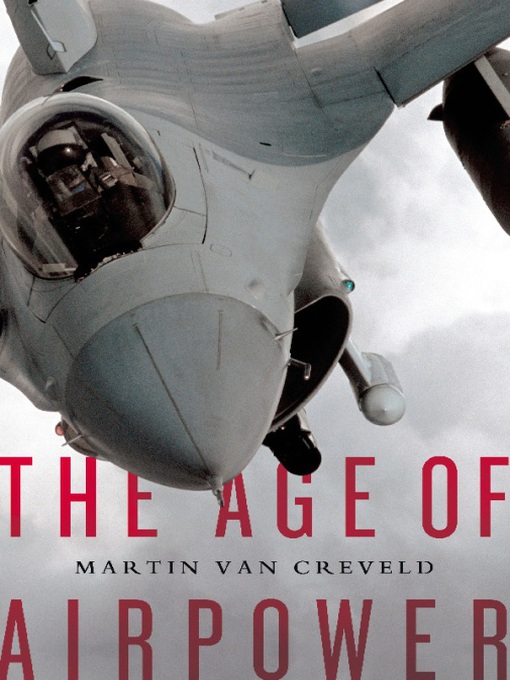
The Age of Airpower

Q: It is stated that Operations Rolling Thunder in Vietnam was the wrong way of using airpower in order to break the will of an opponent. Why? And which is the right way?

MvC: As Jesus once said, by their fruit will thou know them. Given the vast cost of Rolling Thunder, and the meager results it yielded, there can be no question that it was a foolish waste of resources. It was only made possible by the fact that it was carried out by the richest nation in history at the very peak of its economic power and psychological hubris.

The real question is, had the “gradual approach” been replaced by a short, sharp, all-out attack, would it have worked any better? To my mind the answer is almost certainly negative. Look at “Shock and Awe” as carried out both in Afghanistan and in Iraq. Both of these offensives employed weapons infinitely more sophisticated, and in many ways much more powerful, than the ones the Americans used in Vietnam almost forty years earlier (though some aircraft, notably the venerable B-52s, may well have taken part in both campaigns). Both depended their success, if indeed one can talk of success, on the presence of troops of the ground. Vietnam, though, was primarily a guerrilla war. Expanding ground operations into North Vietnam, as some in Washington DC demanded, would merely have made things even more difficult for the Americans.

Postscript: 

Adam has his take on the Infinity article.

Martin van Creveld on The Lebanon War

Monday, June 27th, 2011


Eminent and controversial military historian, Martin van Creveld, analyzes the 2006 Israeli-Hezbollah War in the latest issue of Infinity Journal. Some Excerpts:

The Second Lebanon War: A Re-assessment

….Though the decision to retaliate in force was inevitable, it also meant that the Israel Defense Force (IDF) was taken by surprise and did not have time to prepare properly. Of the entire vast order of battle, only five regular brigades were immediately available. Moreover, these brigades had spent years doing little but carrying out counter-insurgency operations in the Occupied Territories. As a result, they had almost forgotten how to fight a real enemy; he who fights the weak will end up by becoming weak. Some of the burden fell on the Israeli Navy which shelled Lebanon’s coast, imposed a blockade, and cut the country off from the world. In doing so, one of its modern ships was hit by an Iranian-built surface to sea missile, suffering damage and taking some casualties. Since this was the first time in thirty-nine years anything of the kind had happened, it was a considerable propaganda victory for Hezbollah. At the same time it proved how much the crew had underestimated the enemy, since they (perhaps acting on their superiors’ orders) had not even switched on the vessel’s electronic defenses.

….”Stark raving mad” (majnun, in Arabic) was, in fact, the way many people in Lebanon and the rest of the Arab world reacted to the Israeli attack. As the statements of several of Hezbollah’s top leaders indicated, they too were surprised by the strength of the Israeli reaction. None of the organization’s original objectives were achieved. Its fighters remain in prison; the Israeli “occupation” of Shaba Farm continues; and Jerusalem, which it set itself as its ultimate objective to liberate, remains as firmly in Israeli hands as it has been during the last forty-four years. What the war did do was to show that, in case of war, neither Syria nor Iran would necessarily come to Lebanon’s rescue. The country’s infrastructure was left in ruins. Thirty thousand dwellings were destroyed or damaged, and dozens of bridges, underpasses, and gas stations demolished. Hundred of thousands of people were forced to flee, and as many as 2,000 killed.

Free registration required to read the article.

This piece is heavily IDF-centric in the analysis, perhaps reflecting van Creveld’s established authority on command and logistics and his recent work on air power, but I was surprised by the lack of space devoted to Hezbollah’s operations, given the author’s deep influence on 4GW theory and the study of postmodern irregular and asymmetric warfare. That may reflect, in part, the thrust of Infinity as a publication or the need for brevity but there’s an almost Clausewitzian subtext in the conclusion.

Few at SWJ on “Less is Often More?”

Wednesday, June 22nd, 2011

Major Michael Few had a short theoretical post that sparked an important discussion at SWJ Blog and other social networking sites. He’s wrestling with the military-tactical effects of diminishing returns. Well worth your time to read through:

Less is Often More?

This is a post that I never would have written while practicing the art in Iraq. On the ground level, every commander wants more forces. In fact, one of the unstated prerequisites for command is that you must conduct at least one daily bitching session where you emphatically describe how much more effective you could be if you were given another platoon, company, battalion, etc…

– More forces equal more villages and more neighborhoods you can clear and occupy.
– More forces equal more visible power and control.
– More resources equal more money to bribe your enemies.

But, sometimes more is actually less:

– More forces mean that you can act unilaterally and just ignore the impotent host nation security forces.
– More forces mean that you can coerce and bully the corrupt political leaders.
– More resources mean that you may waste money building elaborate schools and medical clinics and digging canals rather than repairing the existing suitable structures.

Sometimes with more, we merely attack the symptoms creating short-term visible gains rather than attacking the root problems. Doctrinally, we would call this creating maneuver space on the human and physical terrain.

Read the rest here.

Follow-Up on the “Astrategic” Discussion

Wednesday, June 22nd, 2011

The real value was in the comment thread. Original post here.

That caused Joseph Fouche to post Overgrown Comment, Short Post from which I will excerpt relevant comments from JF, Dave Schuler and Seydlitz89:

Dave Schuler comments:

I think that the Obama Administration’s actions are less an instance of only an indirect relationship between means and ends than a disagreement with you on ends, Mark. Just as one example, the primary objective of the Obama Administration (as in all administrations) is a second term. Consider the actions through that lens.

Also, isn’t it possible that the Administration is really sincere about the “international support” trope that marked the Libyan intervention? International support will never be forthcoming for intervention against the Syrian regime. I don’t think that either the Russians or Chinese would stand for it. The Russian relationship with Syria at least is much cozier than that between Russia and Libya.

Noted Clausewitzian seydlitz89 comments:

Zen-

Good thought-provoking post, you actually got me out of my hiatus from blogs/blogging, just don’t tell anyone over at milpub ;-)>

While I agree with Joseph’s comment, I would add a few other points to consider:

First, “strategy”, is a specific concept in terms of strategic theory which can be linked to “strategic effect”, but not necessarily so.  Force and personality alone (which are not “strategy” the way I define it -see http://milpubblog.blogspot.com/2010/11/when-strategy-is-not-strategy.html) can achieve strategic effect.  So we need to be clear how we  are using this particular adjective, which need not be linked to a specific strategy at all.  Also the strategy in question might be bad, even self-defeating, as Joseph points out and still be a strategy.

Second, when has our Middle Eastern policy ever been consistent, in terms of treating all countries the same?  Perhaps under Bush I during 1990-91, but we have always treated the different Arab countries differently in line with our different interests involved.  Bahrain gets a pass, whereas Libya gets NATO intervention, and Syria gets referred to the ICC .  .  . In each case the US interest is seen as different so the response is different.

Third, the real root cause of the problem is imo our dysfunctional political system which is unable to implement policies which are in the best interests of the country as a political community.  The Iraq war was essentially a collapse of US strategic thought and rather was based on narrow and corrupt interests, deceptive politics and notions of unlimited US power (force) and exceptionalism (personality)  which triggered a still ongoing strategic disaster for US interests in the region, but not limited to it.

We have a long way to go and I don’t see us getting there any time soon, unfortunately.

The Committee comments posts:

Scottish historian Niall Ferguson, just before transmogrifying into Scottish celebrity historian Niall Ferguson, proposed an approach that serious credentialed historians could use if venturing to write the generally silly and uncredentialed genre of counter-factual history:

To produce serious counter-factual history that is not utter bollocks, your point of departure from our factual timeline has to be a documented and real credible alternative raised by a documented and real credible person at a documented and real point in time prior to the moment when factual and the proposed counterfactual timelines diverge.

As Dave Schuler alludes, how Zen, I, or seydlitz interpret what is strategic, what is astrategic, and what is antistrategic is often determined by what we individually interpret as political, apolitical, or antipolitical. We put events in boxes and eventually there is a box beyond which we do not stray because we don’t know this outer box is there. We can perhaps use Ferguson’s approach to separate which of the Administration’s factual alignment of ends to means are impossible and which are merely improbable and which of our various counterfactual alternative alignments of ends to means are impossible or merely improbable.

….I’ll close my observations on this post and its comment thread with two points:

  • Whatever framework you use to analyze human actions, especially those actions your framework categorizes as war or conflict, it should be equally capable of shedding light (and defining) “good” or “successful” actions and “bad” or “failed” actions. Categorizing one lump of actions as Actions while excluding another lump of actions as less than actions does not a good framework make. For those frameworks that aspire to pass as “strategic theory”, this means that they should be just as capable of analyzing Hitler’s strategy of dividing Germany into bloodied, burned out, and thoroughly wrecked fragments occupied by foreigners as they are of analyzing Bismarck’s strategy of creating a unified and independent Germany. A proposed strategic analytic framework that accepts some strategic phenomena into the garden of strategy while consigning others to the outer darkness of non-strategy does serve a useful purpose. Strategic effect rains on both righteous and wicked alike. Neither can be barred from opening an umbrella to shield themselves from strategic fallout because an observer runs up and commands them to stop because theory forbids it. One of the fundamental principles of strategic theory is that theory cannot absolutely forbid umbrella opening: the umbrella opener will inevitably seek to subvert any theory that seeks to unnaturally restrict their freedom to open umbrellas.

That was very interesting and thought provoking. I have, in fact, thought about these comments for several days and I do not have a neat, plausible rejoinder so much as some thoughts in regard to epistemology, which is the level where this discussion really is taking place.

Dave, I think, is correct that are a jumble of motivations in play within the Obama administration, not least of which is the overriding focus of domestic politics in an administration where the national security and foreign policy apparat is heavy with politicos. There is an internationalist faction in the administration too, though they are hardly dominant. They win some and lose some.  Incidentally, most administrations, from transcripts and memoirs I have read operate in a state of crisis management much of the time – tightly focused sessions like ExComm during the Cuban Missile Crisis are exceptions. Oval Office convos and meetings as a rule, ramble like meetings do everywhere except when the POTUS (like Eisenhower) demands otherwise.

So, is it proper to categorize this behavior as something other than strategy? Yes – at least when you want to discern conscious strategic thinking about geopolitics and military operations, or absence thereof, you’d refer to what the administration is doing currently as “politics” insofar as their eye seemed to be primarily concerned with domestic political effects rather than strategic effects in the international arena. Strategy requires conscious effort because it is pro-active and often, what passes for strategy is brilliantly intuitive tactical reactions coupled with a fair piece of luck that generated fortunate outcomes that were strategic in their effect, if not intent.

I am pretty much in agreement with Seydlitz89 that the root of our inability to think and act in a strategic fashion is our dysfunction as a political community and his caution regarding strategic effects. There’s a number of reasons for this dysfunction but even if that was instantly remedied by the Good Civics Fairy, we would have to make a conscious effort to build a rational strategic culture.

Regarding Joseph Fouche’s comment on frameworks, he has a logical point regarding strategic theory that works….in theory. By that I mean that I don’t disagree, he’s right in the abstract sense that such a comprehensive and consistent structure would be preferable. My impression though – and I think this is in line with what he is arguing above – is that strategic theory as a field itself may not be quite up to the high standard to which Fouche aspires.  Strategic theory in practice, rarely demonstrates the concise  elegance of Newtonian physics. In terms of explanatory power, strategic theory used by practitioners or created by modern day theorists rarely rises beyond being situationally “good enough” for the problem at hand. An intellectual tool, like a sharp rock or a pointy stick in the fist of a paleolithic hunter-gatherer. For that matter, if strategic theory proves to be situationally accurate and useful, that is often a cause for celebration!

Going beyond “good enough” to “universally” or “generally” applicable strategic theory is an intellectual feat of the first order. That kind of system -building is usually the result of a life’s work and cannot be called into being on a moment’s notice. Aside from the fact that most people are not capable of rising to becoming a Clausewitz or Sun Tzu, the time constraints make it impossible for state decision makers to think and act within such a framework unless they have arrived into office with one already inculcated as part of their worldview (and even then, it is of great help if they spent years out of office thinking through real and hypothetical problems using that framework, internalizing the principles without losing the ability to observe and think critically).  This is why in matters of strategy, our decision makers are usually wielding the intellectual equivalent of stone tools – the statesman with the cognitive flintlock musket or strategic steam engine is few and far between.

So, we are often left with a fractured mess, analytically speaking. Entrails to root through, looking for signs from the gods.


Switch to our mobile site