zenpundit.com » saudi arabia

Archive for the ‘saudi arabia’ Category

He must have a long spoon that must eat with the devil

Sunday, September 1st, 2013

[ by Charles Cameron — borrowing my title from Shakespeare, though Chaucer and Erasmus said it first ]
.

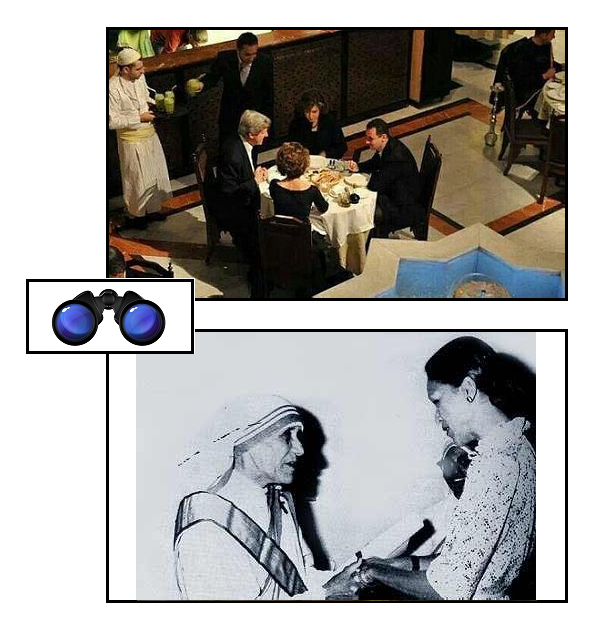
You may or may not like John Kerry. You may or may not like Assad. You may or may not like Mother Teresa, or Michèle Duvalier and Papa Doc. Rumsfeld and or Saddam. GW Bush or Abdullah bin Abd al-Aziz Al Saud. But paired photos of someone you dislike with someone many of us loathe is a neat visual tactic in which the not-so-bad party of the first part is tarred by association with the way-more-evil party of the second.

Does it ever work the other way around, though? is the party of the second part ever redeemed through contact with the party of the first? or even relieved of a few tens or hundreds of thousand dollars for authentic, charitable purposes?

What would I know?

The simplest way in which the two images above can be seen as similar to one another is that each one features someone named Teresa. But that’s not the point.

And I do have to say, that restaurant in Damascus looks pleasant enough.

Egypt: The Blame Game

Tuesday, August 20th, 2013

[ by Charles Cameron — not the world’s most illuminating game, but popular in some circles ]
.

Add these two together, and you get “Zionists and Crusaders” — with a tragic chorus chanting, “told you so”..

**

Sources:

  • Zach Novetsky
  • Thomas Hegghammer
  • Pilgrim visas, the Hajj, and MERS-CoV

    Tuesday, June 11th, 2013

    [ by Charles Cameron — it’s all a matter of concentric circles and the integration of the vertical — ibn Arabi ]
    .


    .

    The concentric circles around the Kaaba ripple out across our world. This means we should be watchful at the intersection of three overlapping regions in a Venn diagram: pilgrim visas, MERS-CoV epidemiology, and pilgrim dispersal.

    John Burgess of Crossroads Arabia is the only one I know focusing on the conjunction, see his Saudis Restrict Pilgrim Visas.

    The point I’d like to be hinting at here is that whereas MERS-CoV epidemiology is a scientific monitoring and interpretive matter using Science Rules, and visa issues are mostly matters of bureaucracy, the Hajj itself is a matter of the most passionate devotional concern, and a “purely rational” understanding will hardly scratch its surface.

    **

    Those with a mixture of poetry and scholarship in their souls may wish to read Love Letters to the Ka’ba: a presentation of Ibn ‘Arabi’s Tâj al-Rasâ’il to glimpse the Kaaba as seen by the al-Sheikh al-Akbar, Muhyiddin ibn Arabi:

    Charles-Andre Gilis has pointed out that in the Islamic tradition the Ka’ba symbolises the centre of every state of Being, as is demonstrated by the tradition recorded by Ibn ‘Abbas according to which there exists a Ka’ba, similar to the one belonging to our world, in each of the seven heavens and seven earths (cf. La Doctrine Initiatique du Pélerinage, Paris, 1982, pp. 45-6). In the introduction to the Tâj, Ibn ‘Arabi refers to the Visited House (al-bayt al-ma’mûr), situated in the seventh heaven, the celestial prototype of the Ka’ba (p. 557).

    As Gilis also observes, the Ka’ba is perceived by Ibn ‘Arabi as a manifestation of the divine Essence (Tâjallî dhâtî). However, he situates it, due to its mineral nature, in the lowest level of Being. But it is precisely the inferior character of its external aspect that allows it to sustain the ladder of beings and to identify itself on each level. It is thus described as “celestial constitution, angelic reality, young girl with formed breasts, level of the perceptible realm, and Meccan dignity (at the same time this constitutes an excellent example of the assonances of his rhymed prose: nash’a falakiyya wa haqîqa malakiyya wa jâriya falkiyya wa martaba mulkiyya wa rutba makkiyya) (p. 555).” Ibn ‘Arabi himself is astonished at the number of contradictory aspects that this being is able to bring together: “Oh marvel: divine constitution, simil (mithliyya), angelic, human, superior and inferior in which we find validity and deficiency, multiplicity and scarcity.” (p. 556)

    The devotional aspect of the Hajj is orthogonal to the realism of bureaucracies and epidemiology — but not on that account any the less powerful!

    Manhunt: Radicalization, & comprehending the full impact of dreams

    Saturday, June 8th, 2013

    [ by Charles Cameron — how do you intercept messages that come via dreams? I’m thinking of al-Balawi ]
    .

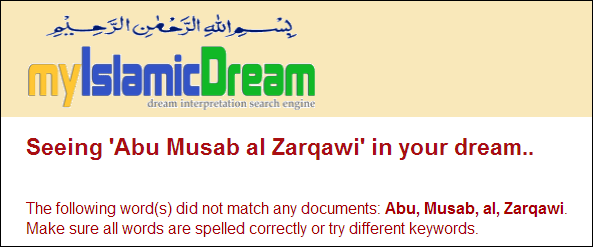
    My little graphic (below) may be kidding — but what of reality?
    **

    In the bin Laden documentary, Manhunt, which I mentioned before seeing it here, and discussed briefly here, another passage (at 1.22.31) that is missing from the CNN transcript concerns the dream which radicalized Humam al-Balawi, the Khost bomber. Balawi speaks, the subtitles translate for us:

    God blessed me to have this dream. I dreamed I saw Zarqawi. He was in my house. His face was like a full moon. He was busy. Preparing an attack. I wishes I could fight with him. Be killed with him. I am your humble brother from Jordan. I am 32 years old and a medical doctor.

    I’m not suggesting there was no prior fertilization of Balawi’s mind and heart, nor that he was influenced by no other drivers: I just wonder what the impact of such a dream would be, given that intense smuggling goes on between our waking and dream lives, of a kind that no intercepts can capture for analysis.

    **

    How powerful can influence can a dream exert?

    Consider this example, taken from Marie-Lousie von Franz, On Dreams & Death: A Jungian Interpretation, p. 64:

    She sees a candle lit on the window sill of the hospital room and finds that the candle suddenly goes out. Fear and anxiety ensue as the darkness envelops her. Fear and anxiety ensue as the darkness envelops her. Then, the candle re-lights on the other side of the window and she awakens. She died the same day.

    **

    If I may borrow a bit from some unpublished writings of mine…

    Dreams as early indicators:

    The western secular paradigm considers dreams to be of little or no significance, and it is therefore entirely possible that intelligence gleaned from the recounting of dreams will seem of little interest to western analysts. In the Islamic view, however, certain dreams are of considered to be of real significance, their importance being indicated by the hadith reported by Bukhari:

    Narrated Ibn ‘Umar: Allah’s Apostle said, “The worst lie is that a person claims to have seen a dream which he has not seen.”

    — Sahih Bukhari, book 87: Interpretation of Dreams, #167.

    One early indicator of a Mahdist tendency in a given population, therefore, would be the presence of dreams about the Mahdi in a given discourse — in jihadist chat rooms, for instance — while the frequency of such mentions would be a useful heuristic measure of the development of such a movement. Thus Yaroslav Trofimov reports [Siege of Mecca, hb. p.50.] that in the run-up to the 1979 siege of the Grand Mosque and Ka’aba in Mecca, many followers of Juhayman al-Otaibi, the leader of the raid, dreamed dreams:

    Then, one after another, hundreds of Juhayman’s supporters experienced detailed, vivid dreams. Mohammed Abdullah’s sister appears to have been the first, quickly followed by others. In their sleep, they all had the same vision: Mohammed Abdullah standing by the sacred Kaaba in Mecca’s Grand Mosque, accepting allegiance as the blessed Mahdi amid multitudes of believers. Militants from as far away as Lebanon who never encountered Mohammed Abdullah in person claimed to have had the same dream.

    It is worth noting here that while, as Trofimov suggests, much of the dreaming “must have been caused by self-suggestion” this in no way invalidates their significance as indicators. Indeed, Reuven Paz writes of the mediaeval scholar Ibn Sirrin‘s still-popular Interpretation of Dreams that “high selling rates of this book can provide us an indicator for rising apocalyptic notions”. Paz also notes a “sizable number” of jihadis publishing their dreams and visions on Jihadist forums on the web [p.4..

    Dream narration of this sort certainly corresponds to hikayat as discussed by Michael Vlahos in his essay Terror’s Mask: Insurgency Within Islam — still one of the most necessary pieces I have read on al-Qaeda..

    **

    Closer to home, in one sense, than the siege of the Grand Mosque, is the 9/11 attack on the Twin Towers and Pentagon. This too had its dream precursors, as we can tell from the video transcript of bin Laden‘s taped meeting of mid-November 2001:

    UBL: He [Abu-Al-Hasan Al-Masri] told me a year ago: “I saw in a dream, we were playing a soccer game against the Americans. When our team showed up in the field, they were all pilots!” He said: “So I wondered if that was a soccer game or a pilot game? Our players were pilots.” He didn’t know anything about the operation until he heard it on the radio. He said the game went on and we defeated them. That was a good omen for us.

    Shaykh: May Allah be blessed.

    Unidentified Man: Abd Al Rahman Al-Ghamri said he saw a vision, before the operation, a plane crashed into a tall building. He knew nothing about it.

    Shaykh: May Allah be blessed!

    and notably:

    UBL: We were at a camp of one of the brother’s guards in Qandahar. This brother belonged to the majority of the group. He came close and told me that he saw, in a dream, a tall building in America, and in the same dream he saw Mukhtar teaching them how to play karate. At that point, I was worried that maybe the secret would be revealed if everyone starts seeing it in their dream. So I closed the subject. I told him if he sees another dream, not to tell anybody, because people will be upset with him.

    (Another person’s voice can be heard recounting his dream about two planes hitting a big building).

    For your in-depth reading pleasure, see Iain R. Edgar, The Inspirational Night Dream in the Motivation and Justification of Jihad if you can get past the paywall…

    **

    Vlahos quotes Albert Hourani, A History of the Arab Peoples, on this point — I’ll present my own version of that quote here, because it describes a mindset that, mutatis mutandis, many of our opponents share to this day:

    It was commonly held, in all cultures before the modern age, that dreams and visions could open a door into a world other than that of senses. They might bring messages from God; they might disclose a hidden dimension of a person’s own soul; they might come from jinns or devils. The desire to unravel the meaning of dreams must have been widespread, and was generally regarded as legitimate; dreams told us something which it was important to know.

    Dreams are “outside the box” of waking reality — and we need to learn to appreciate the force of dream logic, if we want to think outside our own western prejudices, and inside our adversaries’ heads…
    Every day is Ashura, every place is Kerbala

    Wednesday, May 29th, 2013

    [ by Charles Cameron — an Ayatollah’s video take-down of the Grand Mufti ]
    .

    Today’s latest news from the Long War Journal is titled Egyptian jihadists call for attacks in Shiite countries and opens with the paragraph:

    Twenty Egyptian jihadists have issued a statement calling upon Sunnis to launch attacks in Shiite-led countries in response to the Assad regime’s offensive in Qusayr, a city in western Syria near Homs. The chief signatory on the statement is Mohammed al Zawahiri, the younger brother of al Qaeda emir Ayman al Zawahiri.

    **

    **

    I’ve been having some conversations on Twitter recently in which I’d been verifying my own sense that Hezbollah‘s ethos and imagery of martyrdom would presumably extend beyond the poppies and doves depicted here to include also the martyrdom of Husayn at Kerbala, and I’m grateful to Phillip Smyth for his confirmation and elaboration on that theme.

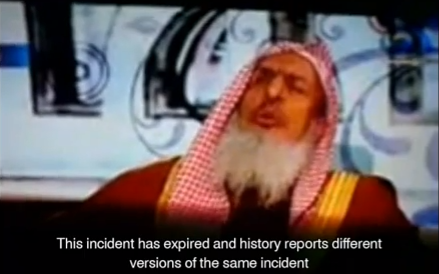
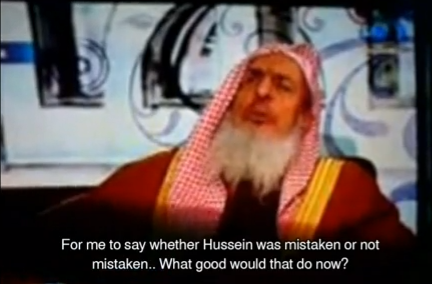
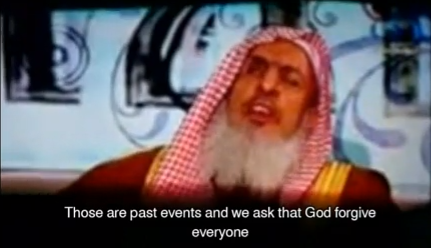
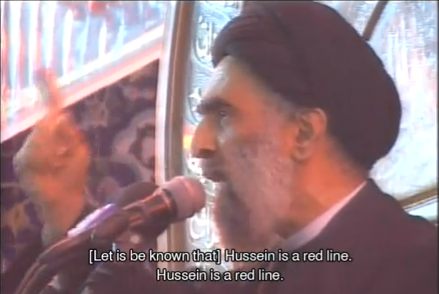
    Somehow in my wanderings, I came across this video, in which Ayatollah Sayed Hadi al Modarresi, a senior Shia cleric, bookends his even more senior Sunni counterpart the Grand Mufti of Saudi Arabia, Sheikh Abdul Aziz al-Sheikh, with his own commentary, speaking from the very heart of Shia passion — the shrine of Imam Husayn in Kerbala.

    The Ayatollah challenges the Grand Mufti’s assertion that Husayn erred in refusing his oath of obedience to Yazid, thus bringing his own death upon himself at the ensuing battle of Kerbala:

    **

    Things that impressed me:

    The simple but rhetorically effective use of one video quoted within another.

    The incredible passion of the crowd in Kerbala, which the poster called to our attention with a note saying:

    Keep watching to see the fury of the audience..

    The half-accusatory, half-conciliatory way in which the Grand Mufti expressed himself, with phrases that suggested Husayn — may God be pleased with him — was in error, while asking God to forgive him…

    and:

    and in response, the Ayatollah’s use of the imagery of the “red line”:

    **

    If the Long War Journal piece shows us an aspect of the current situation, this stunning video offers us a window into the passions such events are poised to arouse.


    Switch to our mobile site