zenpundit.com » alchemy

Archive for the ‘alchemy’ Category

Great photography? Nah, and then Yah

Sunday, August 9th, 2015

[ by Charles Cameron — captivated by, capturing the light of the moon — a meditattion on art, science ]
.

dscovrepicmoontransitfull

**

According to The Smithsonian:

Great photography often comes down to snapping the right subject from the right vantage point at the right time. This image from NASA is just that. It was taken by the camera onboard the Deep Space Climate Observatory (DSCOVR) satellite, one million miles away from Earth — the perfect spot to capture the Moon passing across the sunlit face of our planet.

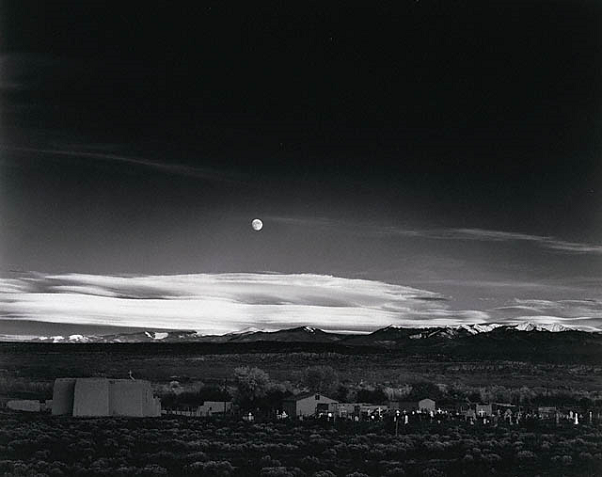
Nah, not really. As I said in an earlier post, Don’t you mess with my mother the moon, the great moon photo is Ansel Adams’ Moonrise, Hernandez, New Mexico<:
moon-over-hernandez

**

Yes, Adams’ photo captures “the right subject from the right vantage point at the right time” but it does so with a great eye — the eye, experience, vision of an Ansel Adams. The NASA photo of the moon transiting the earth, by contast, is brilliant, stunning, extraordinary — but offers sight, not insight. Once again, I think of Blake:

I question not my Corporeal or Vegetative eye any more than I would Question a window concerning a Sight. I look thro’ it & not with it.

That’s from his A Vision of the Last Judgment — apocalypticx, again — and famnously reads in context:

“What,” it will be Questioned, “When the Sun rises, do you not see a round Disk of fire somewhat like a Guinea?” O no no, I see an Innumerable company of the Heavenly host crying “Holy Holy Holy is the Lord God Almighty.” I question not my Corporeal or Vegetative Eye any more than I would Question a Window concerning a Sight: I look thro it & not with it.

**

Ah, but how easy to quote the Ansel Adams imager — it has long been famous for being a great photograph.

And yet the greatness was in Adams, in the moment, not in popular opinion:

I had been photographing in the Chama Valley, north of Santa Fe. I made a few passable negatives that day and had several exasperating trials with subjects that would not bend to visualization. The most discouraging effort was a rather handsome cottonwood stump near the Chama River. I saw my desired image quite clearly, but due to unmanageable intrusions and mergers of forms in the subject my efforts finally foundered, and I decided it was time to return to Santa Fe. It is hard to accept defeat, especially when a possible fine image is concerned. But defeat comes occasionally to all photographers, as to all politicians, and there is no use moaning about it.

We were sailing southward along the highway not far from Espanola when I glanced to the left and saw an extraordinary situation – an inevitable photograph! I almost ditched the car and russed to set up my 8×10 camera. I was yelling to my companions to bring me things from the car as I struggled to change components on my Cooke Triple-Convertible lens. I had a clear visualization of the image I wanted, but when the Wratten No. 15 (G) filter and the film holder were in place, I could not find my Weston exposure meter! The situation was desperate: the low sun was trailing the edge of the clouds in the west, and shadow would soon dim the white crosses.

I was at a loss with the subject luminance values, and I confess I was thinking about bracketing several exposures, when I suddenly realized that I knew the luminance of the moon – 250 c/ft2. Using the Exposure Formula, I placed this luminance on Zone VII; 60 c/ft2 therefore fell on Zone V, and the exposure with the filter factor o 3x was about 1 second at f/32 with ASA 64 film. I had no idea what the value of the foreground was, but I hoped it barely fell within the exposure scale. Not wanting to take chances, I indicated a water-bath development for the negative.

Realizing as I released the shutter that I had an unusual photograph which deserved a duplicate negative, I swiftly reversed the film holder, but as I pulled the darkslide the sunlight passed from the white crosses; I was a few seconds too late

**

See: science.

Back in the day artists were alchemists — grinding their own colors from exotic shrubs (dragonsblood), insects (crimson lake), stones (lapis lazuli) and so forth — and remain so to this day, as in the case of Jan Valentin Saether:

saether epiphany

Those shadows! The light..

**

Is Moonrise, Hernandez, New Mexico, science, then — or art?

Is “art or science” even a real question?

And that “desired image” of a “cottonwood stump near the Chama River” — isn’t that in some way the negative of Moonrise, Hernandez, New Mexico? The drawn bow that propelled Adams’ arrow to its mark?

Agreeable disagreement, disagreeable agreement

Wednesday, April 29th, 2015

[jotted down quickly by Lynn C. Rees]

  1. Politics is the division of power.
  2. The power divided is a variable mix of violence and influence.
  3. The division of power tends to favors those who best wield violent power.
  4. The reason of man exists for victory, not truth.
  5. Victory is measured in agreement, the number of minds who fuel a division of power.
  6. Agreement is peace, a thinning in politics.
  7. Disagreement is conflict, an escalation in politics.
  8. Agreement, once agreed, tends to stay agreed.
  9. Agreement that stays agreed is the most effective way to convert agreement into violence.
  10. The ultimate measure of victory is how well it converts agreement into violence.
  11. Man tends to stay agreed with what he already agrees with:
    • it is the most powerful fuel for the politics of others he agrees with.
    • it reduces power lost by making new agreements.
  12. Man tends to agree with whatever agrees with increases in his own division of power.
  13. Maintenance of the objective, concentration of power, and keeping the initiative are powerful contributors to victory.
  14. Refusal to disagree with what he already agrees with tends to keep:
    • man’s eye single to the glory of his objective
    • man’s power concentrated
    • man from losing the initiative
  15. Yet politics divides power by converting disagreement into agreement.
  16. The intensity and mix of disagreement dictates the intensity and mix of violence and influence needed to convert it into agreement.
  17. Influence is the refinement of argument.
  18. The reason of man exists to refine less effective argument into more effective argument.
  19. Where the argument of influence fails, the argument of violence might succeed.

Happy Birthday, Sir Isaac Newton and …

Tuesday, December 25th, 2012

[ by Charles Cameron — season’s greetings in a couple of different contexts ]
.

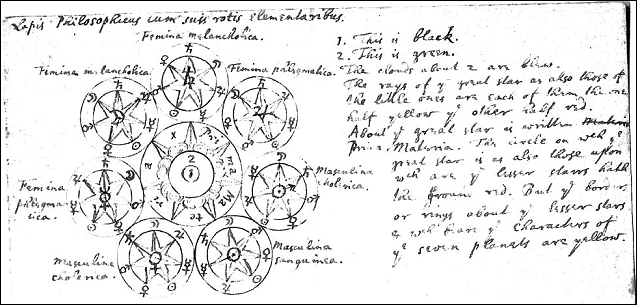
Lapis Philosphicus / The Philosopher's Stone, from Sir Isaac Newton, MS 416

.

It is Sir Isaac Newton‘s birthday today, December 25th, and that’s surely cause for some celebration.

Shakespeare‘s birthday is unknown, but was probably around April 23rd, Bach‘s is celebrated on March 31st, Galileo‘s on February 15th, Buddha‘s is mostly celebrated on April 28th, and HM the Queen‘s on April 21st, making April — TS Eliot‘s “cruelest month” — a powerful time for moving from womb into world.

If you’re a cricketer, you might celebrate WG Grace‘s birthday, 18th July, it takes all kinds to make a world. But December 25th? If you don’t also make a big deal about Leibniz on July 1st, what’s so special about Newton on December 25th?

**

There are some great aggregator blogs out there, and frankly I favor 3 Quarks Daily for their blend of culture, science and an accent from the subcontinent.

Today, as in other years, 3QD is celebrating Isaac Newton’s birthday, and I’ll raise a toast to him too. There are a great many things in our world that I am grateful for, that wouldn’t have been possible without his great and inquiring mind — though it’s his alchemical and apocalyptic interests that capture my own imagination.

What hath Newton wrought? You could do worse than to consult 3QD on this day across the years, 2004, 2005, 2006, 2007, 2008, 2009 — but you know, part of celebrating Newton’s Day (rather than that of Shakespeare, Leibniz, WG Grace, Dante, Marilyn Monroe or whomever) is that you can celebrate it on Christmas Day, on the day assigned conventionally to the birth of Christ — without getting all religious.

So it’s a sort of escape hatch for seculars, in a sacred season. As if all the gifts we give to commerce and each other weren’t enough.

**

In honor, therefore, of the child whose nominal birthday makes Sir Isaac Newton’s so much more easily memorable — this poem:

The birth of phoenix bliss
.

Gallows humor was implicit from the start
in the tiny child, in the newborn universe, in the
very heart of all that breathes and hopes,
evident then, at that first beginning, more so
in the tool shed behind the motel, most
now if we clear the rubble of malls and ads
from our eyes, blink a bit in the light, so
steady, so other than flash and glitter, so very

divinely human unfolding in each folded heart:
for oh, we are pilgrims, zeros traveling in
from earth to infinity, infinity itself
two zeros, two virgins intersecting, breeding,
filling the abyss: believe me, no phoenix
bliss is born, save from the ashes of crucifixion.

**

I know, I know, some of you will wonder WTF Charles is on about.

A lot of people have folded their Sunday suits away and mothballed them, I know — I just happen to think that the finest story in the world tells of an infant conquering men at arms, mighty empires, with love alone in his eyes.

I am not of the opinion that this obliges me to expect greybeards in space, to follow the culinary restrictions of some desert tribe, or to condemn those whose attitudes are different from mine: on the contrary, I find liberty in the childlike gaze, liberty and clarity, depth and profundity, and at bottom a deep mystery.

I wish you all whatever blessings may befall you, now and always.


Switch to our mobile site
