zenpundit.com » foreign policy

Archive for the ‘foreign policy’ Category

R2P Debate Rising ( Part I.)

Friday, February 7th, 2014

I thought I would call the attention of the readership to a debate that has been ricocheting around different social media platforms on R2P (Responsibility to Protect“). I have dealt with the topic several times in the past, related to the ideas of Anne-Marie Slaughter, but not much recently until Victor Allen, over at The Bridge, put up an enthusiastic post:

Strong State, Weak State: The New Sovereignty and the Responsibility to Protect

The Responsibility to Protect doctrine represents a leap forward in accountability for states and does not infringe upon their sovereignty, as states are no longer held to be completely self-contained entities with absolute power over their populations. Rather, there is a strictly defined corpus of actions that begin the R2P process?—?a process that has different levels of corrective action undertaken by the international community in order to persuade, cajole and finally coerce states into actively taking steps to prevent atrocities from occurring within their boundaries. That R2P does not violate sovereignty stems from the evolution of sovereignty from its Westphalian form in the mid 17th century to the “sovereignty as responsibility” concept advanced by Deng, et al. Modern sovereignty can no longer be held to give states carte blanche in their internal affairs regardless of the level of suffering going on within their borders. This does not diminish state agency for internal affairs, but rather holds them responsible and accountable for their action and inaction regarding the welfare of their populations…

Victor’s post deserves to be read in full.

I did not agree with Victor’s framing of the legal character of state sovereignty, to put it mildly, nor his normative assessment of R2P.  Mr. Allen also described R2P somewhat differently than I have seen from other advocates, but I was less concerned by that as the concept does not seem to be presented with consistency by the community of  R2P advocates and theorists. Having seen similar theoretical debates over the years about angels dancing on pins over 4GW, constructivism, EBO, Network-centric Warfare, OODA,  Clausewitz’s remarkable trinity,  nuclear deterrence, preemptive war, COIN,  neoconservatism, free market economics, the agrarian origin of capitalism in England, Marxist theory etc. I am not too worried if Victor’s interpretation in its specifics is not ideologically perfect. It is representative enough.

I responded to Allen’s post somewhat crankily and with too much brevity:

R2P: Asserting Theory is not = Law 

….As far as premises go, the first point is highly debatable; the second is formally disputed by *many* states, including Russia and China, great powers which are permanent members of the UN Security Council; and the third bears no relation to whether a military intervention is a violation of sovereignty or not. I am not a self-contained entity either, that does not mean you get to forcibly enter my house.

That R2P does not violate sovereignty stems from the evolution of sovereignty from its Westphalian form in the mid 17th century to the “sovereignty as responsibility” concept advanced by Deng, et al. Modern sovereignty can no longer be held to give states carte blanche in their internal affairs regardless of the level of suffering going on within their borders.

Academic theorists do not have the authority to override sovereign powers (!) constituted as legitimized, recognized, states and write their theories into international law – as if an international covenant like the Geneva Convention had just been contracted. Even persuading red haired activist cronies of the American president and State Department bureaucrats to recite your arguments at White House press conferences does not make them “international law” either – it makes them “policy” – and that only of a particular administration. 

This riff  set off something of a reaction on Facebook in private groups and on Twitter as Mr. Allen, who I am sure is a fine gent, has a large set of common colleagues with me, some of whom are Boydians and all of whom are sharp strategic thinkers. Consequently,  Victor’s post(s) as well as mine and a later follow up by a “Leonidas Musashi” ( great nom de guerre)  made it into a high caliber defense forum as well as other sites online. My spleen-venting provoked the following rebuttal at The Bridge:

R2P: A Spectrum of Responses 

….Safranski’s final point about sovereignty as carte blanche seems to be a stealth argument for the principles of R2P:

States always could and did take military action in self-defense when disorders in neighboring states threatened their security or spilled over their border outright.R2P seeks to minimize harm caused by disorder through early action taken prior to conflicts spilling over borders that can potentially cause larger conflagrations, but more importantly, it recognizes that atrocities can happen entirely within the confines of a state, and that the international community will not allow them to continue unchecked. This recognition is easily seen in the rhetoric and discussions regarding rebels in both Libya and Syria. Libya is admittedly a flawed example of the use of R2P, with second-order effects seen in the Russian and Chinese opposition to UN-sanctioned stabilization operations in Syria, but that concern for the population first and the state second were common facets to both bear mentioning in the debate and illustrate the shifting nature of intervention and sovereignty. This shift is exemplified in the contrast between discussions in the UN General Assembly regarding Kosovo/East Timor and Syria: “most of the 118 states that mentioned Syria at the UN General Assembly in 2012 expressed concern about the population, up from less than a third who invoked Kosovo and East Timor in 1999… It is clear that a fundamental shift has taken place regarding humanitarian intervention and that more and more states embrace the broad values expressed by R2P.” (“Democracy, Human Rights, and the Emerging Global Order: Workshop Summary,” Brookings Institution, 2012)

Again, I caution about reading posts in full.

Here in this rebuttal Victor doubled down, which I admire because that is interesting, but with which I agree with even less because he seems to be far removed from how the world really works in terms of international relations, not merely in practice, but also in theory as well.  That said, his response deserves a much more serious reply than my first post evinced. I have been fiddling with one ( I seem to be moving slowly these days) but another voice – “Leonidas Musashi” – has entered the debate at The Bridge with a sharp retort against Allen’s conception of R2P:

Responsibility to Protect: Rhetoric and Reality 

….My main observation, however, is that the discussion thus far has been focused more on a “right” to protect than a “responsibility” to do so. The arguments indicate that a state has a responsibility to protect its people but takes for granted that third parties somehow inherit this responsibility when the state cannot fulfill it. There is a missing explanation here. The need to justify such efforts may seem callous, but a nation’s highest moral order is to serve its own citizens first. Such an explanation would certainly be a legitimate demand for a mother that loses a son who volunteered to defend his nation, or for a government entrusted by its people to use their resources to their own benefit. While it is often stated that the international community “should” intervene, explanation of where this imperative comes from is not addressed other than by vague references to modern states being interconnected. But this implies, as previously stated, a right based on the self-interest of states, firmly grounded in realistic security concerns, rather than any inherent humanitarian responsibility to intervene. Instability and potential spillover may very well make it within a nation’s vital interests to intervene in another country and pursuing humanitarian and human rights goals within the borders of another state may well be in a nation’s secondary interests. But if this is the case, the calculus of the political leadership will determine if pursuing this goal is worth the cost/potential costs – as has been done in such cases as North Korea, Iran, Zimbabwe, Tibet and Syria. In either case, the decision is determined by what is in the nation’s interests, a reality that makes R2P not a mandate, but a merely a post hoc justification for interventions that do occur.

Leonidas makes many good points, in my view, but the intellectual fungibility of R2P as a concept, its elastic and ever evolving capacity to serve as a pretext for any situation at hand is the most important, because it is potentially most destabilizing and threatening to other great powers with which the United States has to share the globe. In short, with great responsibilities come greater costs.

In part II. I will lay out a more methodical case on the intellectual phantom that is R2P.
Making Historical Analogies about 1914

Friday, January 10th, 2014

[by Mark Safranski, a.k.a. “zen“]

The Independent has a short, quasi-sensationalist, article featuring historian Margaret MacMillan discussing what is likely to become the first pop academic cottage industry of 2014….making historical analogies about 1914 and World War I! MacMillan is a senior scholar of international relations and administrator at Oxford ( where she is Warden of St Antony’s College)  with a wide range of research interests, including the First World War on which she has published two books.  I am just going to excerpt and comment on the historical analogies MacMillan made – or at least the ones filtered by the reporter and editor – she’s more eloquent in her own writing where each of these points are treated at greater length:

Is it 1914 all over again? We are in danger of repeating the mistakes that started WWI, says a leading historian 

Professor Margaret MacMillan, of the University of Cambridge, argues that the Middle East could be viewed as the modern-day equivalent of this turbulent region. A nuclear arms race that would be likely to start if Iran developed a bomb “would make for a very dangerous world indeed, which could lead to a recreation of the kind of tinderbox that exploded in the Balkans 100 years ago – only this time with mushroom clouds,”

…..While history does not repeat itself precisely, the Middle East today bears a worrying resemblance to the Balkans then,” she says. “A similar mix of toxic nationalisms threatens to draw in outside powers as the US, Turkey, Russia, and Iran look to protect their interests and clients. 

Several comments here. There is a similarity in that like the unstable Balkan states of the early 20th century, many of the Mideastern countries are young, autocratic, states with ancient cultures that are relatively weak  and measure their full independence from imperial rule only in decades.  The Mideast is also like the Balkans, divided internally along ethnic, tribal, religious, sectarian and linguistic lines.

The differences though, are substantial. The world may be more polycentric now than in 1954 or 1994 but the relative and absolute preponderance of American power versus all possible rivals, even while war-weary and economically dolorous, is not comparable to Great Britain’s position in 1914.  The outside great powers MacMillan points to are far from co-equal and there is no alliance system today that would guarantee escalation of a local conflict to a general war. Unlike Russia facing Austria-Hungary over Serbia there is no chance that Iran or Russia would court a full-scale war with the United States over Syria.

On the negative side of the ledger, the real problem  is not possible imperial conquest but the danger of regional collapse. “Toxic nationalism” is less the problem than the fact that the scale of a Mideastern Sunni-Shia sectarian conflict is so enormous, as are the implications . Nothing in the Balkans after the turn of the century compares to Syria, then Iraq and then other states sliding into a Muslim version of the Thirty Year’s War. An arc of failed states from Beirut to Islamabad is likelier than, say, a new Persian empire run by Tehran’s mullahs.

Modern-day Islamist terrorists mirror the revolutionary communists and anarchists who carried out a string of assassinations in the name of a philosophy that sanctioned murder to achieve their vision of a better world

Agree here. The analogy between 21st revolutionary Islamists and the 19th century revolutionary anarchists is sound.

And in 1914, Germany was a rising force that sought to challenge the pre-eminent power of the time, the UK. Today, the growing power of China is perceived as a threat by some in the US.

Transitions from one world power to another are always seen as dangerous times. In the late 1920s, the US drew up plans for a war with the British Empire that would have seen the invasion of Canada, partly because it was assumed conflict would break out as America took over as the world’s main superpower.

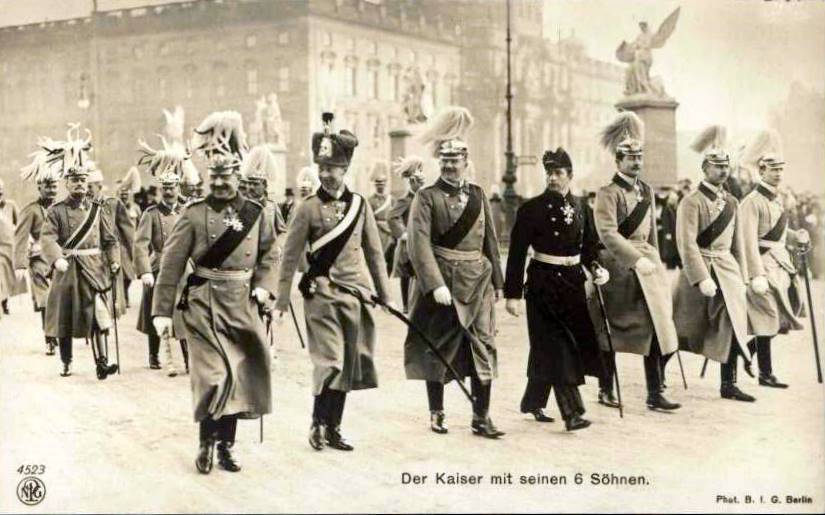
Imperial Germany’s growing power was less troublesome to Edwardian British statesmen than the strategic error of the Kaiser and von Tirpitz to pursue a naval arms race with Great Britain that did not give Germany’even the ability to break a naval blockade but needlessly antagonized the British with an existential threat that pushed London into the French camp.

As to military plans for invading Canada (or anywhere else), the job of military planning staffs are to create war plans to cover hypothetical contingencies so that if a crisis breaks out, there is at least a feasible starting point on the drawing board from which to begin organizing a campaign. This is what staff officers do be they American, French, Russian, German, Chinese and even British. This is not to be taken as serious evidence that the Coolidge or Hoover administrations were hatching schemes to occupy Quebec.

More importantly, nuclear weapons create an impediment to Sino-American rivalry ending in an “August 1914” moment ( though not, arguably, an accidental or peripheral clash at sea or a nasty proxy conflict). Even bullying Japan ultimately carries a risk that at a certain point, the Japanese will get fed-up with Beijing, decide they need parity with China, and become a nuclear weapons state.

Professor MacMillan, whose book The War That Ended Peace was published last year, said right-wing and nationalist sentiments were rising across the world and had also been a factor before the First World War

In China and Japan, patriotic passions have been inflamed by the dispute over a string of islands in the East China Sea, known as the Senkakus in Japan and Diaoyus in China. “Increased Chinese military spending and the build-up of its naval capacity suggest to many American strategists that China intends to challenge the US as a Pacific power, and we are now seeing an arms race between the two countries in that region,” she writes in her essay. “The Wall Street Journal has authoritative reports that the Pentagon is preparing war plans against China – just in case.” 

“It is tempting – and sobering –to compare today’s relationship between China and the US with that between Germany and England a century ago,” Professor MacMillan writes. She points to the growing disquiet in the US over Chinese investment in America while “the Chinese complain that the US treats them as a second-rate power”.

The “dispute” of the Senkakus has been intentionally and wholly created by Beijing in much the same way Chinese leaders had PLA troops provocatively infringe on Indian territory, claim the South China Sea as sovereign territory and bully ships of all nearby nations other than Russia in international or foreign national waters. This is, as Edward Luttwak recently pointed out, not an especially smart execution of strategy. China’s recent burst of nationalistic bluffing, intimidation and paranoia about encirclement are working along the path of self-fulfilling prophecy.

Another similarity highlighted by the historian is the belief that a full-scale war between the major powers is unthinkable after such a prolonged period of peace. “Now, as then, the march of globalisation has lulled us into a false sense of safety,” she says. “The 100th anniversary of 1914 should make us reflect anew on our vulnerability to human error, sudden catastrophes, and sheer accident.

Agree that globalization is no guarantee against human folly, ambition or the caprice of chance.

What are your thoughts?

In Search of Strategy(s), a Voice, a Narrative because, ‘Gentlemen, We Have Run Out Of Money; Now We Have to Think’

Friday, December 13th, 2013

[by J. Scott Shipman] [Warning: Maritime in flavor]

No matter how far humanity may go in seeking to foster the arts of civilization and the ideals of civic peace, there will come times when acts of war are required in order to defend world order and sustain the peace of civilized peoples. Charles Hill’s, Grand Strategies, Literature, Statecraft, and World Order, page 48

The lift quote in the title is attributed to Winston Churchill, and in this period of uncertainty with sequestration and deep cuts in defense commanding the attention of military leadership, one thing is becoming crystal clear: we have no cogent or explainable military strategy. Sure, we have “concepts” like Air-Sea/Air-Land Battle, A2/AD, and Off-Shore Control, but our most recent unclassified Navy strategy document A Cooperative Strategy for 21st Century Seapower was written in 2007 may be a bit dated.

This week I attended the U.S. Naval Institute’s annual Defense Forum, Shaping the Maritime Strategy and Navigating the Budget Gap Reality and given the title, there was a lot of talk about funding and in that light/context, strategy was that thing “we’re in the process of doing.” Several people I spoke with expressed concern about “telling the navy’s story,” “why we have a navy,” and one member of Congress encouraged us to build an engaged constituency to put pressure on Congress to knock-off the schizophrenic approach to appropriations, so that a bit of certainty will allow the development of a strategy. Since DoD hasn’t been successfully audited in a long, long time (if ever), I wouldn’t hold out hope for a grass-roots rescue. As Mr. Churchill wisely advises, “now we have to think.”

Strategy Defined

Since strategy is a hot topic, offered here are several definitions ranging from the classic to practitioners and academics, with the goal of framing the elegant simplicity of strategy as a theory, and challenge of defining in reality. As Colin Gray points out in his National Security Dilemmas: “The United States has shown a persisting strategy deficit.” (page 170) Dilemmas, written in 2009 before the budget axe fell in earnest he offers: “One would think that the following definition and explanation must defy even determined efforts of misunderstanding:” (he then quotes Clausewitz)

Strategy is the use of engagement for the purpose of war. The strategist must therefore define an aim for the entire operational side of the war that will be in accordance with its purpose. In other words, he will draft the plan of the war, and the aim will determine the series of actions intended to achieve it: he will, in fact, shape the individual campaigns and, within these, decide the individual engagements.” (On War, page 177)

The definition of strategy from the Department of Defense Dictionary of Military and Associated Terms, Joint Publication 1-02:

strategy — A prudent idea or set of ideas for employing the instruments of national power in a synchronized and integrated fashion to achieve theater, national, and/or multinational objectives. (JP 3-0)

Other definitions:

J.C. Wylie, RADM, USN, Ret., Military Strategy, page 14

“A plan of action designed in order to achieve some end; a purpose together with a system of measures for its accomplishment” 

Henry E. Eccles, RADM, USN, Ret., Military Concepts and Philosophy page 48:

Strategy is the art of comprehensive direction of power to control situations and areas in order to attain objectives. (emphasis in original)

Bernard Brodie, Sea Power in the Machine Age, page 78

“Tactics may be distinguished from strategy by the criterion proposed by Mahan—the fact of contact. “Tactics” refers to localized hostilities that occur where the adversaries are in contact; “strategy” refers to those basic dispositions in strength which comprise the entire conduct of a war.” 

General André Beaufre, Introduction á la stratégie, 1963, page 16. (note: I don’t read/speak French, I found the quote in Edward Luttwak’s Strategy, The Logic of War and Peace)

“…the art of the dialectics of wills that use force to resolve their conflict.” 

Paul Van Riper, LtGen, USMC, Ret, Infinity Journal, Volume 2, Issue 3, Summer 2012

“…strategy is specifically about linking military actions to a nation’s policy goals, and ensuring the selected military ways and means achieve the policy ends in the manner that leaders intend.”

From John Boyd’s Strategic Game of ?And?

What is strategy?

A mental tapestry of changing intentions for harmonizing and focusing our efforts as a basis for realizing some aim or purpose in an unfolding and often unforeseen world of many bewildering events and many contending interests.

What is the aim or purpose of strategy?

To improve our ability to shape and adapt to unfolding circumstances, so that we (as individuals or as groups or as a culture or as a nation?state) can survive on our own terms. (emphasis added)

Our own Lynn Rees

Politics is the division of strength. Strategy, its tool, squares drive, reach, and grip while striving for a certain division of strength.

Drive falls between too weak and too strong. Reach falls between too short and too far. Grip falls between too loose and too tight.

How strategy squares the three is open ended and ongoing. Outside friction, deliberate or not, always conspires with inside friction, intentional or not, to keep things interesting for strategy.

Drive is the certainty you want. Reach is the certainty you try. Grip is the certainty you get. Grip can be a little sway over certain minds. It can be big hurt carved in flesh and thing. Amid uncertainty, strategy strives for certain grip. The varying gulf between certain want, uncertain try, and not certain getting is the father of strategy.

Observations

Paradoxically, complexity is easy to design.  Colin S. Gray, The Strategy Bridge, page 25

All of these definitions have merit, and most coalesce around: power, conflicting wills, violence, and control. Lynn recently had a post on “Grip” where he offers a guide to physically grasp strategy (I do admire his imagery). Admiral Eccles also has a similar and complementary list:

A strategic concept is best expressed in explicit statements of

What to control,

What is the purpose of this control,

What is the nature of the control,

What degree of control is necessary,

When the control is to be initiated,

How long the control is to be maintained,

What general method or scheme of control is to be used. (page 48)

Both of these lists are unambiguous. (One of the biggest complaints about Air-Sea Battle and A2/AD is the ambiguity. Sam Tangredi wrote a book on the latter which I’ll review soon.) Bernard Brodie in A Layman’s Guide to Naval Strategy, page 14-15 (emphasis added), reminds us:

There is no need for a complicated terminology. However, to say that the basic principles of war are easy to understand is not to say that it is easy to comprehend the finer points, or what is more important, to determine upon a wise plan of strategy and then carry it out. The great commander must of course have a profound insight into all the ramifications of strategic principle, but that is only the first requirement of military leadership. He must thoroughly understand tactics, which with modern arms is bound to be exceedingly complex and require long training and experience. He must know how to solve problems of supply or “logistics,” he must know human nature, and he must have certain qualities of character and personality which transcend mere knowledge. He must be able to stick to his course despite a thousand distractions and yet be sufficiently elastic to recognize when a change in circumstances demands a change in plan. He must above all be able to make adjustments to the inevitable shocks and surprises of war.

Unfortunately, the very preoccupation of commanders with specific and inevitably complex problems sometimes tends to make them impatient with the age old verities. Long-tested doctrines which are utterly simple are rejected in part because of their very simplicity, and in part too because of the dogma of innovation so prevalent in our age. The French High Command in the summer of 1940 found out too late that the side which carries the ball makes the touchdowns, and that all the maxims of great military leaders of the past relative to the merits of initiative had not been outmoded by modern arms. We live in an age when basic theories of naval warfare are being rejected out of hand by responsible officials on the wholly unwarranted assumption that they do not fit modern conditions. One can say about theory what Mahan said about materiel: “It is possible to be too quick in discarding as well as too slow in adopting.”

There’s a lot to digest in those two paragraphs, but one take away is that whatever the Navy presents as a strategy should be easy to understand and explain. The strategy should also explain how it plans to maintain control or “command the seas.” And finally, as Wylie reminds the planner:

Wylie’s assumptions in a General Theory of War:

Despite whatever effort to prevent it, there will be war

The aim of war is some measure of control over the enemy

We cannot predict with certainty the pattern of the war for which we prepare ourselves

The ultimate determinate in war is the man on the scene with a gun

As we build our strategies and plans, these decidedly old-fashioned and many cases very simple guides can help us get it right.

Zen at War on the Rocks on China and Avoiding War

Thursday, November 14th, 2013
Chinese Navy

Chinese Navy

[by Mark Safranski, a.k. a. “zen“]

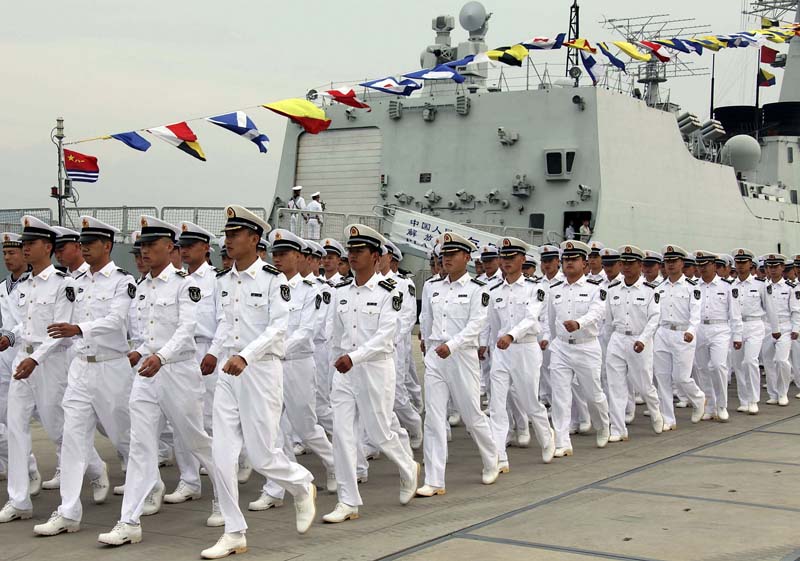
The editors of the excellent War of the Rocks invited me to post a short rebuttal to the op-ed “How Not to Go to War With China”, by Scott Cheney-Peters, which appears in their “Hasty Ambush” section:

UNDERSTANDING CHINA: THE REAL KEY TO AVOIDING WAR

….A place to begin our efforts in avoiding war with China might be avoiding engagement in some of the same incorrect mirror-imaging assumptions we once made about the Soviet Union, not least of which was MAD.  As a doctrine, Soviet leaders never accepted MAD and the Red Army general staff ignored it in drafting war plans to fight and prevail in any nuclear war. While the Soviets had no choice but to tackle the logic of deterrence as we did, the operative Soviet assumptions were predicated on a different strategic calculus, a different force structure and above all, different policy goals from their American counterparts.  A dangerous gap between American assumptions of Soviet intentions and the reality of these intentions came to light when in 1983 the Reagan administrationdiscovered to their alarm that Soviet leaders had interpreted the NATO exercise Abel Archer 83 as preparations for a real, imminent nuclear first strike on the USSR and ordered Soviet nuclear forces on high alert.

The military-to-military confidence-building initiatives outlined by Cheney-Peters intended to construct “habits of cooperation” are not entirely useless. There is some value in ensuring that high-ranking American military officers have personal and limited operational familiarity with their Chinese counterparts in the People’s Liberation Army (PLA), but as potential game-changers, they need to be taken with a grain of salt. Such a policy misses the essential strategic and political centers of gravity in the Sino-American relationship.  Namely that for the first time in 600 years, China is building a blue water Navy that will foster power projection as far away as the Indian ocean and Australia.  Secondly, this naval expansion, coupled with a new Chinese foreign policy, aggressively presses grandiose territorial demands on nearly all of its neighbors, including India and Japan.  These are fundamental conflicts with American interests that cannot be explained away or papered over by banquet toasts with visiting delegations of Chinese admirals. […]

Read the rest here.

Also read another WotR  China piece “99 Red Balloons: How War with China would Start” by Matthew Hipple

Guest Post: Cheryl Rofer – I Hope the Government Doesn’t Listen to Nathan Myhrvold

Monday, September 23rd, 2013

Cheryl Rofer, scientist, WMD expert and founder of Nuclear Diner.com and long-time friend of ZP blog, will be cross-posting here today regarding the report “Strategic Terrorism: A Call to Action” by Microsoft billionaire, venture capitalist, theoretical mathematician and cookbook author, Dr. Nathan Myhrvold

I Hope The Government Doesn’t Listen to Nathan Myhrvold

by Cheryl Rofer

Shane Harris at Foreign Policy tells us that Nathan Myhrvold, fresh off introducing the world to liquid nitrogen and other expensive innovations for cookery, is now going to straighten out the US government on terrorism. He has produced a thirty-three page paper that he is shopping around Washington to help the government get things right.

Except that Myhrvold does not understand the definition of a threat: intent + capability. And he gets a lot of things wrong.

He has a lot to say about what he calls, and barely defines, “strategic terrorism.” This is apparently intended to be parallel to the strategic nuclear threats of the Cold War. But during the Cold War, both the United States and Russia had nuclear weapons aimed at each other. They still do. The terrorists that Myhrvold discusses do not have weapons that can kill millions of Americans, which seems to be central to “strategic terrorism.” It’s not even clear that they have intent, but, for the sake of argument, let’s assume they do. That is only half a threat.

Could they get that capability? Myhrvold is convinced they can, but he offers little in the way of evidence, and some of that is incorrect. Further, he confuses possibility with actuality throughout the paper, slipping easily from might to could to can.

Let’s get the biggest factual error out of the way first. On page 5, Myhrvold says:

The collapse of the Soviet Union has also greatly aided the dispersal of nuclear knowledge and potentially even complete weapons.

Note that potentially. again on page 10:

Today, tremendously lethal technology is available on the cheap. Anyone—even a stateless group—can have the deadliest weapons on earth. Several trends led to this inflection point. One is nuclear proliferation, which in recent years reached a tipping point at which access to nuclear weapons became impossible to control or limit in any absolute way. The collapse of the Soviet Union scattered ex-Soviet weapons across many poorly governed and policed states, and from there, the weapons may spread further into the hands of terrorists. At the same time, the set of ragtag countries that have developed homegrown nuclear devices is large and growing. The entrance to the nuclear-weapons club, once limited to a small number of sophisticated and stable countries, is now far more open.

Myhrvold is simply wrong that “The collapse of the Soviet Union scattered ex-Soviet weapons across many poorly governed and policed states.” He may have heard that when the Soviet Union split into fifteen separate states in December 1991, four of them had nuclear weapons: Russia, Ukraine, Kazakhstan, and Belarus. This was a consequence of Soviet basing policy and the rapidity with which the Soviet Union fell apart. Kazakhstan decided it didn’t want to be a nuclear power and sent its missiles back to Russia. It took a bit more persuasion to convince Belarus and Ukraine, but they sent theirs back too. Twenty-two years after the breakup, there is no evidence that any Soviet nuclear weapons are outside Russia.

And the “large and growing” number of “ragtag countries” that “have developed homegrown nuclear devices”? Well, let’s count them. Outside the five nuclear weapons countries enumerated in the Nuclear Nonproliferation Treaty, India, Israel, and Pakistan that are known to have significant numbers of nuclear weapons. North Korea has tested three nuclear devices; whether they have weaponized any is not known. And, despite Iran’s insistence that it is not developing nuclear weapons, some people believe that is the case. That’s all I can think of. Nine is not a large number, nor is it growing particularly rapidly. I’ll leave it to Myhrvold to tell us which of those countries are “ragtag.”

So his assumption that nuclear weapons are easily available to terrorist organizations fails. I’m not as closely acquainted with the issues of biological weapons, but if Myhrvold’s arguments there are equivalent to the ones on nuclear weapons, I’m not worried. Likewise, he cites only one example, Aum Shinrikyo, for the terrorist use of chemical weapons, but there have been no incidents since. And he uses his expansionary sense of capability: If they had been able to disperse the sarin more effectively, more people would have died. But they didn’t; these weapons are difficult to make effective, and small groups, even with expertise, have shown themselves not up to the capability of states.

It’s worth going back to that paragraph from page ten to examine Myhrvold’s rhetorical methods, which persist throughout the paper. The first two sentences are sensational assertions with no specific content. And it is an inflection point – everything has changed! This is a common trope for computer guys, and the rest of us are on to it. Again, no specifics. Then the “facts,” which turn out to be wrong and unsupported. And then the sensational conclusion that the first two sentences told us we would come to.

He provides a number of old chestnuts, again with no support. Many of them have been shown to be doubtful.

  • Terrorists have no home address; therefore retaliation and deterrence are difficult or impossible.
  • “If a nation-state really wants to hurt the United states, why risk reprisal? Why not inflict damage by giving encouragement, resources, and direction to a group such as al Qaeda?”
  • “The quickest path to power for a ruthless and ambitious 21st-century man in many parts of the world is now to lead a stateless terror group.”
  • “The bully pulpit afforded by modern communications has allowed what once would have been isolated fringe groups to knit together into formidable adversaries against the most powerful nations on earth.”

He conflates all terror groups with al-Qaeda and almost asserts that their single goal is to build a caliphate. I say “almost” because throughout the paper, he implies or states pseudo-conclusions loosely connected to earlier statements, not quite willing to own his implications. However, since he includes them, one might assume that they represent his thinking. This method of presentation, however, leaves him ample room to say “I didn’t say that.”

He defines (or, in his loose way, almost defines) tactical and strategic terrorism, presumably attempting a parallel with tactical and strategic nuclear weapons. Tactical terrorism – the shooting up of shopping malls and bombing of marathons – can be handled by normal means of law enforcement. Strategic terrorism – which seems to mean actions that can kill millions of Americans – needs Myhrvold’s advice.

The parallel, however, doesn’t work, because strategic nuclear weapons exist, but the capability for a terrorist group to kill millions of Americans doesn’t and isn’t likely to for some time, if ever.

But let’s consider Myhrvold’s advice. It is to centralize and highly fund (ah, now we see why he’s getting an audience in Washington) an organization with a single executive to prevent strategic terrorism.

Business knows best, he says, and this is how business does it. But, whatever the virtues, this has been tried before. Any number of politicians and lobbyists have advocated a special agency with an executive focused like a laser on their preferred goals. Sometimes the agency is formed. It would be helpful if Myhrvold would list the successful examples.

The government is doing many of the things that Myhrvold advocates; he seems not to have researched what is being done and what is not. And some of his (almost) suggestions are scary: we must reconsider whether the dangers from the Bill of Rights outweigh the benefits. Not even that explicitly, his goals of preventing strategic terrorism imply a great deal of surveillance, probably a lot more than the NSA is now being accused of.

Harris says that Myhrvold is talking to people in federal agencies concerned with terrorism, although Myhrvold is shy about saying whom. There are always a few people in federal agencies who are impressed by a Big Name with Big Money. Perhaps they just wanted him to sign their copy of his cookbook. And perhaps some see an opportunity to use Myhrvold’s recommendations to enhance their agency’s budget or reach.

But it’s the sameold sameold: be very afraid, the terrorists are coming to get you! The country seems to be moving past that after twelve long years.


Switch to our mobile site