zenpundit.com » putin

Archive for the ‘putin’ Category

Four angles plus one on reading Trump

Sunday, July 31st, 2016

[ by Charles Cameron — on the need for an analytic open mind — or hedging one’s bets? ]
.

I suppose we have to start with Trumpian Fundamentalism — by wbich I mean, taking the literal meaning from whatever he says. This view is simple, even simplistic.

One down, three to go.

**

There’s Lt. Gen. Flynn‘s view:

In the linked Politico article, Flynn is quoted thus:

Former Defense Intelligence Agency Director Lt. Gen. Michael Flynn says he’s trying to get Donald Trump to be more precise in how he talks about foreign policy, but he defended some of his hardline proposals as simply opening offers in negotiations on world affairs.

“First of all, I don’t agree with everything that he said. But he’s an individual who’s willing to take on a challenge,” the retired lieutenant general, a former President Barack Obama appointee who advises Trump on foreign policy, told Al Jazeera English’s “UpFront.” “The other aspect is there must be more precision in the use of the language that he uses as the potential leader of the free world. There has to be more precision, and those are the types of pieces of advice that I’m trying to get into him to say [to] be more precise, be more conscious about what you say about foreign policy issues because they are complicated.” [ .. ]

In Trump’s defense, Flynn said the real estate mogul sees the world from the perspective of a global businessman and suggested the billionaire’s bombastic rhetoric is just a starting point for negotiations.

Trump’s strategy is to “start really, really high and really, really hard, OK?” Flynn explained. “And then, be prepared to get down to where you think you can actually negotiate.”

This view has the advantage of following a business model, and Trump may or may not be anything else, but he’s surely a businessman. It also leaves a lot of room for “play” between his stated intentions on the one hand, and what he’s liable to settle for when talk comes to signature on the other.

**

Third, there’s Trump’s ghostwriter’s view:

Schwartz‘ tweet was quickly paired — for instance — with:

This angle has the advantage of psychological plausibility.

How can I put this kindly? The poet Rumi is quoted as saying “Many of the faults you see in others, dear reader, are your own nature reflected in them.”

**

Fourth..

I gather there is or was until fairly recently a US submarine defensive system called a MOSS (mobile submarine simulator) MK70 — a decoy launched from a torpedo tube which Wikipedia tells us [1, 2] lacked an explosive warhead but was “able to generate both an active sonar echo and a passive sound signature recorded to be extremely similar to that of the launching submarine” — thus effectively simulating a full size submarine.

I learned this today after looking up “chaff” in the belief that Trump may simply be scattering all manner of provocative yet contradictory statements in his wake, with a view to confusing the hell out of his enemies — whether his fellow Republicans, his presumptive Democratic opponent, or potentially hostile state and nonstate actors abroad.

Call that the Kim Jong Il factor — and consider by way of analogy Why it’s sane for Kim Jong-il to be crazy.

**

And quintessentially?

Those were my four original angles — but thought of Trump and Kim Jong Il reminded me of talk of Trump and Vladimir Putin — and I can’t really leave this topic without noting blog-friend Cheryl Rofer‘s recent writings on the subject:

  • Cheryl Rofer, Trump and Russia
  • Cheryl Rofer, Trump’s Russian Deals
  • Cheryl Rofer, What Trump Has Said About Russia
  • Cheryl Rofer, Donald Trump: Fellow Traveler Or Useful Idiot?
  • **

    In my view, reading Trump comes close to qualifying as a wicked problem:

    A wicked problem is one for which each attempt to create a solution changes the understanding of the problem. Wicked problems cannot be solved in a traditional linear fashion, because the problem definition evolves as new possible solutions are considered and/or implemented. The term was originally coined by Horst Rittel.

    Wicked problems always occur in a social context — the wickedness of the problem reflects the diversity among the stakeholders in the problem.

    Perhaps this explains in part why there’s such considerable polarization in our various responses to Donald J Trump and his many tweets and speeches.

    For more on wicked problems:

  • Jeff Conklin, Wicked Problems and Social Complexity
  • The epigraph to Conklin’s chapter is from Laurence J. Peter, and reads:

    Some problems are so complex that you have to be highly intelligent and well informed just to be undecided about them.

    I have to say, I feel that way a lot these days.
    Putin, Hezbollah on the Brit right, Pokémon Go at the Yasukuni

    Saturday, July 23rd, 2016

    [ by Charles Cameron — a couple of discordant notes on goings on ]
    .

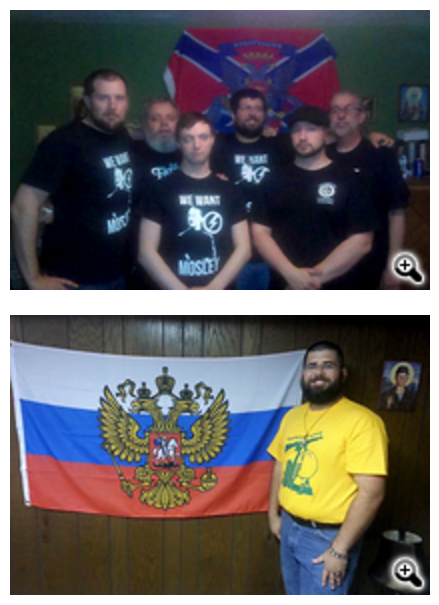
    This tweet from Casey Michel showing contemporary American fans of Sir Oswald Mosley

    — looked interesting, so I went to the linked Eurasia.net article, US Hate Group Forging Ties with the “Third Rome”, where I found these images:

    Matthew Heimbach

    — with a caption that reads:

    In two photos posted to his personal social media networks, Matthew Heimbach stands with other white nationalists underneath the “Novorossiya” flag in a photo he published in May 2016 to his personal Twitter account (top) and he stands next to a flag used to represent the president of Russia in a photo he published to his personal page on the Russian social media web site VKontakte in August 2015. Heimbach, an American citizen, claims that Russian President Vladimir Putin is the best European leader of the 21st century. (Photos: Matthew Heimbach/VKontakte;Twitter)

    **

    The double-headed eagle flag in the second image, according to the Appleton Studios heraldry blog, is in fact the “achievement of arms of the Russian Federation: The red shield with St. George on horseback slaying the dragon, the shield on the breast of a double-headed eagle wearing crowns (with a third crown in chief) and holding in its talons the orb and scepter.”

    That’s interesting, next to the Oswald Mosley guy — but what’s just as intriguing is ther symbolism of the t-shirt he’s wearing. That’s a Hezbollah t-shirt — and it’s no coincidence, as this next image from his twitter-stream shows:

    **

    Okay, that’s my first note. Here’s the lead-in to my second:

    **

    Pokémon Go Is At The Center Of An International Incident

    Wha??

    What’s worth noting here is that the Pokemon GO “gym” (augmented reality contest location) that’s at the center of this kerfuffle is geolocated at the Yasukuni Shrine — which can be seen as the Japanese approximate equivalent of the Arlington National Cemetery in the US — the nation’s most sacred shrine to its war fallen — always bearing in mind this major difference, that the Yasukuni Shrine includes numerous convicted war criminals among those venerated:

    Why is the Yasukuni Shrine so controversial?

    The Shrine is a national religious institution in Japan. Since 1869 it has honored the souls of those who have died in the service of Japan. So it mostly contains military men, but also some classes of civilians who’ve died in war-time. These include merchant seamen, and workers in bombed munitions factories, but not people in the general population killed, say, by allied bombing in World War II.

    In Shinto religion, the souls become ‘kami,’ or revered spirits. The word can be translated as ‘gods,’ but perhaps the word ‘saints’ is the most appropriate word in the western religious lexicon. So it’s a holy place for millions of Japanese who lost relatives fighting for their country.

    Among the 2.4 million souls enshrined and revered in the Yasukuni Shrine are about 1,000 war criminals from World War II. These were men who were convicted and executed by Allied war tribunals, or who died in jail. This is one of the main problems for Japan’s neighbors; that reverence is being paid to those who committed some of history’s most egregious crimes. The shrine wasn’t an issue before they were inducted en masse in a secret ceremony in 1978, after a special new category of eligibility was created for the ‘victims’ of the international war crimes tribunals.

    Those crimes were horrendous. The charge sheet at the tribunal included “murdering, maiming and ill-treating prisoners of war (and) civilian internees … forcing them to labor under inhumane conditions … plundering public and private property, wantonly destroying cities, towns and villages beyond any justification of military necessity; (perpetrating) mass murder, rape, pillage, brigandage, torture, and other barbaric cruelties upon the helpless civilian population of the over-run countries.”

    That list hardly captures some of the individual horrors. For example, during the “Rape of Nanking” in 1937, two Japanese officers had a contest to see who could kill the most Chinese with their swords. Japanese newspapers covered it as though it was a sporting event, talking about the contest going into an “extra innings” when they both reached 100 at about the same time. Elsewhere, prisoners of war were used for bayonet practice, to toughen up new recruits in the Imperial Japanese Army; while other PoWs and Chinese civilians were staked out at scientific intervals to test the effectiveness of chemical and biological weapons. Chinese cities were deliberately infected with biological agents. Countless young Asian women were forced into sex-slavery to ‘entertain’ the troops.

    The Yasukuni Shrine:

    600px-Yasukuni_Shrine

    Two-sided nuke-rattling against the ISIS third?

    Thursday, December 17th, 2015

    [ by Charles Cameron — trying to catch up with posts here when working on book proposals ]
    .

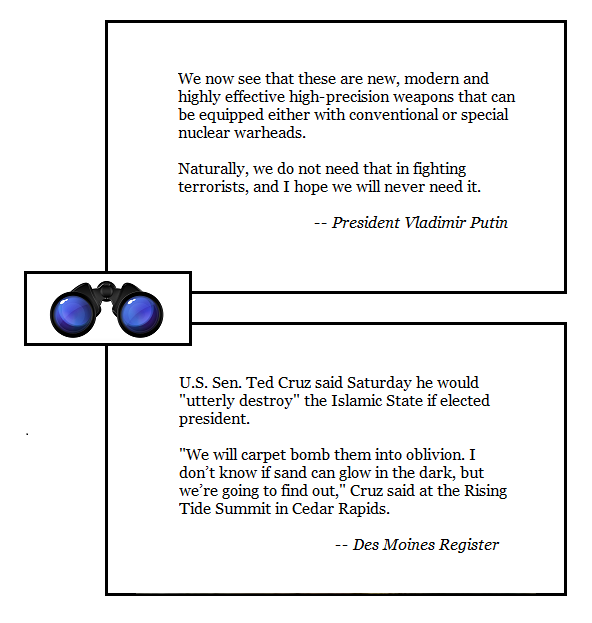
    Consider these two statements made in recent days:

    SPEC DQ nukes ISIS

    How does a war game — or game theory, for that matter — deal with the differenes, similarities, or continuum between threats and exercises on the one hand, and the actions they threaten or game on the other?

    **

    I have eagerly forgotten what temperature a nuclear strike inflicts on its human victims, and just how quickly they arrive there from room temperature. A sahih (trustworthy) hadith found in Tirmidhi tells us that the Prophet reserved the burning of infidels for God in the hereafter, and rejected its use by his followers in carrying out a death sentence:

    That ‘Ali burnt some people who apostasized from Islam. This news reached Ibn ‘Abbas, so he said: “If it were me I would have killed them according to the statement of Messenger of Allah (saw). The Messenger of Allah (saw) said: ‘Whoever changes his religion then kill him.’ And I would not have burned them because the Messenger of Allah (saw) said: ‘Do not punish with the punishment of Allah.’ So this reached ‘Ali, and he said: “Ibn ‘Abbas has told the truth.”

    I lasck specific knowledge of contemporary commentary on this hadith, but it occurs to me that in the time of the early Muslim community’s war for survival, apostasy would be equivalent to desertion. The US sentence for desertion in time of war, to this day, is described thus in the US Manual for Courts-Martial:

    Any person found guilty of desertion or attempt to desert shall be punished, if the offense is committed in time of war, by death or such other punishment as a court-martial may direct,

    The death penalty for desertion in time of war was last administered by US authorities in 1945.

    **

    Don’t we have something pretty close to a taboo on the use of nuclear weaponry?

    Sunday surprise: House of Cards meets monks and sexy riot grrls

    Sunday, October 11th, 2015

    [ by Charles Cameron — wondering if the same mind (Beau Willimon?) suggested both? ]
    .

    Two very different modes of factual reality found their ways into the fictional world of House of Cards, Season 3, American version, and I found the two choices pretty interesting. I’ve recently found clips relating to both on YouTube, so here they are for your consideration:

    Pussy Riot:

    and

    Tibetan monks:

    Taking those two choices together is a bit like juxtaposing Gregorian chant and punk rock — which, come to think of it, is pretty close to what I was getting at in my first ever Riot Grrls post, Pussy Riot, Holy Foolishness and Monk Punk.

    **

    Contemplation and activism — poles apart, or one the mainspring for the other?

    Lapido: Putin, Russia’s second Prince Vladimir

    Wednesday, August 26th, 2015

    [ by Charles Cameron — my piece contains some choice quotes from John Schindler to give perspective ]
    .

    Here’s a teaser from my latest post at LapidoMedia:

    St Vlad

    There’s a small Russian Orthodox sect that, as Time magazine reported in 2011, considers Russian President Vladimir Putin a Saint.

    It’s an all-female sect, it’s called The Chapel of Russia’s Resurrection, and its members venerate Putin as a sort of second coming of the Apostle Paul.

    The group’s founder, Mother Fotina, explains:

    ‘According to the Bible, Paul the Apostle was a military commander at first and an evil persecutor of Christians before he started spreading the Christian gospel. In his days in the KGB, Putin also did some rather unrighteous things. But once he became president, he was imbued with the Holy Spirit, and just like the apostle, he started wisely leading his flock. It is hard for him now but he is fulfilling his heroic deed as an apostle.’

    The focus, then, is not so much on Vladimir Putin as on Russian nationalism. And while the sect itself is small and obscure, the concept of Putin symbolizing Russian nationalism of a specifically spiritual sort is a potent one in Putin’s own projected image

    But perhaps you should read the whole thing


    Switch to our mobile site