zenpundit.com » JM Berger

Archive for the ‘JM Berger’ Category

Daveed Gartenstein-Ross in Foreign Affairs #2, more directly to his point

Sunday, March 5th, 2017

[ by Charles Cameron — following up on Daveed Gartenstein-Ross in Foreign Affairs, my oblique analysis and more pertinent to the point he’s making ]
.

Daveed is illustrating a pretty significant pattern with his latest article in Foreign Affairs, The Coming Islamic Culture War, subtitled What the Middle East’s Internet Boom Means for Gay Rights, and More:

These paragraphs:

Today, a new type of discursive space—one that will foster a very different set of ideas—is opening up in the Muslim world. In April 2011, Bahraini human rights activists created one such space when they launched the website Ahwaa, the first online forum for the LGBT community in the Middle East and North Africa (MENA) region. Esra’a al-Shafei, one of the website’s founders, was modest about the site’s ambitions, explaining that Ahwaa was intended “as a support network” for the “LGBTQ community” as well as a resource for those “who want to learn more by interacting with [LGBT] people.”

Although little-noticed at the time, Ahwaa’s seemingly innocuous project was in fact revolutionary. Homosexuality in the MENA region is not only stigmatized but generally criminalized and banished from the public sphere. The creation of an online platform where LGBT people could candidly discuss the issues affecting their lives, such as romantic relationships or the tensions between Islam and gay rights, was thus a direct challenge to deeply inscribed cultural and religious norms. Indeed, Ahwaa heralds a wave of challenging ideas that, fueled by rapidly rising Internet penetration, will soon inundate Muslim-majority countries.

Online communications, by their nature, give marginalized social and political groups a space to organize, mobilize, and ultimately challenge the status quo. In the MENA region, online spaces like Awhaa will give sexual minorities the ability to assert their identity, rights, and place in society. So too will the Internet amplify discourses critical of the Islamic faith, or of religion in general, and solidify the identities of secularists, atheists, and even apostates. The rise of these religion-critical discourses will in turn trigger a backlash from conservative forces who fear an uprooting of traditional beliefs and identities. The coming social tsunami should be visible to anyone who knows what signs to look for.

Into the black swirl of geographical regimes that give no room for questioning — gay, political, religious, or whatever — a white circle of online discussion and possibility blossoms —

Shielded by the relative anonymity of online communications, marginalized individuals of all stripes can discuss intimate and controversial issues. The Internet, furthermore, allows like-minded people from disparate corners of the world to find one another and create virtual communities. An atheist living in rural Egypt, for example, may not know anyone else who shares his views. But when he goes online, he will find millions of people who do.

— and as it blossoms, the black swirl of repressive backlash again threatens it.

**

Likewise, though this does not happen to be Daveed’s point, into the white swirl of western democratic societies a black circle of illiberalism opens — the internet providing a networking space for anti-Semites and other far right groups they would previously lacked —

Today, the Internet is a powerful and virulent platform for anti-Semitism — hate towards Jews that has a direct link to violence, terrorism and the deterioration of civil society. Hitler and the Nazis could never have dreamed of such an engine of hate. [ .. ]

The Internet allows anti-Semites to communicate, collaborate and plot in ways simply not possible in the off-line world.

— and this blossoming extends into the Trump camp, as JM Berger suggested

New developments and new propaganda items are a constant part of the ISIS landscape, whereas content in white nationalist networks tends to be repetitive, with few meaningful changes to the movement’s message, landscape, or political prospects. A notable exception to this is Donald Trump’s presidential candidacy, which has energized white nationalists and provided new talking points and opportunities for engagement. Trump’s candidacy is likely driving some portion of movement’s recent gains on Twitter.

And again likewise, this blossoming begins to be threatened by its own backlash — the blossoming of internet speech within contrary geographical cultural norms cuts both ways. It’s almost apocalyptic — that internet space blossoming can open up cracks in what David Brooks called “the post-World War II international order — the American-led alliances, norms and organizations that bind democracies and preserve global peace” — to which Steve Bannon is vehemently opposed.

Apocalyptic? Whether we’re speaking of Daveed’s “coming Islamic culture wars” or Brooks’ “international order” there are signs of the times to be seen. As Daveed says —

The coming social tsunami should be visible to anyone who knows what signs to look for.

— and in closing —

Regardless of their ultimate outcome, however, signs of the coming Islamic culture wars can already be discerned. Western observers have long overlooked or misinterpreted social trends that have swept through Muslim-majority countries. This is one trend that they cannot afford to miss.
Three from PBS: Ruby Ridge, Oklahoma City and the Turner Diaries

Saturday, February 18th, 2017

[ by Charles Cameron — two sad and deeply moving documentaries from PBS: The American Experience, plus a short ]
.

Last week, PBS brought us the Oklahoma City bombing (at 1 hr. 53 mins, the longest of the three videos in this post):

I’m not usually prone to tears, but moments in this documentary moved me in much the same way that the HBO docu Manhunt‘s portrayal of the Camp Chapman attack did.

**

This week, the same PBS team explored Randy Weaver and Ruby Ridge (53 mins):

Here I was particularly impressed by Randy Weaver’s daughter, Sara. She not only clarified the apocalyptic element in the Weavers’ thinking:

My Mom interpreted some of the things in the Bible very literally. There’s a verse in the Old Testament about not having graven images, and so there was a point when the TV, you know, kind of left and my parents started to dig deeper into the Bible. They did believe in an apocalyptic future. And I think that they started to take that more seriously as they got ready to leave Iowa. Fear was–was a big part of it.

She also showed an impressive sense of closure on what must have been a horrific period in her young life. Close to the end of the film, two find clips are juxtaposed:

Jess Walter, Writer: People focused so much on who was to blame. But if you look at what happened and how many times it could have been averted and avoided, how many mistakes had to be made, and how many times both sides would multiply the mistakes, the question of who was more to blame is less interesting to me than the question of how did an all-American Iowa family end up with these beliefs. And how did the government end up treating them like a group of armed terrorists?

Sara Weaver, Daughter: I do know there’s a lot of remorse and I know that the FBI uses what happened to my family as a training tool as to what not to do, and that is hugely gratifying to me. But the same way they stereotyped my dad and blew him up into this thing he wasn’t, I think a lot of people do that with our government as well. And when you operate out of misinformation and fear, things can go wrong.

Powerful, even-handed.

**

Also posted very recently: a short film (8 mins) in which JM Berger discusses the Turner Diaries:

Berger’s calm and clear narrative of the impact of William Pierce’s awful book is admirable — as is his more detailed exposition of the same topic in his ICCT report, The Turner Legacy: The Storied Origins and Enduring Impact of White Nationalism’s Deadly Bible.

**

There’s some clear overlap between the three films. All three are highly recommended.

Jabhat breaks from al-Qaida

Thursday, July 28th, 2016

[ by Charles Cameron — and al-Jolani is dressed to kill ]
.

An insightful DoubleQuote in the Wild:

As Shakespeare puts it, the apparel oft proclaims the man.

**

Readings:

  • Charles Lister, Profiling Jabhat al-Nusra
  • JM Berger, Jabhat al Nusra Splits From al Qaeda
  • Just added:

  • Charles Lister, The Nusra Front Is Dead and Stronger Than Ever Before
  • D Gartenstein-Ross, Does Jabhat al-Nusra split from al-Qaeda and what does it mean?
  • Sunday surprise: Pokemon Go Go Go

    Sunday, July 24th, 2016

    [ by Charles Cameron — for Adam Elkus, John Robb & JM Berger among others ]
    .

    Three tweets:

    *

    *

    **

    I find that last one pretty interesting, and would like to juxtapose it with a para from Michael Moore‘s piece — almost certainly the only piece of his writings I’ve actually downloaded onto my hard drive — Five Reasons Why Donald Trump Will Win:

    The fire alarm that should be going off [CC: for Hillary supporters] is that while the average Bernie backer will drag him/herself to the polls that day to somewhat reluctantly vote for Hillary, it will be what’s called a “depressed vote” – meaning the voter doesn’t bring five people to vote with her. He doesn’t volunteer 10 hours in the month leading up to the election. She never talks in an excited voice when asked why she’s voting for Hillary. A depressed voter. Because, when you’re young, you have zero tolerance for phonies and BS. Returning to the Clinton/Bush era for them is like suddenly having to pay for music, or using MySpace or carrying around one of those big-ass portable phones. They’re not going to vote for Trump; some will vote third party, but many will just stay home. Hillary Clinton is going to have to do something to give them a reason to support her — and picking a moderate, bland-o, middle of the road old white guy as her running mate is not the kind of edgy move that tells millenials that their vote is important to Hillary. Having two women on the ticket – that was an exciting idea. But then Hillary got scared and has decided to play it safe. This is just one example of how she is killing the youth vote.

    Department of unintended consequences and black swans:

    Who’d have thought a Japoanese telephone-based game might have an influence on the demographics of democracy in the US of A?

    Putin, Hezbollah on the Brit right, Pokémon Go at the Yasukuni

    Saturday, July 23rd, 2016

    [ by Charles Cameron — a couple of discordant notes on goings on ]
    .

    This tweet from Casey Michel showing contemporary American fans of Sir Oswald Mosley

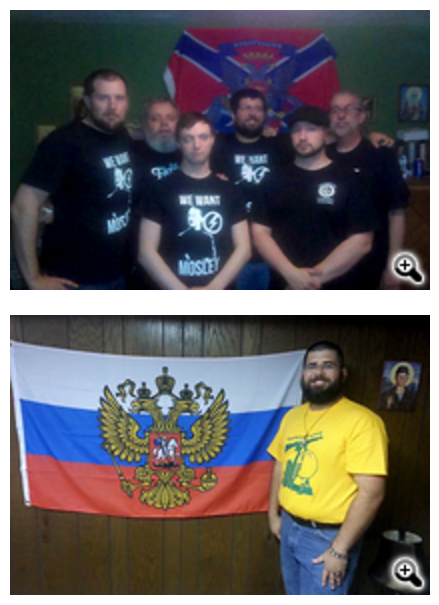
    — looked interesting, so I went to the linked Eurasia.net article, US Hate Group Forging Ties with the “Third Rome”, where I found these images:

    Matthew Heimbach

    — with a caption that reads:

    In two photos posted to his personal social media networks, Matthew Heimbach stands with other white nationalists underneath the “Novorossiya” flag in a photo he published in May 2016 to his personal Twitter account (top) and he stands next to a flag used to represent the president of Russia in a photo he published to his personal page on the Russian social media web site VKontakte in August 2015. Heimbach, an American citizen, claims that Russian President Vladimir Putin is the best European leader of the 21st century. (Photos: Matthew Heimbach/VKontakte;Twitter)

    **

    The double-headed eagle flag in the second image, according to the Appleton Studios heraldry blog, is in fact the “achievement of arms of the Russian Federation: The red shield with St. George on horseback slaying the dragon, the shield on the breast of a double-headed eagle wearing crowns (with a third crown in chief) and holding in its talons the orb and scepter.”

    That’s interesting, next to the Oswald Mosley guy — but what’s just as intriguing is ther symbolism of the t-shirt he’s wearing. That’s a Hezbollah t-shirt — and it’s no coincidence, as this next image from his twitter-stream shows:

    **

    Okay, that’s my first note. Here’s the lead-in to my second:

    **

    Pokémon Go Is At The Center Of An International Incident

    Wha??

    What’s worth noting here is that the Pokemon GO “gym” (augmented reality contest location) that’s at the center of this kerfuffle is geolocated at the Yasukuni Shrine — which can be seen as the Japanese approximate equivalent of the Arlington National Cemetery in the US — the nation’s most sacred shrine to its war fallen — always bearing in mind this major difference, that the Yasukuni Shrine includes numerous convicted war criminals among those venerated:

    Why is the Yasukuni Shrine so controversial?

    The Shrine is a national religious institution in Japan. Since 1869 it has honored the souls of those who have died in the service of Japan. So it mostly contains military men, but also some classes of civilians who’ve died in war-time. These include merchant seamen, and workers in bombed munitions factories, but not people in the general population killed, say, by allied bombing in World War II.

    In Shinto religion, the souls become ‘kami,’ or revered spirits. The word can be translated as ‘gods,’ but perhaps the word ‘saints’ is the most appropriate word in the western religious lexicon. So it’s a holy place for millions of Japanese who lost relatives fighting for their country.

    Among the 2.4 million souls enshrined and revered in the Yasukuni Shrine are about 1,000 war criminals from World War II. These were men who were convicted and executed by Allied war tribunals, or who died in jail. This is one of the main problems for Japan’s neighbors; that reverence is being paid to those who committed some of history’s most egregious crimes. The shrine wasn’t an issue before they were inducted en masse in a secret ceremony in 1978, after a special new category of eligibility was created for the ‘victims’ of the international war crimes tribunals.

    Those crimes were horrendous. The charge sheet at the tribunal included “murdering, maiming and ill-treating prisoners of war (and) civilian internees … forcing them to labor under inhumane conditions … plundering public and private property, wantonly destroying cities, towns and villages beyond any justification of military necessity; (perpetrating) mass murder, rape, pillage, brigandage, torture, and other barbaric cruelties upon the helpless civilian population of the over-run countries.”

    That list hardly captures some of the individual horrors. For example, during the “Rape of Nanking” in 1937, two Japanese officers had a contest to see who could kill the most Chinese with their swords. Japanese newspapers covered it as though it was a sporting event, talking about the contest going into an “extra innings” when they both reached 100 at about the same time. Elsewhere, prisoners of war were used for bayonet practice, to toughen up new recruits in the Imperial Japanese Army; while other PoWs and Chinese civilians were staked out at scientific intervals to test the effectiveness of chemical and biological weapons. Chinese cities were deliberately infected with biological agents. Countless young Asian women were forced into sex-slavery to ‘entertain’ the troops.

    The Yasukuni Shrine:

    600px-Yasukuni_Shrine


    Switch to our mobile site

