zenpundit.com » complexity

Archive for the ‘complexity’ Category

Look, I’m sorry to be so blunt — II: all you need is math

Thursday, July 19th, 2012

[ by Charles Cameron — global warming, global curriculum ]
.

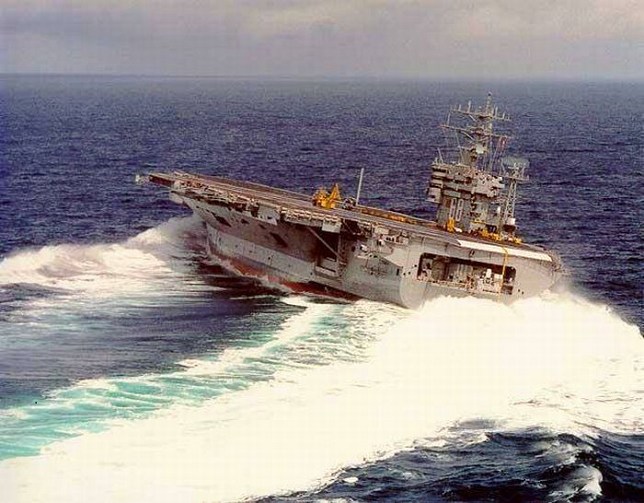
you can turn an aircraft carrier pretty fast -- but the human population?

.

Bill McKibben has an article out in Rolling Stone, Global Warming’s Terrifying New Math, in which he says:

When we think about global warming at all, the arguments tend to be ideological, theological and economic. But to grasp the seriousness of our predicament, you just need to do a little math.

Well, no you don’t.

You need something closer to global understanding. Once you’ve gathered — via that “little math” — that we’re not on a sustainable track, you’ll need to understand a few other things. Like:

Look, I’m sorry to be so blunt, but… the problem isn’t understanding, it’s changing.

Psychology. Inwardness.

And I can’t speak for economy or ideology, but believe me — theology will have a role to play!

Life imitates art, or vice versa?

Wednesday, July 11th, 2012

[ by Charles Cameron — burqas and veiled threats, Martha Nussbaum, virtual reality ]
.

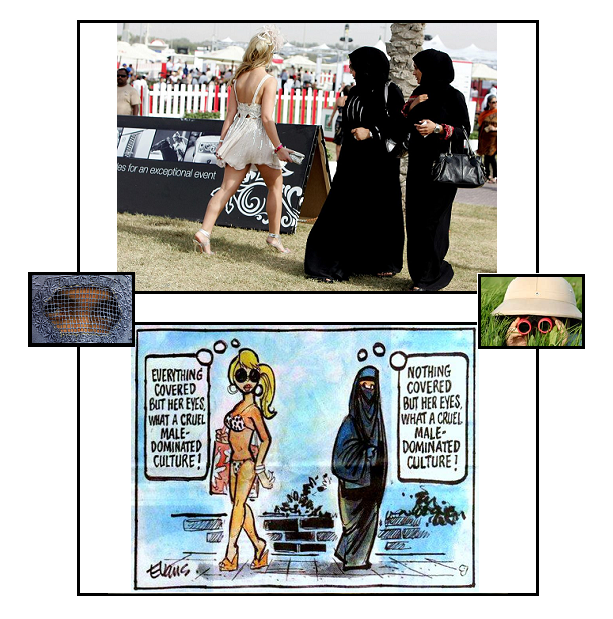
I believe the photo is from Dubai, the cartoon is by New Zealand’s Malcolm Evans, and all sorts of things are going on when we put the two of them together, thus:

**

For a start, the photographer presumably saw the same thing with his eyes and through his lens that the cartoonist saw in the mind’s eye, and then on paper. Who knows, one of them may have seen the other’s work, and that could have been what triggered their interest in capturing the same effect.

Call that the problem of simultaneous, independent vs sequential, causally connected origination. It’s a fascinating issue in archetypal psychology and cultural anthropology…

Then there’s the juxtaposition of the two images, and the fact of their close similarities and differences. Apart from the obvious difference of media, there’s the neat difference that the women in the photo reality might be thinking roughly the thoughts attributed to them in the cartoon, we’ll never know because thoughts are private — but the cartoon reality adds a “virtual” layer of text to the image, so the women’s “thoughts” and their parallelisms and oppositions are no longer tacit.

But then — hey, those two sets of thought are juxtaposed, just as the two styles of clothing are — so each of the two images I’ve juxtaposed is itself a carefully-executed juxtaposition, artfully conceived, and revealing by comparing and contrasting.

Each of those two images is a Sembl move.

And we haven’t even begun to talk about the issue of burqas and veils — or bikinis and short short skirts — yet.

**

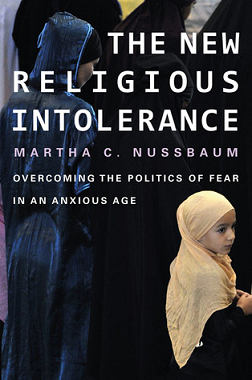
But this post is really my oblique way of introducing Martha Nussbaum‘s book, The New Religious Intolerance, which grew out of her column on veils and burqas — and tummy tucks and breast implants — Veiled threats, on the NY Times Opinionator blog.

I’d love to review it. Will I ever even find time to read it?

**

Veils worn by nuns, Muslims, ninjas — and everybody in the Windy City in December. Circumcision in Islam and Judaism, metzitzah b’peh — and various forms of female genital mutilation around the world. Prayer in schools, other people’s prayers in school. Peyote and wine as taboos, as sacraments. Pork and beef, pigs and cows. Kosher, halal, voodoo — and Socrates sacrificing a cock to Asclepius…

This business of religion and society is a subtle, multi-faceted business.

**

**

My sympathies tend to go with whoever wants to wear whatever. But then I tell myself, I have different body parts, and they have different preferences.

Perhaps more accurately — and certainly more metaphorically — I might say that I am part-angel, part-beast.

Either way, I too contain multitudes.

Infinity Journal: The Foundation of Strategic Thinking

Tuesday, July 3rd, 2012

I first heard Lieutenant General Paul Van Riper speak at the Boyd ’07 Conference at Quantico and came away impressed. General Van Riper has a new article posted at Infinity Journal (registration required but always free….):

The Foundation of Strategic Thinking 

….While Clausewitz alludes to this nonlinearity through much of his opus On War, he speaks to it directly in Book One, Chapter 1, Section 28. This section, which hardly takes up half a page, summarizes many of the essentials of Clausewitz’s theory of war. He begins the section noting: “War is more than a true chameleon that slightly adapts its characteristics to the given case.”[vii] His use of a biological metaphor indicates war is not mechanistic and therefore not a controllable or predictable phenomenon. He then lays out the dominant tendencies of that phenomenon, which strategists often sum up as passion, probability, and reason. He mentions that most often the three tendencies are the concern of the people, army, and government.[viii] Continuing, Clausewitz makes a strong claim: “A theory that ignores anyone of them or seeks to fix an arbitrary relationship between them would conflict with reality to such an extent that for this reason alone it would be totally useless.”[ix]

In other words, to be valid any theory of war must incorporate war’s intrinsic dynamism. He goes on to say: “Our task therefore is to develop a theory that maintains a balance between these three tendencies like an object suspended between three magnets.” This analogy points to a cutting-edge scientific experiment of his era, that demonstrates the nonlinearity of any system where there is freedom of movement among three or more elements.[x] The virtual impossibility of duplicating the path of a pendulum as it moves among three equally spaced magnets tells us that despite our desire to balance passion, probability, and reason—the three central tendencies of war—it is simply not possible.[xi] War is a nonlinear phenomenon.

As with all nonlinear phenomena, we can only study war as a complete system, not as individual parts. Clausewitz is clear in this regard claiming that, “. . . in war more than in any other subject we must begin by looking at the nature of the whole; for here more than elsewhere the part and the whole must always be thought of together.”[xii] This advice runs counter to Americans’ preference for using an engineering approach to solve all problems. Reductionism tends to be part of the national character. We persist in using linear methods even when the evidence shows their limitations.

John Lewis Gaddis described the difficulties this approach has caused the U.S. national security community in a ground-breaking article questioning why political scientists failed to forecast the end of the Cold War.[xiii] His convincing conclusion is that while members of the physical and natural sciences were incorporating the tools of nonlinear science into their various disciplines those in political science were adopting classical linear practices, which blinded them to the dynamics that led to the Soviet Union’s demise. In the end, we confront the reality that as with war, international relations is nonlinear. Indeed, so also are most things that flow from it, including strategies and strategic thinking. […]

Read the rest here.

I particularly liked Van Riper’s later comment as going to some of what ails us:

….Good strategists know how nonlinear systems such as nation-states, non-state actors, international relations, politics, economics, wars, campaigns, and a host of others work in the real world. More importantly, they use this knowledge of a nonlinear world when they ponder strategic questions or recommend strategies. Good strategists don’t depend on analytical tools to uncover the future security environment or potential enemies. Rather, they look to history and economic and demographic trends to inform their judgments of what might happen in a nonlinear world.

If you look at the biographies of the men who were “present at the creation” or made the transition from World War to Cold War – Stimson, Acheson, Harriman, Marshall, Bohlen, Kennan, McCloy, Forrestal, Nitze, Eisenhower, Dulles, Lovett – they had overlaps of background in international business, diplomacy, banking, law and war. While this did not mean policy harmony – for example Acheson, Kennan, Bohlen, Harriman and Nitze had disagreements among themselves in regards to the Soviets  – they possessed a shared understanding of strategy and the historical context in which they operated.

Today, high level discussions of strategy between the military, policy and political worlds are too often exactly that – communications between different planets rather than a dialogue within one small world.

Damascus, Dearborn, Rome, Vienna?

Sunday, July 1st, 2012

[ by Charles Cameron — first in a series of three posts about celestial & terrestrial geographies ]
.


.

Joel Rosenberg, again. This time it’s Damascus he’s on about, and he’s been discussing it with “a prominent Member of Congress”:

… the official asked, “What are your thoughts on Isaiah 17?” For much of the next hour, therefore, we discussed the coming judgment of Damascus according to Bible prophecy, and how this scenario could possibly unfold in the coming years in relation to other Bible prophecies and current geopolitical trends in the Middle East.

Should we file that under Foreign Policy background, Syria?

Rosenberg clearly thinks Damascus is Damascus — and it’s easy to see why, it’s almost a tautology, one might think:

These prophecies have not yet been fulfilled. Damascus is one of the oldest continuously inhabited cities on earth. It has been attacked, besieged, and conquered. But Damascus has never been completely destroyed and left uninhabited. Yet that is exactly what the Bible says will happen. The context of Isaiah 17 and Jeremiah 49 are a series of End Times prophecies dealing with God’s judgments on Israel’s neighbors and enemies leading up to — and through — the Tribulation.

How exactly will Damascus be destroyed? When will exactly it be destroyed? What will that look like, and what will be the implications for the rest of Syria, for Israel and for the region? The honest answer is that the Bible does not say. I’m currently writing a novel entitled, The Damascus Countdown, that envisions how these prophecies could come to pass.

**

But wait — the idea that Damascus (the word) means Damascus (the place) may not be so obvious at all. Consider the possibility that the names of peoples and places are, well, somtimes a bit mixed up.

Read this, for instance, from Rafil Kroll-Zaidi, Byzantium: Their ears were uncircumcised, in Harper’s, May 2102:

The Byzantines called themselves Greeks (because they were) and also Romans (because they had been). To the Muslims, who had been the Arabs (who had coveted Constantinople even before they were Muslims) but were later the Turks, the Byzantines were usually the Romans (Rum) and sometimes, though these Romans spoke Greek, the Latins (which to the Byzantines meant the barbarians of Western Europe), and sometimes the Children of the Yellow One, who was Esau. The Arabs called the Byzantine emperor (who signed his letters in purple ink EMPEROR AND AUTOCRAT OF THE ROMANS) the Dog of the Byzantines, and by the fifteenth century the sultan of the Ottoman Turks (whom the Muslims farther east called Romans and whom the Byzantines called Trojans) called himself sultan i-Rum in expectation that he soon would be and in recognition that he already, for most purposes, was.

You can see why GEN Boykin might think Dearborn is Damascus:

Dearborn, in fact, I’ve been there a couple of times recently, and if you walk down the streets, you would think you were in Beirut or Damascus.

Just kidding — Boykin sees a cultural similarity between them, that’s all.

**


.

But Rum — that means Rome, remember? — figures prominently in Islamic apocalyptic, so we “need to know” what it actually refers to. Here’s Harun Yahya on the topic:

Another astonishing piece of revelation that the Quran gives about the future is to be found in the first verses of Surah Rum, which refers to the Byzantine Empire, the eastern part of the later Roman Empire. In these verses, it is stated that the Byzantine Empire had met with a great defeat, but that it would soon gain victory.

“Alif, Lam, Mim. The Romans have been defeated in the lowest land, but after their defeat they will themselves be victorious in a few years’ time. The affair is God’s from beginning to end.”(The Quran, 30:1-4)

Okay, Rome is Byzantium, got it. Constantinople. Istanbul.

Stamboul.

**

Ibn Kathir, in The Signs Before Day of Judgement, offers this hadith from the collection Sahih Muslim:

Nafi’ ibn ‘Utbah said, “The Prophet said, ‘You will attack Arabia, and Allah will enable you to conquer it. Then you will attack Persia, and Allah will enable you to conquer it. Then you will attack Rome, and Allah will enable you to conquer it. Then you will attack the Dajjal, and Allah will enable you to conquer him.'”

Let’s get into a little more detail. Stephen Ulph quotes a writer in Al-Jama’a, a “periodical magazine on Algerian jihad affairs” in a 2004 piece in CTC’s Terrorism Monitor:

From Afghanistan comes the kernel of the Nation; it was the beginning…proud Iraq was not the end…for those infidels and the apostate agents in our lands there are not enough graves…it is high time that Rome had its Cross uprooted and the city decked out for the arrival of the new conquerors, passing through Al-Andalus and the Pavement of the Martyrs, and Vienna and Constantinople, to which we are yet drawn by a longing that grows in our breasts day by day. For our Prophet (who does not lie when he speaks, being the most truthful of speakers) did promise: “God hath set aside for me the world, and I beheld its east and western lands, and the dominion of my Nation shall reach unto that which was set aside for me.”

So Afghanistan is Afghanistan, Al-Andalus is Andalusia, Vienna is Vienna — and Rome is Rome along with the Vatican, eh?

Or is Al-Andalus Spain — or Afghanistan Khorasan for that matter?

**

**

I was reminded by another sentence in Rafil Kroll-Zaidi’s piece in Harper’s —

Halfway between Heaven and earth were tollbooths where demons taxed the sins of the Byzantines.

— of the beautiful opening sentences of Charles Williams‘ lyrical “short history of the Holy Spirit in the Church”, The Descent of the Dove:

The beginning of Christendom, is, strictly, at a point out of time. A metphysical trigonometry finds it among the spiritual Secrets, at the meeting of two heavenward lines, one drawn from Bethany along the Ascent of the Messias, the other from Jerusalem against the Descent of the Paraclete. That measurement, the measurement of eternity in operation, of the bright cloud and the rushing wind, is, in effect, theology.

And the title essay of Guy Davenport‘s book The Geography of the Imagination should give us a clue that confusion as to what exactly is where is not solely the province of prophets and their interpreters. In a memorable sentence about the American artist Grant Wood, he writes:

If Van Gogh could ask, “Where is my Japan?” and be told by Toulouse-Lautrec that it was Provence, Wood asked himself the whereabouts of his Holland, and found it in Iowa.

**

Photo credits:

Damascus: Roberta F under CC BY-SA 3.0
Vatican: Sébastien Bertrand under CC BY 2.0
Istanbul: Preference-events & elsewhere
Vienna: Canaletto, Kunsthistorisches Museum Wien via Wikipedia
Cordoba: Timor Espallargas under CC BY-SA 2.5

**

So. Where is Zion / Jerusalem?
Boko Haram: religious vs social war

Wednesday, June 27th, 2012

[ by Charles Cameron — follow up to Taliban: religiosity vs pragmatism ]
.

Sen. Ita Solomon Enang, Chairman of Nigeria’s Senate Committee on Business and Rules, recently responded to a press question about Boko Haram, in an interview published under the curious title, Boko Haram war more religious than social — Engang:

Q: Previously you said Boko Haram attacks were not targeted at Christians but with the consistent attacks on worshippers in churches, have you not changed your mind and how do you think this problem can be dealt with?

A: Unfortunately, I held a position that it is not a religious war in the past. But my position on that is becoming shaky because when people now blatantly take guns to churches and aim at unarmed worshippers, kill them and go away; or they take a bomb to the church and detonate it there, I would say this is like a jihad and I think we should stop behaving like ostriches. I think that the sooner we accept it as a religious war, the better we will be able to handle it.

**

I keep circling around this central point. Much of interest and concern in today’s world revolves around the manner in which politics and religion are separable, braided together, or inseparable…


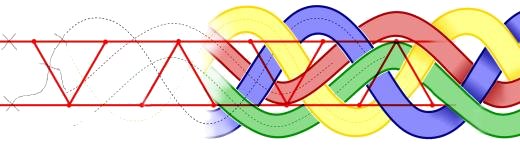
image credit: Christian Mercat, under GNU license v 1.2 — see documentation.

What does it mean for a war to be a religious war, or — to avoid the complexities that defining war bring into the picture while substituting the equivalent complexities attendant on the word violence — for violence to be religious violence?

  • Do both sides have to fight a religious war for it to be religious?
  • Can individuals perform acts of religious violence within a war that is not itself religious?

In some ways the issue parallels the one raised by Zen today in a quote from Colin Gray:

It is not sensible to categorize wars according to the believed predominant combat style of one of the belligerents. Guerrilla-style warfare is potentially universal and, on the historical evidence, for excellent reasons has been a favored military method of the weaker combatant eternally. There are no such historical phenomena as guerrilla wars. Rather, there have been countless wars wherein guerrilla tactics have been employed, sometimes by both sides. To define a war according to a tactical style is about as foolish as definition according to weaponry. For example, it is not conducive of understanding to conceive of tank warfare when the subject of interest is warfare with tanks and so forth, typically, if not quite always, in the context of combined arms.

Zen’s response to Gray:

Gray is correct that many wars partake of a blend of tactical fighting styles or that most wars are better defined (or at least should be in terms of causation) by their political character. That said, a specific fighting style sometimes is a definitive descriptive characteristic of a war, particularly if a dominant tactical style explains one side’s consistent comparative advantage (ex. the Macedonian phalanx vs. the Persians) in battle and some of the resultant choices which were forced upon the adversary.

**

We have a sort of Venn-diagram-in-words possibility: religiopolitical — but it’s really little more than a sop to the fact that religion and politics are at time closely woven. The religiosity of voiolence, and for that matter the violence of religiosity — these are things that wax and wane, shifting sands — they don’t always stay still long enough for us to box them in words, to reify them, to treat them as easily discernible and manipulable mental objects.

That said, to paraphrase Zen, “a specific religious style sometimes is a definitive descriptive characteristic of a war…”

Our understanding may be shifting and nuanced, but the briefs and executive summaries that decision-makers receive, the soundbites they articulate (can one articulate a soundbite?), and the headlines that preach their doctrines to the wide world — these use a given word or they don’t.

Let me turn that around: the briefs and executive summaries that decision-makers receive, the soundbites they articulate, and the headlines that preach their doctrines to the wide world inevitably either use a given word, or they don’t. And yet a realistic understanding of the given situation will be no less inevitably shifting and nuanced…

I feel very timid dipping a toe into Boyd in present company, but a fighter-pilot is a one-person observer, orienter, decider and actor, no? with a loop measured in fractions of seconds, not months? — whereas between intelligence gathering, strategic orientation, policy-making, and diplomatic or military action there are a multitude of communications channels — many of which function as shears that trim nuance down to the nub.

I suspect that questions like “is this a religious war?” and “is this guerrilla war?” carry (at a minimum) book-length subtleties with them, and wind up all too often with answers which are either yes or no, one or zero.

**

It’s all a bit like asking, “what game is this war we’re playing?”

One senior US official in Iraq was quoted by Anthony Cordesman as saying:

the current situation is like playing three dimensional chess in the dark while someone is shooting at you.

Tom Barnett, in The Pentagon’s New Map:

It is not chess but something closer to soccer. The ball is always moving, and substitutions are constantly changing the composition of both your team and your enemy’s. But worse still, your political leadership’s definition of the “problem” you are trying to solve keeps changing, making your attempts to keep score almost meaningless. You want to know what today’s definition of the problem is? Try reading the op-ed pages; you will have plenty to choose from.

John Arquilla and David Ronfeldt:

Major transformations are thus coming in the nature of adversaries, in the type of threats they may pose and in how conflicts can be waged. Information-age threats are likely to be more diffuse, dispersed, multidimensional nonlinear and ambiguous than industrial-age threats. Metaphorically, then, future conflicts may resemble the Oriental game of Go more than the Western game of chess. The conflict spectrum will be remolded from end to end by these dynamics.

As I noted recently, Alasdair MacIntyre wrote, about the complexity of contemporary life in general:

Not one game is being played, but several, and, if the game metaphor may be stretched further, the problem about real life is that moving one’s knight to QB3 may always be replied to by a lob over the net

When it comes time to think, there are only so many metaphor-boxes to fit your nuances into. You pays your money, and you takes your choice.


Switch to our mobile site