zenpundit.com » complexity

Archive for the ‘complexity’ Category

The speeds of thought, complexities of problems

Wednesday, February 1st, 2012

[ by Charles Cameron — instinct, rationality, creativity, complexity and intelligence ]
.

Guy Claxton, Hare Brain, Tortoise Mind
Daniel Kahneman, Thinking, Fast and Slow

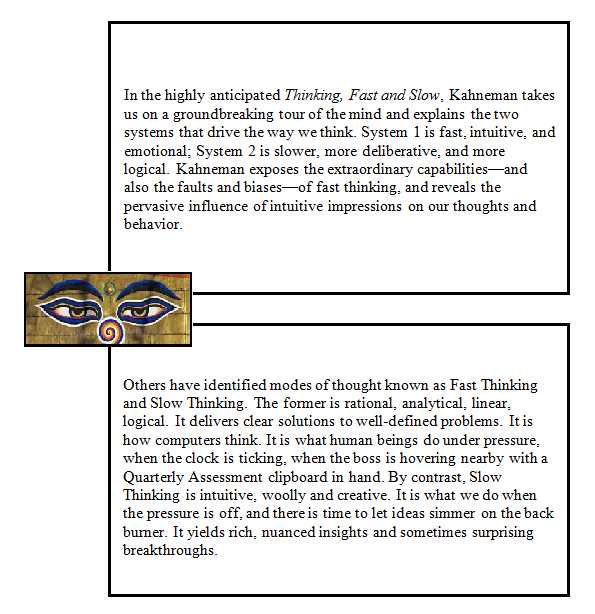
You might think, taking a quick glance at their titles, that these two books would be in substantial agreement with one another about the speeds of thought. But consider these two comments, in one of which the deliberative, logical mind is “slower” than the intuitive and emotional — while in the other, it is the rational mind that is “faster” and the intuitive mind which is “slower”. Brought together, the two quotes are amazing — it would seem that either one or the other must be wrong:

\

Happily, I don’t believe either one is wrong — I think it’s more a matter of there being three speeds of thought, and the two books in question using different terminologies to emphasize different distinctions between them.

Here’s a more extended version of Guy Claxton’s position:

Roughly speaking, the mind possesses three different processing speeds. The first is faster than thought. Some situations demand an unselfconscious, instantaneous reaction. … Neither a concert pianist nor an Olympic fencer has time to figure out what to do next. There is a kind of ‘intelligence’ that works more rapidly than thinking. This mode of fast, physical intelligence could be called our ‘wits’. (The five senses were originally known as ‘the five wits’.)

Then there is thought itself — the sort of intelligence which does involve figuring matters out, weighing up the pros and cons, constructing arguments and solving problems. A mechanic working out why an engine will not fire, a family arguing over the brochures about where to go for next summer’s holiday, a scientist trying to interpret an intriguing experimental result, a student wrestling with an examination question: all are employing a way of knowing that relies on reason and logic, on deliberate conscious thinking. … Someone who is good at solving these sorts of problems we call ‘bright’ or ‘clever’.

But below this, there is another mental register that proceeds more slowly still. It is often less purposeful and clear-cut, more playful, leisurely or dreamy. In this mode we are ruminating or mulling things over, being contemplative or meditative. We may be pondering a problem, rather than earnestly trying to solve it, or just idly watching the world go by. What is going on in the mind may be quite fragmentary. What we are dunking may not make sense. We may even not be aware of much at all. As the English yokel is reported to have said: ‘sometimes I sits and thinks, but mostly I just sits’. […]

That third mode of thinking is the one Claxton identifies with “wisdom” — which is interesting enough. Just as interesting, though, is his identification of this slowest mode of thought with “wicked problems”:

Recent scientific evidence shows convincingly that the more patient, less deliberate modes of mind are particularly suited to making sense of situations that are intricate, shadowy or ill defined. Deliberate thinking, d-mode, works well when the problem it is facing is easily conceptualised. When we are trying to decide where to spend our holidays, it may well be perfectly obvious what the parameters are: how much we can afford, when we can get away, what kinds of things we enjoy doing, and so on. But when we are not sure what needs to be taken into account, or even which questions to pose — or when the issue is too subtle to be captured by the familiar categories of conscious thought — we need recourse to the tortoise mind.

I haven’t read either book, and I’d hope that Kahneman as well as Claxton actually addresses all three speeds of thought. But my immediate point is that the slowest of the three forms of thought is the one that’s best suited to understanding complex, wicked and emergent problems.

And that’s the one that can’t be hurried — the one where the Medici Effect takes effect — and the one which provides Claxton with one of his finest lines, with which he opens his book, a western koan if ever I saw one:

There is an old Polish saying, ‘Sleep faster; we need the pillows’, which reminds us that there are some activities which just will not be rushed. They take the time that they take.

More on that front shortly, insha’Allah and the creek don’t rise.

If you can look into the seeds of time

Friday, December 2nd, 2011

[ by Charles Cameron — intelligence, games, and Intelligence ]
.
spec-gamings.png

I snagged both these graphics — different as they are — from the PAXsims announcement that the Defense GameTech 2012 conference is now open for registration, because I thought between them they neatly posed a question I wonder quite a bit about.

How much intelligence is in the tech, and how much in the focused mind?

*

Consider the selection of Bletchley analysts who were tasked with cracking the Enigma code:

The cryptanalysts were continually forced to innovate, to redesign and refine the bombes, and to devise wholly new strategies. Part of the reason for their success was the bizarre combination of mathematicians, scientists, linguists, classicists, chess grandmasters and crossword addicts within each hut. An intractable problem would be passed around the hut until it reached someone who had the right mental tools to solve it…

Simon Singh, The code book: the science of secrecy from ancient Egypt to quantum cryptography

How to calibrate the analytical reach of a single mind, the group reach of a well-chosen assortment of minds?

*

Banquo:

If you can look into the seeds of time,
And say which grain will grow and which will not,
Speak then to me, who neither beg nor fear
Your favours nor your hate.

Macbeth, Act 1, Scene 3

The Haqqani come to high Dunsinane

Wednesday, November 23rd, 2011

[ by Charles Cameron — why is non-actionable (useless) intelligence sometimes the most intelligent (useful)? – importance of multiple frames for complex vision ]
.

spec-taliban-to-high-dunsinane.png

I have fun choosing my data points, I’ll admit, and I enjoy the art of juxtaposition for its own sake — but the particular juxtaposition above is frankly useless.

Readers of the Chuang-Tzu, however, will be familiar with the idea that the useless is not without its uses

Here, then, is the method to this madness.

What I want to establish in myself – and in others who choose to follow me – is a rich supply of frames, of analogies, of patterns that can be seen at a glance. And the ways to do this are (a) to read widely in those arts and sciences which make frequent use of symmetry, analogy, metaphor, and pattern, and (b) to practice, oneself, the techne of analogy-, metaphor-, symmetry-, and pattern-making.

1.

In the two image-frames above, the lower image shows a still from a Haqqani network training video from SITE — which could be viewed as the fulfillment (albeit in Afghanistan, and waking reality) of a prophecy made earlier (about Scotland, a not-entirely-dissimilar country, mountainous, clannish, proud), in suitably oracular fashion, in Shakespeare’s Macbeth Act IV Scene 1 (shown in the upper frame, from the First Folio edition).

Here, you might say, the Taliban come to high Dunsinane Hill.

But…

This is not actionable intelligence.

The injunction to “keep a lookout for people on the move pretending to be trees” is not a useful addition to tradecraft.

It is, however, vivid. And it’s an instance of “the leap” from one idea to another that’s at the heart of the process of insight and discovery. It is an example of a specific skill of considerable analytic importance.

2.

Karl Weick and Kathleen Sutcliffe, in Managing the Unexpected: Assuring High Performance in an Age of Complexity, p. 42, [quoted in Fishbein and Treverton and Jeffrey Cooper ] define mindfulness thus:

By mindfulness we mean the combination of ongoing scrutiny of existing expectations, continuous refinement and differentiation of expectations based on new experiences, willingness and capability to invent new expectations that make sense of unprecedented events, a more nuanced appreciation of context and ways to deal with it, and identification of new dimensions of context that improve foresight and current functioning.

How’s that for a prose version of the basic OODA insight?

3.

Obviously, I am not talking about the kind of tactical intelligence that is concerned with materiel and logistics here, but with mindset and morale.

This may get overlooked, since…

Emphasizing current intelligence for actionable exploitation may have created an unintended mind-set that undervalues the immense importance of knowing and understanding the adversary’s intentions throughout the course of the confrontation, even at cost of foregoing exploitation of these sources for temporary advantage on the battlefield or in the diplomatic conference room.

[Cooper, Curing Analytic Pathologies: Pathways to Improved Intelligence Analysis, p.30]

4.

What I am talking about here is that “willingness and capability to invent new expectations that make sense of unprecedented events, a more nuanced appreciation of context and ways to deal with it, and identification of new dimensions of context that improve foresight and current functioning mentioned above.

New dimensions of context? What this boils down to is multiple frames of vision… which the IC understands very well, as expressed in the often-repeated chess master analogy — good for strategic thinkers of all stripes. Here’s Robert Sinclair‘s version, in Thinking and Writing: Cognitive Science and Intelligence Analysis, p. 13:

Simon estimates that a first-class player will have 50,000 of these patterns to call on — by no means a small number, but orders of magnitude less than the theoretical possibilities that flow from any given position. The expert can use them to drastically reduce the number of choices he must consider at any point in a game, with the result that he often hits on an effective move with such speed that the observer attributes it to pure intuition.

Enter Neustadt and May, whose book Thinking in Time Zen reviewed here just the other day — enter, in fact, history, as a store of stories.

Richards Heuer explains [Psychology of Intelligence Analysis, p. 38]:

An analyst seeks understanding of current events by comparing them with historical precedents in the same country, or with similar events in other countries. Analogy is one form of comparison. When an historical situation is deemed comparable to current circumstances, analysts use their understanding of the historical precedent to fill gaps in their understanding of the current situation. Unknown elements of the present are assumed to be the same as known elements of the historical precedent. Thus, analysts reason that the same forces are at work, that the outcome of the present situation is likely to be similar to the outcome of the historical situation, or that a certain policy is required in order to avoid the same outcome as in the past.

And the analogies and insights can come from fiction as well as history, as Charles Hill is quoted here as saying:

That is why Alexander the Great carried the Iliad with him on his conquests, and why Queen Elizabeth studied Cicero in the evenings. It is why Abraham Lincoln read, and was profoundly influenced by, Walt Whitman’s “Leaves of Grass,” and why Paul Nitze paged through Shakespeare on his flights to Moscow as America’s chief arms negotiator.

Further, the appropriate insights and possible framings can come from future and/or speculative histories — hence the meetings between IC members and various science fiction authors and thriller screenwriters which then DDI Jami Miscik arranged in an attempt “to see beyond the intelligence report and into a world of plot development”.

As I noted a few days back, I’m particularly impressed by Frank Herbert‘s ability to recognize the importance of the oil / desert / ecology / major powers / jihad / Mahdi complex – back between 1957 and 1965, while writing Dune.

5.

But all this takes me back to a comment I made a while back on Mark Stout‘s On War and Words blog, on “the notion of the kinship of spycraft and literature.” I wrote there:

I think that idea has a lot of merit. Chaucer was a spy, as was Kit Marlowe, and Wordsworth, and Basil Bunting. Somerset Maugham and Graham Greene spied, and John le Carre – and if I’m not mistaken, much of the early OSS was recruited from the Yale literature department by the likes of Archibald MacLeish…

My own suggestion would be that this is because the literary mind is well suited to understanding and expressing complex relationships, just as (it has been suggested) the engineering mind is suited to seeing things in black and white – you’ve probably seen Diego Gambetta and Steffen Hertog’s paper on Engineers of Jihad, in which they determine that “engineers, in particular, were three to four times more likely to become violent terrorists than their peers in finance, medicine or the sciences”.

I don’t know whether that allegation is accurate, or just an artifact of their research methods – but if it’s true that literature offers a different (and in some ways more subtle) means of modeling the kinds of complex situation we’re all facing these days, maybe we need to increase the intake of lit and humanities majors into the IC, and stop being so tech-centric about our analytic methods. The human mind might just be better at selecting and connecting the right dots than our datamining programs.

Keith Oatley‘s paper Shakeapeare’s invention of theatre as simulation that runs on minds might give us a hint or two.

And we’re back to Shakespeare.

6.

Why?

Because what’s important in all this is the quality of imagination expressed. And the core insight is that the greatest poets, dramatists, science fiction writers and historians create pocket universes — worlds invented or perceived in which the logics of the many binary oppositions, tides, undertows, tipping points and emergent patternings of our profoundly complex world are found in miniature.

The mind in a nutshell, the world in a grain of sand…

Perhaps clearest statement of this perspective comes from the great scientist Gregory Bateson, who writes about poetry in these terms:

One reason why poetry is important for finding out about the world is because in poetry a set of relationships get mapped onto a level of diversity in us that we don’t ordinarily have access to. We bring it out in poetry. We can give to each other in poetry the access to a set of relationships in the other person and in the world that we are not usually conscious of in ourselves. So we need poetry as knowledge about the world and about ourselves, because of this mapping from complexity to complexity.

7.

If it is great imaginative power that provides the deepest insights into a complex world, great minds and hearts will be those you need to follow — not minds cowed by the pressures of bureacracy and success.

“You want some new ideas? Read some old books” Marine Gen. James Mattis told his audience at the 14th annual American Veterans Center conference the other day, in a speech which “recommended books by and about leaders like Nelson Mandela, Martin Luther King Jr., George Washington and Abraham Lincoln.”

Great hearts, great minds. And not always well-tolerated by those around them.

8.

Jami Miscik again, at a conference discussing “The Power of Impossible Thinking: A Prerequisite for Profitable Growth“:

Embrace the maverick.

Miscik is clear that the purpose isn’t only to be widely read, but to be independently and courageously thoughtful.  Bureaucracies are not by nature the most friendly places for independent thinking, stove-piping and soloing, seniority and comfort all militate against it — hence the need to embrace the maverick, to develop (in fact) a culture that embraces the maverick.

Miscik addresses that issue, too: “She also warned the audience that a single spate of change is not enough; an organization will always have to change again.”

Or as Sinclair has it in Thinking and Writing (op. cit., p. 9):

I do believe diversifying the workforce in this way would require a cultural shift at least comparable to that involved in a shift to online substantive collaboration. Without such a shift, the directorate, like any organism under threat, would identify people who failed to fit the dominant pattern as foreign bodies and extrude them.

9.

I am thinking, in all this, of those whose task it is to provide the richest, highest level analysis of “the adversary’s intentions” — the readers of minds by which history is about to be written.

Those whose job it is to be concerned about the threats that face us, from the Haqqani, from the Chinese, from Pakistan, from wherever, will do their job better, with greater insight – with greater critical doubt and critical confidence – if their minds are richly sown with myths and histories, matter for analogies pattern languages, than if they have focused down along the scope of a single silo…

As Mattis, Hill, Miscik, Sinclair, Bateson, Oatley, Heuer and company, each in their own way, suggest…

10.

When you come right down to it, audacious, insightful thinking is its own form of special ops.

Striking Iran: Two Games and a World – Pt 2

Tuesday, November 15th, 2011

[ by Charles Cameron board game and board-room simulation of an Israeli strike on Iran ]

.

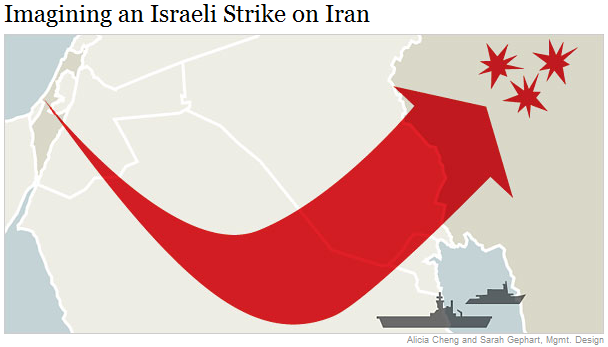
nyt-osiraq.png

[graphic & headline from the New York Times]

[continuing from part I]

5.

Osiraq Redux

Karim Sadjadpour described a very different style of game in Foreign Policy just one day after Michael Peck’s description of Persian Incursion. It was conducted by the Brookings Saban Center, and also written up by Kenneth Pollack in the Center’s Middle East Memo of February 2010, and by David Sanger at the New York Times.

Here is Pollack’s description of the structure of the Brookings game:

The simulation was conducted as a three-move game with three separate country teams. One team represented a hypothetical American National Security Council, a second team represented a hypothetical Israeli cabinet, and a third team represented a hypothetical Iranian Supreme National Security Council.

As a scholar of religion, I would be tempted to add, after the manner of the Athanasian Creed, “Yet there are not three hypotheticals but one hypothetical.”

More:

The U.S. team consisted of approximately ten members, all of whom had served in senior positions in the U.S. government and U.S. military. The Israel team consisted of a half dozen American experts on Israel with close ties to Israeli decision-makers, and who, in some cases, had spent considerable time in Israel. Some members of the Israel team had also served in the U.S. government. The Iran team consisted of a half-dozen American experts on Iran, some of whom had lived and/or traveled extensively in Iran, are of Iranian extraction, and/or had served in the U.S. government with responsibility for Iran.

This game begins with an Israeli strike – that is to say, the strike itself is not what is gamed here: the game is designed to be “a day-long simulation of the diplomatic and military fallout that could result from an Israeli military strike against the Iranian nuclear program.” Again, I will not rehearse nor comment in much detail on what has been reported of play, both in Pollack’s official Brookings report on the game and in Sadjadpour’s account, noting only that the Brookings game features a response from Hizbollah which (as Michael Peck noted) was lacking in the board game.

6.

Differences of style

What interests me is the difference in style between the two games, the two approaches:

  • The emphasis on the initial strike in Persian Incursion focuses that game more tightly on questions of materiel and logistics, while the Brookings game naturally puts greater emphasis on the responses of individuals and groups. And I’d suggest that the structures of the two games in some sense parallels that distinction:
  • The board game is played by two players, typically experienced grognards, wargame hobbyists or designers, often with military backgrounds. Their skill is in decision-making in the context of such games, and Larry Bond has provided them with an exhaustively-researched briefing on the issues he considered salient.
  • The board-room sim is played by a couple of dozen players, each of them already possessing their own highly detailed “takes” on the specific aspects of the game their voices will “represent”.

One might say that Persian Incursion is an entertainment and the Brookings game a high-level albeit informal strategic deliberation — but that comparison fails to account for the detailed research that has gone into PI — and the Harpoon gaming system which underlies it. Both games are serious attempts, at the limit of human imagination, to figure out — to “game” — one specific, now perhaps looming, future.

Taking both games with equal seriousness, then, we can say that both players of PI have Larry Bond and his two associates (in the form of those booklets, maps, target specs and so forth) as their intel resources, whereas the Brookings game features the combined (cooperating and competing) intelligences of the two dozen or so participants.  That’s not quite crowdsourcing, as is the Naval Postgraduate School‘s ongoing MMOWGLI anti-piracy game, but it is polyphonicit allows and attends to a variety of voices…

Of course, if those various voices are selected in such a way that they form too much of a “choir” or “chorus” this advantage is diminished: there’s no great benefit to hearing a dozen or two versions of group-think. And while the individual voices in a group may in fact propose usefully distinct ideas, there’s always the possibility that some key factor or factors will be overlooked, because a single world-view is operating where a true polyphony would require a deeper and richer diversity.

Is Persian Incursion more practical, having a greater emphasis on actual force projection? Is Osiraq Redux more realistic, having a wider set of expertises to draw on?

7.

Omnium gatherum

For the sake of completeness, I should mention that a game not unlike the Brookings game of 2009 was played by a similarly qualified group at the behest of the Atlantic magazine in 2004, as reported by James Fallows. I was particularly intrigued by this piece because Mike Mazaar, with whom I once collaborated briefly, was playing SecDef.

What I’d hope for from ZP’s readers would be some discussion of these two different approaches to gaming, and of gaming itself– along with scenario planning — as a means of exploring possible futures where the impact downstream may be considerable.

The piece of the puzzle that I fear may be missing from both games, as those who know me will have guessed, is the potential influence of messianism — from the Israeli / Judaic, the U.S. / Christian Zionist, and the Iranian / Mahdist sides. But then I generally expect the seriousness of millennial aspirations to be discounted, and try to keep track of those things accordingly myself.

Three puzzle pieces that I would find relevant would be:

(i) the Ayatollah Khamenei‘s fatwa “that the production, stockpiling and use of nuclear weapons are forbidden under Islam and that the Islamic Republic of Iran shall never acquire these weapons”;

(ii) Timothy Furnish‘s observation:

The Leader of the Islamic Republic of Iran, Ayatollah Ali Khamenei has issued the Fatwa My own study of both geopolitics and of Shi`i traditions on the 12th Imam leads me to conclude that the clerical regime does NOT believe in nuking Israel (or anyone else), because while the Mahdi will return at a time of great violence and upheaval, there is no Shi`i teaching that creating such bloodshed would induce Allah to send him. Also, I think the ayatollahs are crazy like foxes, not literally crazy-and they know full-well what would be the Israeli (and perhaps American ) response to any use of nuclear weapons against Israel. The Mahdi would not be happy to return and rule over a radioactive wasteland..

For more detail, see also Furnish’s A Western View on Iran’s WMD Goal: Nuclearizing the Eschaton, or Pre-Stocking the Mahdi’s Arsenal?

and (iii) Benjamin Netanyahu‘s statement in opening the Knesset:

Our policy is guided by two main principles: the first is “if someone comes to kill you, rise up and kill him first,” and the second is “if anyone harms us, his blood is on his own hands.”

The first is “im ba l’hargekha, hashkem l’hargo” — a well-worn phrase that can be found in the Talmud and derives from Exodus; I’m unsure whether the second — “If anyone harms us, his blood is on his own hands” — comes from a Talmudic source, or whether it is an abbreviated restatement of Ezekiel 33 1-9.

8.

Some trivia for good measure…

As Michael Peck points out, the game’s graphic designers write Persian Incursion using a faux-Devanagari script more properly associated with Sanskrit and Hindu sources than Iranian Shi’ism…a minor pity, that.

And ha! — I’m left wondering whether the title, Persian Incursion, came to Larry Bond or his crew out of the ethers — or whether someone had been watching…

persian-incursion-carmen-sandiego.png

Where in the World is Carmen Sandiego, Season 5, Episode 39?

GMTA?

Striking Iran: Two Games and a World – Pt 1

Tuesday, November 15th, 2011

[ by Charles Cameron — board game and board-room simulation of an Israeli strike on Iran ]

.

persian-incursion.png

1.

We suppose we can game the world.

It may in fact be the best thing we can do, or the only thing: we guess, guesstimate, estimate the possible outcomes of an act or series of acts — and somehow in there, we hope to match the major trends in the complexity we seek to understand with selected complexities of our own that we build into our games.

And yet as Richard Danzig noted in the opening paragraph of his Driving in the Dark: Ten Propositions About Prediction and National Security which I quoted here yesterday, “whereas routine, short-term predictions are generally right, strategic judgments about future environments are often, one might say predictably, wrong.”

So we have knee-jerk responses, which can suitably be expressed in barks or sound-bites, and we have deliberative inquiry, which requires suitably nuanced exegesis. And our games and simulations are attempts at the deliberative approach.

2.

The chess board:

So the question of an attack on Iranian nuclear facilities is once again in the air, and we would like to be able to peer as far down the chess-board as a Kasparov, computing the counter-move an adversary would make against a friend’s counter-move to the adversaries response to an initial move. Sadly, though, we all too often find ourselves in the bind that a senior US official in Iraq described to Anthony Cordesman a while back, where our best efforts at gaming the situation are “like playing three dimensional chess in the dark while someone is shooting at you.”

Except that my own version of the board may be more accurate:

it’s more like an n-dimensional spider’s web, with multiple gravities, tugs, and tensions – and some of those tensions are in the category of known unknowns that one of your predecessors talked about, some of them unknown unknowns, and some of them literally unknowable – hidden in the hearts of more devious men than you, and known only to God.

3.

So, anyway, we game things out as best we can.

And since the idea of bombing Iran’s nuclear facilities has been in the news of late, so have two attempts to “game” that particular possibility and its sequelae.

What interests me here is not the outcomes envisioned – but the inherent differences between the two games. Let’s take a look.

4.

Persian Incursion.

As Michael Peck — he splashed Persian Incursion into our consciousness with one post on Foreign Policy and another on Danger Room last week, not to mention an interview on NPR – puts it:

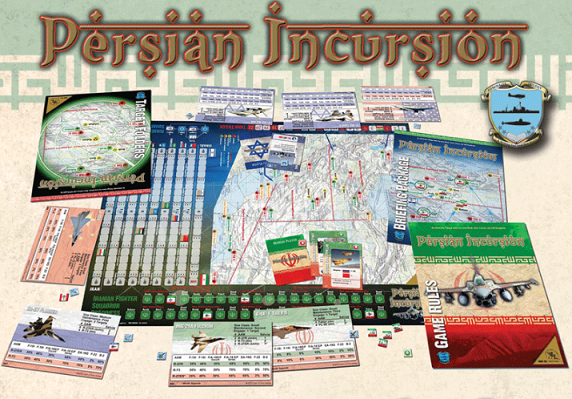
Persian Incursion is basically two games in one. There is a highly detailed military game of a seven-day Israeli air offensive in which Israel plans and executes its strikes while the Iranian air defenses try to stop them. But there is also a political game that unlocks the military aspect. Persian Incursion assumes that an Israeli attack is only possible if one of Iran’s neighbors — Saudi Arabia, Turkey, or a U.S.-influenced Iraq — either publicly or tacitly allows Israeli entry into its airspace for the strike on Iran. (The rules state that though Israel could chance an initial airstrike without an agreement, it would need permission for follow-up attacks.) With that in mind, the game comes with various starting scenarios, such as a super-radical Iran that scares its neighbors into allowing Israeli access, or Turkish support for an Israeli strike (note that the game came out in 2010, before the current Israeli-Turkish spat).

Here’s how Clash of Arms, the publisher, describes the game packet:

Persian Incursion provides comprehensive and detailed information on:

• Orders of battle for the Israeli and Iranian Air Forces and the Iranian Air Defense Force
• Analysis of the Iranian nuclear and oil infrastructure
• Iranian ballistic missiles and Israeli ballistic missile defenses
• Target folders for Iranian nuclear facilities, oil terminals and refineries, and airfields
• Variable starting conditions

Components:

• Rulebook; Briefing Package and Target folders;
• 17 x 22″ Full color map;
• Short Deck of “Super Cards” (4.25 x 6″);
• 2 Full decks of playing cards (110 cards);
• Cardboard counters;
• Box and dice.

Now I am absolutely not the guy you want to ask about the game-play, or about the game’s possible implications for policy analysis. Michael Peck may well be that guy, but even he doesn’t leave the game with a clear sense of how things might play out in real time:

The real question of this exercise, however, is whether an Israeli strike on Iran is a good or bad idea. Persian Incursion’s answer is an unqualified “maybe.” Israel can’t stop Iran from retaliating with missile attacks and terrorism. But it also can’t guarantee complete destruction of Iran’s nuclear program. Perhaps most importantly, the key to victory is winning the public-opinion, political war.

And when you get granular, “public opinion” turns out to mean the interwoven opinions of many, many and diverse people — some influential, some easily influenced, some whose world-view features a rigorous scientism, some a potentially wrathful deity – all of whom are themselves beset by a myriad of doubts, certainties, hopes, fears, bouts of toothache and who knows what else…

Modeling even one of those minds (and associated hearts) would be quite a trick…

So. That’s the “reference library” approach, to use Peck’s term:

Persian Incursion isn’t a novel — it’s a reference library inside a game. The background information included is staggering. Besides the rules book, there is a target folder and a briefing booklet listing the precise dimensions of Iranian nuclear facilities down to the meter…

The gamer has what we’ll assume is a highly accurate representation of the materiel side of things. Morale, at the granular level of a Netanyahu or a Khamenei?

Who can game the workings of a single human mind (and heart)?

[continued in Pt 2]


Switch to our mobile site