zenpundit.com » complexity

Archive for the ‘complexity’ Category

The Said Symphony: Introduction

Wednesday, June 15th, 2011

[ by Charles Cameron – extended analytic game on Israeli-Palestinian conflict ]

.

I have begun work on a major personal project, the Said Symphony, and I’ll be posting the work as it proceeds, privately in the Alumni forum of Howard Rheingold‘s online classes, and in public here on Zenpundit.

Here’s the deal.

The idea of the Said Symphony Game:

Edward Said, the Palestinian “public intellectual” was also an accomplished musician, and the music critic of The Nation for quite a while. One time he brought his musical and Palestinian interests together in a stunning suggestion:

When you think about it, when you think about Jew and Palestinian not separately, but as part of a symphony, there is something magnificently imposing about it…

I intend to explore that idea, in an attempt to “see” the Israeli-Palestinian question with fresh eyes, to hear it in some of the many voices – from sound-bites to scriptures – embodied in that conflict, some of the many individuals whose dreams and lives and olive trees are rooted in that sacred ground… and to present it in a way that is at once analysis and synthesis, history and work of art.

The complexity of the situation:

Let’s make this personal. Here’s a poem that expresses the way I’m thinking here:

I am Charles

My concern is the human mind in service
to an open heart, and my problem
is that the heart picks issues rich in ambiguity
and multiplicity of voices, tensions
and torsions tugging not one way but
in many directions, even dimensions, as does
a spider’s web weighed down with dew –
to clarify which a mind’s abacus is required

equal in subtlety to subtlety itself, while
in all our thinking and talking, one
effect follows one cause from question
to conclusion down one sentence or white
paper — whereas in counterpoint,
Bach’s fugal voices contain their dissonance.

Okay?

Take a look at this spider’s web, for example:

spider_web.jpg

Spiders and dewdrops do a pretty convincing job of portraying a certain level of complexity in what I think of as (virtually, metaphorically) a node-and-edge diagram of the global situation.

Mapping ideas and places:

Now, to apply that style of thinking to a serious world problem… the Palestinian-Israeli or Israeli-Palestinian conflict…

When, say, Hamas and Fatah signed their National Reconciliation Agreement on May 4, 2011, or Netanyahu won 29 standing ovations during his May 24 speech before a joint session of the US Congress, it’s like a few new drops of rain falling on that spider’s web — the droplets fall this way and that, carom into one another, the fine threads they’re on snap or stretch and swing down and around… until a new equilibrium is reached…

But try thinking the issues through before breakfast one morning if you’re the US Secretary of Defense — with the fresh winds of the Arab Spring promising a new Egypt, Iran announcing its intention to test a nuclear weapon shortly, and al-Qaida and associates training and recruiting in the background…

PakistanChina

And your problem isn’t a two-dimensional spider’s web with gravity pulling in just one direction – it’s more like an n-dimensional spider’s web, with multiple gravities, tugs, and tensions – and some of those tensions are in the category of known unknowns that one of your predecessors talked about, some of them unknown unknowns, and some of them literally unknowable – hidden in the hearts of more devious men than you, and known only to God.

That’s the complexity of the thing: to map the spaces where salaam might meet shalom.

That’s also the node-and-edge nature of the graphical approach I shall use.

Coming up shortly:

In my next post, I’ll explain the HipBone gameplay – the way in which moves are made on the board, and what their juxtapositions mean — and introduce the board.

Guest Post: Few’s The Serenity Prayer for Grand Strategy

Thursday, May 26th, 2011

[Cross-posted from SWJ Blog]

Major Mike Few, one of the SWJ Blog’s trusty editors opines on the nuts and bolts of “doing grand strategy”. Pay close attention to points #2 and #7. Hopefully, the first of many guest posts here by Major Few, if I can steal some of his time from Dave Dilegge 🙂 :

The Serenity Prayer for Grand Strategy: Nine-Step Recovery Method for Reframing Problem Solving

by Mike Few

Recently, our authors began to shift from problem definition to reframing problem solving. Over the last year, we published some remarkable works effectively describing Iraq, Afghanistan, Mexico, Libya, and others. Simultaneously, we published several series on design and wicked problems.

The challenge we are posing is can someone produce a concise document applying design to an existing problem? If we cannot find practical application or wisdom, then the process becomes a moot effort. Below is my white board attempt to provide an example and discussion for others to follow. This blog post is similar to many of the discussions our authors and readers have daily in the classroom and nightly at the pub or dinner with colleagues. Simply put, I am merely merging the sum of our published thought and discussions.

Three years ago, I was challenged to determine if my experiences in big wars and counterinsurgency could be applied to the macro level. On the tactical level, I found that I simply relearned the lessons of those that had come before me, the countless art of war and warfare. However, when I consider how my thinking had changed, I feel that perhaps there are some lessons that can be applied for us all.

In combat, I finally learned the limits of my own control. This understanding freed me to concentrate focusing on changing the things that I could control. I look at framing problem solving in international relations in a similar manner. It’s kind of like the Serenity Prayer for Grand Strategy. So, as a practical exercise, below is an example of how I would use Design, Wicked Problems, and Military Decision Making Process using the example of Mexico.

1. Define what we cannot control. We cannot “fix” Mexico. They are a sovereign nation-state, and they must choose to work on their internal issues. Moreover, our “solution” to their problems may not be a proper fit despite our best intentions. Our intervention efforts in Central and South America over the past sixty years (or more) have had mixed results.

2. Define the problem as it is not as we wish to see it. Are we really in a war on poverty, drugs, education, terrorism, and governance? Are we really at war? Labels are often limiting, but there needs to be some common framework to understanding. Typically, that can be driven by good communication and active listening. We must learn to transcend how “I” see the problem and work towards how the collective group sees the problem accounting for all stakeholders.

3. Define our relationship. How does the US and Mexico see each other? This perception requires a degree of self-introspection and humility. Are we a brother attempting to help our sibling overcome addiction or work through difficult financial times? Are we a parent disciplining a spoiled child? Are we a spouse in a broken marriage? How we see ourselves defines our national interest. If we see ourselves as the parent, then we’re self-imposing a conceptual block.

As Martin Luther King wrote while sitting in the Birmingham Jail,

“Moreover, I am cognizant of the interrelatedness of all communities and states. I cannot sit idly by in Atlanta and not be concerned about what happens in Birmingham. Injustice anywhere is a threat to justice everywhere. We are caught in an inescapable network of mutuality, tied in a single garment of destiny. Whatever affects one directly, affects all indirectly. Never again can we afford to live with the narrow, provincial “outside agitator” idea. Anyone who lives inside the United States can never be considered an outsider anywhere within its bounds…In any nonviolent campaign there are four basic steps: collection of the facts to determine whether injustices exist; negotiation; self-purification; and direct action.”

4. Describe what we are currently doing and how we can adjust these things.

– Impact of NAFTA
– Border Security
– FID efforts in Mexico
– Counter-Drug efforts in Mexico
– Counter-Drug efforts in the United States
– Anti-Gang efforts in the United States

5. Discuss the cost benefits of future intervention efforts and internal reforms

– Comprehensive immigration reform
– Dream Act
– Expanded Counter-Drug efforts
– Expanded FID efforts to better strengthen Mexico’s Army and Police internal security forces
– State Department “better” governance efforts (Plan Colombia)- to include judicial and economic issues
– Legalizing drugs in the continental United States (demand side interdiction)
– Comprehensive Prison Reform in the United States
– Treasury Department financial interdiction to narco banking
– Promoting and expanding free press in Mexico through Twitter, Facebook, and new media

6. Describe Area of Influence- Central and South America

– Illegal immigration from Guatemala
– Drug Trafficking from Colombia

7. Ask the hard questions

-What are the key factors driving the problem?
-What is the causality?
-And, if the analysis is from a U.S. perspective, to what degree and in what ways is the problem a problem for the United States?
-what ways do those in power benefit by the status quo?

8. Rethinking the Assumptions

-What are the desired outcomes?
-Is the policy driving the process or is the effort outcome based?
-Are our efforts helping or hurting?

9. Timing of Implementation

– Simultaneous, Sequential, or Cumulative
-Prepare to accept that some items are not decision points; Rather, they are processes that change and morph over time.

Special thanks to those that contributed to the proofreading of this post, and I would like to specifically highlight Dr. Nancy Robert’s methodology for teaching any class on problem solving,

A. Creativity
B. Problem Framing
C. Systems thinking
D. Entrepreneurship and Innovation
E. Collaboration in Networks

Now, let the discussion and writing continue…

“Trust, but verify” and Pakistan: III

Sunday, May 8th, 2011

[ by Charles Cameron — third of three parts ]

*

.

David Ronfeldt said something in a recent comment here on strategy that to my mind maps very nicely — like one of those zooms in films from a very long view of a New York cityscape right in through the window of a brownstone onto a particular book on a certain someone’s bedside table or desk – onto this week’s questions about Pakistan:

as others have noted better than i, strategic relationships may involve competition in one area, collaboration in another, and a potential for serious conflict in yet another.

Bingo.

That seems to be pretty much the attitude of the ISI retiree Michael Wahid Hanna described on the Afpak channel two days ago:

“As for duplicity, I would say that diplomacy is not single tracked. We all follow many different tracks; sometimes, apparently, working against each other,” a retired senior official from Pakistan’s Inter-Services Intelligence Directorate (ISI) told me and my colleagues during a private gathering in Islamabad in July 2010 that was organized as part of The Century Foundation’s International Task Force on Afghanistan. “Double games or triple games are part of the big game.”

*

Time magazine gives the argument from both the “they must have known” and “honest, we didn’t” sides:

The most damaging accusation against the Pakistani military, of course, is that it must have known bin Laden’s was hiding in the small garrison town where army personnel at frequent checkpoints demand identification. “They knew. They knew he was there,” wrote Dawn columnist Cyril Almeida, echoing the suspicion of many Pakistanis. Kayani had driven past bin-Laden’s bolt-hole literally a week earlier, on his way to tell a gathering at the military academy that the “Pakistan army is fully aware of internal and external threats.”
.
Kayani was adamant that the Pakistanis had no idea that bin-Laden was hiding in Abottabad. “We had no clear, actionable information on Osama bin-Laden,” he told the journalists. “If we had it, we would have acted ourselves. No one would have questioned our performance for ten years. It would have raised our international prestige.”

That’s fair and balanced with, if you’ll excuse the pun, a great deal hanging in the balance…

*

Pat Lang at Sic Semper Tyrannis, accordingly, tries to weight the the US and Pakistan in terms of their respective affordances to each other…

Let’s see… What does Pakistan do for the US? … Pakistan’s military keeps it’s existing and future nuclear capability out of the larger world game. As has been discussed at SST many times, Pakistan either has or will soon have the real world CAPABILITY of ranging Israel’s target set. They have around 100 fully engineered and manufactured deliverable nuclear weapons. They have aircraft and missiles (Shahiin 2 improved) that would do the job. The missile launchers are fully mobile. The US has zero control over this nuclear strike force. Logically, the willingness of the Pakistan military to keep this “piece” off the chess board is a major boon to the US. We do not want to see that willingness change to something else.
.
On the other hand … The Pakistani security services support many of our worst opponents in Afghanistan. This is so well documented that I won’t bother to do so again.

*

Are you dizzy yet?

Lawrence Wright at the New Yorker – he wrote The Looming Tower, simply *the* book about AQ’s road to 9-11 – drops one of those tidbits that just might be the exact detail we need to pursue, in one of those long shot zooms in through the window I was talking about. He tells us:

Within the I.S.I., there is a secret organization known as the S Wing, which is largely composed of supposedly retired military and I.S.I. officers. “It doesn’t exist on paper,” a source close to the I.S.I. told me. The S Wing handles relations with radical elements. “If something happens, then they have deniability,” the source explained. If any group within the Pakistani military helped hide bin Laden, it was likely S Wing.

So.

Are we getting closer to that starkly phrased remark of Zen’s that I quoted at the outset of this three post series, “Osama bin Laden was caught and killed in an ISI safe house in Abbottabad” ?

I trust Lawrence Wright quite a bit — but I would like to verify

“Trust, but verify” and Pakistan: I

Sunday, May 8th, 2011

[ by Charles Cameron ]
*
.

Ronald Reagan said “Trust, but verify.” Gorbachev said, “You repeat that at every meeting.” Reagan said, “I like it.”

*

Zen claimed a couple days ago that “Osama bin Laden was caught and killed in an ISI safe house in Abbottabad” — while over at ChicagoBoyz, Trent Telenko asserted:

We already knew Pakistan is what we feared a nuclear-armed Iran would be — a nuclear-armed, terrorist supporting, state. Just ask India about Mumbai and the Lashkar-e-Taiba. Now we know that Pakistan is attacking us too. Al Qaeda is the operational arm of Pakistani intelligence (ISI) attacking us just as Lashkar-e-Taiba is its operational arm attacking India.

Those are “strong” versions of claims that have been made in “weaker” forms for some time now.

*

Thus the NY Times refers to “the belief among administration officials that some elements of the ISI may have ties to Bin Laden and the Afghan Taliban” while according to the BBC, Adm. Mike Mullen recently claimed the ISI had a “long-standing relationship” with the Haqqani network. A Guardian report used the phrase “rogue elements” in discussing recently wikileaked documents from Guantanamo:

The documents show the varying interpretations by American officials of the apparent evidence of ISI involvement with insurgents in Afghanistan. There are repeated “analyst’s notes” in parentheses. Several in earlier documents stress that it is “rogue elements” of the ISI who actively support insurgents in Afghanistan.

So: is it “some elements of the ISI”—or “rogue elements of the ISI” — or simply “the ISI”?

*

The Pakistani Inter-Service Intelligence Directorate was included in the “list of terrorist and terrorist support entities identified as associate forces” in one of the leaked documents, the “JTF-GTMO Matrix of Threat Indicators for Enemy Combatants” with the notation:

This list is not all inclusive but provides the primary organizations encountered in the reporting from and about JTF-GTMO detainees. Through associations with these groups and organizations, a detainee may have provided support to al-Qaida or the Taliban, or engaged in hostilities against US or Coalition forces.

“Association with Pakistan ISID, especially in the late 1990s up to 2003” was listed in the same document as among the “the primary indicators for assessing a detainee’s membership or affiliation with the Taliban or ACM elements other than al-Qaida.”

BTW, what happened to the ISI in 2003?

*

And what of Pakistan itself? is it just the ISI that’s problematic, or the entire state of Pakistan? Time magazine reports:

CIA ruled out participating with its nominal South Asian ally early on because “it was decided that any effort to work with the Pakistanis could jeopardize the mission. They might alert the targets,” Panetta says.

Indeed, the problem may not be that there are rogue elements in ISI, nor that the ISI is a rogue element in Pakistan, but that Pakistan itself may be a rogue state, and a nuclear one at that.

How simple it is to write such a sentence – and how subtle the task of understanding – not leaping to conclusions but penetratingly understanding – just what the real situation is.

*

As Zen says in the same post:

It is long past time for a deep, strategic, rethink of what ends America wants to accomplish in Central Asia and some hardheaded realism about who our friends really are.

Intelligence needs to be intelligent, and to be seen to be intelligent.  Whether we trust or mistrust — we need to verify.

[ first of three, at least ]

The DARPA arts

Friday, April 29th, 2011

[ by Charles Cameron ]

.

Blog-friend Cameron Schaefer has a piece up at Small Wars Journal today in which he quotes Boyd (writing that his approach “incorporated science, but more closely approximated the often chaotic, creative impulses of art”) and Mahan (“art, out of materials which it finds about, creates new forms in endless variety”), and concludes:

Approaching strategy in an indirect fashion, as more of an art than science may make some uneasy, specifically those who find safe haven in the concreteness of checklists and formulas. Yet, the nature of strategy reflects the nature of the world. It is infinitely complex, it is always changing and it is filled with humans that often do irrational things. Literature (see Charles Hill) and psychology have as much of a place at the strategy table as military history… as do mathematics, physics, political science and technology. So, when asking, “what must one study to be a great strategist?” the answer seems to be, “everything else.”

Okay, so that (and Hill‘s work, which Zen reviewed recently) gives us the significance of the arts in strategic thinking which, one hopes, is practiced before going in to battle, and may indeed give one second thoughts about it…

*

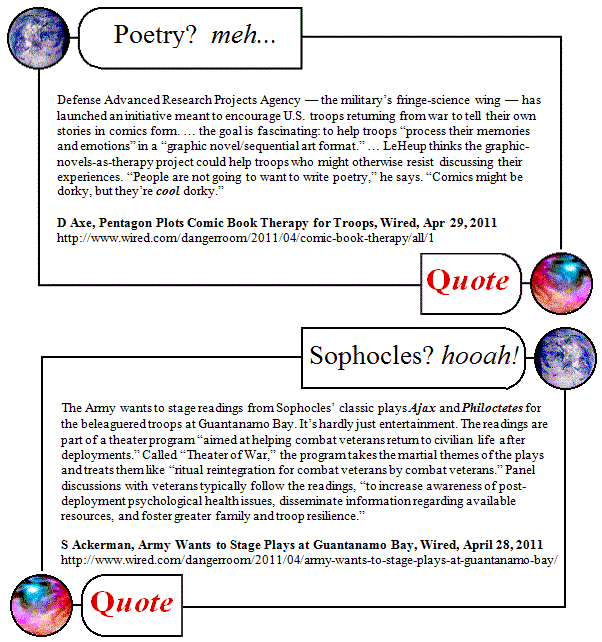
Literature and the arts are also important after battle, though – and the US Military and DARPA have clearly been thinking about that side of things:

quodarpa-arts1.gif

Sources: ComicsPlays

Poetry? meh… Sophocles? Chlanna nan con thigibh a so’s gheibh sibh feoil!

*

Lionel Tiger and Robin Fox in The Imperial Animal characterize modern health care as the “bureaucratization of mercy” and propose that for comparison, we set it beside:

the Greek ideal of the hospital as the place with the best food, the finest furnishings and paintings, and the most skilled musicians and comedians.

The greatest healing center in ancient Greece was the Asclepion at Epidavros / Epidaurus, which housed an amphitheater that could seat more than ten thousand people for dramatic and musical performances without amplification.

At Epidavros, patients would be healed by watching those same dramas of Sophocles to which the US Army is now turning for therapeutic relief in Guantanamo — for as Tiger and Fox (what a pair of names) go on to argue:

It is not the healthy, but the sick who most vitally needed such agreeable and re-creative stimuli; and the resources the community had were most beneficially and sanely used in helping them ease their personal disarray and feel encouraged by this display of their community’s careful concern.

*

It’s also interesting to note that the graphic novel Silver Shields mentioned in Axe‘s piece as a precursor to DARPA’s “Online Graphic Novel/Sequential Art Authoring Tools for Therapeutic Storytelling” project is “set during the ancient Greek invasion of Afghanistan more than two millenniums ago” as a metaphor for America’s current situation…


Switch to our mobile site
